
Barley farming in the north Indian plains starts with sowing certified, fungicide-treated seed in rows about 22–23 cm apart in November, followed by 2–3 irrigations and harvest in March–April. Barley is a rabi cereal that needs less water than wheat and copes better with poor soil, so barley farming suits dry, light or mildly saline fields.
This guide covers nine steps in order, how to choose between malt and feed barley, and the mistakes that cut yield. Check every dose against your state agriculture university before you act.
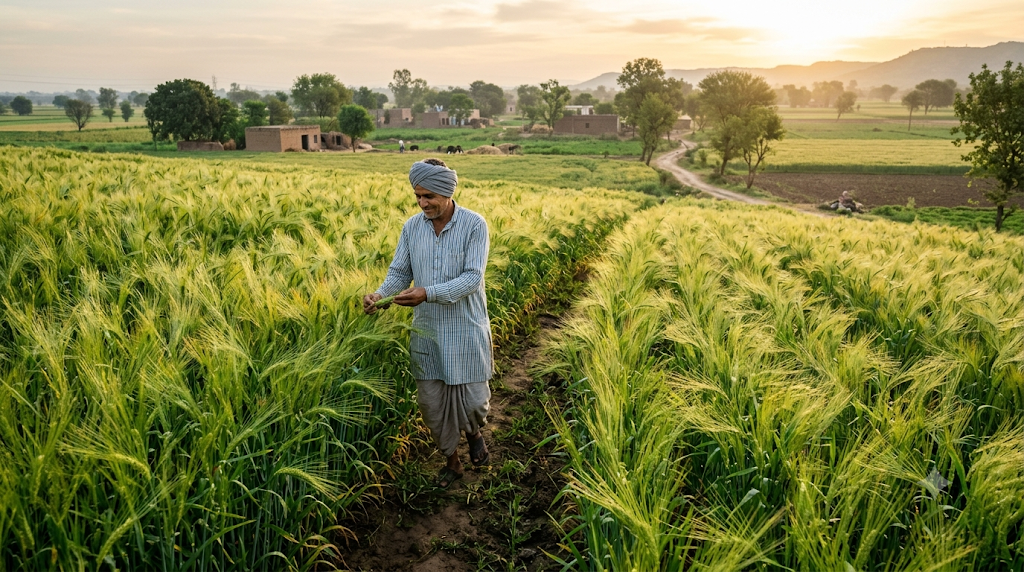
Table of Contents
What Is Barley Farming?
Barley farming is the cultivation of barley (jau), a cool-season cereal grown in the rabi season. In the plains, farmers sow it in November and harvest it about four months later.
The grain has three main uses: animal feed, food (flour, sattu and porridge) and malt for the brewing and malt-drink industry. The straw is a common dry fodder for cattle and buffalo.
Rajasthan, Uttar Pradesh, Madhya Pradesh, Haryana and Punjab are the main growing states. Hill areas also grow it, often in rotation with pea and wheat.
Barley is one of the oldest cultivated cereals, and Indian farmers have grown it for generations. What has changed is the market. Demand from maltsters has made barley farming a contract crop in some districts, which is a different business from growing it only for the home or the local mandi.
Why Barley Farming Suits Small Farms
Barley asks for fewer irrigations than wheat. For a smallholder with an unreliable borewell or a fixed canal turn, that matters.
It also tolerates salinity and alkalinity better than wheat. A field where wheat looks patchy may still give a fair barley crop.
It matures earlier than wheat, which can free the field sooner for the next crop. Input needs are modest, so the cash you put into the field is lower.
The main risk in barley farming is marketing. Feed barley sells locally. Malt barley needs the right quality and usually a buyer arranged before sowing. Decide this first, because it decides your variety, seed and fertiliser plan.
Barley Farming Season Calendar
| Stage | Plains (irrigated) |
|---|---|
| Land preparation | Late October to early November |
| Seed treatment and sowing | November (late sowing up to mid-December) |
| First irrigation | 25–30 days after sowing |
| Weeding | 30–35 days after sowing |
| Later irrigations | Booting and milk stage, if soil is dry |
| Harvest | Late March to mid-April |
Dates shift by district and weather. Use this as a plan and adjust with your KVK.
Step 1: Check Climate and Soil for Barley Farming
Barley grows best in cool, dry weather during growth and warm, dry weather at ripening. Heavy rain or fog at grain filling invites disease and spoils grain colour.
Choose well-drained loam to light loam. Waterlogged clay is the worst choice for barley farming, because roots suffocate.
Test the soil before sowing. A Soil Health Card from your block office shows nutrient status and pH, so you do not guess fertiliser. For malt barley, avoid fields with very high leftover nitrogen, because it raises grain protein.
If your field is saline, say so when you ask for advice. The right variety and sowing method change with the problem.
Step 2: Choose the Right Variety
Pick the variety by end use first, not by what your neighbour grows.
- Feed or food barley: a locally recommended six-row or double-purpose variety with good straw.
- Malt barley: a malting variety approved for your zone, usually grown under buyer contract.
- Hills and rainfed areas: varieties released for those conditions.
Variety lists change every few years. The ICAR-Indian Institute of Wheat and Barley Research and your nearest Krishi Vigyan Kendra publish current recommendations. Our guide to Kisan Sarathi explains how to reach a KVK scientist for your district.
Buy certified seed with a tag and keep the bill. Farm-saved seed that has run for many seasons loses purity and can carry smut. If you must reuse seed, use it for no more than a season or two and treat it.
Step 3: Prepare the Field
Barley farming needs a fine, level seedbed with moisture in the top layer. Do one deep ploughing if the field is compacted, then two to three harrowings or cultivator passes.
Level the field with a planker. Uneven fields hold water in patches and drain in others, which gives uneven germination.
If you harvested paddy or cotton, clear the residue. Standing stubble makes sowing harder and shelters pests.
Add well-rotted farmyard manure during land preparation if you have it. It helps light soils hold moisture. If you keep cattle, our dairy farming in India guide covers manure handling.
Step 4: Treat Seed and Sow on Time
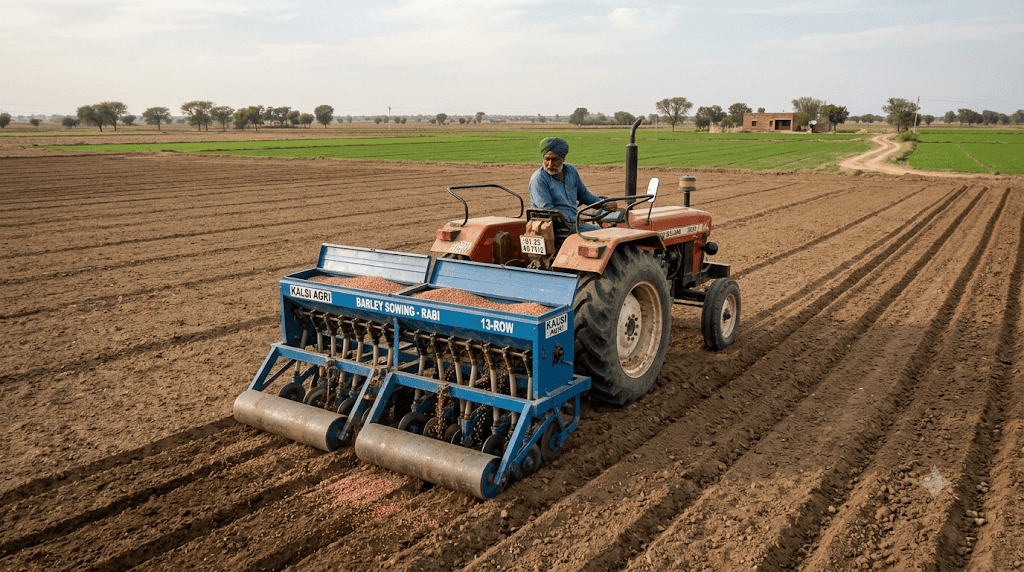
Sowing date decides more of your result than any input. In barley farming on irrigated land, sow in November. Late-sown barley, up to mid-December, needs a higher seed rate and usually yields less.
Typical recommendations:
- Seed rate: about 100 kg per hectare (roughly 40 kg per acre) for timely sowing, and about 125 kg per hectare for late sowing.
- Row spacing: 22–23 cm.
- Depth: 5–6 cm.
- Method: seed drill or seed-cum-fertiliser drill. Broadcasting wastes seed and gives patchy stands.
Treat seed with a fungicide recommended by your KVK before sowing. This protects against loose smut and covered smut, which travel inside or on the seed. Read the product label for the dose, and do not guess.
For malt barley, follow the buyer’s seed and spacing advice. Grain uniformity matters to them, and a thin or patchy crop ripens unevenly.
Step 5: Feed the Crop Without Overdoing Nitrogen
A common schedule for irrigated, timely-sown barley is 60 kg nitrogen, 30 kg phosphorus and 20 kg potash per hectare. Treat that as a starting point and adjust it with your Soil Health Card and state guidance.
Apply all phosphorus and potash and half the nitrogen at sowing. Give the rest of the nitrogen after the first irrigation.
Here is where barley farming differs from wheat. More nitrogen does not always mean more profit. For malt barley, excess nitrogen raises protein in the grain, and maltsters reject high-protein lots. Excess nitrogen also makes the crop lodge, which means it falls over before harvest.
Zinc deficiency shows on light soils as pale, stunted patches. If your soil test shows low zinc, apply it as advised locally.
Step 6: Irrigate at Critical Stages
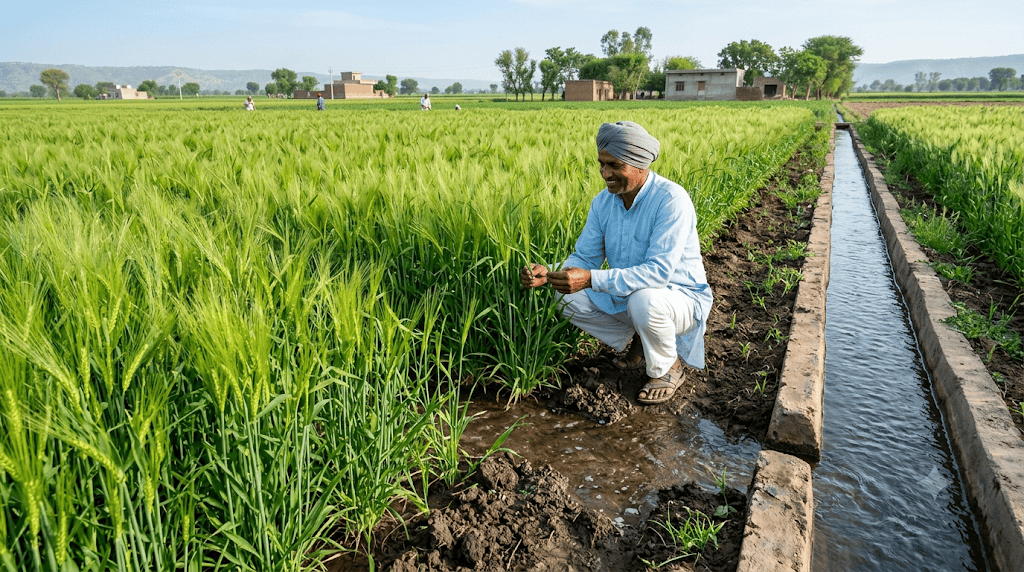
Barley farming usually needs two to three irrigations. Time them to crop stage, not the calendar.
- Crown root initiation, about 25–30 days after sowing: the most important irrigation.
- Maximum tillering or booting: if soil is dry and tillers are thin.
- Flowering to milk stage: protects grain filling.
Skip the last irrigation if wind is strong, because lodging damages grain and makes harvest harder. Stop irrigation as the grain hardens.
A light, well-timed irrigation beats one heavy flood. Barley does not like standing water, so make sure the field drains.
Step 7: Control Weeds Early
Weeds that compete in the first 30–40 days cost the most. Wild oat, phalaris minor and broadleaf weeds like bathua are common in rabi fields.
Do one hand weeding or hoeing at 30–35 days if labour is available. This also loosens the soil after the first irrigation.
If you use a herbicide, choose one recommended for barley, not wheat. Some products safe for wheat can harm barley. Ask your KVK for the product, dose and spray stage, and wear protective gear while spraying.
Clean seed also helps. Weed seeds mixed into poor-quality seed are an easy way to bring new weeds onto the field.
Step 8: Handle Pests and Diseases
Scout your field every week. In barley farming, early action saves more than late spraying.
Diseases to watch:
- Yellow rust: yellow stripes on leaves, common in cool, humid spells. Report it early to your KVK.
- Net blotch and spot blotch: brown patches on leaves.
- Powdery mildew: white powder on leaves.
- Loose smut and covered smut: black, powdery grain heads. Prevent them with seed treatment, because you cannot cure them in a standing crop.
Pests to watch:
- Aphids: cluster on leaves and ears and suck sap.
- Termites: damage roots on light, dry soils.
Use resistant varieties first, spray only when needed, and follow label doses. Do not mix pesticides on your own, and keep sprayers away from ponds and drinking water.
Step 9: Harvest, Thresh and Store
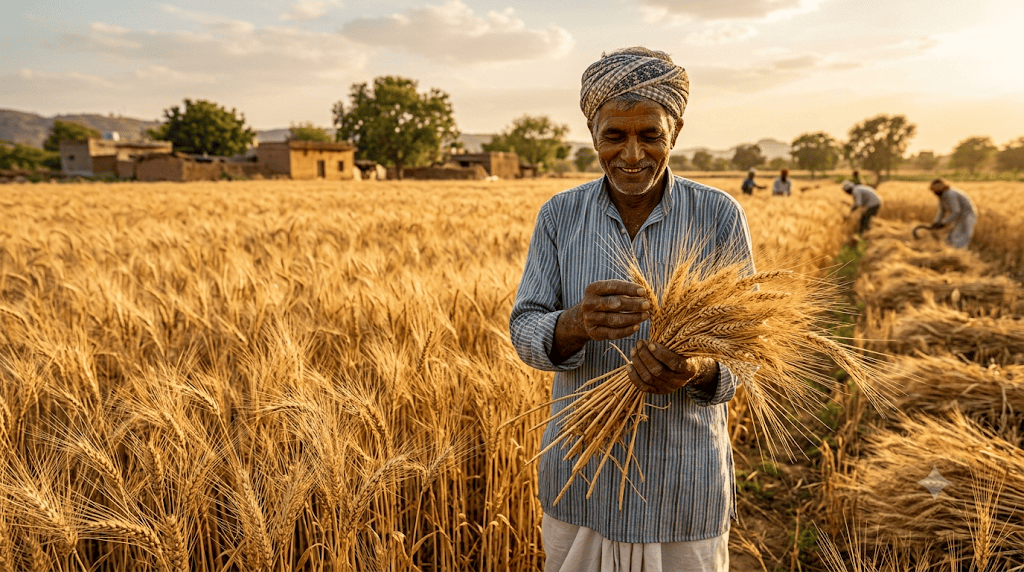
Barley farming comes to harvest in late March to mid-April in the plains, about four months after sowing. Harvest when the plant turns golden and the grain is hard and dry.
Do not wait too long. Over-ripe barley shatters in the field and ears can break off.
Thresh on a clean floor or with a thresher, and dry grain well before storage. Moist grain develops mould and loses quality.
Store in clean, dry bags on pallets away from walls. Keep malt barley separate and clean, since buyers test moisture, purity and germination. Keep straw dry and stack it for fodder. If you feed straw to insured animals, our livestock insurance guide explains how cover works.
Malt Barley vs Feed Barley: Where to Sell
Decide your market before you sow. This is the biggest money question in barley farming.
| Point | Feed or food barley | Malt barley |
|---|---|---|
| Buyer | Local mandi, feed makers, traders | Maltsters, usually under contract |
| Quality test | Basic moisture and cleanliness | Protein, grain size, germination, purity |
| Seed | Local variety is fine | Approved malting variety |
| Main risk | Lower price | Rejection if protein is high |
Check the government-declared Minimum Support Price for barley each season on the official portal before you decide. This guide does not quote a figure, because it changes every year.
Register on eNAM to see prices across mandis. Our eNAM registration guide shows the steps.
If you plan to sell malt barley, talk to the buyer in September or October, not at harvest. Ask for the variety they accept, the protein limit, the moisture limit and the delivery point.
Planning Your Barley Farming Costs
We do not give a cost or profit figure here, because prices of seed, labour and diesel differ by district. Build your own budget with this checklist:
- Certified seed and seed treatment
- Land preparation and sowing (tractor or seed drill hire)
- Fertiliser and any zinc
- Two to three irrigations (pump hours or canal charges)
- Weeding labour or herbicide
- Plant protection, if needed
- Harvesting, threshing and transport
- Bags and storage
Write each cost for one acre, then divide by the grain you expect to sell. Compare that with the current mandi price or the buyer’s contract price. If the numbers are thin, barley farming under a malt contract or on land that is poor for wheat is where it usually makes more sense.
Barley in Crop Rotation
Barley fits well into rotations. In parts of the Himalayan region, farmers rotate barley, pea and wheat. FAO notes that pea after barley adds nitrogen to the soil, and the rotation helps stop disease carrying over from one crop to the next.
On plains, barley can follow paddy or a short kharif crop. A legume such as pea farming, chana farming or masoor farming in a different year breaks pest cycles and rebuilds nitrogen.
If you want a cash crop in the same rabi window, garlic farming is another option on a separate plot.
Common Mistakes in Barley Farming
- Late sowing. Every week of delay after November hurts yield.
- Untreated seed. Smut shows only at heading, when it is too late.
- Too much nitrogen. It causes lodging and, for malt, rejection.
- Wrong variety for the market. A feed variety cannot be sold as malt.
- Skipping the crown-root irrigation. This is the stage barley cannot afford to miss.
- Waterlogging. Barley farming punishes standing water more than most rabi crops.
- No buyer plan. Grain without a buyer waits for a low mandi price.
Government Tools That Help
Use official services before you spend on inputs.
- Soil Health Card: get a soil report from the Soil Health Card portal and plan fertiliser from it.
- Farmer ID: many schemes now ask for it. See our Farmer ID registration guide.
- Farmer portal: scheme and advisory information is on farmer.gov.in.
- State advisories: ICAR and state universities issue rabi agro-advisories, such as the ICAR rabi advisory listed on Vikaspedia, which covers barley variety and seed guidance for hill areas.
Browse more guides in our Farming category.
FAQs
What is barley farming?
Barley farming is the cultivation of barley (jau), a rabi cereal grown mainly for animal feed, food products and malt production. It is generally sown in November and harvested between March and April.
When should I start barley farming in India?
November is generally the best time for barley farming in the northern plains. Late sowing up to mid-December is possible, but it may reduce crop yield.
How much seed is needed for barley farming?
Around 100 kg of seed per hectare (40 kg per acre) is required for timely sowing. For late sowing, the requirement may increase to 125 kg per hectare.
How many irrigations does barley farming need?
Barley generally requires two to three irrigations, depending on soil moisture and weather. The first irrigation at the crown root initiation stage (25–30 days after sowing) is the most important.
Which soil is best for barley farming?
Well-drained loamy and light-loamy soils are suitable for barley farming. The crop can tolerate mild salinity but does not grow well in waterlogged fields.
Is barley farming profitable for small farmers?
Barley farming can be profitable when input costs are managed and suitable buyers are available. Profitability depends on cultivation expenses, crop quality and local market prices.
What is the difference between malt barley and feed barley?
Malt barley is used in the brewing and malt-drink industries and requires specific grain quality. Feed barley is mainly used for livestock nutrition and has comparatively fewer quality requirements.
Which diseases affect barley?
Common barley diseases include yellow rust, net blotch, spot blotch, powdery mildew, loose smut and covered smut. Certified seeds and recommended seed treatments help reduce disease risks.
Can barley farming work on saline or poor soil?
Yes, barley can tolerate mildly saline and alkaline soils better than wheat. However, proper drainage, soil testing and suitable variety selection are necessary.
What crop should follow barley?
Farmers can grow legumes such as pea, chickpea (chana) or lentil (masoor) after barley. These crops help improve soil fertility and support better crop rotation.
Conclusion
Barley farming can be a good option for farmers looking for a rabi crop that requires less water than wheat. However, good results depend on choosing the right variety, sowing on time, managing irrigation and controlling weeds and diseases. Before planting, check your soil condition and local market demand. A little planning before sowing can help you avoid unnecessary expenses and make better use of your farmland.