
eNAM registration is the one-time process of creating a farmer account on the National Agriculture Market portal (enam.gov.in) so you can sell through online bidding at a connected mandi. You fill in your details, link your bank account, pick an integrated mandi, and get verified before you bring your first lot.
Once eNAM registration is approved, buyers from other mandis and states can bid on your produce, and the sale money goes straight to your bank account.
This guide covers the steps, what to keep ready, what happens after you register, and where farmers actually get stuck. I have kept to official numbers and marked what I could not confirm.
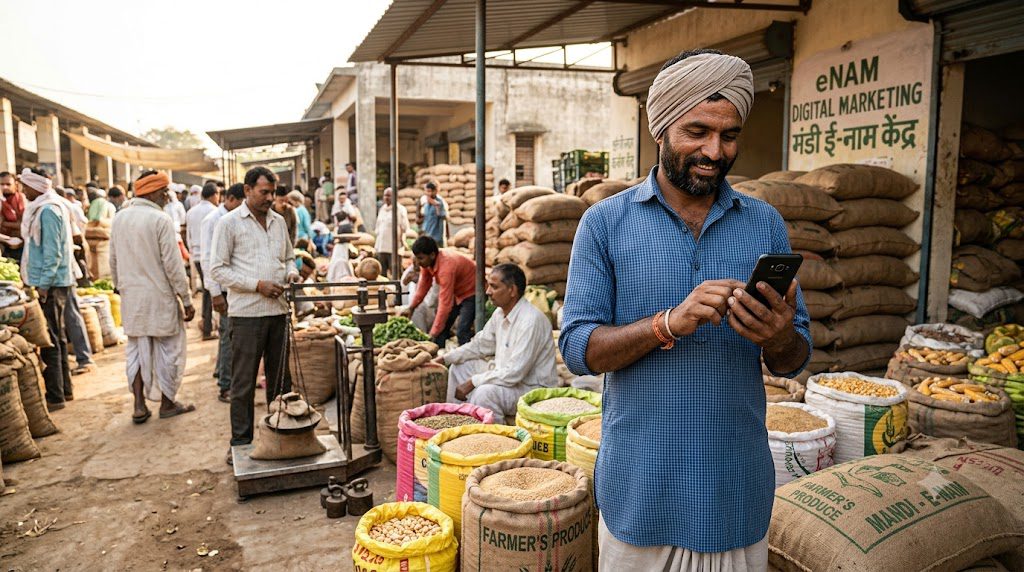
Table of Contents
What eNAM Registration Actually Means
eNAM stands for electronic National Agriculture Market. It is not a new mandi. It is a digital layer built over existing APMC mandis, so the physical trade continues while bidding happens online.
The Small Farmers’ Agribusiness Consortium (SFAC) is the lead agency under the Ministry of Agriculture and Farmers’ Welfare. It launched in April 2016.
So eNAM registration is simply your entry ticket. Without it, you cannot create lots or take part in online bidding, even if your local mandi is connected.
Think of it like opening an account at a bank. The account itself earns you nothing. It lets you use the system.
eNAM registration is not the same as Farmer ID
Many farmers mix these up. Farmer ID is your digital identity under AgriStack. eNAM registration is a marketplace account. You may need both at different times, and our guide on Farmer ID registration explains the first one step by step.
Why eNAM Registration Matters: The Numbers
Official data shows how large the platform has become. By March 2026, the PIB release on eNAM reports 1,656 mandis integrated across 23 States and 4 Union Territories.
The number of connected mandis was 1,389 in 2024. That is growth, but it is also a reminder that most markets in the country are still not on the platform.
A government statement reported by Zee Business adds these figures:
- More than 1.80 crore farmers registered
- 2.73 lakh traders registered
- 4,724 Farmer Producer Organisations onboarded
- Cumulative trade of 13.25 crore metric tonnes worth ₹4.84 lakh crore over ten years
- Financial assistance of up to ₹75 lakh per mandi for infrastructure
Read that last line carefully. The ₹75 lakh goes to mandi infrastructure, not to farmers. Registration does not pay you anything.
What the platform offers is access to more buyers. That is a chance at a better price, not a guarantee. I could not find a reliable national figure showing how much extra price a registered farmer actually earns, so I will not claim one.
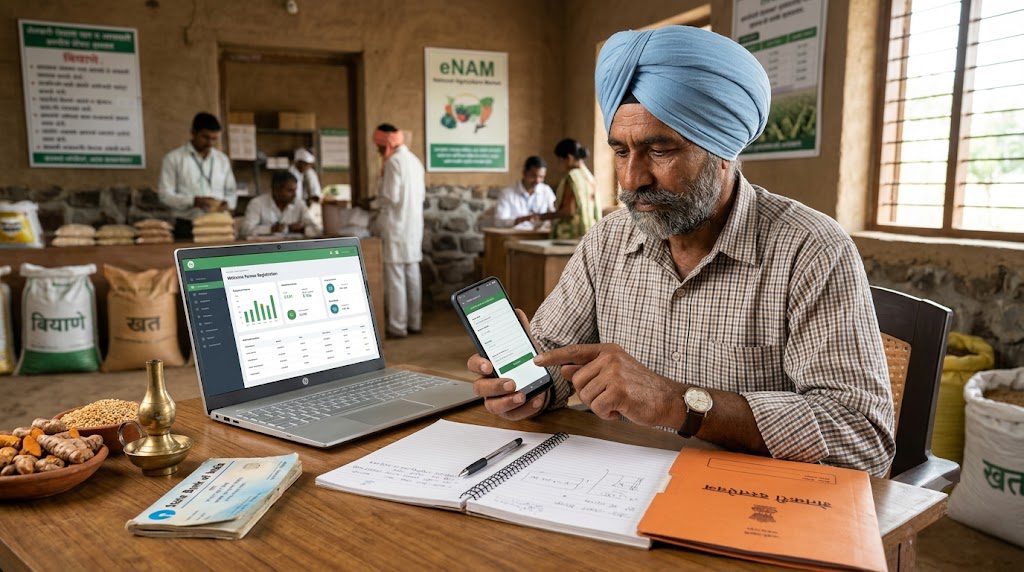
Who Should Do eNAM Registration
Do eNAM registration if you sell grain, pulses, oilseeds or vegetables through a mandi that is already integrated. If you sell mostly to a village trader or directly at the farm gate, the benefit is smaller.
You should think about it if:
- Your nearest regulated mandi appears in the portal’s mandi list
- You sell in bulk, such as a full trolley, rather than a few kilos
- You want payment in your bank account rather than cash
- You belong to an FPO that can aggregate and list produce together
Skip it for now if no integrated mandi is within reach. Registering without a nearby connected market only gives you a login you cannot use.
Honest advice: visit your mandi first and ask whether it runs eNAM trading daily for your crop. Some crops are traded online and some are not. Ask before you spend a day on paperwork.
What to Keep Ready Before eNAM Registration
The portal tells you the exact list at the time you apply, so treat this as a checklist to prepare, not a rulebook. Keep these within reach:
- A mobile number that you use and can receive OTPs on
- Your bank account details, including IFSC code, in your own name
- A valid identity document, as the portal asks
- Your address and the name of your nearest integrated mandi
- A clear photo or scan of any document the form requests
Your bank details matter most. Under eNAM, sale proceeds are transferred directly to the farmer’s registered bank account. A wrong account number means a delayed payment.
Check that your name matches across documents. A spelling mismatch is one of the most common reasons any online verification stalls.
If you are not comfortable with the portal, take a family member or the mandi’s help desk with you. Do not hand your OTP to a stranger who offers to “do it fast”.
eNAM Registration in 7 Steps
Here is the process in the order most farmers follow. Screen names may differ slightly on the live portal.
Steps of eNAM registration on the enam.gov.in portal
Step 1: Confirm Your Mandi Is Connected
Open the official portal at enam.gov.in and look at the list of integrated mandis for your state. Note the mandi name exactly as listed.
This one check saves most of the wasted effort in eNAM registration.
Step 2: Start the Farmer Registration on the Portal
Find the registration option for farmers. Choose your state, enter your mobile number and verify it with the OTP.
Use your own number. Every later alert, including bid and payment updates, depends on it.
Step 3: Fill in Personal and Address Details
Enter your name, address and the other fields the form asks for. Match your spelling to your identity document.
Do not rush this page. A small typo here can follow your account for months.
Step 4: Add Your Bank Account
Enter your account number and IFSC code carefully. Since payments go directly to your registered bank account, this is the most important field in the whole eNAM registration form.
Prefer an account that is active and linked to your mobile number.
Step 5: Select Your Mandi
Pick the integrated mandi where you plan to sell. You can only trade at mandis that are connected, so choose the one you actually visit.
Step 6: Upload Documents and Submit
Upload the documents requested. Submit the form and note down your application or registration reference.
Take a screenshot or a photo of the confirmation. If something goes wrong later, that reference is your proof.
Step 7: Wait for Verification and Log In
Verification may involve the mandi or an official. Timelines can differ by market, and I could not find a national turnaround time, so ask the mandi desk what to expect.
When approved, log in and keep your credentials safe. Now your eNAM registration is complete and you are ready to list produce.
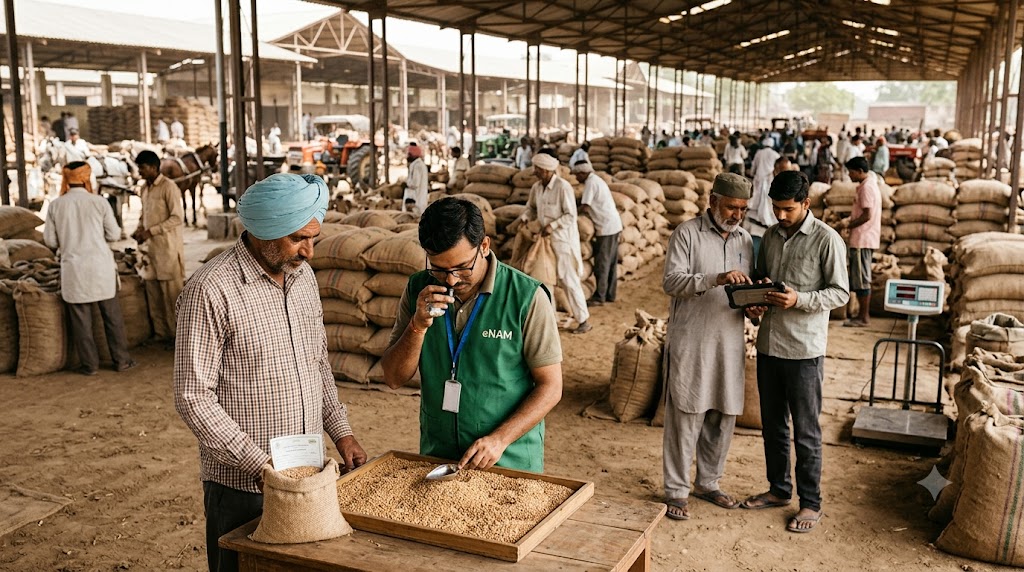
How Selling Works After eNAM Registration
Registration is only the start. The official description of the trade cycle has several stages:
- Digital gate entry: your produce is recorded when it arrives at the mandi.
- Lot creation: each lot gets a unique identifier.
- Quality assaying: the quality of the lot is tested.
- Online bidding: registered traders bid in a competitive process, and you can track bids in real time.
- Price discovery and payment: the final price is set, and money goes electronically to your account.
Produce can enter through an APMC mandi, an FPO collection centre or a recognised warehouse, such as one registered with the Warehousing Development and Regulatory Authority (WDRA).
Quality assaying decides your price
Buyers bid on the grade of your lot. Clean, dry, graded produce gets a fair look. Mixed or damp produce loses ground even on a good platform.
So the real work for you starts before the trolley leaves the farm. Our guide on solar-powered cold storage for farmers is useful if you grow fruit or vegetables and lose value between harvest and sale.
Keep records of every lot
Save the lot ID and the bid details. If a payment is delayed, these records make your complaint much easier to resolve.
Where Farmers Get Stuck
Official numbers show reach. They do not show how smoothly it works on the ground. A 2026 study in the Indian Journal of Extension Education, published through the ICAR journals site, looked at eNAM adoption in Tamil Nadu. It surveyed 390 respondents: 150 eNAM farmers, 150 non-eNAM farmers and 90 traders.
It found that knowledge levels are higher among eNAM farmers and traders than among non-eNAM farmers. That tells us awareness matters. It does not prove that eNAM made farmers richer, and one state’s study cannot speak for all of India.
From what farmers and mandi staff commonly report, the friction points tend to be practical:
- No integrated mandi nearby
- Not knowing how quality assaying works
- Low comfort with a smartphone or portal
- Doubt about whether a trader will bid higher than the local rate
These are my observations, not measured national statistics. If any of them applies to you, solve it before you register, not after.
Mistakes to Avoid During eNAM Registration
Most delays come from small errors. Watch for these:
- Wrong bank details. Check the account number twice. A wrong digit can hold up your payment.
- Using someone else’s mobile number. You will miss OTPs and alerts.
- Registering at the wrong mandi. Select the market you actually sell at.
- Name mismatches. Keep spellings identical across documents.
- Sharing your OTP or password. No official will ask for it over the phone.
- Paying agents. Be careful of anyone who charges you to complete your eNAM registration. Ask the mandi office or the portal helpdesk first.
- Skipping the confirmation. Always save the reference number.
The official helpdesk emails are listed in the PIB document, and it is wise to use those rather than numbers from social media posts.
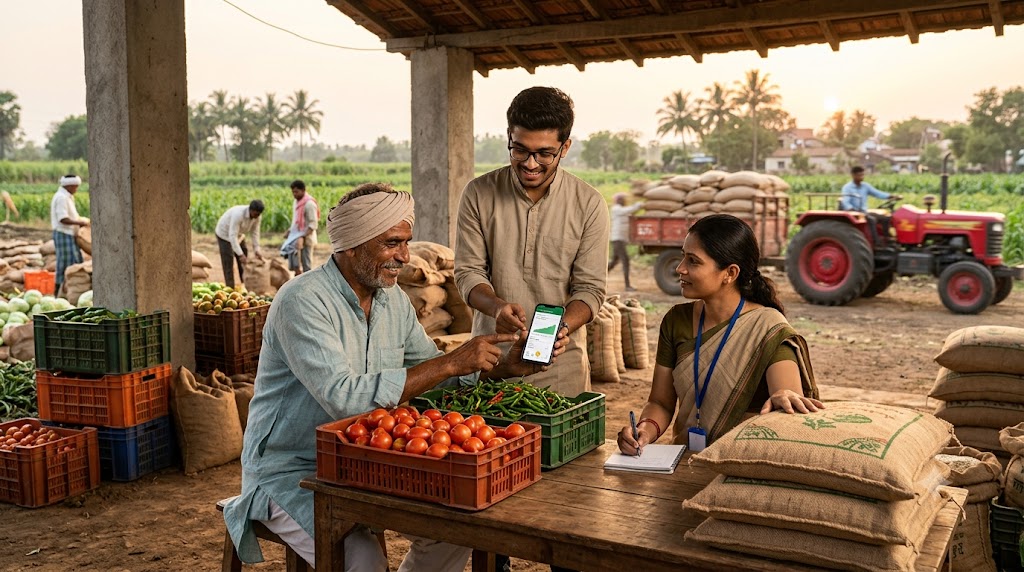
eNAM Registration for FPOs and Students
FPOs
FPOs are a growing part of the platform, with 4,724 onboarded by March 2026. A group can pool produce and list a larger lot, which often attracts more attention from traders.
If you run or belong to an FPO, ask the board whether collective eNAM registration is planned. Aggregated lots also make quality assaying easier to manage.
Agriculture students
If you study agriculture or economics, the platform is a rich case study in market reform. Use the PIB document and the Tamil Nadu study as starting points, and note what is measured and what is claimed.
For students writing assignments, the gap between registered farmers and active sellers is a strong research question. The public numbers show registrations and trade value, but not how many registered farmers sell regularly.
Pair eNAM With Other Digital Tools
eNAM works best when it is one part of a digital routine, not the only part.
- Use Bharat VISTAAR to ask about mandi prices and weather by voice before you decide when to sell.
- Complete your digital crop survey so your crop record is on file.
- Read our overview of AI in agriculture to see how tools like quality assessment are developing.
- Browse more guides in our Agritech category.
Treat each as a helper. None of them replaces your own judgment about when and where to sell.
Farmer checking mandi prices after eNAM registration
Frequently Asked Questions About eNAM Registration
1. What is eNAM registration?
eNAM registration allows farmers to create an account on the National Agriculture Market portal. Through this platform, farmers can participate in online trading at connected mandis and make their produce available to registered buyers. It is a useful option for farmers who want to explore digital agricultural markets instead of relying only on traditional selling methods.
2. Who can register on the eNAM portal?
Farmers who want to sell their crops through an integrated mandi can register on eNAM. Traders and Farmer Producer Organisations (FPOs) can also join the platform, subject to the applicable requirements. Before registering, check whether your local mandi supports eNAM trading for the crops you grow.
3. Is eNAM registration compulsory for farmers?
No, every farmer does not need to register on eNAM. You can continue selling your crops through traditional mandis or other available channels. However, if you want to use eNAM’s online trading facilities, registration is an important first step.
4. How can I register for eNAM online?
Visit the official website at enam.gov.in and look for the farmer registration option. Follow the instructions on the portal, enter the requested details, and submit the application. You can also visit your local mandi’s eNAM help desk if you need assistance with the process.
5. Which documents are required for eNAM registration?
Keep your mobile number, bank account details, IFSC code, identity document, and address information ready before starting. The exact documents required may depend on the current registration process. Check the official portal or contact your mandi’s eNAM desk to confirm the latest requirements.
6. Do I need a bank account to register on eNAM?
Bank details are important for receiving payments from completed sales through the applicable payment process. Enter your account number and IFSC code carefully, and make sure your account is active. Double-check the information before submitting the form to avoid unnecessary payment delays.
7. Can I sell my crops at any mandi after eNAM registration?
No, registration does not automatically allow you to trade at every mandi in India. You need to use mandis connected to the platform, and trading facilities can vary by market and crop. Check the available mandi list and speak with your local mandi office before deciding where to sell.
8. How long does eNAM registration take?
The time required can vary depending on the verification process at your selected mandi. A confirmed nationwide processing timeline was not available for this guide. After submitting your application, save the reference number and contact the mandi’s eNAM desk if your registration takes longer than expected.
9. Does eNAM guarantee better prices for farmers?
No, registering on eNAM does not guarantee a higher price. The platform can help farmers access online bidding and additional buyers, but the final price depends on demand, crop quality, market conditions, and buyer participation. Before selling, compare the available offers and make sure your produce is properly cleaned, sorted, and prepared for sale.
10. Can an FPO register on eNAM?
Yes, Farmer Producer Organisations can participate in eNAM, subject to the platform’s registration requirements. An FPO can help farmers bring their produce together and organise sales collectively. Larger, well-managed lots may attract buyer interest, although the actual results depend on quality, demand, and local trading conditions.
Conclusion
eNAM registration is worth the effort only if a connected mandi is within reach and you sell in meaningful quantities. Check the mandi list first, keep your bank details accurate, and treat quality as your main price lever.
The platform offers real reach, with over 1.80 crore farmers registered, but registration alone will not raise your income. Use it as one tool, and keep records of every lot.
If you have already completed eNAM registration, tell us in the comments how long verification took in your mandi. Your experience will help other farmers more than any statistic.