
Table of Contents
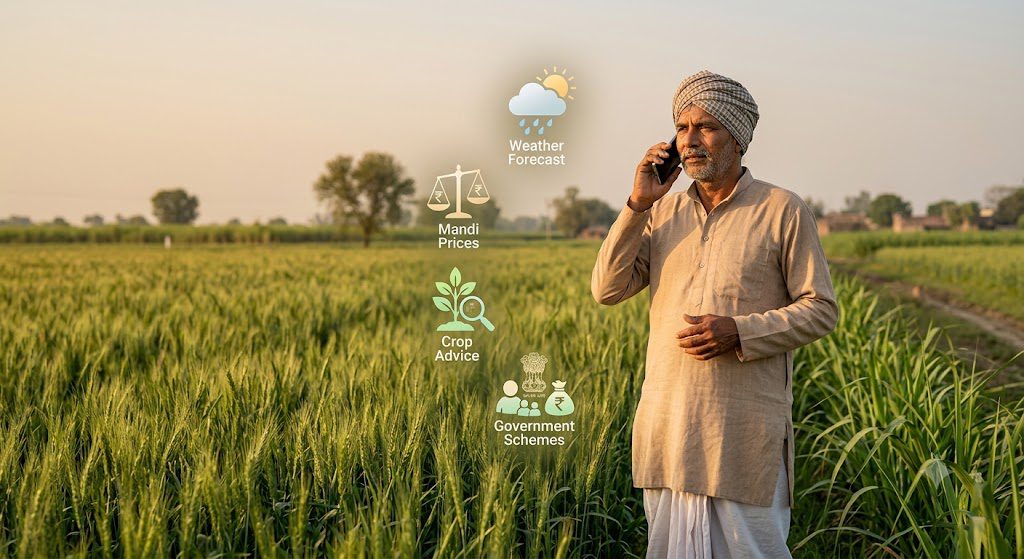
Bharat VISTAAR is the government’s AI-powered, voice-first farm advisory platform, built so a farmer can ask about crops, weather, mandi prices and schemes by phone instead of chasing five different offices and apps.
If you farm in India, you have probably seen the name in the news or in a WhatsApp forward. The harder question is whether Bharat VISTAAR is ready to guide a real sowing, spraying or selling decision on your farm.
This guide explains what the platform does, how to reach it, which schemes it covers and where it still falls short. Every claim traces to a source linked in the text.
What Is Bharat VISTAAR?
Bharat VISTAAR stands for Virtually Integrated System to Access Agricultural Resources. The PIB describes it as a nationwide, AI-powered, voice-first, multilingual Digital Public Infrastructure platform. Official documents write the name with a hyphen, as Bharat-VISTAAR.
The Finance Minister announced it in the Union Budget 2026-27 with an allocation of ₹150 crore. Her speech said the tool would connect AgriStack portals and ICAR’s package of practices with AI systems to give customised advice.
Phase I went live on 17 February 2026 in Jaipur, launched by Union Agriculture Minister Shivraj Singh Chouhan, according to IMPRI’s October 2026 review.
In plain words, Bharat VISTAAR is meant to be one window for advice, prices and scheme information. Think of it as a phone-based extension officer who never closes, and whose advice is only as good as the data behind it.
Why Bharat VISTAAR Matters for Farmers
Farmers have long juggled separate sources for weather, mandi rates, crop practices and scheme status. A missed update on any one of them can cost a season’s margin.
Bharat VISTAAR tries to merge those sources. If it works, you could check a pest alert, a mandi price and your PM-KISAN complaint in one phone call.
The voice design matters most. A farmer without a smartphone can still use the helpline, which makes the platform more inclusive than a pure app.
It also matters for the wider agritech picture on this site. Data tools only help when the advice reaches the field in time, a theme we explored in decision-grade intelligence in agriculture.
7 Essential Facts About Bharat VISTAAR
1. You can call it on 155261. The PIB lists a dedicated telephone number, 155261, a voice-based AI chatbot, a ministry web portal and a downloadable mobile app as access channels.
2. The AI voice assistant is called Bharati. NewsBytes reported that farmers can reach the assistant through the helpline for advice on agricultural topics.
3. Phase I integrates 10 central schemes. They include PM-KISAN, PMFBY, Soil Health Card and Kisan Credit Card, per the PIB.
4. It works for non-smartphone users. The PIB says voice and IVRS access are provided for farmers without smartphones.
5. It started in Hindi and English only. The government planned four more languages within three months and five more within six months.
6. It follows the DPDP Act, 2023. The PIB says the platform complies with the Digital Personal Data Protection Act and cyber security guidelines.
7. Public usage data is missing. IMPRI found no consolidated national figures on registered farmers, helpline calls or resolved queries.
How Bharat VISTAAR Works
Reaching the Platform
You can dial 155261, use the web portal of the Ministry of Agriculture and Farmers Welfare, or install the mobile app. Check that any app lists the ministry as its publisher before you install it.
Voice and IVRS access let a farmer with a basic phone get answers. This is the channel that matters most for small and marginal farmers.
Where the Advice Comes From
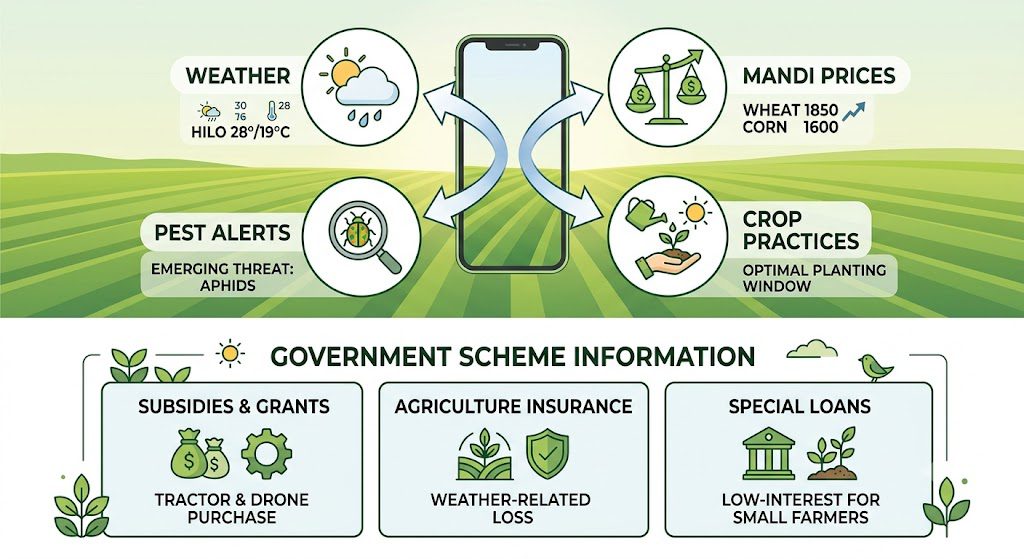
According to IMPRI’s summary of the government’s launch material, Phase I draws on four kinds of data. IMD supplies weather, AgMarkNet supplies mandi prices, the National Pest Surveillance System supplies pest and disease alerts, and ICAR supplies its package of practices.
AgriStack data personalises the answer. Our guide to the digital crop survey and Farmer ID explains how the plot-level records behind that personalisation get built.
The 10 Schemes It Covers
The PIB lists them as PM-KISAN, PMFBY, Soil Health Card, Kisan Credit Card, Agriculture Infrastructure Fund, PM Krishi Sinchayee Yojana, PM-AASHA, Modified Interest Subvention Scheme, Per Drop More Crop and the Sub-Mission on Agricultural Mechanization.
Farmers can also register and track PM-KISAN complaints through the platform, as IMPRI notes.
AgriStack, Farmer ID and Your Advice
Advice becomes personal only when the platform knows who you are and what you grow. That is where AgriStack comes in. Your Farmer ID links your land and crop records, so an answer about fertiliser can reflect your plot instead of a district average.
This also explains why record accuracy matters. If your crop entry or plot number is wrong, any service that reads the record starts from a wrong base. We covered this risk in our guide to the digital crop survey.
If you have no Farmer ID yet, general questions on weather, prices and practices do not appear to need one, but we could not confirm this. Test it by calling. Personalised answers likely need the registry, so ask your block agriculture office or a Common Service Centre about registering.
Bharat VISTAAR at a Glance
| Item | What the sources say |
|---|---|
| Full name | Virtually Integrated System to Access Agricultural Resources |
| Announced | Union Budget 2026-27, 1 February 2026 |
| Allocation | ₹150 crore |
| Phase I launch | 17 February 2026, Jaipur |
| Helpline | 155261 |
| Launch languages | Hindi and English |
| Schemes integrated | 10 central schemes |
| Data sources | IMD, AgMarkNet, NPSS, ICAR, AgriStack |
| Legal basis for data | DPDP Act, 2023 |
Bharat VISTAAR Targets vs Reality
Launching on time is easy to verify. Delivering the promised expansion is harder. The table compares what the government said with what IMPRI found as of October 2026.
| Indicator | Government target | Status found (October 2026) |
|---|---|---|
| Launch | Phase I, 17 February 2026 | Launched in Jaipur |
| Languages | 4 more in 3 months, 5 more in 6 months | Portal still listed two languages |
| Schemes | 10 at launch, all central schemes by May 2026 | 10 at launch, no public update on May target |
| Usage data | Public reporting needed | No consolidated national figures |
Reports also disagree on language. The Secretariat wrote in May 2026 that the platform has audio in more than 11 regional languages. The same report quotes a Gujarat official saying it was available only in Hindi and English.
When sources conflict, trust the official portal and test the helpline in your own language before you rely on it.
State platforms fill part of the gap. IMPRI names Maharashtra’s MahaVistaar and Vasudha, Gujarat’s AmulAI and the Bihar Krishi App as state-level tools, and reports that MahaVistaar crossed three million downloads. Downloads show reach, not impact.
What Bharat VISTAAR Can and Cannot Do Today
It can:
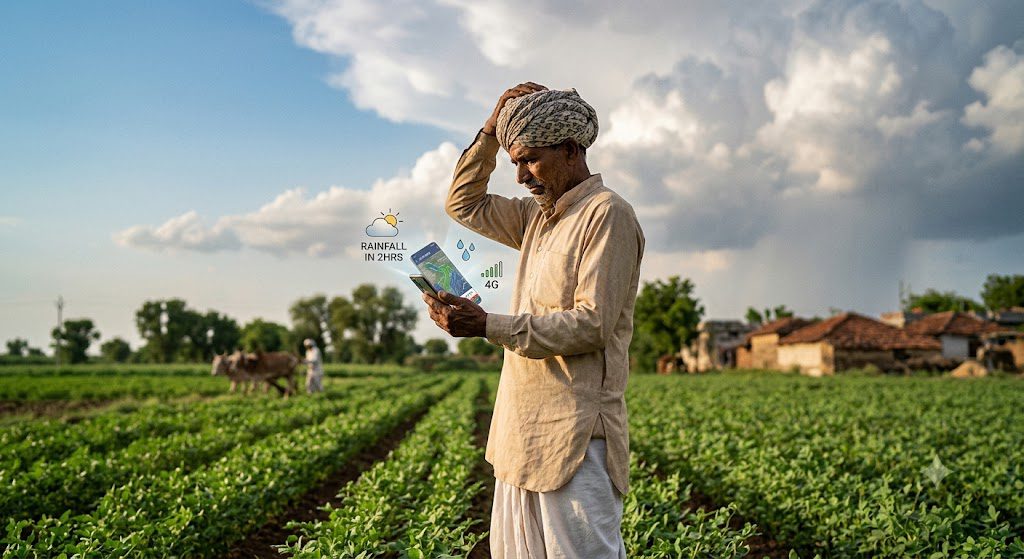
- Answer questions on crop practices, weather, mandi prices and pest alerts in Hindi and English.
- Show scheme eligibility and benefit information for the 10 integrated schemes.
- Help you register and track a PM-KISAN complaint.
It cannot yet:
- Replace a local agronomist for a field-specific disease diagnosis. For photo-based diagnosis tools, read our guide to AI crop disease detection.
- Guarantee coverage of every state scheme or every language.
- Give you a legal remedy if its advice causes a loss.
Who Benefits Most From the Platform
Smallholders with basic phones gain the most, because the helpline needs no data plan and no app. Farmers who own a smartphone can compare the helpline with the app and the web portal and keep whichever answers faster.
Women farmers and older farmers may find voice easier than typing. We found no data on who actually uses the service, so this is a reasonable expectation, not a measured result.
Farmer producer organisations can use the helpline as a quick reference for scheme eligibility when they advise members. Input dealers and extension workers may use it too. Treat their advice and the platform’s advice as two inputs, not one verdict.
How to Use Bharat VISTAAR Step by Step
- Start with a simple call. Dial 155261 and ask a question you already know the answer to, such as today’s mandi price at your nearest market.
- Compare the answer. Check it against your local mandi or agriculture office. This tells you how accurate the service is for your area.
- Ask in your own words. Describe the crop, the stage and the problem.
- Note the advice. Write down the date, the question and the answer.
- Verify before spraying. For chemicals, confirm the product and dose with your Krishi Vigyan Kendra or agriculture officer.
- Use the scheme tools. Check PM-KISAN or PMFBY status through the platform.
- Report problems. If the advice is wrong or unavailable in your language, tell your block agriculture office.
Sample Questions to Ask the Helpline
Good questions are specific. Name the crop, the growth stage and your district. A vague question gets a vague answer.
- What is today’s price of wheat at my nearest mandi?
- What is a suitable sowing window for mustard in my district this rabi season?
- Which pest alerts are active for chickpea in my area this week?
- What is the status of my PM-KISAN payment or complaint?
- Am I eligible for the Kisan Credit Card, and what documents do I need?
- When is the next rainfall forecast for my block?
If you are planning rabi sowing, our list of the names of rabi crops and their MSP shows which crops carry support prices. Then use the helpline to check market prices before you decide.
Questions to Ask Before You Act on AI Advice
This is an advisory tool, not an authority. A few checks protect your money.
Ask whether the advice fits your soil, water and labour. IMPRI’s review, drawing on The Secretariat, notes that advice may not reflect water scarcity, power cuts or labour shortages.
Ask whether your neighbours got the same advice. If a whole village sows one crop on one recommendation, prices at harvest can fall.
Ask who is responsible if you lose money after following the advice. We found no source that answers this clearly.
For forecasting tools that predict yield from data, see our explainer on AI crop yield prediction.
Real Risks of Bharat VISTAAR
- Over-production. Experts quoted by The Secretariat warn that similar crop advice across a region can push supply up and prices down.
- Accountability. It is unclear who is liable if a farmer loses money after following AI-generated advice.
- Ground realities. Water, power and labour limits may not be reflected in the advice.
- Data and dependence. The same report raises concerns about farmer data and growing reliance on large technology companies. The PIB says the platform follows the DPDP Act and undergoes periodic security audits.
- Language gaps. Hindi and English cover many farmers, but not all.
- Missing evidence. IMPRI found no independent evaluation and no public usage dashboard.
None of these makes the platform useless. They make it a tool to test before you trust it.
What to Watch Next
Three signals will show whether the platform is maturing. First, watch whether the portal adds the promised languages and whether your own language works when you call.
Second, watch for an official update on the remaining central schemes. The May 2026 target has passed without a public status report, so any announcement would be news.
Third, watch for published usage numbers. A monthly count of calls, registered farmers and resolved queries would let outsiders judge the ₹150 crore spend. Until those appear, treat adoption claims with caution.
Common Mistakes Farmers Make
- Treating the advice as final. It is a starting point, not a prescription.
- Spraying on a voice answer alone. Confirm chemicals with a local expert.
- Assuming every scheme is covered. Only 10 central schemes are integrated so far.
- Sharing OTPs or Aadhaar details with callers. Use only the official helpline and ministry portal.
- Ignoring state apps. MahaVistaar, AmulAI and similar tools may serve your language better.
How We Researched This Guide
We reviewed the PIB’s March 2026 Rajya Sabha reply on the rollout, IMPRI’s October 2026 policy review, The Secretariat’s May 2026 report, NewsBytes’s launch coverage and the budget announcement reported by NewKerala. We could not load the official portal’s content because it needs JavaScript, so we did not verify language lists there ourselves.
We left out download numbers and app store ratings we could not verify. For more technology guides, browse our Agritech category and read our editorial policy.
FAQs About Bharat VISTAAR
1. What is Bharat VISTAAR?
It is a multilingual, AI-powered, voice-first digital platform from the Ministry of Agriculture and Farmers Welfare that gives farmers advice on crops, weather, markets, pests and schemes.
2. What is the Bharat VISTAAR helpline number?
The PIB lists 155261 as the dedicated telephone number.
3. Is Bharat VISTAAR free to use?
IMPRI describes the helpline as toll-free. We did not find any published charge for the web portal or app.
4. Which languages does Bharat VISTAAR support?
It launched in Hindi and English, with more planned. Reports disagree on how many languages are live, so test your language.
5. Do I need a smartphone to use it?
No. The PIB says voice and IVRS access are provided for farmers without smartphones.
6. Which schemes does Bharat VISTAAR cover?
Ten central schemes, including PM-KISAN, PMFBY, Soil Health Card and Kisan Credit Card.
7. Is my data safe with Bharat VISTAAR?
The PIB says it follows the DPDP Act, 2023, and periodic security audits. No system is risk-free, so never share OTPs.
8. Can the platform tell me which crop to grow?
It is designed to give crop advisories, but you should compare the advice with local conditions and your agriculture officer’s view.
9. Who runs Bharat VISTAAR?
The Ministry of Agriculture and Farmers Welfare is the implementing ministry.
10. What are the biggest problems with Bharat VISTAAR?
Missing usage data, language gaps, over-production risk and unclear accountability, according to IMPRI and The Secretariat.
Final Thought
Bharat VISTAAR tackles a real problem: farm information is scattered, slow and hard to act on. A single helpline that works without a smartphone is a genuine step forward.
But a launch is not a result. The language targets, the scheme expansion and the usage data are all still unproven in public.
For a farmer, the lesson is practical. Call 155261, test it with questions you can check, and confirm any chemical or sowing advice locally before you act.
Languages, scheme integration and published usage data are the three numbers to check again in a few months. If they improve, the platform earns more trust. If they stay silent, keep it as one input among several.
Related reading on this site: AI in Agriculture 2026: How Artificial Intelligence Is Transforming Farming, Digital Crop Survey: 7 Powerful Facts Every Farmer Needs, and Decision-Grade Intelligence Agriculture: 7 Powerful Shifts.