
Table of Contents
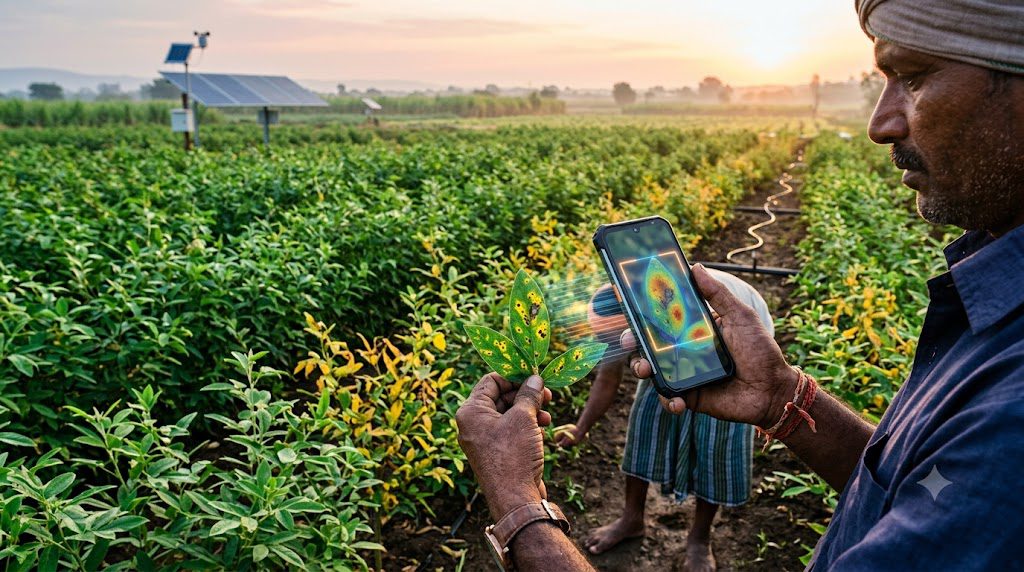
AI crop disease detection — using computer vision and machine learning to spot fungal, bacterial, and viral disease from a leaf photo or aerial image — has moved from a research curiosity to genuinely widespread use in the last few years. One consumer app alone has been downloaded more than 135 million times.
But the research behind these tools contains a specific, well-documented caveat that most marketing pages leave out: accuracy above 95% on laboratory datasets doesn’t reliably translate to the same accuracy in an actual field. This article covers what these tools actually do, what the peer-reviewed research says about their real-world performance, and how to evaluate one honestly.
What Is AI Crop Disease Detection?
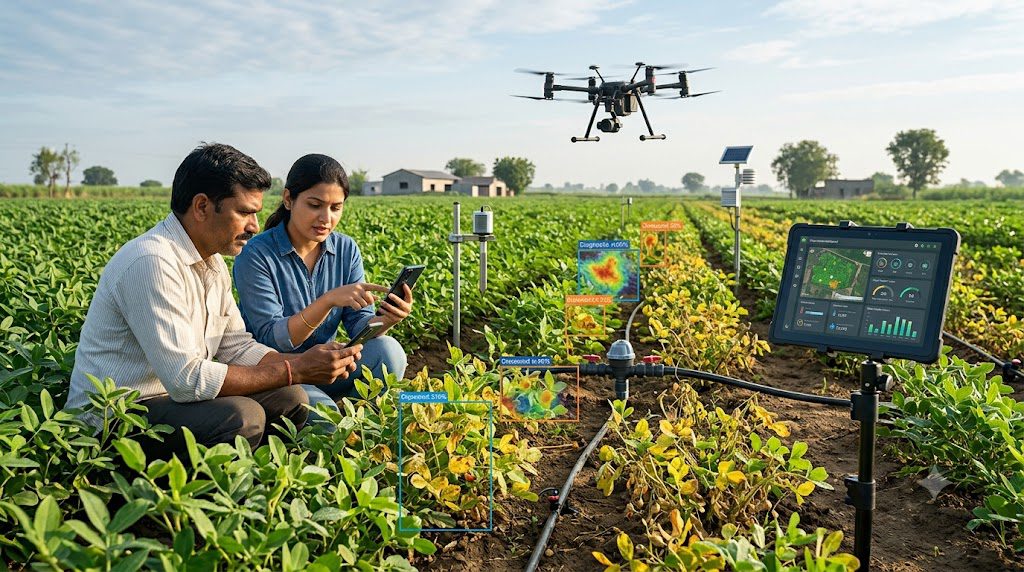
AI crop disease detection uses computer vision — deep learning models trained on large sets of labeled plant images — to identify disease, pest damage, or nutrient deficiency from a photograph, drone image, or satellite scan, typically returning a diagnosis and a treatment recommendation.
A peer-reviewed review published on PMC, the National Institutes of Health’s open-access archive, frames the underlying problem plainly: disease infection is among the most significant challenges in crop production, and traditional detection methods are time-consuming, require specialized expertise, and don’t scale well across large operations. AI-based image analysis is positioned as a faster, more accessible alternative to manual scouting or lab diagnostics.
Why This Category Is Moving Fast in 2026
1. The consumer-facing tools have reached genuine scale. Plantix, developed by German agtech company PEAT GmbH, has been downloaded more than 135 million times and serves nearly 10 million farmers annually, according to GSMA’s Mobile for Development program, the mobile industry association’s technology-for-development arm. The same source reports the underlying model has been trained on a database of more than 120 million farmer-submitted images.
2. The market is genuinely growing, not just getting louder. Industry analysis projects the AI pest detection market to grow at a 25.5% compound annual rate from 2026 to 2034, with North America accounting for roughly 36% of 2025 global revenue, driven partly by commercial scale-up of vision-guided spraying systems.
3. Government research investment has accelerated. USDA’s Agricultural Research Service maintains an active National Program specifically focused on plant disease research, and in August 2025 partnered with the University of Texas at Arlington to open a dedicated Smart Agriculture Research Center, pairing USDA-ARS scientists with university researchers on projects including plant disease prediction and livestock disease forecasting.
4. Adjacent AI-driven tools are proving out the broader category. Vision-guided precision spraying systems have demonstrated an average 77% reduction in herbicide use in commercial deployment, according to industry tool comparisons — a proof point that AI-based visual analysis in the field can produce measurable input reductions, not just diagnostic novelty.
5. Academic publishing on this topic has surged. A 2026 systematic review published in Discover Applied Sciences, a Springer Nature journal, following PRISMA systematic review guidelines, examined peer-reviewed studies from 2021 through 2025 on leaf-image-based crop disease detection — reflecting a research base substantial enough to support a formal systematic review, which typically requires a critical mass of underlying published studies.
How AI Crop Disease Detection Actually Works
Image Capture
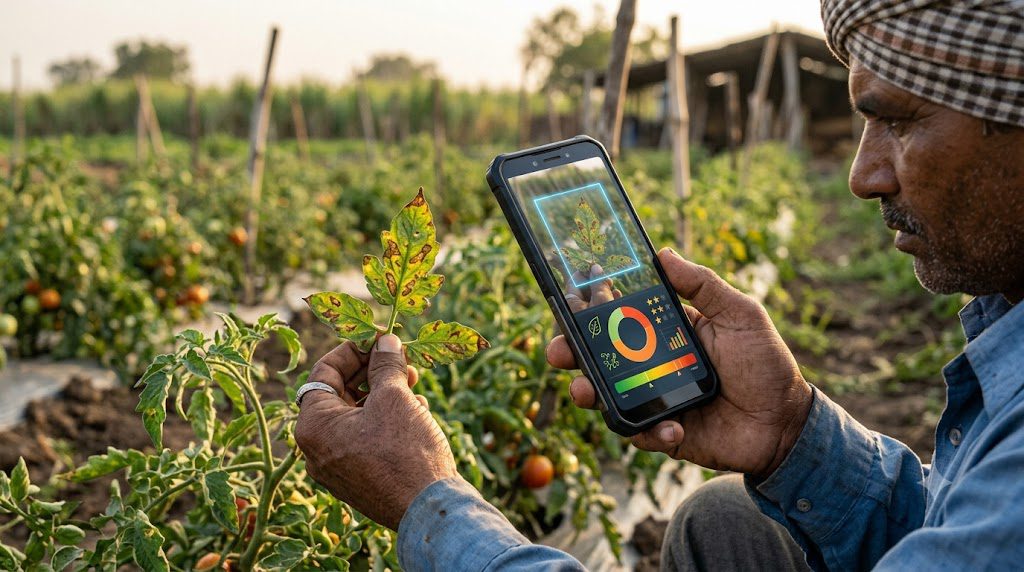
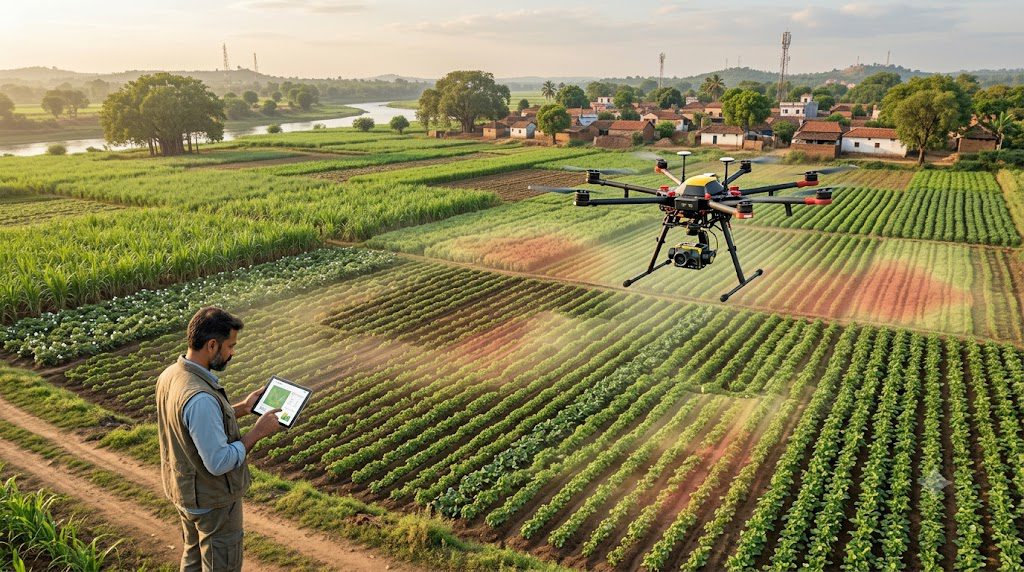
Depending on the platform, images come from a farmer’s smartphone camera, a drone flying a scouting pattern, or satellite passes capturing multispectral data across an entire field.
Model Training
Deep learning models — typically convolutional neural networks — are trained on large labeled datasets. The Springer Nature systematic review notes that many models are developed and validated on datasets like PlantVillage, a widely used public image library of labeled, disease-affected leaf photos captured under controlled conditions.
Diagnosis and Recommendation
Once a disease or pest is identified, most commercial tools return a treatment recommendation. Plantix specifically draws on research and pest-management data from the International Crops Research Institute for the Semi-Arid Tropics to generate localized recommendations in the farmer’s own language, according to GSMA’s reporting.
Specialized Approaches for Early Detection
Some research goes further than visible-symptom detection. USDA-ARS-supported research into hyperspectral imaging — using wavelengths beyond what the human eye can see — has been applied to detect soybean sudden death syndrome before visible symptoms appear at all, a meaningfully earlier detection window than photo-based diagnosis of an already-symptomatic plant.
The Accuracy Claim You Need to Read Carefully
This is the single most important nuance in the entire category, and it’s worth stating plainly rather than burying it.
Marketing materials for consumer apps commonly cite accuracy figures above 90%. GSMA’s own reporting states Plantix’s diagnostic accuracy exceeds 90%, citing GSMA’s own analysis.
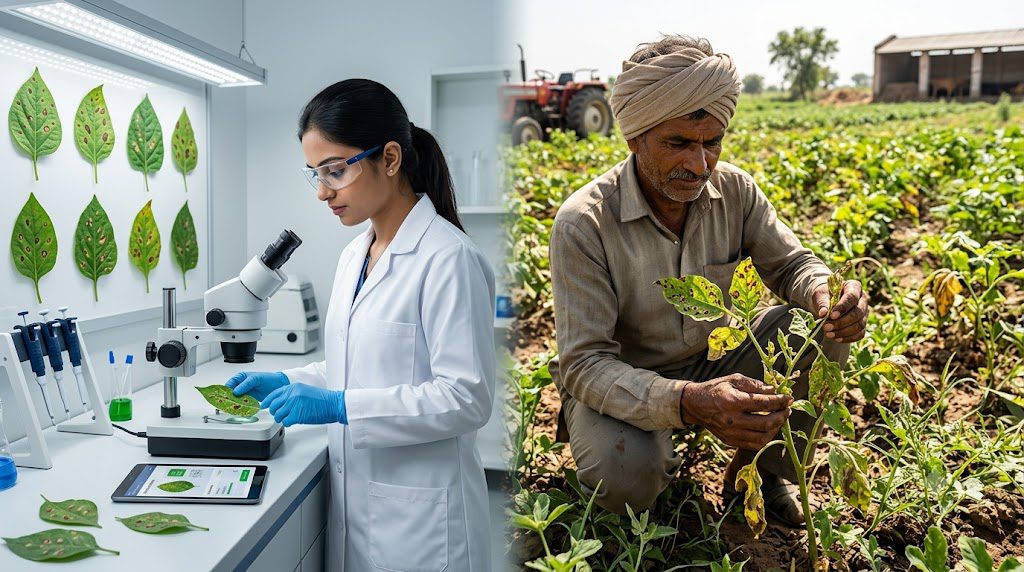
Separately, the Springer Nature systematic review reports that deep learning models achieve greater than 95% accuracy specifically on controlled datasets like PlantVillage — but states directly that performance degrades significantly under actual field conditions, due to what researchers term dataset bias, domain shift, and multi-disease complexity.
In plain terms: a model trained on clean, well-lit, single-disease leaf photos taken under lab conditions does not automatically perform at the same accuracy when pointed at a real leaf, in real field lighting, potentially showing more than one stress factor at once.
This is not a flaw unique to any one product — it’s a well-documented, general limitation across the research literature on this entire category, and any tool that doesn’t acknowledge it deserves a more skeptical look, not less.
Phone Apps vs. Drone Scouting vs. Satellite Monitoring
| Approach | Best For | Detection Level | Typical Cost |
|---|---|---|---|
| Phone-camera apps (e.g., Plantix) | Smallholder and small-to-medium farms | Leaf-level, single-plant | Free to low-cost |
| Drone-based scouting (e.g., Taranis) | Large-scale row crop and specialty operations | Leaf-level across entire fields | Custom/enterprise pricing |
| Satellite and multispectral monitoring | Whole-field vegetation health trends | Field-level patterns, not individual plants | Subscription-based |
The honest takeaway: these aren’t competing approaches so much as different resolution levels solving different problems. A phone app helps an individual grower diagnose one struggling plant; drone and satellite systems help larger operations or agricultural advisors prioritize which fields need a closer look, at a scale no human scouting crew could match on foot.
Data Privacy: The Question Most Reviews Skip
Every AI crop disease detection tool built on farmer-submitted photos runs on a data pipeline most users never think to ask about, and a genuinely trustworthy overview of this category should raise it directly.
Plantix’s model, per GSMA’s own reporting, is trained on more than 120 million farmer-contributed images, labeled by the company’s crop scientists and continuously refined through validation and testing datasets.
That’s a legitimate and effective way to build a large, diverse training set — but it also means a farmer’s field photos become part of a company’s commercial dataset, typically under whatever terms are stated in that app’s privacy policy at the time of signup.
This isn’t a reason to avoid these tools. It’s a reason to actually read the data-use terms before uploading photos of your fields, particularly if you’re working with a specialty or high-value crop where competitors or buyers might have commercial interest in your yield and disease pressure data.
Ask directly: does the company retain rights to your images indefinitely, are they shared with or sold to third parties, and can you request deletion of your data if you stop using the app.
Who’s Building This: Research and Commercial Players
Plantix (PEAT GmbH) is the most widely deployed consumer tool, founded in 2015 and based in Berlin. According to CB Insights’ company profile, the company has raised approximately $15.76 million and was acquired into majority ownership by HELM in May 2023.
Taranis targets agricultural advisors and larger operations with leaf-level aerial imagery captured at high enough resolution to see fine plant detail, positioned specifically for scouting across many grower accounts rather than a single smallholder farm.
USDA-ARS and university research partnerships represent the public-sector side of this category. Beyond the UTA Smart Agriculture Research Center, USDA-ARS maintains an active cereal rust disease detection research project applying deep convolutional neural networks and hyperspectral imaging to plant breeding programs, according to USDA-ARS’s own project database.
The academic research community publishing in journals like Phytopathology, the flagship journal of the American Phytopathological Society, is actively working through the harder scientific questions — how to set reliable action thresholds for AI-flagged disease, and how to align digital detection tools with existing plant pathology practice and regulation.
A wider commercial field is developing around specific niches. Beyond Plantix and Taranis, tools like Sentera focus on multispectral imaging paired with variable-rate treatment prescriptions, while platforms like Climate FieldView position themselves around aggregating data from multiple sources — soil, weather, and imagery — into a single dashboard rather than specializing purely in disease diagnosis.
This fragmentation reflects a category still figuring out where the strongest product-market fit sits, rather than a mature market with one clearly dominant approach.
If you’re evaluating a specific commercial tool, ask directly which dataset and field conditions its published accuracy figures come from — controlled-dataset accuracy and real-field accuracy are, per the research above, genuinely different numbers.
Real Limitations the Research Itself Identifies
No credible academic source in this space claims the technology is a finished, universal solution. The specific limitations the literature itself raises:
- Domain shift between lab and field conditions, cited directly in the Springer Nature systematic review as a primary driver of the accuracy gap between controlled datasets and real deployment
- Multi-disease complexity, since a single plant showing multiple simultaneous stress factors — disease, pest damage, and nutrient deficiency together — is harder for a model to parse than a single, isolated symptom
- A genuine expertise gap in the workforce building these tools. The Phytopathology perspective piece states directly that classical university degrees in plant science don’t typically include coursework on sensors, robotics, or machine learning — meaning the people best positioned to validate these tools scientifically often aren’t trained in the tools themselves, a structural gap the field is still working through
- Unresolved questions about action thresholds, meaning even an accurate AI diagnosis doesn’t automatically tell a grower the right point at which to intervene — that judgment call remains an open research and practice question
How to Evaluate an AI Disease Detection Tool
- Ask what dataset the published accuracy figure is based on — a lab dataset like PlantVillage, or field-validated data from conditions similar to your own farm.
- Match the tool to your actual scale. A phone-camera app suits a smallholder checking individual plants; a drone or satellite platform suits an operation needing to prioritize which of many fields to walk.
- Treat the AI diagnosis as a first opinion, not a final one, particularly for high-value crops or ambiguous symptoms, and confirm with a local extension agent or agronomist before committing to a treatment plan.
- Ask whether the tool’s recommendations are localized to your crop varieties, regional pest pressures, and available treatments, rather than generic.
- Check whether the underlying research or company discloses field-condition performance, not just lab-dataset accuracy — a company that publishes this distinction transparently is a stronger trust signal than one that doesn’t.
This kind of tool sits naturally alongside broader precision agriculture practices already covered on this site, which use similar sensor- and data-driven approaches for irrigation and nutrient management — and connects to the way modern farming methods increasingly use drones for early disease detection as part of a broader precision toolkit.
Common Mistakes Farmers Make
- Treating a lab-dataset accuracy figure as a field-performance guarantee, when the peer-reviewed research explicitly shows these numbers diverge.
- Using a smallholder phone app for enterprise-scale scouting needs, or the reverse — buying enterprise drone scouting for a scale of operation a free app would adequately serve.
- Skipping a second opinion on high-stakes diagnoses, particularly when a treatment decision carries real cost or risk to a valuable crop.
- Assuming one tool covers every crop and disease equally well, when coverage (Plantix’s roughly 800 documented disease-pest combinations across 60 crops, for example) still leaves real gaps for less common crops or regional diseases.
For farms already tracking supply chain transparency or exploring broader agritech tools covered on this site, AI disease detection is typically one layer in a wider precision-farming stack rather than a standalone solution.
FAQs About AI Crop Disease Detection
1. What is AI crop disease detection?
AI crop disease detection uses artificial intelligence, computer vision, and machine learning to identify possible crop diseases, pests, or plant health problems from images. Farmers can use smartphone photos, drone images, or other agricultural imaging systems to detect potential problems.
2. How accurate is AI crop disease detection?
AI crop disease detection can achieve high accuracy on controlled research datasets, with some deep-learning models reporting more than 95% accuracy. However, accuracy can decrease in real field conditions because of lighting, image quality, multiple diseases, pests, and nutrient deficiencies.
3. Can AI detect crop diseases from a mobile phone photo?
Yes. Some AI-powered agricultural apps allow farmers to photograph a crop leaf using a smartphone and receive a possible disease or pest diagnosis. The result should be treated as an initial assessment rather than a guaranteed diagnosis.
4. What is the Plantix crop disease app?
Plantix is a mobile agricultural application that uses image-based technology to help identify crop diseases and pests. Farmers can photograph affected plants and receive information about possible problems and recommended management practices.
5. Can AI crop disease detection replace an agronomist?
No. AI crop disease detection is better viewed as a diagnostic support tool rather than a complete replacement for an agronomist or plant pathologist. For serious, unusual, or high-value crop problems, farmers should verify the diagnosis with a qualified agricultural expert.
6. How does AI detect plant diseases?
AI systems are trained using large collections of labeled plant images. When a farmer uploads a new image, the computer-vision model analyzes visual characteristics such as leaf spots, discoloration, lesions, or other symptoms and compares them with patterns learned during training.
7. Are drone-based crop disease detection systems better than phone apps?
They serve different purposes. Smartphone apps are useful for checking individual plants or leaves, while drones can survey much larger areas and identify locations that may require closer inspection. The appropriate technology depends on farm size, crop type, budget, and scouting requirements.
8. Can AI detect crop diseases before visible symptoms appear?
Some advanced AI research systems can detect plant stress before symptoms become clearly visible. For example, hyperspectral imaging can capture information outside the visible light spectrum. However, early-detection capabilities vary significantly between technologies and should not be assumed for every commercial AI tool.
9. What are the limitations of AI crop disease detection?
Major limitations include differences between laboratory and field conditions, poor image quality, lighting variation, multiple diseases occurring simultaneously, limited training data for some crops, and confusion between disease, pest damage, and nutrient deficiency.
10. What should farmers check before using an AI disease detection tool?
Farmers should check which crops and diseases the tool supports, where its accuracy data comes from, whether it has been tested under real field conditions, how recommendations are localized, and how uploaded images and farm data are handled. For important treatment decisions, AI results should be verified before action.
Final Thought
AI crop disease detection has reached real scale — tens of millions of downloads, active government and university research investment, and a genuine, still-growing peer-reviewed evidence base. The technology is legitimate and useful.
But the honest picture, straight from the peer-reviewed research rather than marketing copy, is that headline accuracy figures apply best to controlled lab conditions, and real field performance is a documented, ongoing challenge the research community is still actively working through.
Use these tools as a fast, valuable first read on a struggling crop — and back up any high-stakes decision with a second opinion from someone who’s actually walked your specific field.
Related reading on this site: Precision Farming Ultimate: Precision Ag & Vertical Farming, Agric Technology: Transforming Agriculture for Greater Productivity in 2026, and Top 5 Best Farm-Tech Tools For Agriculture.