
Table of Contents
Key Takeaways
- AI in agriculture has moved from pilot projects to mainstream adoption, with AI-based tools now used on a majority of large commercial farms worldwide.
- The biggest 2026 shift is from AI that quietly analyzes data in the background to generative AI that talks directly to farmers, explaining recommendations in plain language.
- Core applications include AI crop monitoring, precision farming, smart irrigation, agricultural drones, yield prediction, and farm robotics.
- Connectivity, cost, and data trust remain the biggest barriers to wider AI adoption, especially for small and mid-sized farms.
- Farmers don’t need a full tech overhaul to benefit; starting with one high-impact tool, like AI-based pest detection or irrigation scheduling, is usually the smarter first step.
Introduction
Agriculture is facing pressure from every direction at once. Labor is harder to find. Input costs keep climbing. Weather is less predictable than it used to be. And global food demand isn’t slowing down; production needs to rise sharply over the next few decades just to keep pace with population growth.
Into that pressure, artificial intelligence in agriculture has arrived not as a futuristic concept but as a practical, working tool. This isn’t the AI of five years ago, running quietly in the background of a satellite imagery dashboard that only a data scientist could interpret.
In 2026, AI is showing up directly in the cab of a tractor, on a farmer’s phone, and inside the decision-making process itself, telling growers not just what happened in a field, but what to do next and when to do it.
This guide breaks down what AI in agriculture actually means in practice right now, where it’s delivering real value, where it’s still struggling to gain traction, and how farmers from large commercial operations to smallholders can realistically start using it.
What Is AI in Agriculture?
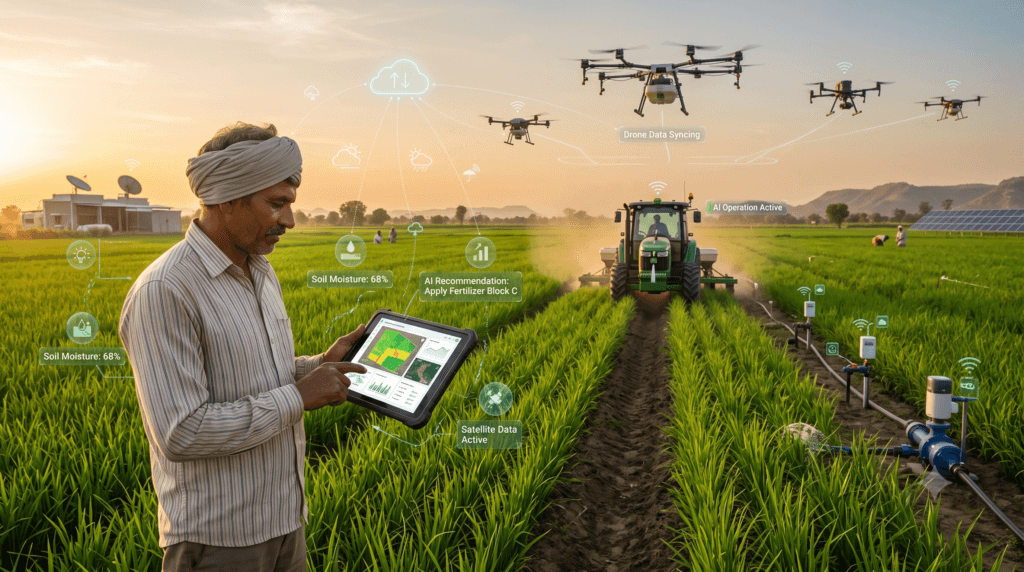
AI in agriculture refers to the use of machine learning, computer vision, predictive analytics, and increasingly generative AI to support farming decisions and automate physical or analytical tasks across the crop and livestock production cycle.
In practical terms, this covers a wide range of tools:
- Software that analyzes drone or satellite images to spot crop stress before it’s visible to the human eye
- Sensors and algorithms that decide exactly how much water or fertilizer a specific patch of field needs
- Robots that can identify and remove weeds without spraying the whole field
- Systems that predict yield weeks before harvest based on weather, soil, and historical data
- Chat-style assistants that let a farmer ask, in plain language, “why is this AI recommending less nitrogen this week?” and get a clear answer
The common thread across all of these is that AI is being used to turn large volumes of farm data weather, soil, imagery, machine sensors, market prices into decisions a farmer can actually act on, faster and with more precision than manual analysis would allow.
Why AI in Agriculture Is Trending in 2026
A few forces are converging at once to push AI in agriculture from “interesting experiment” to “standard operating practice.”
Labor shortages are forcing automation. Agriculture is dealing with a significant and growing gap between the labor a farm needs and the labor it can actually find or afford, particularly for repetitive, physically demanding tasks like harvesting, weeding, and sorting. AI-powered robotics and automation are increasingly seen as the only scalable answer to that gap.
AI adoption has crossed a real threshold. On large commercial farms, AI-based tools are no longer a minority practice; a majority of large operations now use some form of AI in their workflow, whether for imagery analysis, yield forecasting, or equipment automation. That kind of adoption curve changes the market: more tools, more competition, lower prices, and faster iteration.
Generative AI changed the interface, not just the engine. For years, AI in agriculture worked “behind the scenes,” powering yield prediction models or disease-detection algorithms that a specialist had to interpret.
The 2026 shift is that generative AI now sits on top of those models, translating outputs into direct, conversational guidance. A farmer doesn’t need to read a satellite-imagery heat map anymore; the system can simply explain, “this section of Field 4 is showing early drought stress; consider irrigating within 48 hours.”
Data is becoming a tradeable, valuable asset. Shared agricultural data environments sometimes called data spaces are emerging as infrastructure that lets farm data flow between machinery, software providers, cooperatives, and advisory services more freely.
AI models get sharply better when they’re trained on more, richer, real-world data, so this shift in data infrastructure is quietly accelerating everything else on this list.
Investment has matured, not disappeared. After a period of inflated valuations in agritech startups, investors are now backing AI-driven agriculture companies with more realistic expectations and longer timelines which tends to produce more durable, farmer-usable products rather than hype-driven ones that disappear after a funding round.
Major Applications of AI in Agriculture
1. AI Crop Monitoring and Disease Detection
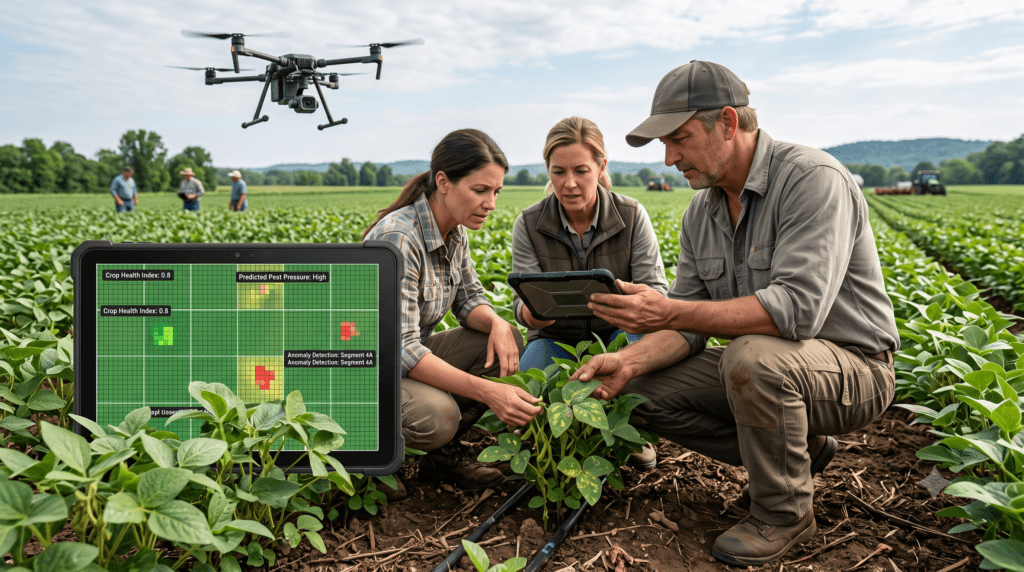
This is one of the most mature and widely adopted uses of AI in agriculture. Cameras mounted on drones, satellites, or fixed field sensors capture continuous imagery of crops. Computer vision models trained on thousands of prior images can then flag early signs of disease, nutrient deficiency, pest infestation, or water stress often days or weeks before those problems would be visible to a person walking the field.
The value here isn’t just early detection. It’s early detection at scale. A single agronomist can physically scout only so many acres in a day. An AI system can effectively “scout” an entire farm every single day, flagging only the small percentage of area that actually needs human attention.
2. Precision Farming and Variable-Rate Technology
Precision farming AI takes the “one field, one treatment plan” model and breaks it down into much smaller decision zones sometimes as small as a few square meters. Instead of applying the same amount of seed, fertilizer, or water across an entire field, AI-guided variable-rate technology adjusts application rates in real time based on soil type, historical yield data, and current crop condition.
This matters financially as much as agronomically. Overapplying inputs is expensive and often illegal to a certain degree under tightening environmental regulations; underapplying costs yield. AI-driven precision farming aims to hit the exact right rate for every part of the field, which reduces both waste and risk.
3. Smart, AI-Optimized Irrigation
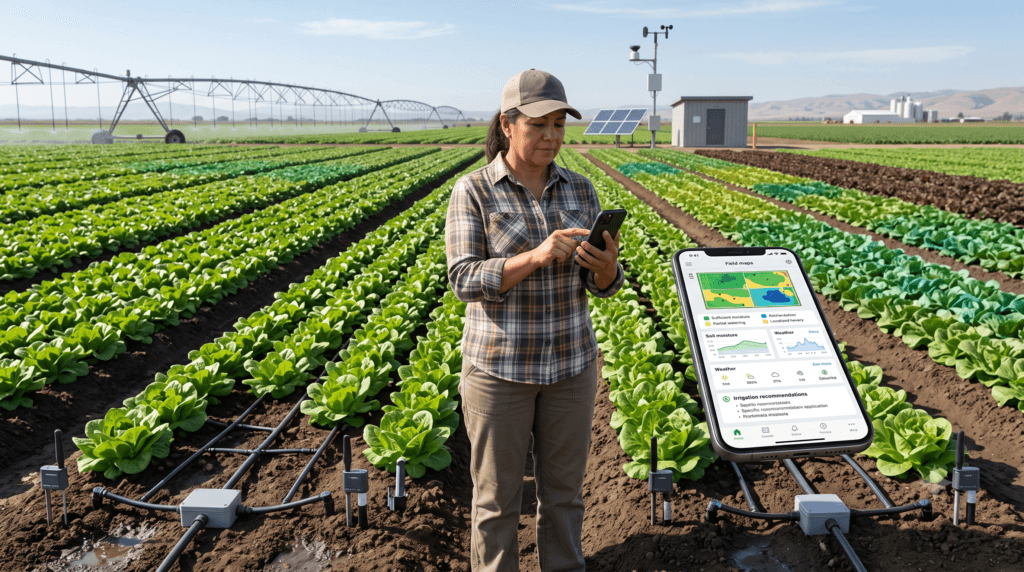
Water optimization remains one of the top operational priorities for farms globally, and AI-based irrigation systems are one of the clearest ways this shows up in daily practice. Soil moisture sensors, combined with weather forecasting models and crop-specific water-need algorithms, allow irrigation systems to water only when and where it’s actually needed.
For farms in water-stressed regions, this isn’t a luxury feature it’s often the difference between a viable harvest and a failed one, especially as regulatory pressure on water usage continues to tighten in many parts of the world.
4. Farm Automation and Robotics
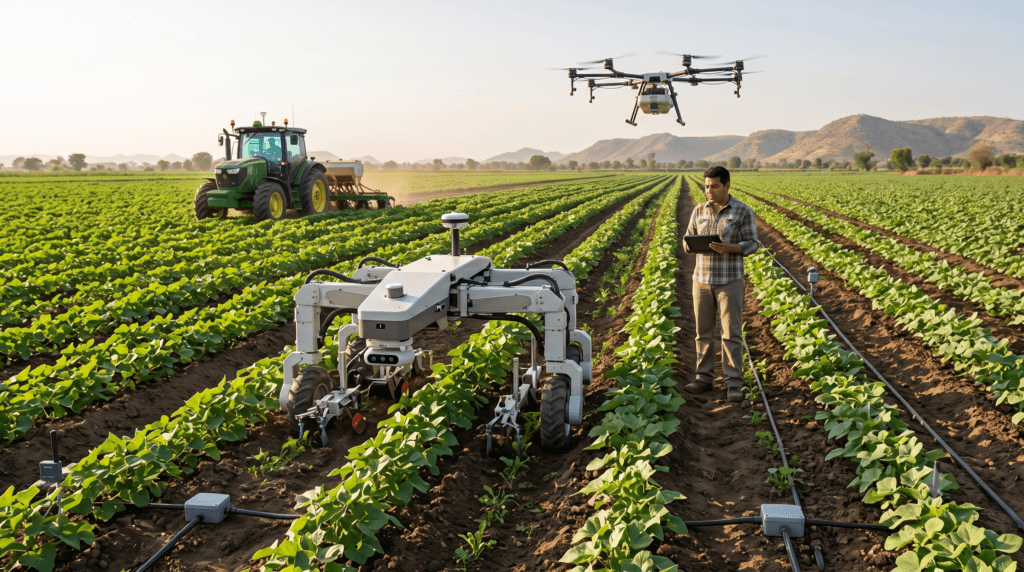
Automation and robotics in agriculture have expanded well beyond experimental prototypes. Autonomous or semi-autonomous machines are now handling tasks like precision weeding (identifying and removing weeds without blanket herbicide spraying), selective fruit and vegetable harvesting, and automated sorting and grading of produce.
The most successful automation model in 2026 isn’t a single do-everything robot it’s targeted automation applied to specific, high-labor-cost tasks, integrated into an existing workflow rather than replacing it entirely. That distinction matters for farmers evaluating whether a given automation investment will actually pay off.
5. AI Yield Prediction and Farm Data Analytics
AI models that combine weather data, soil composition, historical yield records, and real-time crop imagery can now generate yield predictions well before harvest, with a level of accuracy that continues to improve as more data feeds these models. This gives farmers a genuine planning advantage for storage, labor scheduling, contract negotiations, and cash flow forecasting rather than having to wait until harvest to know what they’re actually working with.
6. Generative AI as a Farm Decision Assistant
This is the newest and fastest-growing category. Instead of a dashboard full of charts, farmers increasingly interact with an AI assistant conversationally asking questions, getting explanations for recommendations, and receiving next-step guidance in plain language. This lowers the technical barrier to using AI meaningfully, particularly for farms that don’t have in-house data specialists.
7. Agricultural Drones
Agricultural drones combine several of the applications above into a single physical tool. Beyond imagery capture for crop monitoring, drones are increasingly used for targeted spraying (applying pesticide or fertilizer only where AI models indicate it’s needed), field mapping, and even seeding in some specialized applications. Drone-collected data is often the raw input that AI crop-monitoring and precision-farming systems are actually built on.
Benefits of AI in Agriculture
- Higher input efficiency : applying water, fertilizer, and pesticide only where and when needed reduces waste and cost.
- Earlier problem detection : catching disease, pest, or stress issues before they spread or become severe
- Better yield forecasting : improved planning for storage, labor, and sales
- Reduced labor dependency : automation helps offset a shrinking agricultural workforce
- More sustainable practices : precision application supports compliance with tightening environmental regulations
- Faster, clearer decision-making : generative AI interfaces translate complex data into direct, actionable guidance
- Improved resilience : better data means better preparation for climate volatility and unpredictable weather patterns
Challenges and Barriers to AI Adoption in Farming
It’s worth being honest about where AI in agriculture is still struggling, because the barriers are real and they’re not purely technical.
Connectivity remains a limiting factor. Many AI-powered farm tools depend on reliable internet or cellular connectivity to function well, and rural connectivity gaps still limit adoption in a lot of farming regions. Offline-capable tools are improving, but this remains a genuine constraint.
Cost and complexity are steep for smaller operations. Adoption is noticeably uneven across farm sizes. Large commercial operations can absorb the upfront cost and complexity of AI systems more easily than small and mid-sized farms, which creates a real risk of a widening gap between well-resourced and under-resourced producers.
Data trust is a bigger barrier than data availability. As shared agricultural data infrastructure expands, the main obstacle isn’t technical capability. it’s farmer trust and willingness to actually share their data with software providers, cooperatives, or third parties. Without addressing that trust gap directly, a lot of AI’s potential value stays locked away.
Interoperability is still inconsistent. Farms often use multiple pieces of software and machinery from different providers that don’t communicate well with each other. Until AI tools and farm equipment can share data more seamlessly across brands and platforms, farmers are left doing manual work to bridge the gaps themselves.
Top AI-Driven Agritech Trends to Watch in 2026
- AI in biotechnology and crop science : AI is dramatically accelerating trait discovery and crop breeding research, with some estimates pointing to research timelines many times faster than traditional methods.
- Digital twins of farms and fields : virtual, data-driven models of a physical farm that let growers simulate the outcome of a decision (like changing irrigation timing) before applying it in the real world.
- AI-supported regenerative agriculture : using data and predictive modeling to guide soil-health practices, cover cropping, and reduced tillage more precisely than traditional rule-of-thumb approaches.
- Ag retailers becoming data and technology partners : rather than simply supplying inputs, retailers are increasingly using AI-driven insights to advise farmers directly, shifting the retailer relationship from transactional to advisory.
- Carbon and sustainability data monetization : AI-verified sustainability metrics are increasingly being tied to real financial incentives, including carbon credit markets and retailer-led payment schemes that reward measurable improvements.
How Farmers Can Start Using AI in Agriculture (Without Overhauling Everything)
Adopting AI in agriculture doesn’t have to mean a complete operational overhaul. A more realistic path looks like this:
- Start with one clear, high-cost problem. Identify the single input or task that costs you the most irrigation, pest management, or labor for a specific task and look for an AI tool built specifically to address that.
- Choose tools that work with your existing equipment. Interoperability issues are real. Prioritize software and sensors that integrate with machinery and systems you already use, rather than requiring a full replacement.
- Treat the first season as a trial, not a full commitment. Run the AI tool alongside your existing process for one season before fully switching over, so you have a direct comparison of outcomes.
- Ask providers directly about offline functionality and data ownership. Given connectivity gaps and data-trust concerns, get clear answers before signing on not after.
- Involve the people actually doing the field work. AI tools succeed or fail based on whether the people using them day-to-day trust and understand the recommendations. Skipping this step is one of the most common reasons adoption fails.
The Future of AI in Agriculture
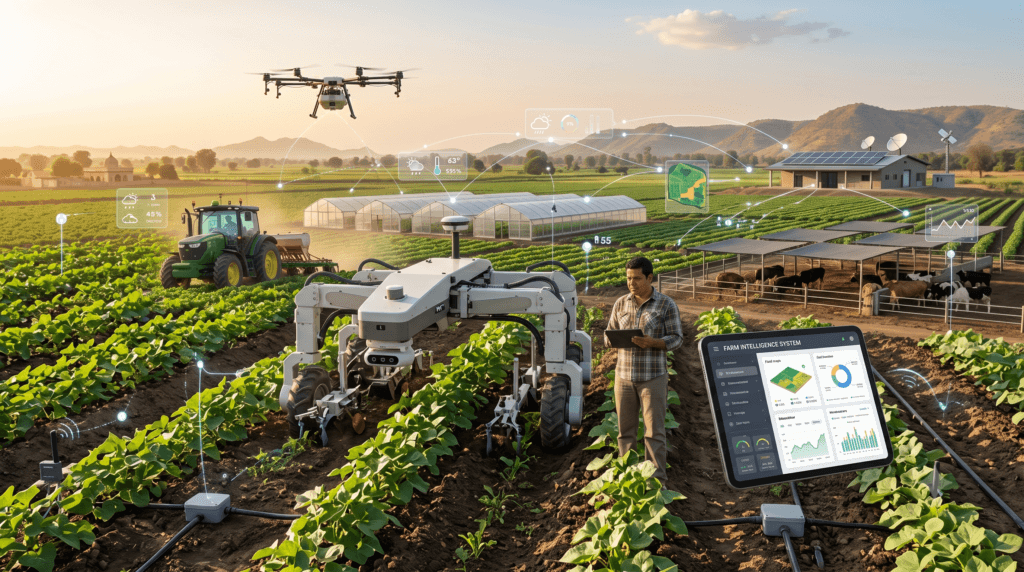
The direction is fairly clear: AI in agriculture is moving away from being a specialized, standalone tool and toward being an integrated layer across the entire farm connecting equipment, data, weather, markets, and decision-making into one continuous workflow. The technologies making headlines individually today generative AI assistants, digital twins, autonomous robotics, biotechnology acceleration are converging rather than competing.
For farmers, the practical implication is straightforward: the value of AI in agriculture in the coming years will depend less on any single breakthrough tool and more on how well different systems work together, and how much a given farm’s data infrastructure and connectivity can support that integration.
Frequently Asked Questions About AI in Agriculture
Is AI in agriculture only useful for large commercial farms? No, though adoption has been faster among large farms due to cost and complexity. Smaller and mid-sized farms can benefit from targeted, lower-cost AI tools such as smartphone-based crop-disease identification apps or basic soil-sensor irrigation scheduling without needing an enterprise-level system.
What is the difference between precision farming and AI in agriculture? Precision farming is a broader practice of managing crop inputs at a finer, more localized level than treating a whole field uniformly. AI is one of the key technologies that makes modern precision farming possible, by analyzing data and generating the specific recommendations that guide those localized decisions.
Do farmers need technical or data science skills to use AI tools? Increasingly, no. The shift toward generative AI interfaces means many modern tools are designed to explain recommendations in plain language, reducing the need for specialized technical skills to interpret the output.
What are the biggest risks of adopting AI in agriculture too quickly? The main risks are financial overcommitment to tools that don’t fit the farm’s actual scale or needs, dependency on connectivity that isn’t reliably available, and data-sharing agreements that aren’t fully understood before signing. A gradual, trial-based adoption approach reduces most of this risk.
Will AI replace farm labor entirely? Unlikely in the near term. Current automation trends favor targeted use automating specific high-labor-cost tasks like weeding or sorting rather than full-farm automation. AI is more accurately described as addressing labor shortages than eliminating the need for skilled farm labor altogether.
Conclusion
AI in agriculture in 2026 isn’t a distant, experimental concept anymore it’s an operational reality for a growing share of the world’s farms, and the barrier to entry is dropping as generative AI makes these tools easier to understand and use. The farms that benefit most won’t necessarily be the ones that adopt the most tools, but the ones that identify their highest-cost, highest-impact problem and apply the right AI-driven solution to it first.
Whether you’re managing a few acres or a large commercial operation, the practical starting point is the same: understand where AI can genuinely reduce cost, save time, or catch a problem earlier and build from there.