
Livestock population in India was 535.78 million animals in the 20th Livestock Census (2019), not counting poultry. Poultry added another 851.81 million birds.
By category, cattle lead with 192.49 million, then goats at 148.88 million, buffalo at 109.85 million, sheep at 74.26 million and pigs at 9.06 million.
Table of Contents
What the Livestock Population in India Actually Counts
The livestock population in India is a head count of farm animals, taken by the government every five years. The census has run since 1919.
It counts cattle, buffalo, sheep, goat, pig, horse, pony, mule, donkey, camel, yak and mithun. Poultry is reported as a separate figure.
Enumerators visit households, farms and institutions. The 21st census is the second one done fully on digital devices, per DAHD.
Why should a farmer care? Because the livestock population in India decides where feed, vaccines, breeding bulls and credit are sent. Districts with more animals get more attention.
Livestock Population in India by Category: The Table
Here is the category-wise livestock population in India from the 2019 census.
| Category | Head count (million) | Change vs 2012 census |
|---|---|---|
| Cattle | 192.49 | -0.8% |
| Buffalo | 109.85 | +1.0% |
| Goat | 148.88 | +10.1% |
| Sheep | 74.26 | +14.1% |
| Pig | 9.06 | -12.03% |
| Total livestock | 535.78 | +4.6% |
| Poultry | 851.81 | +16.8% |
Cattle and buffalo together with mithun and yak make up the bovine group. DAHD puts that group at 302.79 million.
Goats and sheep together cross 223 million. That is why small ruminants matter so much to landless and marginal families.
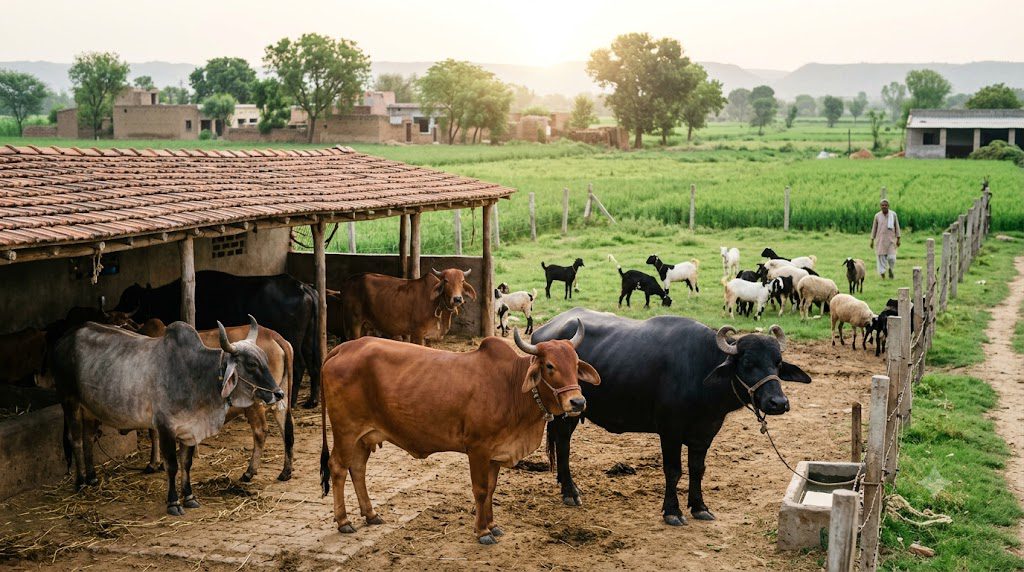
Cattle: The Largest Category in the Livestock Population in India
Cattle are the biggest single category in the livestock population in India at 192.49 million. They are used for milk, draught power and manure.
The number fell 0.8% between the 2012 and 2019 counts. Fewer bullocks are needed as tractors spread.
For a farmer, the cattle category splits into three uses:
- Milch animals: indigenous and crossbred cows kept for milk.
- Draught animals: bullocks for ploughing and carting.
- Young stock: calves and heifers, which cost money to feed before they earn.
Disease is the big risk in this category. Read our guides on foot and mouth disease and brucellosis in cattle before you add animals to a herd.
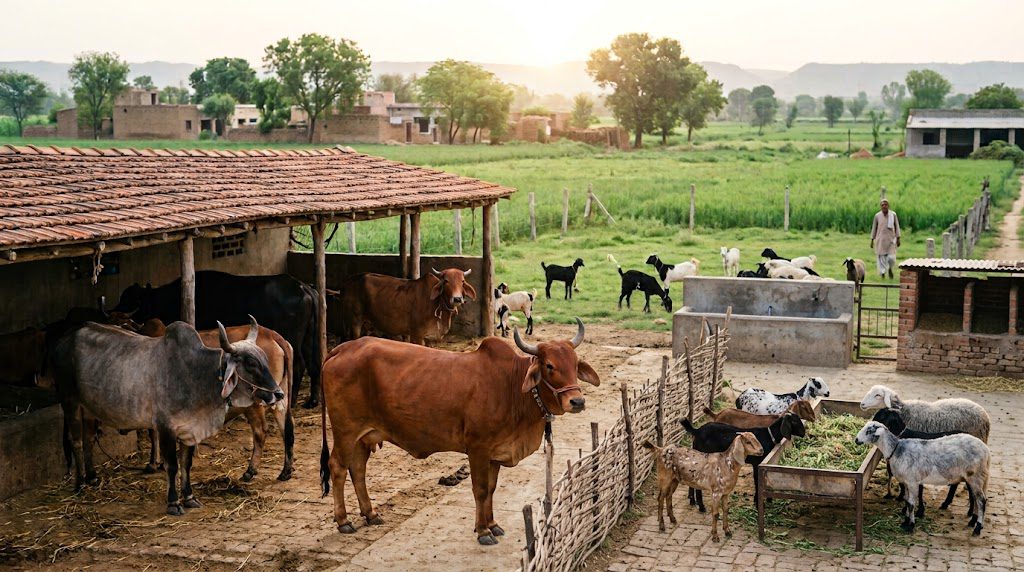
Buffalo: Fewer Animals, More Milk Value
Buffalo stand at 109.85 million in the livestock population in India. The count rose 1.0% over 2012, the only large bovine category to grow.
Buffalo milk is richer in fat than cow milk, so dairies often pay more per litre for it. That price gap is why many north Indian dairy farmers choose buffalo over cattle.
The trade-off is cost. Buffalo need more water, a wallowing or cooling arrangement in summer, and often a longer gap between calvings.
If you plan a milk business, start with our dairy farming in India guide.
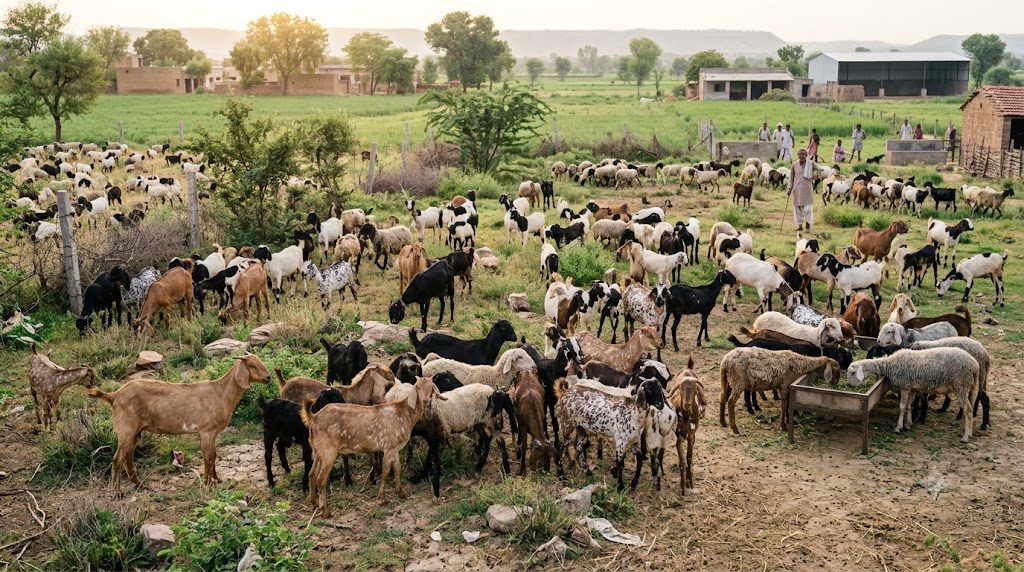
Goat and Sheep: The Small Ruminant Story
Goats number 148.88 million, up 10.1%. Sheep number 74.26 million, up 14.1%. Both grew faster than total livestock.
Why do small ruminants keep growing in the livestock population in India? The entry cost is low, they breed quickly, and meat demand stays steady.
A goat can be bought for a fraction of what a crossbred cow costs. That makes it the first animal many landless households buy.
Goat keepers still lose animals to disease. Sheep pox and goat pox have been a live concern; see our post on sheep pox and goat pox. For setup steps, read goat farming in India.
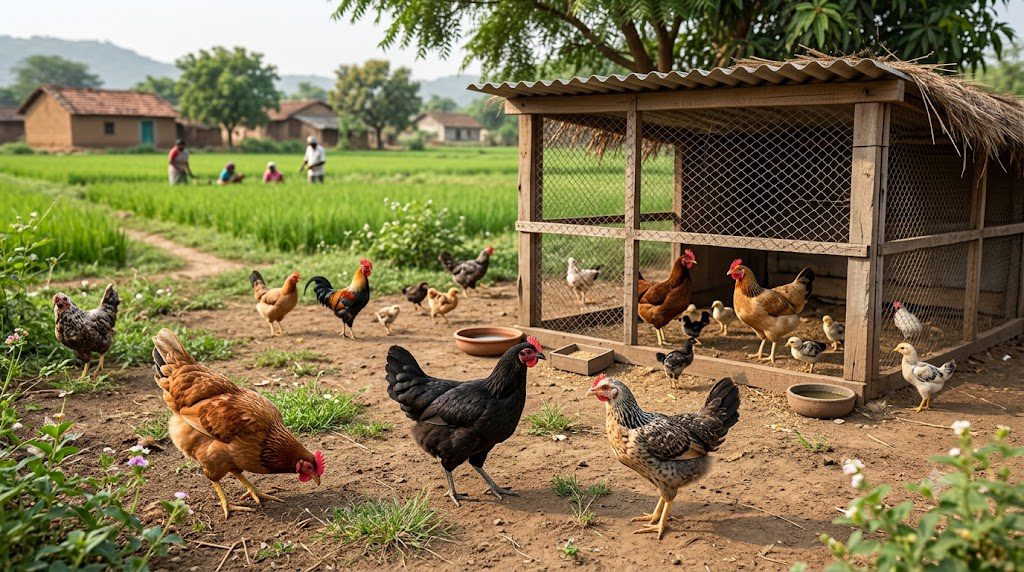
Pig and Poultry: Small Herd, Fast Turnover
Pigs are only 9.06 million in the livestock population in India, and the count fell 12.03% from 2012. Pig keeping is concentrated in a few regions and communities, so national numbers stay small.
Poultry is the largest group by head count: 851.81 million birds, up 16.8%. Poultry is not added into the 535.78 million livestock total.
Birds turn over fast. A broiler batch is measured in weeks, while a cow’s payback is measured in years.
That speed is also the risk. One disease outbreak or one bad feed price swing can wipe out a batch margin.
Which Categories Grew and Which Shrank
The pattern in the livestock population in India is clear from the 2019 table.
- Grew: poultry (+16.8%), sheep (+14.1%), goat (+10.1%), buffalo (+1.0%).
- Shrank: cattle (-0.8%), pig (-12.03%).
- Total: livestock rose 4.6%.
The reasons are partly economic. Small animals need less land and less capital. Draught cattle lose value as machines replace them.
Treat the reasons as informed readings, not census findings. The census counts animals. It does not explain why numbers moved.
What the 21st Livestock Census Changes
DAHD launched the 21st Livestock Census on 25 October 2024 in New Delhi. It collects data on 16 species, and it is the first census to count pastoral livestock and pastoral communities.
Data collection ran on tablets and smartphones. DAHD review presentations from 2025 showed early state-level comparisons: cattle and buffalo falling in several zones, with poultry, sheep and goat rising in the southern states.
We could not find a final national table for the 21st census while researching this article. So the 2019 figures remain the last complete national numbers we can verify. Check the DAHD website for the final release, and expect the livestock population in India figures on this page to be updated then.
Milk, Egg and Meat Output
Head count is one side. Output is the other. DAHD’s 2025 review slides give these estimates for all-India production:
| Product | Latest estimate | Growth over previous year |
|---|---|---|
| Milk | 239.30 million tonnes | 3.78% |
| Eggs | 142.77 billion | 3.18% |
| Meat | 10.25 million tonnes | 4.95% |
Output is growing even where cattle numbers are flat. That points to more yield per animal, not just more animals.
For a farmer, this is the key lesson from the livestock population in India data: a smaller herd of better animals can out-earn a large herd of weak ones.
How a Smallholder Should Pick a Category
The livestock population in India tells you what is common. It does not tell you what suits your land. Use this table as a starting filter.
| Your situation | Category to look at first | Main risk |
|---|---|---|
| Some land, steady water, near a milk collection point | Buffalo or crossbred cow | High feed and vet cost |
| Little or no land, low capital | Goat | Disease and kid mortality |
| Dry region, grazing access | Sheep | Pox, parasites, market access |
| Small yard, want quick cash | Backyard poultry | Disease outbreaks |
| Cultural and market access for pork | Pig | Disease control and local demand |
Before you buy any animal, check three things: where you will sell, how far the nearest vet is, and what feed costs per day.
Feed is the cost most beginners underestimate. Our guide on hydroponic fodder production covers one way to lower it.
Government Support by Category
Central support is routed through DAHD. The National Livestock Mission offers a capital subsidy of 50% of project cost for eligible units, which we explain in full in that article.
Dairy farmers can also look at the National Dairy Development Board for cooperative and milk-marketing information.
For breed and research information, the Indian Council of Agricultural Research publishes material on indigenous breeds.
Scheme rules and subsidy rates change. Confirm current terms with your district animal husbandry office before you invest.
Mistakes Farmers Make When Reading Livestock Data
- Treating poultry as part of the 535.78 million. It is counted separately.
- Using old numbers as current. The 2019 census is the last complete national count we can confirm.
- Assuming growth means profit. More goats in the livestock population in India does not mean your goat unit will earn well.
- Ignoring local market. A category that sells well in one district can be unsellable in the next.
- Skipping vaccination. Head count does not protect animals. Vaccination does.
For a broader overview of species and their uses, see our earlier post on types of livestock. You can browse every article in the Livestock category.
FAQs: Livestock Population in India
1. What is the livestock population in India according to the latest verified census?
According to the 20th Livestock Census conducted in 2019, the total livestock population in India was 535.78 million animals, excluding poultry. The census recorded cattle, buffalo, goats, sheep, pigs, and other livestock species. Poultry was counted separately, with a population of 851.81 million birds. These figures remain the reference data used in this article because a complete national dataset from the 21st Livestock Census could not be verified during research.
2. Which category has the highest livestock population in India?
Cattle represent the largest single category in the livestock population in India, with approximately 192.49 million animals recorded in the 2019 census. Goats ranked second, with 148.88 million animals, followed by buffalo at 109.85 million. These animals play an important role in milk production, agricultural activities, manure supply, and rural livelihoods. Their population figures also help policymakers understand the distribution of livestock resources across the country.
3. How many buffalo are there in India according to the 2019 Livestock Census?
The 20th Livestock Census recorded approximately 109.85 million buffalo in India in 2019. Buffalo are particularly important to the Indian dairy sector because their milk generally contains a higher fat percentage than cow milk. This can influence milk prices and dairy product production. However, buffalo farming also requires careful management of feed, drinking water, summer cooling, breeding, and veterinary care to maintain animal health and productivity.
4. How many goats and sheep are there in India?
According to the 2019 Livestock Census, India had approximately 148.88 million goats and 74.26 million sheep. Both categories recorded substantial growth compared with the 2012 census, with goat numbers increasing by 10.1% and sheep numbers increasing by 14.1%. Goat and sheep farming can be suitable for some small and marginal farmers because these animals may require less initial investment than dairy cattle. However, profitability depends on feed availability, disease prevention, mortality rates, and access to reliable markets.
5. Is poultry included in the total livestock population in India?
No. Poultry is reported separately from the main livestock population total in the 20th Livestock Census. India had approximately 851.81 million poultry birds in 2019, while the total livestock population was recorded at 535.78 million animals. Poultry farming supports egg and meat production and provides livelihood opportunities through commercial farms and backyard poultry systems. Farmers considering poultry production should assess feed costs, housing, biosecurity, vaccination requirements, and local market demand before investing.
6. Which livestock categories grew the fastest in India between 2012 and 2019?
Poultry recorded the highest growth among the categories listed in this article, increasing by 16.8% between the 2012 and 2019 censuses. Sheep numbers increased by 14.1%, while goat numbers grew by 10.1%. Buffalo numbers increased by 1.0%. These changes show that livestock populations developed differently across animal categories. However, census figures only measure population changes; they do not independently explain the reasons behind them or establish whether individual farmers experienced higher profits.
7. Which livestock categories declined in India between 2012 and 2019?
The 20th Livestock Census recorded a 0.8% decline in cattle numbers and a 12.03% decline in pig numbers compared with the 2012 census. These changes may reflect differences in farming practices, regional production systems, and market conditions, but the census figures alone do not establish a single cause. Farmers and researchers should consider local livestock data, breed distribution, animal health, feed availability, and market access when evaluating changes in India’s livestock sector.
8. When was the 21st Livestock Census launched in India, and what is new about it?
The 21st Livestock Census was launched on 25 October 2024 in New Delhi by the Department of Animal Husbandry and Dairying. It covers 16 livestock species and includes the counting of pastoral livestock and pastoral communities for the first time. The census also uses digital devices, such as tablets and smartphones, to support data collection. Its findings are important for understanding livestock distribution, planning animal health services, and improving the development of India’s animal husbandry sector.
9. How often is the livestock census conducted in India?
India conducts its Livestock Census every five years. The programme began in 1919 and provides information about the number and distribution of livestock across the country. Census data help government departments, researchers, farmers, and policymakers understand changes in animal populations and plan breeding, vaccination, veterinary services, and livestock development programmes. Comparing census results across different years also helps identify which animal categories are growing or declining over time.
10. Where can I check the latest livestock population figures in India?
You can check official livestock population statistics, census updates, and animal husbandry reports through the Department of Animal Husbandry and Dairying (DAHD), Government of India, at https://dahd.gov.in/. The department publishes information related to livestock censuses, milk production, egg production, meat production, and government initiatives. Before using livestock figures in a research project or business plan, verify the publication date and reporting year so that historical census data are not mistakenly presented as current population estimates.
Conclusion: Livestock Population in India
Livestock is an important part of Indian agriculture. It supports dairy farming, provides employment in rural areas, and helps millions of farming families earn a livelihood. According to the 2019 Livestock Census, India had 535.78 million livestock animals, excluding poultry, which accounted for another 851.81 million birds.
Cattle, buffalo, goats, and sheep all play an important role in animal husbandry. The census figures also show that different livestock categories have changed over time. However, having more animals does not automatically mean higher profits. Farmers need to focus on proper feeding, animal health, vaccination, breeding, and market demand to manage their livestock successfully.
The latest census data will help us better understand how India’s livestock sector is changing. Farmers and researchers should check official updates from the Department of Animal Husbandry and Dairying (DAHD) for the latest verified figures.
At FarmSutras, we aim to make agricultural knowledge simple and useful for farmers, students, and agriculture enthusiasts. Keep following FarmSutras for practical farming guides, livestock information, and the latest developments in Indian agriculture.