
Dairy farming in India means keeping cows or buffaloes mainly to produce milk, and it is the most common livestock business among Indian farm families because milk sells every single day.
Daily income is the attraction. Daily costs are the trap. Feed, labour and vet bills arrive every morning, whether the milk pays or not.
This guide gives you seven practical steps. It draws on the Basic Animal Husbandry Statistics, ICAR institutes and state agricultural university guidance, and it flags where the evidence runs out.
Table of Contents
What Is Dairy Farming in India?
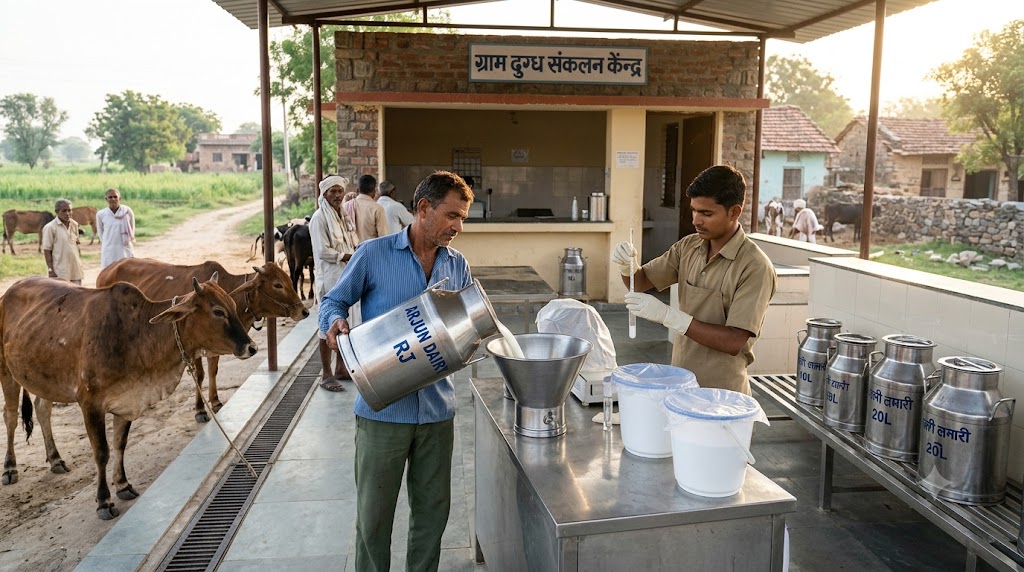
Dairy farming in India is the rearing of milch cows and buffaloes, at household or commercial scale, to produce and sell milk.
India ranks first in the world in milk production. The Department of Animal Husbandry and Dairying (DAHD) reports 247.87 million tonnes for 2024-25, according to a Vikaspedia summary of Basic Animal Husbandry Statistics.
The 20th Livestock Census counted 145.91 million cows and 125.75 million milch cows and buffaloes, as a People’s Archive of Rural India summary shows.
Most of this milk does not come from big farms. An ICAR-linked NCAP study found that nearly 75% of dairy farmers kept only two or three milch animals. That paper dates from 2014, so treat it as a pattern and not a current count.
Small herds mean small margins. That is why dairy farming in India rewards discipline more than size.
For the bigger picture of farm animals, read our guide to the types of livestock.
Why Dairy Farming in India Needs a Plan First
Milk is a steady product, but yield varies widely. The BAHS 2023 summary reports average daily yields of 8.55 kg per exotic or crossbred animal and 3.44 kg per indigenous or non-descript animal, according to Vikaspedia.
That gap tells you something. A high-yielding animal earns more, but it also needs better feed, shade and care.
Location matters too. Uttar Pradesh produced 16.21% of India’s milk in 2023-24 and Rajasthan 14.51%, as a BAHS 2024 summary notes.
Where your farm sits decides your fodder, your climate and your milk buyers. Plan these first, and dairy farming in India becomes far less risky.
Dairy Farming in India: 7 Steps to Start
Work through these steps in order. Each one removes a common cause of loss.
Step 1: Choose Cows or Buffaloes for Dairy Farming in India
Decide your animal before your shed. Both species work, but they behave differently.
| Factor | Cows | Buffaloes |
|---|---|---|
| Milk | Lower fat in most breeds | Richer, higher-fat milk |
| Heat | Zebu breeds tolerate heat and ticks; crossbreds need shade | Feel heat badly, need wallowing or cooling |
| Growth | Heifers mature sooner | Heifers mature slowly |
| Space | Smaller covered area | Larger covered and open area |
If your buyers pay by fat percentage, buffalo milk can earn more per litre. If your summers are harsh and water is short, a hardy zebu cow may be safer.
Our guide to heat stress in cattle shows how fast milk falls in hot weather.
Step 2: Pick a Breed That Suits Your Climate and Feed
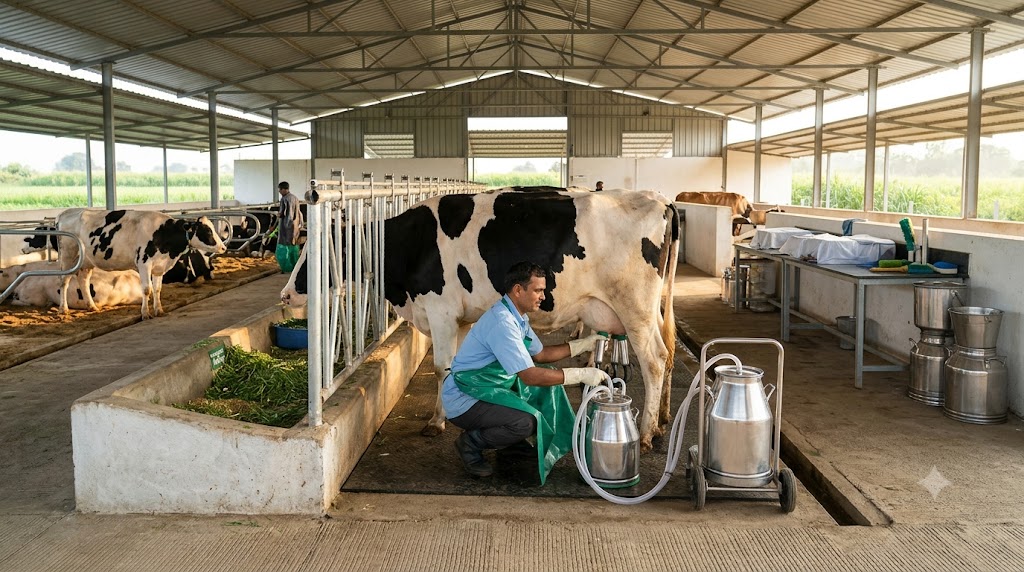
Match the breed to your feed and climate, not to a poster. Indigenous breeds such as Gir, Sahiwal and Red Sindhi handle heat and ticks well. Crossbreds built on Holstein Friesian or Jersey blood give more milk but demand better feed and vet care.
Among buffaloes, Murrah, Jaffarabadi, Mehsana and Surti are well-known dairy breeds.
Start with a breed already doing well in your block. Visit two or three farms that keep it and ask about yield, feed cost and disease.
Our guide to breeding cows explains how breeding choices shape long-term yield.
Buy from a known source, ask for health and vaccination records, and quarantine new animals for at least two weeks.
Step 3: Build a Clean, Shaded, Well-Drained Shed
The TNAU expert system on cattle and buffalo housing gives these floor-space figures for adult animals.
| Animal | Covered area | Open area |
|---|---|---|
| Adult cattle | 3.5 sq m | 7.0 sq m |
| Adult buffalo | 4.0 sq m | 8.0 sq m |
The same source suggests about 75 cm of manger and water-trough space per animal.
Other guidance on Vikaspedia gives different figures for different housing styles, so match the numbers to your system.
Keep the floor non-slippery and easy to clean. Slope it for drainage. Give animals shade and fresh air, and keep the milking area away from manure.
Plan separate space for dry animals. Roughly one-third of the animals on a dairy farm are usually dry or in late pregnancy, as the TNAU material notes.
Calves need their own pens. TANUVAS guidance, shared on Vikaspedia, gives these figures per calf.
| Calf age | Covered area | Open area |
|---|---|---|
| 0 to 3 months | 1.0 sq m | 2 sq m |
| 3 to 6 months | 1.5 sq m | 3 sq m |
| 6 to 12 months | 2.0 sq m | 4 sq m |
Our cow shelter guide covers shed design in more detail.
Step 4: Secure Fodder Before You Buy Animals
Feed is the biggest running cost in dairy farming in India. Many first-time dairy farmers buy animals first and chase fodder later. That order costs money.
The TNAU expert system says a cow giving 6 to 8 litres of milk a day can be sustained on 25 to 30 kg of green fodder. It describes a daily mix of 10 to 15 kg of cereal fodder, 8 to 10 kg of legume fodder and 3 to 4 kg of dry fodder.
It also suggests about 1.5 to 2 kg of concentrate as a flushing ration before breeding. Pregnant cows get the same amount 60 to 90 days before calving.
Treat these as starting points. Your vet will adjust them for breed, body weight and yield.
Dry fodder needs its own plan. An adult animal eats about 5 to 10 kg of hay or straw a day, and young stock about 2 to 5 kg, according to the TNAU housing notes on Vikaspedia. Multiply by your herd size and 365 days to see how much storage space you need.
Dairy farming in India fails fastest in the dry months, when green fodder runs short. Plan silage or hay before that gap arrives.
Always provide clean water. Wash troughs daily.
Our guides on hydroponic fodder production, corn silage basics and feeding cattle without overspending show practical ways to cut the feed bill.
Step 5: Protect Herd Health With a Vaccination Plan
Disease cuts milk quietly. Build a vaccination plan with your vet before the first animal arrives.
The DAHD Livestock Health and Disease Control Programme aims to control and eradicate foot-and-mouth disease by 2030. It also supports vaccination against bovine brucellosis.
Read our guides on foot and mouth disease, FMD in cattle and brucellosis in cattle to understand the threats.
Lumpy skin disease is another risk. See our lumpy skin disease guide before the monsoon.
Keep a simple health diary. Log vaccination dates, treatments and illness for every animal.
Step 6: Control Mastitis Through Milking Hygiene
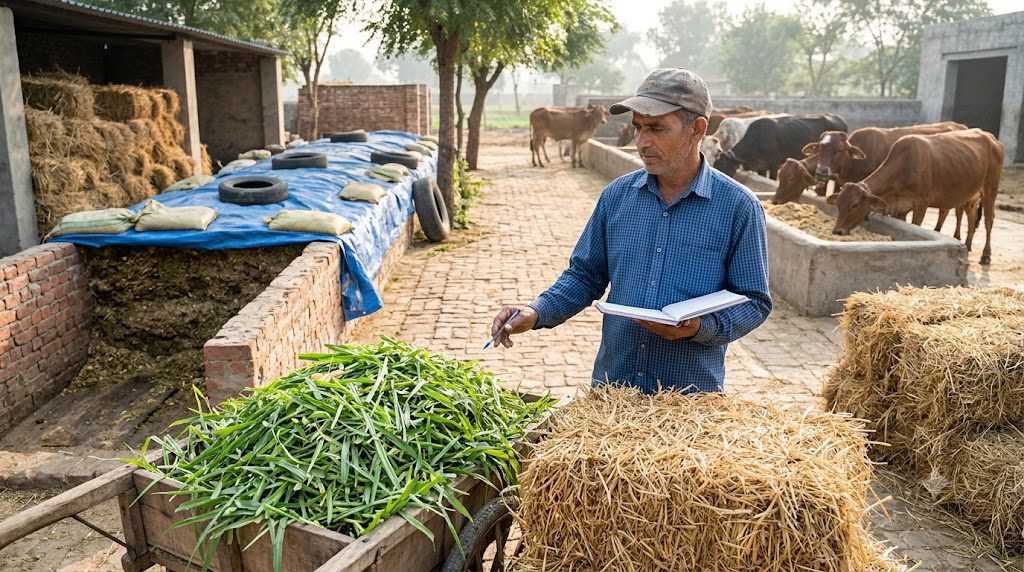
Mastitis is inflammation of the udder, and it quietly drains income. Researchers at ICAR-Central Institute for Research on Cattle report that prevalence in dairy cows varies from 5% to 50%. Their Indian Farming review adds that sub-clinical mastitis causes a 10% to 25% fall in milk and costs more overall than visible cases.
Sub-clinical mastitis shows no obvious signs, so you must test for it. The review lists cow-side tests, post-milking teat dips, dry cow therapy, clean premises and good nutrition as the core controls.
The TNAU mastitis guidance adds simple habits.
- Milk healthy cows first and known infected cows last.
- Screen newly bought cows with the California Mastitis Test.
- Dip all teats after every milking.
- Keep milking times regular.
It also notes that exotic and crossbred cows are more prone to mastitis than Indian zebu cows.
Dudhsagar Dairy’s Mastitis Control Project page says affected animals lose 20% to 25% of their milk. It also reports teat-dip solution sold to member farmers at a subsidised rate. Ask your own milk union whether a similar scheme exists.
The DAHD has published a national strategy document on mastitis prevention, which is worth reading with your vet.
Step 7: Fix Your Market and Cash Flow First
Before you buy, know who will collect your milk and what they will pay. Visit the nearest dairy cooperative or private collection centre. Ask about fat and SNF testing, payment cycles and rates in lean and flush seasons.
India’s cooperative model dates to Operation Flood, launched in 1970. It spread village milk cooperatives across the country, according to an Issuelab summary. For many small farms, a cooperative is still the easiest route to a regular buyer in dairy farming in India.
Then run a cash plan. Include the shed, animals, fodder, labour, vet care and at least six months of feed before income stabilises.
Start small. A few animals teach you more than a big loan does. Scale only after you have managed one full lactation and one summer.
Keep records from day one. Log daily milk, feed, health events and sales. Records make dairy farming in India easier to scale and show you which animals lose you money.
When your herd grows, you may look at robotic milking systems, though they suit large farms more than small ones.
Government Support for Dairy Farming in India
The most accessible support for small dairy farmers is credit. The Kisan Credit Card has been extended to animal husbandry and fisheries farmers for working capital, as a Government reply in Parliament explains.
The reply sets a credit limit of ₹2 lakh for animal-husbandry-only card holders, and ₹3 lakh overall for existing KCC holders. It also describes an interest subvention for short-term loans.
An RBI circular sets out the original guidelines. Interest rates, subvention percentages and limits have changed more than once, so confirm the current terms with your bank.
Ask your state animal husbandry department and nearest milk union about training, fodder schemes and veterinary camps. Programmes differ by state.
Animal Welfare in Dairy Farming in India
Welfare is not a side issue. It affects yield, health and your reputation with buyers.
The Issuelab summary notes that most welfare problems on Indian dairy farms come from lack of basic care, poor or uncomfortable housing, tethering and abandonment of unproductive animals.
Good welfare practice is also good business. Comfortable, clean and well-fed animals fall sick less often. Plan for the whole life of the animal, including what you will do when a cow stops giving milk, because that decision comes in every herd.
Responsible dairy farming in India means feeding enough, housing well, treating illness early and never leaving animals without care.
5 Common Mistakes in Dairy Farming in India
- Buying animals before securing fodder. Hungry animals give less milk and fall sick.
- Ignoring sub-clinical mastitis. The loss is invisible until you test.
- Skipping quarantine. One new animal can bring disease to the whole herd.
- Chasing high yield without shade or feed. Crossbreds punish poor management.
- Borrowing heavily before finding a buyer. Loan instalments do not wait for milk prices.
What We Still Do Not Know
The 20th Livestock Census is the last full count I could verify, and the 21st census results were not confirmed at the time of writing.
I found no trustworthy, all-India profit figure per litre or per animal. Returns swing with breed, feed price, milk rate and disease, so this guide avoids income promises.
Housing space figures, feed rations and loan terms differ across sources and change over time. Treat every number here as a starting point for a conversation with your vet and bank.
Questions to Ask Your Vet Before You Buy
- Which diseases are most common in my block?
- Which vaccines are due, and when is the next campaign?
- Which breed suits my climate and fodder?
- How should I design the shed and milking area?
- How do I test for sub-clinical mastitis?
Write the answers down and keep them with your farm records.
Frequently Asked Questions
1. What is dairy farming in India?
Dairy farming in India is the rearing of cows and buffaloes to produce and sell milk. It ranges from two-animal household units to large commercial dairies.
2. Is dairy farming in India profitable?
It can be, but returns depend on breed, feed cost, milk price and disease control. No honest all-India profit figure exists, so test your numbers locally.
3. Which is better for dairy farming in India, cow or buffalo?
Neither wins everywhere. Buffalo milk is richer in fat, while hardy zebu cows cope better with heat. Choose by your buyer, climate and fodder.
4. How many animals should a beginner start with?
Start with a small herd you can feed and milk well. Grow only after one full lactation and one summer.
5. How much space does a dairy animal need?
TNAU guidance gives 3.5 sq m covered and 7.0 sq m open space for an adult cow, and 4.0 and 8.0 sq m for a buffalo.
6. How much fodder does a dairy cow need?
The TNAU expert system says a cow giving 6 to 8 litres daily can be sustained on 25 to 30 kg of green fodder, with dry fodder and some concentrate. Your vet will fine-tune this.
7. What is mastitis and why does it matter?
Mastitis is udder inflammation. ICAR researchers report that sub-clinical cases can cut milk by 10% to 25%.
8. Which vaccines do dairy animals need?
Common ones include foot-and-mouth disease, brucellosis for calves, haemorrhagic septicaemia and black quarter. Follow your state schedule and your vet.
9. Is there a loan for dairy farming in India?
Yes. Kisan Credit Card facilities cover working capital for animal husbandry, and banks offer dairy term loans. Confirm current limits and interest rates with your bank.
10. Can I start dairy farming in India without land?
You can, but you will buy most of your fodder. That raises costs and risk, so test a small herd first.
Key Takeaways
Dairy farming in India pays the people who prepare. Fodder, shed and a milk buyer come first, and the animals come after.
- Dairy farming in India rewards daily discipline more than farm size.
- Choose cows or buffaloes by buyer, climate and fodder.
- Secure fodder and water before you buy a single animal.
- Test for sub-clinical mastitis and dip teats after every milking.
- Vaccinate on a calendar and keep health records.
- Check current loan terms with your bank before borrowing.