
Mustard farming is the cultivation of Indian mustard (sarson, rai), India’s main winter oilseed, which gives edible oil, oilcake for cattle and a cash crop that needs far less water than wheat. On 30 September 2026 the Cabinet raised the rapeseed-mustard MSP by Rs 413 to Rs 6,613 per quintal for the 2027-28 marketing season, the second-largest rabi increase after safflower. Sowing is under way right now, so your next two weeks matter.
This guide gives you nine practical steps, from field choice to selling the seed. It draws on ICAR research papers, state advisories and the official MSP announcement, and each source is linked so you can verify it yourself.
Quick answer
- Season: rabi, sown from late September to mid-November depending on your region
- Seed rate: about 4 to 5 kg per hectare, in rows 40 to 45 cm apart
- Key nutrient: sulphur (commonly 20 to 40 kg per hectare), plus N, P and K
- Biggest pest: mustard aphid
- MSP 2027-28: Rs 6,613 per quintal (up Rs 413)
- Government’s expected margin over cost: 96%
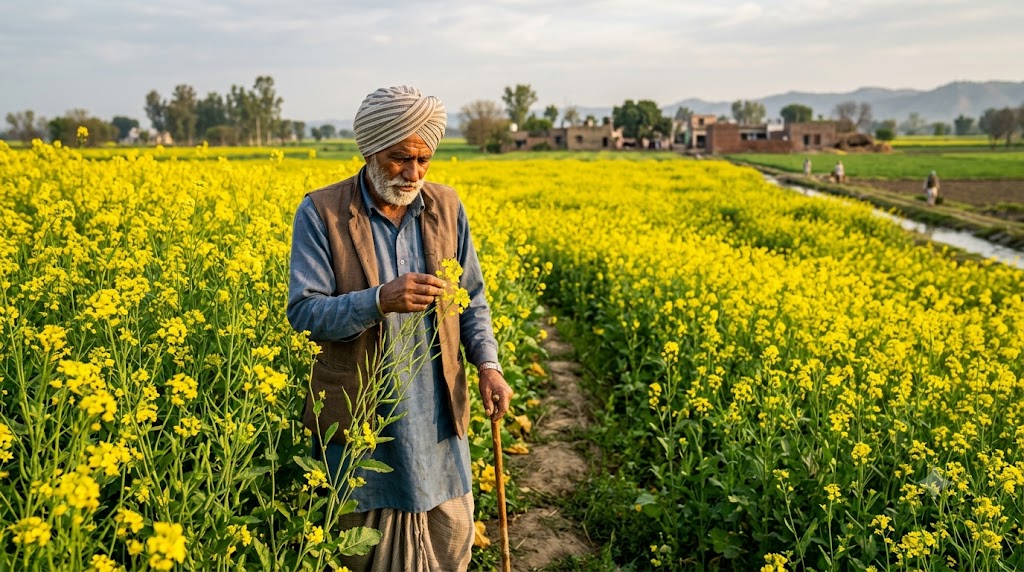
Table of Contents
What Is Mustard Farming?
Mustard farming means growing Brassica juncea, the Indian mustard, and its close relatives for their oil-rich seed. Rapeseed-mustard is generally described as India’s second most important oilseed crop after soybean.
The seed is crushed for mustard oil, a staple cooking oil across north and east India. The leftover cake is a protein-rich cattle feed. Typical oil content in B. juncea varieties is in the range of 38 to 42%, according to standard agronomy notes.
It is a cool-season crop. Plants flower in winter, and the bright yellow fields you see in January are the crop at peak bloom. If you want the wider list of what else is sown now, read our guide on the names of rabi crops.
Why Mustard Farming Is in the Spotlight This Rabi Season
The numbers explain the interest. Rapeseed-mustard MSP rose from Rs 6,200 to Rs 6,613 per quintal, according to the official announcement reported by All India Radio. Wheat, by comparison, got only Rs 25.
The government’s table puts the all-India weighted average cost of production at Rs 3,367 per quintal, which it says gives an expected margin of 96%, as shown in this report of the official MSP table.
Market prices are also running above the floor. A commodity market report noted wholesale modal prices in key mandis in the mid-Rs 7,000s per quintal around 1 October 2026. Prices move daily, so treat that as a snapshot, not a promise. For the policy background, see our explainer on MSP for farmers.
Step 1: Choose the Right Field for Mustard Farming
Mustard prefers light to medium loam with good drainage. Heavy, waterlogged soil hurts germination and invites root and stem diseases, so avoid fields where water stands after rain.
An even, fine seedbed matters more here than for most crops, because mustard seed is tiny. Rotation also helps. Mustard fits after kharif crops such as paddy, bajra, cotton or fallow, and it can follow or share a season with pulses. Our guide on lentil farming covers a crop that is often grown alongside it in mixed systems.
Test the soil before you buy fertilizer. A Soil Health Card shows your sulphur and phosphorus status, and sulphur is the nutrient mustard farming cannot do without.
Step 2: Pick a Proven Variety
Choose a variety released for your state and ask your Krishi Vigyan Kendra (KVK) for the current notified list. The names below appear in ICAR-linked papers and advisories.
| Variety | Where it appears | Notes |
|---|---|---|
| Pusa Mustard 25, 28 and 30 | State rabi advisories | Widely recommended Indian mustard varieties |
| NRCHB 101 | ICAR research paper on IPM | Studied with an integrated pest management package |
| DRMR IJ-31 | ICAR-DRMR demonstrations, Bharatpur | Used in cluster frontline demonstrations |
| RH 749 | Standard agronomy notes | Listed among Indian mustard varieties |
| Pusa Bold | Uttar Pradesh organic package | Used in organic mustard packages |
The ICAR paper on NRCHB 101 shows how a variety plus a good pest package outperforms farmer practice. Buy certified seed with a bill, since saved seed loses vigour and carries disease.
Step 3: Time Your Sowing Correctly
Sowing date is one of the cheapest yield decisions you will make. Optimum temperature for sowing is around 25 degrees Celsius, according to the ICAR oilseed compendium. Sow too early and warm weather invites pests. Sow too late and the crop meets cold at flowering and heat at grain filling.
| Region or source | Sowing guidance |
|---|---|
| Jharkhand, Chhattisgarh (state advisories) | 15 October to 15 November |
| West Bengal | Third week of October to second week of November |
| Maharashtra | First fortnight of November |
| North-western plains (ICAR-IIOR compendium) | About 30 September to 15 October for mustard |
ICAR-DRMR work also notes that timely sowing helps the crop miss the peak aphid period, while delayed sowing cuts yield. If you are in the north-west and the best window has just passed, do not wait for a perfect date. Sow as soon as the field is ready, choose a variety suited to late sowing and keep a close eye on aphids. Confirm your dates with your KVK, because the advisories above differ by state.
Step 4: Prepare Land and Treat the Seed
Plough, harrow and level to a fine tilth. If the soil is dry, give a pre-sowing irrigation so seed meets moisture straight away.
Seed treatment protects the weakest stage of the crop and costs little.
- For general seed-borne diseases, treat with carbendazim at about 2 g per kg of seed, as used in ICAR-DRMR frontline demonstrations.
- For white rust, the oilseed compendium recommends metalaxyl-type treatment (Apron SD 35 at about 6 g per kg). The Bharatpur demonstrations used metalaxyl at 5 g per kg together with carbendazim.
- For a biological option, Trichoderma seed treatment is used in organic packages.
Follow your state advisory dose and the product label. Treated seed must not be used for food or feed.
Step 5: Sow in Lines at the Right Rate
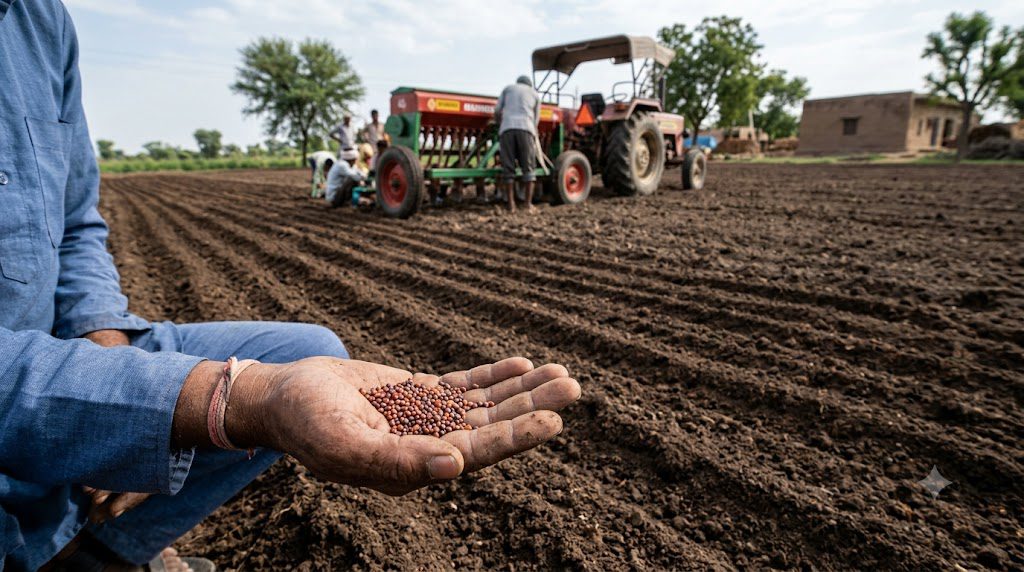
The common seed rate in mustard farming is 4 to 5 kg per hectare. The Bharatpur demonstrations used 5 kg per hectare with the full package. Higher rates produce thick, weak stands and more aphid trouble.
Sow in rows 40 to 45 cm apart, at a shallow depth. ICAR-DRMR researchers found that a purpose-made mustard planter gave 9 to 22% more seed yield than an ordinary wheat seed drill, which tends to over-seed and break the small seed.
An ICAR organic-package paper also found that line sowing did better than cross sowing or broadcasting. If you cannot get a planter, mix the seed with dry sand or fine soil to spread it evenly.
Step 6: Feed the Crop, Especially Sulphur
Mustard is a heavy sulphur feeder. Sulphur builds the oil and protein in the seed, and a shortage lowers both yield and quality. The Bharatpur demonstrations applied 25 kg of sulphur per hectare along with N and P2O5.
Standard agronomy notes for irrigated mustard cite 80:40:20 kg of N, P2O5 and K2O per hectare plus about 40 kg of sulphur, with half the nitrogen and all the P, K and S at sowing, and the rest of the nitrogen at the first irrigation. Rainfed crops need much less. Treat these as reference figures, and let your soil test and state advisory set the final dose.
Gypsum or elemental sulphur are the usual sources. Put them in at sowing, not as a late rescue. To trim chemical bills, read about bio fertilizer and nano fertilizer, and test either on a small plot first. Our wheat fertilizer guide shows how nutrient splitting works in the same season.
Step 7: Thin, Weed and Irrigate on Time
Thinning. Thin the crop about three weeks after sowing, leaving an even stand. Crowded plants compete for light and grow thin stems.
Weeding. The ICAR oilseed compendium advises clean cultivation with regular weeding up to flowering. Use hand weeding or a pre-emergence herbicide recommended by your state university, and follow the label.
Irrigation. Mustard needs far less water than wheat, and over-irrigation pushes leafy growth at the cost of seed. Where water is available, one or two irrigations at branching and pod filling are the stages most advisories stress. Skip an irrigation if rain has already wet the soil. For water-saving options, see our guide on irrigation farming.
Step 8: Control Aphids and Diseases
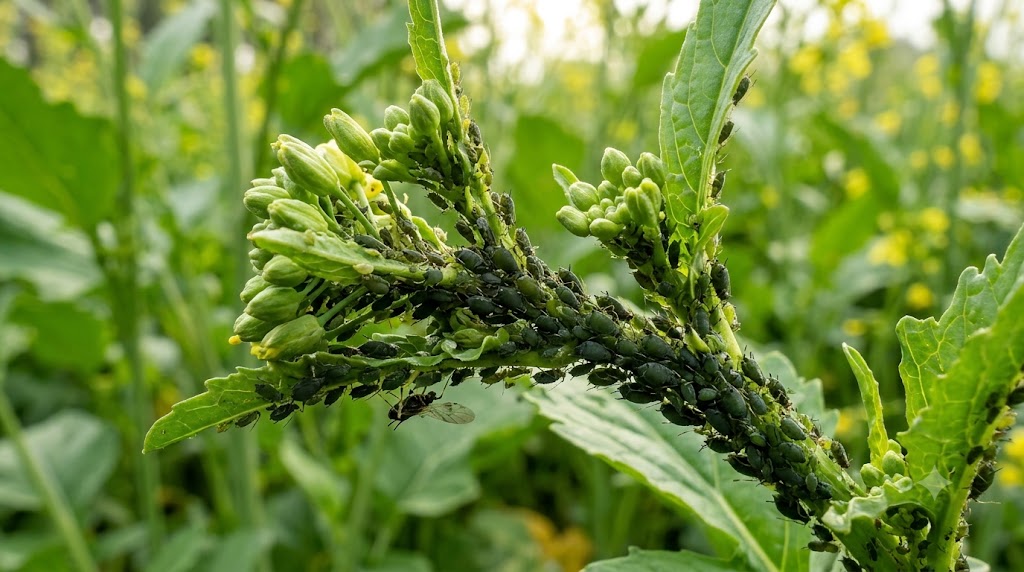
Mustard aphid is regarded as the most destructive pest in mustard farming. The ICAR paper on NRCHB 101 reports seed weight losses of about 30% from aphid damage, and links timely sowing and an IPM module to better results.
| Problem | What you see | What to do |
|---|---|---|
| Mustard aphid | Clusters on shoots and pods, sticky leaves | Timely sowing, scout from flowering, neem-based spray first, label-dose insecticide only at threshold |
| Mustard sawfly | Holes in seedling leaves | Early monitoring, advisory control |
| Alternaria blight | Dark spots with rings on leaves and pods | Treated seed, spray per advisory when severity crosses the threshold (ICAR cites about 3%) |
| White rust | White pustules on leaves | Metalaxyl-type seed treatment, resistant varieties |
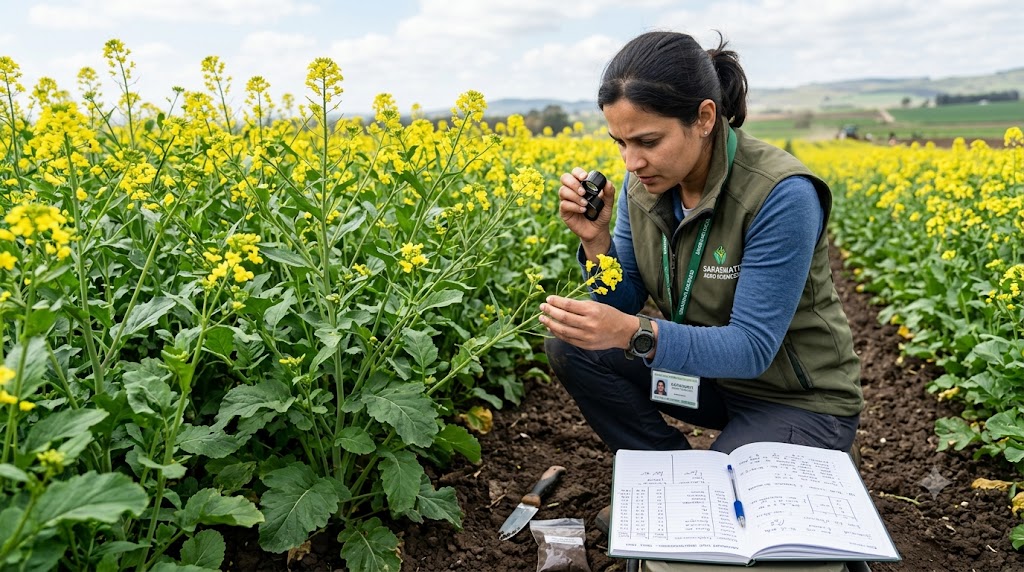
Scout the field twice a week from flowering. Spray in the evening, away from honeybees, because mustard flowers support pollinators and bees improve seed set. Weather swings affect pest cycles too, which we cover in our guide on climate-resilient crops.
Step 9: Harvest, Store and Sell
Harvest when most pods turn yellow-brown and the seed inside is hard. Cutting too late shatters the pods and spills seed, so cut in the cool morning, stack the bundles to dry, then thresh and clean the seed.
Dry the seed well before bagging, because damp seed loses oil quality. Clean bags, a dry store and raised stacks keep it safe.
For selling, compare the mandi price with MSP before you decide. You can also sell through the e-NAM platform. A Kisan Credit Card can fund inputs, and crop insurance protects against a bad season.
Mustard Farming Economics at the New MSP
Here is a simple illustration using the government’s cost figure of Rs 3,367 per quintal and the MSP of Rs 6,613. The margin per quintal is Rs 3,246. The yields below are assumptions for illustration, since national and field yields vary widely.
| Yield per hectare | Gross at MSP (Rs) | Margin over average cost (Rs) |
|---|---|---|
| 14 quintals (rough national level) | about 92,600 | about 45,400 |
| 20 quintals (good management) | about 132,300 | about 64,900 |
The 14 quintal figure comes from rough national totals of about 10 million tonnes from about 7 million hectares in standard teaching notes, so verify current Agriculture Ministry statistics before you quote it. Your own cost will differ with rent, labour and irrigation, so build your own sheet.
The lesson is simple. Yield decides your profit more than the price rise does. Moving from 14 to 20 quintals adds roughly Rs 19,500 per hectare at the MSP margin, which is more than the MSP hike alone would add.
MSP is a floor, not a guaranteed sale. Procurement depends on your state and your registration, so check dates with your agriculture office, and read about the digital crop survey, since crop records often decide eligibility.
Common Mistakes in Mustard Farming
- Sowing too thick, which weakens plants and feeds aphids.
- Skipping sulphur, the nutrient that decides oil and yield.
- Using untreated or saved seed.
- Sowing at the wrong time by copying another state’s calendar.
- Over-irrigating, which grows leaves instead of pods.
- Ignoring aphids until the crop is already damaged.
- Spraying at midday and harming pollinating bees.
- Harvesting late, so pods shatter in the field.
FAQs on Mustard Farming
1. What is mustard farming?
Mustard farming is the cultivation of Indian mustard (Brassica juncea), a Rabi oilseed crop grown mainly for its seeds. These seeds are processed into mustard oil, while the leftover oilcake is commonly used as livestock feed.
2. When should I sow mustard in India?
The ideal sowing time depends on your region and variety. In many eastern and central regions, mustard is sown from mid-October to mid-November, while north-western plains generally favour late September to mid-October. Follow your local agricultural advisory for the best results.
3. How much seed is needed per hectare?
Mustard generally requires around 4–5 kg of seed per hectare. Sow the seeds in rows spaced approximately 40–45 cm apart to support healthy plant growth and easier crop management. The exact seed rate may vary by variety and sowing conditions.
4. Why is sulphur important in mustard farming?
Sulphur plays an important role in mustard seed development, oil formation and crop quality. A deficiency can reduce yield and oil content. Apply sulphur according to your soil test results and local fertilizer recommendations for balanced crop nutrition.
5. How many irrigations does mustard need?
Mustard commonly needs one or two irrigations, depending on rainfall, soil type and growing conditions. Branching and pod formation are important stages when irrigation may be beneficial. Avoid over-irrigation, as excess moisture can harm root health and reduce crop performance.
6. What is the biggest pest of mustard?
Mustard aphid is one of the most damaging pests affecting mustard crops. These insects feed on plant sap and can damage shoots, flowers and developing pods. Inspect your crop regularly, encourage beneficial insects and use recommended pest-control measures when necessary.
7. What is the MSP of mustard for 2027–28?
The Minimum Support Price (MSP) for rapeseed and mustard for the 2027–28 marketing season is ₹6,613 per quintal, an increase of ₹413 over the previous MSP of ₹6,200. However, actual sales at MSP depend on procurement arrangements and applicable state requirements.
8. Is mustard farming profitable?
Mustard farming can be profitable when farmers manage input costs, select suitable varieties and achieve good yields. The government’s estimated margin over average production cost is 96%, but this is not a guaranteed individual profit. Actual earnings depend on yield, labour, irrigation, input costs and selling price.
9. Can I grow mustard with other crops?
Yes, mustard can be grown as a sole crop or intercropped with suitable crops, including certain pulses. The best combination depends on local climate, soil conditions, available resources and crop duration. Follow regional agricultural recommendations for suitable crop combinations and row arrangements.
10. When is mustard ready to harvest?
Mustard is generally ready for harvest when most pods turn yellowish-brown and the seeds become hard. Crops sown in October are often harvested between February and March, depending on the variety and region. Harvesting at the right time helps reduce seed shattering and avoid unnecessary yield losses.
Conclusion
Mustard farming rewards farmers who get four things right: timely sowing, thin sowing in lines, enough sulphur and early aphid control. The higher MSP and firm mandi prices make this a good season to look at mustard, but yield decides your income. Confirm your local sowing window with your KVK, treat your seed and register for procurement early. If this guide helped, share it with a farmer planning rabi acres, and explore more in our Farming category.