
Every rate and figure below is sourced directly from official Press Information Bureau releases from the Cabinet Committee on Economic Affairs and Ministry of Agriculture, cross-checked against independent policy reporting — each linked at the point it’s used and listed again in the Sources section, so you can verify every number yourself.
MSP for farmers is one of the most searched, most argued-about terms in Indian agriculture — and also one of the most misunderstood. Many farmers assume it means a guaranteed sale at a fixed price for whatever they grow. In practice, it’s a floor price the government commits to for 22 specific crops, backed by procurement that varies enormously by crop, state, and season.
This guide covers exactly how MSP is calculated, the full 2026-27 rate list, how procurement actually works, and — because a genuinely trustworthy account has to include this — the real, well-documented gaps between what MSP promises and what most farmers actually experience.
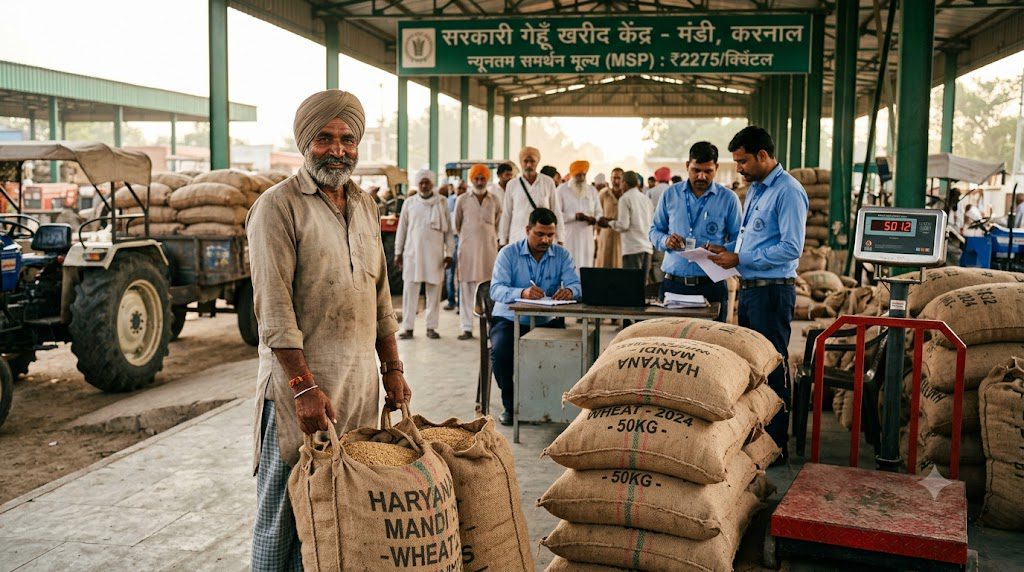
Table of Contents
What Is MSP for Farmers?
MSP for farmers — the Minimum Support Price — is a floor price the Government of India commits to for 22 mandated agricultural crops, announced annually based on recommendations from the Commission for Agricultural Costs & Prices (CACP).
According to the Press Information Bureau’s detailed backgrounder on the scheme, MSP functions as a mechanism where the government purchases crops directly from farmers at a pre-determined price when market prices fall below that floor, protecting farmers against distress sales during periods of oversupply or price crashes.
MSP is set separately for Kharif crops (announced before monsoon sowing, typically around May-June) and Rabi crops (announced before winter sowing, typically around October).
It’s worth being precise about what MSP is not: it does not mean the government buys every farmer’s entire harvest. Procurement infrastructure, crop type, and state-level implementation all significantly affect whether a specific farmer can actually sell at the announced MSP rate — a distinction covered in detail later in this guide.
MSP also functions differently from a direct payment program like the PM-KISAN scheme: PM-KISAN provides fixed annual income support regardless of what a farmer sells, while MSP is entirely tied to actually growing and selling a specific mandated crop.
How MSP Is Actually Calculated
The CACP’s calculation methodology is more specific than the phrase “minimum support price” suggests, and understanding it helps explain why some crops see much larger increases than others each year.
Per the official PIB backgrounder, CACP considers several factors when recommending MSP: cost of production, overall demand-supply conditions in domestic and world markets, domestic and international prices, inter-crop price parity, the terms of trade between agriculture and non-agriculture sectors, and a minimum guaranteed margin of 50% over the cost of production.
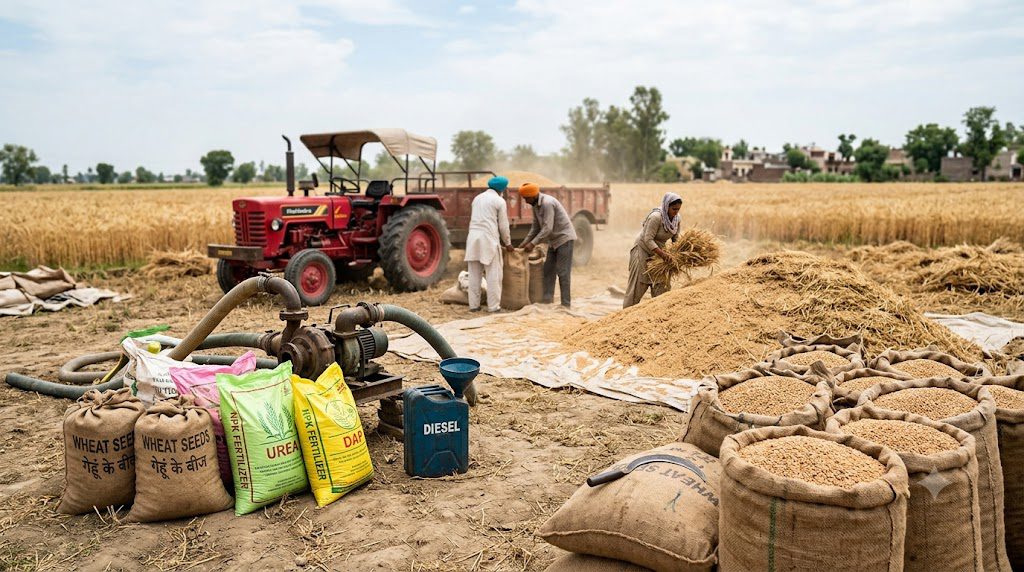
The cost of production figure itself includes hired human labour, bullock or machine labour, land rent, material inputs (seeds, fertilizers, manures), irrigation charges, depreciation on implements and farm buildings, interest on working capital, fuel or electricity for pump sets, and — notably — the imputed value of unpaid family labour. This cost formula is applied uniformly across all 22 mandated crops and all states.
Since 2018-19, government policy has been to set MSP at a minimum of 1.5 times this calculated cost of production, guaranteeing at least a 50% margin for farmers over their documented cost — a policy commitment reaffirmed in every subsequent MSP announcement since.
MSP Rates for 2026-27: The Full Picture
The Cabinet Committee on Economic Affairs approved Kharif MSP rates for Marketing Season 2026-27 on May 13, 2026, while Rabi MSP for the same marketing year was approved earlier, on October 1, 2025.
| Crop | MSP 2026-27 (₹/quintal) | Margin Over Cost |
|---|---|---|
| Paddy (Common) | 2,441 | 50% |
| Wheat | 2,585 | 109% |
| Bajra | 2,900 | 56% |
| Maize | 2,410 | 56% |
| Tur/Arhar | 8,450 | 54% |
| Moong | 8,780 | 61% |
| Groundnut | 7,517 | 50% |
| Cotton (Medium Staple) | 8,267 | 50% |
| Rapeseed & Mustard | 6,200 | 93% |
| Gram | 5,875 | 59% |
For Kharif 2026-27, the largest absolute increases went to sunflower seed (+₹622/quintal), cotton (+₹557), nigerseed (+₹515), and sesamum (+₹500) — a pattern that reflects the government’s deliberate push toward pulses, oilseeds, and nutri-cereals (Shree Anna) over traditional cereal cultivation.
For Rabi 2026-27, wheat shows the highest margin over cost of production at 109%, meaning the MSP roughly doubles the calculated cost of growing it.
For context on scale: during Rabi Marketing Season 2026-27, procurement is estimated at approximately 297 lakh metric tonnes, with farmers expected to receive around ₹84,263 crore at MSP rates.
10 Powerful Facts About MSP for Farmers
- MSP covers 22 mandated crops, plus toria and de-husked coconut, which are priced based on rapeseed/mustard and copra MSPs respectively.
- The 50% margin guarantee has been policy since 2018-19, tied to the Union Budget 2018-19 commitment to price MSP at 1.5 times cost of production.
- Sugarcane isn’t covered by MSP at all. It has its own separate mechanism — the Fair and Remunerative Price (FRP) — set differently from the CACP-driven MSP process.
- Cotton and jute have no procurement ceiling. Unlike other MSP crops, there is no maximum quantity limit on how much cotton or jute the government will procure through the Cotton Corporation of India and Jute Corporation of India.
- Pulses procurement has grown by over 7,000% in a decade. MSP-based pulses procurement rose from 1.52 lakh metric tonnes (2009-14) to 82.98 lakh metric tonnes (2020-25), part of a broader push toward diversifying away from water-intensive cereals — a shift that also underpins the growing interest in climate-resilient crop varieties.
- Digital procurement platforms now exist. NAFED’s e-Samriddhi and NCCF’s e-Samyukti let farmers register online with Aadhaar, land records, and bank details, and book a procurement slot digitally.
- The government has committed to 100% procurement of specific pulses. Tur (arhar), urad, and masoor are being procured at up to 100% of state production through 2028-29 as part of a pulses self-sufficiency push.
- MSP procurement heavily favors a handful of states. Historically, Punjab, Haryana, and Madhya Pradesh together have accounted for the large majority of wheat procurement nationally.
- Cotton farmers get a dedicated mobile app. The Kapas Kisan App from the Cotton Corporation of India offers self-registration, slot booking, and real-time quality assessment updates.
- A parliamentary committee has formally recommended making MSP a legal right — a recommendation the government has not yet implemented, discussed in detail below.
How MSP Procurement Actually Works
Different crop categories are procured through different dedicated agencies, and understanding which applies to your crop matters for knowing where to actually go.
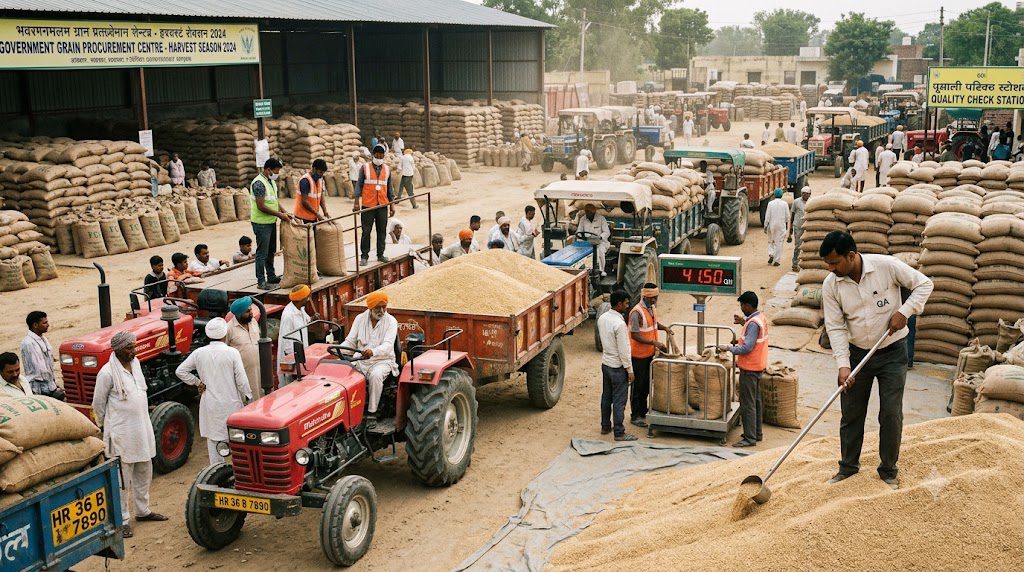
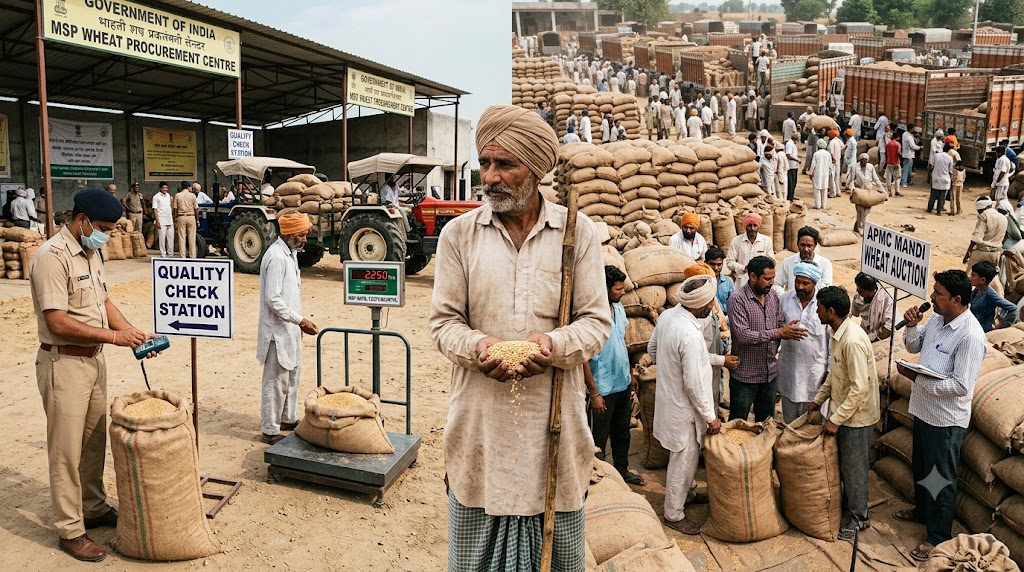
Cereals and coarse cereals — including wheat and paddy — are procured by the Food Corporation of India (FCI) and designated State Agencies, with procurement estimates finalized jointly by the central government, state governments, and FCI ahead of each marketing season.
Pulses, oilseeds, and copra are procured under the Price Support Scheme (PSS), part of the umbrella Pradhan Mantri Annadata Aay Sanrakshan Abhiyan (PM-AASHA), triggered specifically when market prices fall below MSP during peak harvest.
The National Agricultural Cooperative Marketing Federation (NAFED) and National Cooperative Consumers’ Federation (NCCF) handle this procurement, buying directly from pre-registered farmers with valid land records.
Cotton and jute are procured through the Cotton Corporation of India (CCI) and Jute Corporation of India (JCI) respectively, with no maximum procurement ceiling on either.
The Real Reach of MSP: An Honest Look
This is the section a purely promotional summary of MSP would skip, and any genuinely trustworthy account has to include it.
The government’s own procurement data shows real, substantial growth — foodgrain procurement rose from 761.40 lakh metric tonnes in 2014-15 to 1,175 lakh metric tonnes in 2024-25, benefiting 1.84 crore farmers. But independent policy analysis paints a more complicated picture of how evenly that benefit is actually distributed.
The Shanta Kumar Committee’s 2015 report — still the most frequently cited independent assessment of MSP’s actual reach — found that only around 6% of Indian farm households were selling to the government at MSP rates, meaning the large majority of farmers were not directly benefiting from the mechanism, regardless of what the announced rate said.
In 2019-20, three states alone — Punjab, Haryana, and Madhya Pradesh — accounted for roughly 85% of national wheat procurement, illustrating how geographically concentrated actual MSP benefit has historically been.
A separate structural gap: the 2019-20 Situation Assessment Survey of Agricultural Households found that only about 23.5% of farmers were even aware of the MSP mechanism in the first place, as reported by independent policy commentary in The Statesman — a basic awareness gap that exists well before questions of procurement access even come into play.
The same reporting notes that over 70% of small and marginal farmers, who make up the majority of India’s farming population, face logistical difficulty accessing MSP procurement centres at all.
None of this means MSP delivers no value — the digital procurement reforms and expanded pulses procurement commitments described above are genuine and growing.
But a farmer’s actual likelihood of directly benefiting from a specific year’s MSP announcement depends heavily on which crop they grow, which state they farm in, and whether functional procurement infrastructure exists near them — not simply on the rate published each season.
The Legal Guarantee Debate
No honest account of MSP in 2026 can skip the central controversy surrounding it: farmer organizations have been demanding, for several years now, that MSP be converted from an announced policy into a legally enforceable right covering all crops, not just the current mandated list.
This demand was a central issue in the 2024-2025 Indian farmers’ protest, alongside implementation of the M.S. Swaminathan Committee’s recommendations — which had proposed pricing MSP at cost of production (C2, a broader cost measure including imputed rent and interest on owned land and capital) plus 50%, rather than the currently used cost formula.
In December 2024, the Parliamentary Standing Committee on Agriculture, chaired by Charanjit Singh Channi, formally recommended granting MSP legal status, arguing that a legally binding guarantee could help address agrarian distress and encourage farmers to invest more confidently in productivity-improving inputs and technology. As of this article’s publication, this recommendation had not been implemented into law.
The arguments on both sides are substantive enough to state fairly. Proponents argue a legal guarantee would reduce exploitation by middlemen, encourage investment in better seeds and technology, and directly address the income insecurity linked to farmer distress.
Opponents — including some of the policy’s original architects — have raised concerns about the fiscal burden of guaranteed procurement across all crops, potential conflicts with World Trade Organization subsidy limits, and the risk of market distortion if guaranteed pricing overrides natural supply-demand signals.
This remains a live, unresolved policy debate rather than a settled question, and farmers should treat both the “current MSP system is sufficient” and “MSP must be legally guaranteed” positions as active political arguments rather than established fact in either direction.
How to Access MSP Procurement as a Farmer
- Confirm your crop is currently notified for procurement in your state. Not every mandated crop is actively procured in every district; check with your local agriculture department.
- Register on the relevant digital platform. Use e-Samriddhi (NAFED) or e-Samyukti (NCCF) for pulses, oilseeds, and copra; the Kapas Kisan App for cotton; or your state’s FCI-linked portal for wheat and paddy.
- Have your documentation ready. Aadhaar, land records, and bank account details are typically required for registration across these platforms.
- Book your procurement slot digitally where available. Several platforms now offer scheduled visit slots rather than requiring farmers to simply show up and wait.
- Verify Fair Average Quality (FAQ) standards for your produce. Procurement under schemes like PM-AASHA specifically requires produce to meet defined quality standards.
- Track payment through your registered bank account. Digital reforms are specifically designed to route MSP payments directly to farmers, reducing intermediary handling.
MSP Procurement vs Selling in the Open Market
| Factor | MSP Procurement | Open Market Sale |
|---|---|---|
| Price certainty | Fixed floor price | Fluctuates with supply and demand |
| Availability | Depends on crop, state, and active procurement centres | Generally always available through local mandis or e-NAM platform trading |
| Payment speed | Increasingly digital and direct | Varies, often faster in cash-based local sales |
| Upside potential | Capped at MSP rate | Can exceed MSP during high-demand periods |
| Documentation required | Land records, Aadhaar, bank details | Typically minimal |
This is why an informed farmer generally treats MSP as a safety net rather than an automatic first choice — checking real-time prices through a tool like the e-NAM platform before deciding whether MSP procurement or open-market sale offers the better return for a given harvest.
Common Misunderstandings About MSP
- Assuming MSP guarantees the government will buy their entire harvest. Procurement capacity and active buying centres vary significantly by crop, state, and season.
- Not checking whether their specific crop is being actively procured locally. A crop being MSP-mandated nationally doesn’t guarantee active procurement in every district.
- Confusing MSP with a legal right. Except in specific, limited contexts, MSP remains a government policy commitment, not a court-enforceable legal guarantee, as of this article’s publication.
- Overlooking digital registration requirements. Farmers who skip e-Samriddhi, e-Samyukti, or equivalent state registration can face delays or miss procurement windows entirely.
- Assuming MSP and open-market price move together. Open market prices can be higher or lower than MSP depending on the season and crop, which is why checking current market rates before committing to sell at MSP is worthwhile.
FAQs About MSP for Farmers
1. What is MSP for farmers in India?
MSP (Minimum Support Price) is a government-announced floor price for 22 mandated agricultural crops. It is intended to protect farmers from distress sales when market prices fall below the announced MSP.
2. How is MSP calculated in India?
MSP is recommended by the Commission for Agricultural Costs & Prices (CACP), considering factors such as production costs, demand and supply, domestic and international prices, inter-crop price parity, and the terms of trade between agriculture and non-agriculture. Since 2018-19, MSP policy has targeted at least 1.5 times the calculated cost of production.
3. What is the MSP for farmers in 2026-27?
The 2026-27 MSP varies by crop. For example, the MSP is ₹2,441 per quintal for common paddy, ₹2,585 for wheat, ₹2,900 for bajra, ₹8,450 for tur, ₹8,780 for moong, and ₹6,200 for rapeseed and mustard.
4. How many crops are covered under MSP in India?
MSP currently covers 22 mandated crops, including cereals, pulses, oilseeds, cotton and jute. Toria and de-husked coconut are also priced with reference to the MSP of rapeseed and mustard and copra, respectively.
5. Is MSP legally guaranteed in India?
No. MSP is currently a government policy mechanism rather than a general, legally enforceable right for farmers. A Parliamentary Standing Committee has recommended giving MSP legal status, but that recommendation has not itself created a legal guarantee.
6. Does the government buy every crop at MSP?
No. Government procurement varies by crop, state, season and available procurement infrastructure. A crop being covered by MSP does not automatically mean that every farmer can sell their entire harvest to the government at MSP.
7. Which agencies procure crops under MSP?
Different crops are handled by different agencies. FCI and designated state agencies primarily handle wheat and paddy, while NAFED and NCCF procure eligible pulses, oilseeds and copra under applicable schemes. Cotton and jute are procured through the Cotton Corporation of India and Jute Corporation of India.
8. Can farmers sell their crops above MSP in the open market?
Yes. MSP is a government-announced floor price, while open-market prices fluctuate according to supply, demand and local market conditions. When market prices are higher, farmers may choose to sell through available market channels rather than MSP procurement.
9. Does MSP cover fruits and vegetables?
No. Most fruits and vegetables are not included among the 22 crops covered by the MSP system. MSP primarily covers selected cereals, pulses, oilseeds and commercial crops such as cotton and jute.
10. How can farmers access MSP procurement?
Farmers should first check whether their crop is being actively procured in their state or district. Depending on the crop, they may need to register through the relevant procurement platform, provide documents such as Aadhaar, land records and bank details, meet quality requirements, and book a procurement slot where required.
About the Author
This article was researched and written by the Farm Sutras Editorial Team, fact-checked against official Press Information Bureau releases from the Cabinet Committee on Economic Affairs and Ministry of Agriculture and Farmers Welfare, cross-referenced with independent policy reporting — each linked below for independent verification.
This is an editorial compilation of publicly available government data, not a substitute for confirming current, district-specific procurement status with your local agriculture department.
Sources Cited in This Article
- Press Information Bureau — Cabinet Approves MSP for Kharif Crops, Marketing Season 2026-27
- Press Information Bureau — Minimum Support Prices: From Safety Net to Self-Sufficiency (Backgrounder)
- Drishti IAS — Promise and Perils of Legalizing MSP
- The Statesman — The MSP Muddle
- Wikipedia — 2024–2025 Indian Farmers’ Protest
Final Thought
MSP for farmers is a genuinely significant policy mechanism — the 2026-27 rates represent real, substantial increases, procurement volumes have grown meaningfully over the past decade, and digital reforms are making the process more transparent than it was even five years ago.
But the honest picture also includes a persistent, well-documented gap between the announced rate and the share of farmers who actually benefit from it, concentrated heavily by crop and by state.
Check whether your specific crop has active procurement infrastructure in your district before assuming MSP applies to you in practice, register early through the relevant digital platform, and treat MSP as one tool among several — alongside resources like crop insurance for farmers and the e-NAM platform — rather than assuming the announced rate alone guarantees you a specific outcome this season.