
A soil health card is a free report that tells you what your soil actually contains, so you stop guessing how much fertilizer to buy. Many farmers receive one, glance at the numbers, and put it in a drawer. That is a waste, because the card is one of the cheapest decision-making tools a farmer in India can get.
This guide explains what the card measures, how to get it, how to read each number, and how to turn it into a fertilizer plan. It is written in plain language, with official sources linked throughout so you can verify every claim.
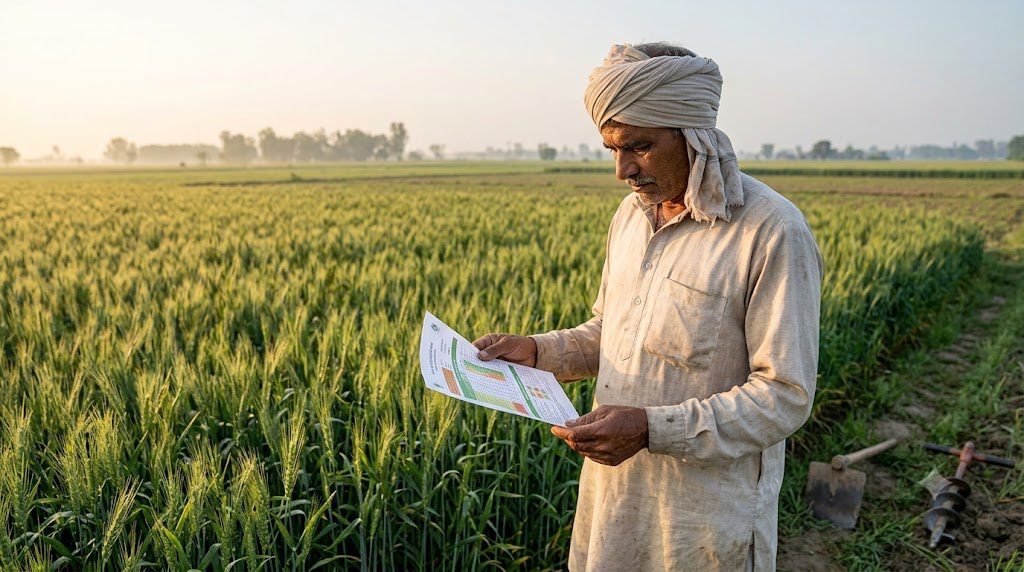
Table of Contents
What Is a Soil Health Card?
A soil health card is a printed or digital report issued for each farm holding. It lists the nutrient status of your soil and recommends fertilizer doses for your crops.
According to the Press Information Bureau’s factsheet on the scheme, the card gives farmers information on the nutrient status of their soil, along with recommendations on the appropriate dosage of nutrients to improve soil health and fertility.
Think of it like a blood test report for your field. A doctor does not prescribe medicine without a test. Applying fertilizer without a soil test is the same kind of guesswork.
Why a Soil Health Card Saves Money
Most farmers apply urea and DAP by habit or by what the neighbor uses. That habit often leaves one nutrient in excess and another missing.
The report shows where your field really stands. If phosphorus is already high, you can cut back on it. If zinc is low, you can fix a hidden problem that more nitrogen will never solve.
Who Can Get One?
Any farmer in India with agricultural land can apply. The service is provided through state agriculture departments, so the process and timing vary slightly by state.
How the Soil Health Card Scheme Began
The Soil Health Card Scheme was launched on 19 February 2015 at Suratgarh, Rajasthan, as the PIB factsheet records. The same year was the International Year of Soils, which gave the programme global context.
The first cycle ran from 2015 to 2017. During that cycle, PIB reports that 107,348,416 cards were issued to farmers.
Since the 2022–23 financial year, the scheme has been a component of the Rashtriya Krishi Vikas Yojana (RKVY) under the heading “Soil Health & Fertility,” as summarized in Vision IAS’s ten-year review of the scheme. That review also reports that about 24.74 crore cards had been generated by the time the scheme completed ten years.
Check the official portal for current figures, because these numbers change with every cycle.
The 12 Parameters on a Soil Health Card
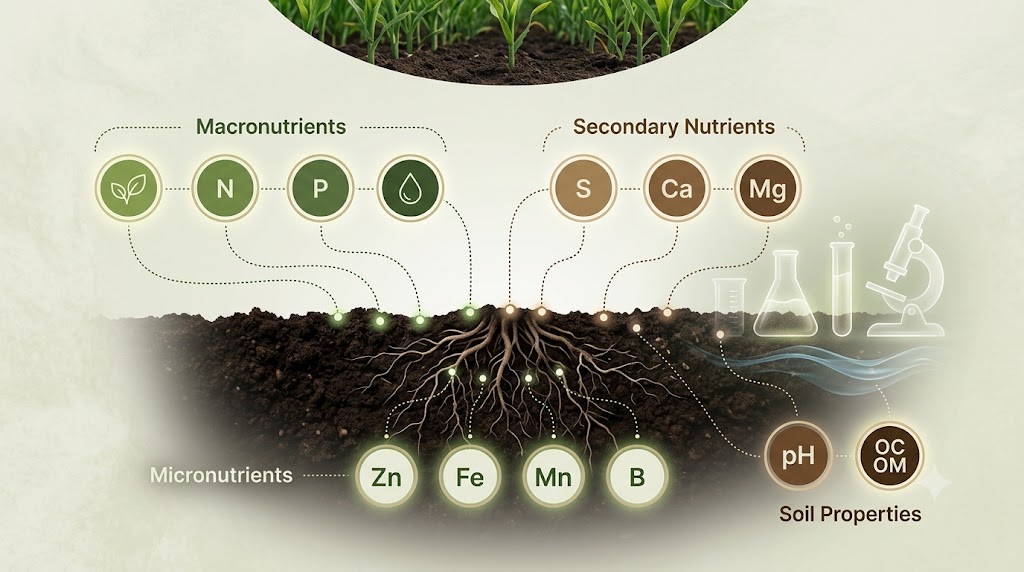
Every card reports 12 parameters. They fall into four groups, as listed on the official factsheet.
Macronutrients on Your Soil Health Card
Nitrogen (N), phosphorus (P) and potassium (K) are the big three. Crops need them in the largest quantities.
- Nitrogen drives leaf and stem growth.
- Phosphorus supports roots and early crop establishment.
- Potassium improves grain filling, water use and disease tolerance.
Secondary Nutrient: Sulphur
Sulphur is listed on its own. It matters most for oilseeds and pulses, and deficiency is more common than most farmers expect.
Micronutrients Listed on the Card
Zinc (Zn), iron (Fe), copper (Cu), manganese (Mn) and boron (B) are needed in tiny amounts. A shortage of any one can cap your yield even when the big three are plentiful.
Physical Parameters: pH, EC and Organic Carbon
These three describe the soil itself rather than a single nutrient. Soil pH measures acidity or alkalinity. Electrical conductivity (EC) shows salt level. Organic carbon (OC) is a marker of soil biology and fertility.
7 Steps to Use Your Soil Health Card
Follow these seven steps in order. Each one builds on the last.
Step 1: Register and Request Your Soil Health Card
Start at the government’s Soil Health Card portal. It generates cards in a standard format and in many Indian languages.
You can also visit your block agriculture office or the nearest Krishi Vigyan Kendra (KVK). Staff there can tell you when sampling is scheduled in your area.
Step 2: Collect the Soil Sample the Right Way
The report is only as good as the sample behind it. A bad sample gives a wrong card, and a wrong card leads to wrong decisions.
Use these standard field practices:
- Sample when there is no standing crop, usually after harvest of the previous Rabi or Kharif crop.
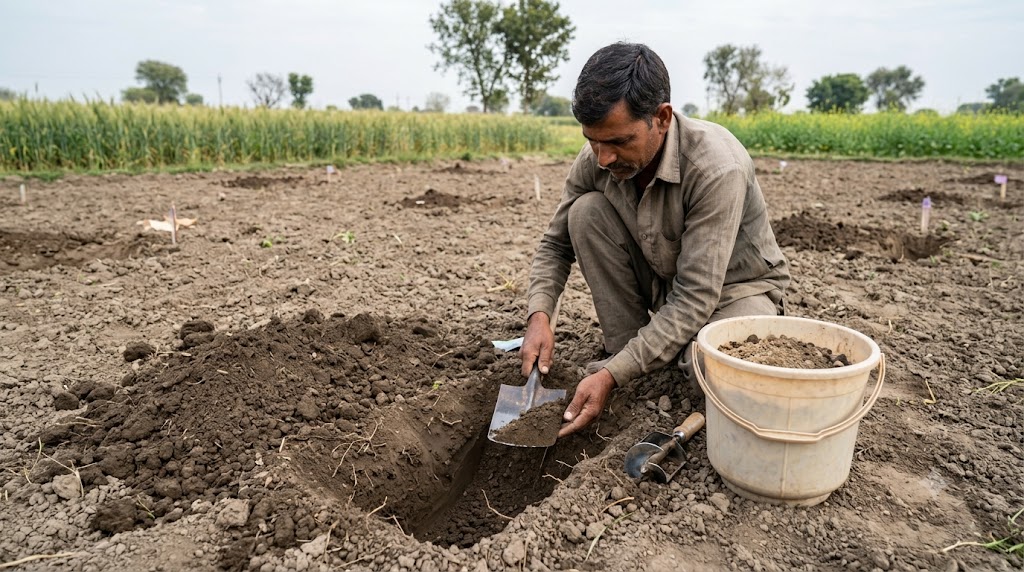
- Walk the field in a zigzag pattern and take samples from 6 to 10 spots.
- For most field crops, dig a V-shaped hole about 15 cm deep and take a thin slice from the side.
- Avoid field edges, bunds, compost heaps, wet patches and spots where fertilizer was dumped.
- Mix all slices in a clean bucket, then reduce the mix by quartering until you have about half a kilogram.
Sampling depth and method differ for orchards and some special crops. Ask your local agriculture officer before sampling those.
Step 3: Submit the Sample for Testing
Label the bag with your name, survey number, village, previous crop and the crop you plan to grow. Hand it over to the soil testing laboratory or the official sampler.
Ask for a receipt. It helps you track your card if it is delayed.
Step 4: Read pH and Salt Levels First
Do not jump to nitrogen. Start with pH and EC, because these decide whether your plants can even use the nutrients in the soil.
- pH 6.5 to 7.5 is generally comfortable for most crops.
- Below 6.5 means acidic soil. Liming materials are usually recommended.
- Above 8.5 suggests alkaline or sodic soil. Gypsum is a common amendment, but follow the card’s advice.
- High EC means salts are building up. Sensitive crops will struggle, and drainage and irrigation water quality need attention.
The card lists the amendment needed. Trust the card over general rules, because it reflects your actual field.
Step 5: Check Organic Carbon
Organic carbon tells you how much living, decaying matter your soil holds. Under commonly used Indian soil test ratings, below 0.5% is low, 0.5% to 0.75% is medium, and above 0.75% is high.
Low organic carbon is very common in intensively cropped land. Fertilizer alone does not fix it. Compost, farmyard manure, green manure and crop residue returned to the field do.
Step 6: Build Your Fertilizer Plan from the Soil Health Card
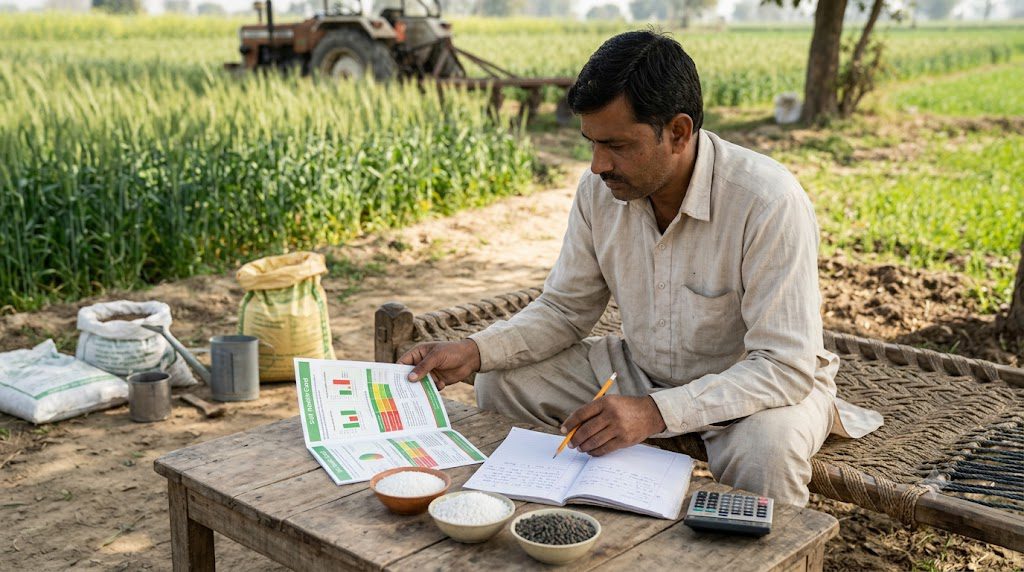
Now read the nutrient ratings and the recommended doses for your chosen crop. The card typically gives a dose for the main crop and sometimes for an alternate crop.
Take it to your input dealer or agriculture officer and plan around the card. For example:
- If phosphorus is rated high, you may not need a full DAP dose this season.
- If zinc is low, add zinc sulphate as the card advises.
- If sulphur is low and you grow mustard or soybean, include a sulphur source.
Never exceed the recommended dose “to be safe.” Extra fertilizer costs money and can harm crops and groundwater.
Step 7: Retest and Compare Over Time
The card is a snapshot, not a permanent answer. Soil changes with each crop, each irrigation and each fertilizer decision.
Keep every card in a folder. When the next soil health card arrives, compare organic carbon, pH and the key nutrients. A rising organic carbon number is one of the best signs that your management is working.
Combining Your Results With Better Practices
The card tells you what is missing. It does not tell you how to farm. Pair it with these habits for the best results.
Read our guide on making compost at home to raise organic carbon. For nutrient losses through water, see smarter irrigation practices. If you want to cut chemical costs, our post on bio-fertilizers for field crops is a useful next read.
Rotating crops, adding legumes and leaving residue on the field all help. Each one improves what the next report will show.
Understanding Low, Medium and High Ratings
Most cards do not just print a raw number. They also give a rating, usually low, medium or high, so you can see at a glance where the problem is.
Pay attention to the units. Available nitrogen, phosphorus and potassium are generally reported in kilograms per hectare. Micronutrients such as zinc and iron are reported in parts per million (ppm). Mixing up these units leads to wrong conclusions.
A “low” rating means a crop is likely to respond well to that nutrient. A “medium” rating means a maintenance dose is usually enough. A “high” rating means you can often reduce or skip that nutrient for a season, as long as the recommendation on the card agrees.
A Simple Illustration
Here is a made-up example to show the thinking, not a recommendation for your field. Suppose a wheat plot shows high phosphorus, medium potassium, low nitrogen and low zinc, with a pH of 8.2.
The farmer would focus on nitrogen, add zinc as advised, keep potassium at a maintenance level and reduce phosphorus. Because pH is slightly high, the farmer would also add organic matter and watch irrigation water quality. The card in hand would give the exact doses.
When to Sample: A Practical Calendar
Good timing makes the report more reliable and gives you enough time to act on it.
- After Kharif harvest: sample before preparing land for Rabi sowing, so you can plan basal doses.
- After Rabi harvest: sample before summer ploughing or the next Kharif crop.
- Before planting a perennial crop: sample the full root zone, because correcting soil later is difficult and expensive.
- After a flood, waterlogging or heavy salt deposit: sample again, since these events can change soil chemistry quickly.
Do not sample within a few weeks of heavy manure or fertilizer application. Residues from recent inputs can distort the result.
Keep a Simple Farm Record
Write down what you applied, when, and what the crop yielded. When the next soil health card arrives, you can connect what you did with what changed. Many farmers find that this single habit teaches them more than any training session.
Common Mistakes Farmers Make With the Soil Health Card
Ignoring the Card After Receiving It
This is the biggest mistake. A card in a drawer has zero value. Bring it along when you buy inputs.
Using One Card for the Whole Village
Soil varies, sometimes within the same village. The recommendation applies to the holding that was sampled. A neighbor’s report tells you little about your own land.
Sampling Right After Applying Fertilizer
Fresh fertilizer inflates the reading. Wait until the field has been without a standing crop and has not recently received heavy inputs.
Skipping Organic Matter Because the Card Shows Only Chemicals
The card recommends nutrient doses, but organic carbon is on it for a reason. Fertility is chemistry plus biology. Ignore the biology and the chemistry costs more every year.
Limits of the Soil Health Card
An honest guide should state the weak points too. The scheme is useful, but it is not magic.
- It reflects the sample, not the whole field. A poorly taken sample gives a poor result.
- Delays happen. In some areas cards arrive late, after sowing decisions are already made.
- Recommendations are general. Your actual yield also depends on water, seed, weather and pests.
- Some soil factors are not covered. Soil texture, compaction and biological activity need other checks.
For crop-specific advice, talk to your nearest KVK or the Indian Council of Agricultural Research network. For global background on why soil testing matters, the FAO Global Soil Partnership publishes freely available guidance.
How the Soil Health Card Supports Sustainable Farming
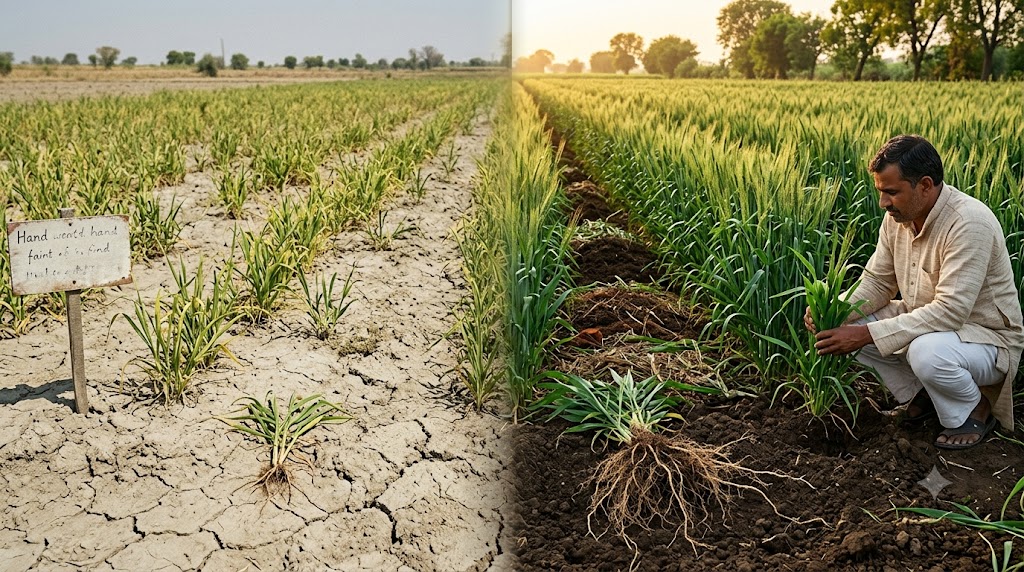
Excess fertilizer runs off into water and wastes money. By matching doses to need, the card supports both lower costs and lower pollution.
The Vision IAS review linked above notes that the scheme is meant to promote soil test based nutrient management and better nutrient use efficiency. In plain terms, that means getting more crop from each rupee of fertilizer.
Over several cycles, the card also builds a record of your land. That record helps when you apply for credit, join a natural farming program, or sell to buyers who ask for proof of practices.
Frequently Asked Questions About the Soil Health Card
1. What is a Soil Health Card?
A Soil Health Card is a printed or digital report that shows the nutrient status of agricultural soil and provides fertilizer recommendations for the crops specified.
2. Is the Soil Health Card free?
Under the government scheme, the Soil Health Card is provided to farmers through state agriculture departments. However, private laboratory soil testing may involve separate charges.
3. Who can get a Soil Health Card in India?
Farmers with agricultural land in India can apply for a Soil Health Card. The service is provided through state agriculture departments, so the process and timing can vary between states.
4. What are the 12 parameters in a Soil Health Card?
The Soil Health Card covers 12 parameters, including nitrogen, phosphorus, potassium, sulphur, zinc, iron, copper, manganese, boron, pH, electrical conductivity (EC), and organic carbon.
5. How do I apply for a Soil Health Card?
You can start through the government’s Soil Health Card portal or contact your block agriculture office or nearest Krishi Vigyan Kendra (KVK) to learn about soil sampling and testing in your area.
6. How is a soil sample collected for a Soil Health Card?
For most field crops, samples are collected from several spots in a zigzag pattern. A V-shaped hole of about 15 cm depth is recommended, while field edges, bunds, compost heaps, wet patches, and fertilizer-dumped areas should be avoided.
7. How often should I get a new Soil Health Card?
The article notes that the scheme issues cards in cycles and official summaries mention an interval of about two years. Farmers should check the official portal or their agriculture office for the current schedule in their state.
8. What does pH mean on a Soil Health Card?
Soil pH indicates whether soil is acidic or alkaline. The article explains that pH around 6.5 to 7.5 is generally comfortable for most crops, while lower or higher values may require appropriate soil management.
9. What does EC mean on a Soil Health Card?
EC, or electrical conductivity, indicates the salt level in soil. High EC can create problems for sensitive crops and may require attention to drainage and irrigation water quality.
10. What does organic carbon mean on a Soil Health Card?
Organic carbon is an indicator related to soil fertility and biological activity. The article explains that low organic carbon can be addressed through practices such as compost, farmyard manure, green manure, and returning crop residues to the field.
Final Thoughts: Make the Soil Health Card Work for You
The card costs a farmer almost nothing and can save thousands of rupees in unnecessary fertilizer. The value comes from reading it, acting on it, and comparing it across seasons.
Start with a proper sample for your soil health card. Read pH and salt first, then organic carbon, then nutrients. Plan inputs around the card and keep every copy. Your soil will tell you what it needs if you ask the right way.