
Table of Contents
Black soldier fly farming sounds like the perfect circular-economy story. A harmless fly eats rotting waste, and out come animal feed and fertilizer. The science behind that story is real. So is the liquidation of the French company that raised more than $600 million to scale it. Anyone considering black soldier fly farming in 2026 needs to hold both facts in mind, and this guide walks through each.
The honest summary is that the biology works, and the business is much harder than the biology. The rest of this guide to black soldier fly farming shows where the line falls, using published research instead of promotional claims.
What Is Black Soldier Fly Farming?
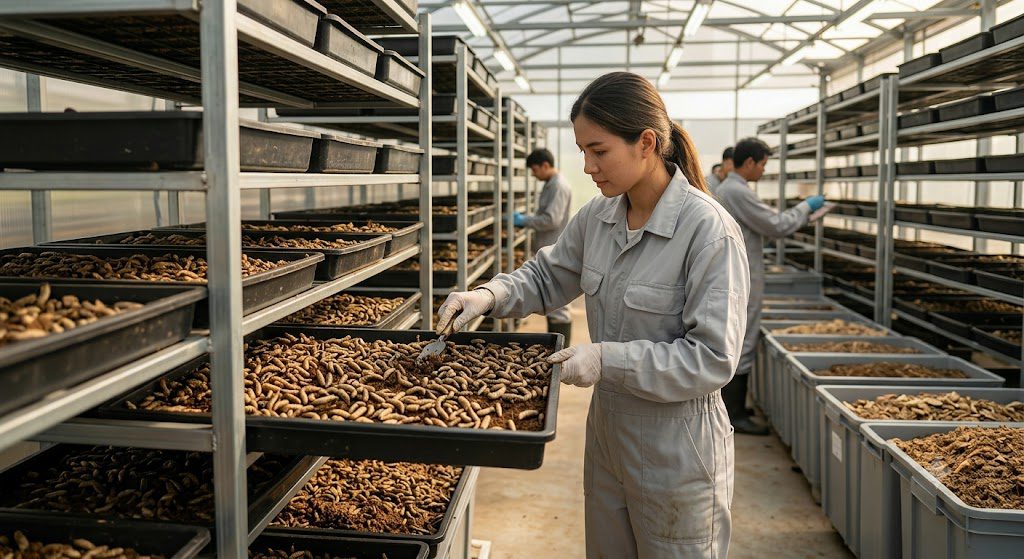
Black soldier fly farming is the commercial or small-scale rearing of Hermetia illucens larvae, usually to convert organic material into three products: larvae for animal feed, oil, and a soil amendment called frass.
A 2025 review in Discover Sustainability describes the larvae as able to cut organic waste volume by 50 to 80 percent while converting up to about 20 percent of it into biomass. That is the headline number behind most pitches for black soldier fly farming. It is also the number you should treat with the most care, because it describes how well larvae perform under good conditions, not how well a business performs.
How the Life Cycle Works
Understanding the life cycle explains why black soldier fly farming is more of a manufacturing process than a livestock hobby.
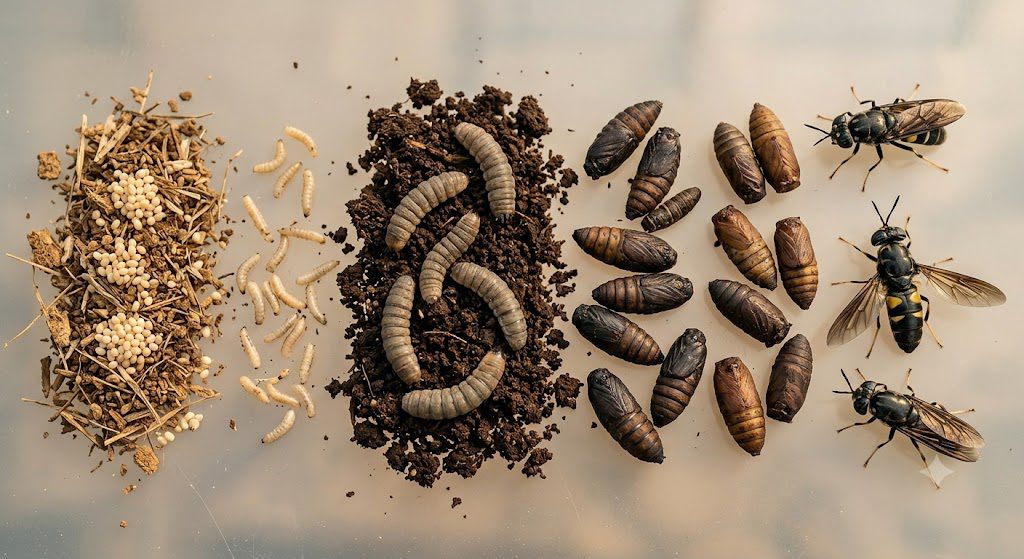
Eggs and Larvae
Adults lay eggs, and the eggs hatch into larvae that eat continuously and grow fast. How fast depends heavily on what you feed them. A review in Sustainable Production and Consumption, drawing on earlier trials, reports development times of roughly 10 days on high-quality feed, 15 days on brewery grains, 18 days on expired food, and 35 days on potato peels. Slower growth means more days of heating, labor, and space for the same output.
Prepupae
When larvae finish feeding, they darken and crawl away from the food to find a dry place. A USDA-funded project record notes that this self-harvesting behavior is useful in continuous rearing systems, because mature larvae remove themselves from the substrate.
Adult Flies
Adults mate and lay eggs, restarting the cycle. The Discover Sustainability review reports that temperatures between 25 and 35 degrees Celsius and managed light cycles improve mating and egg-laying. If you farm in a cold climate, that temperature range is a recurring energy bill. If you farm in a warm one, it is largely free.
What Black Soldier Fly Farming Actually Produces
A working operation produces three outputs, and each has its own market and its own problems.
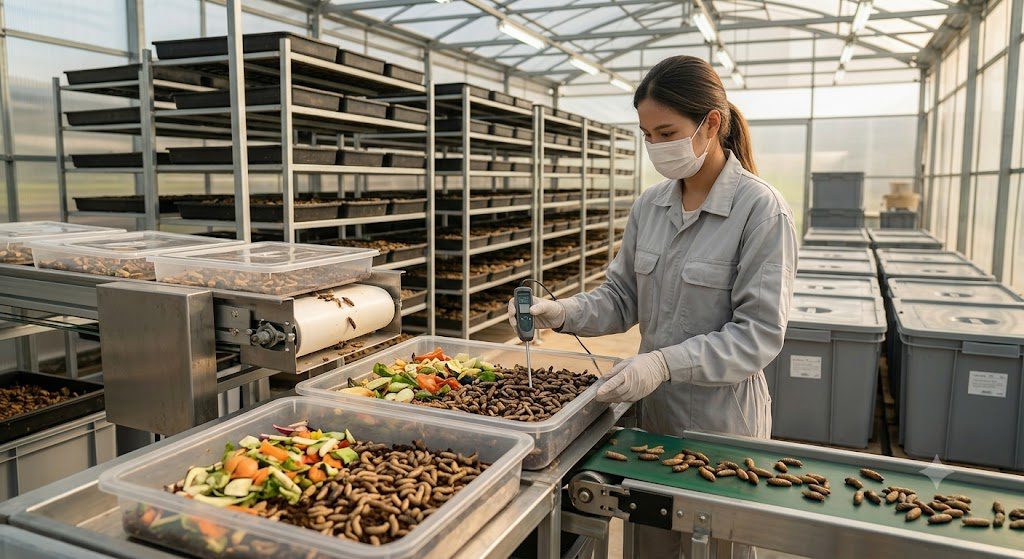
- Larvae and larvae meal. The same review reports larvae meal at roughly 40 to 43 percent crude protein on a dry-matter basis. It is positioned as a substitute for fishmeal and soybean meal in poultry and fish diets. Inclusion levels vary by species and growth stage, so any claim that it can fully replace those ingredients deserves skepticism.
- Larvae oil. A fat fraction used in feed, and a precursor for biodiesel.
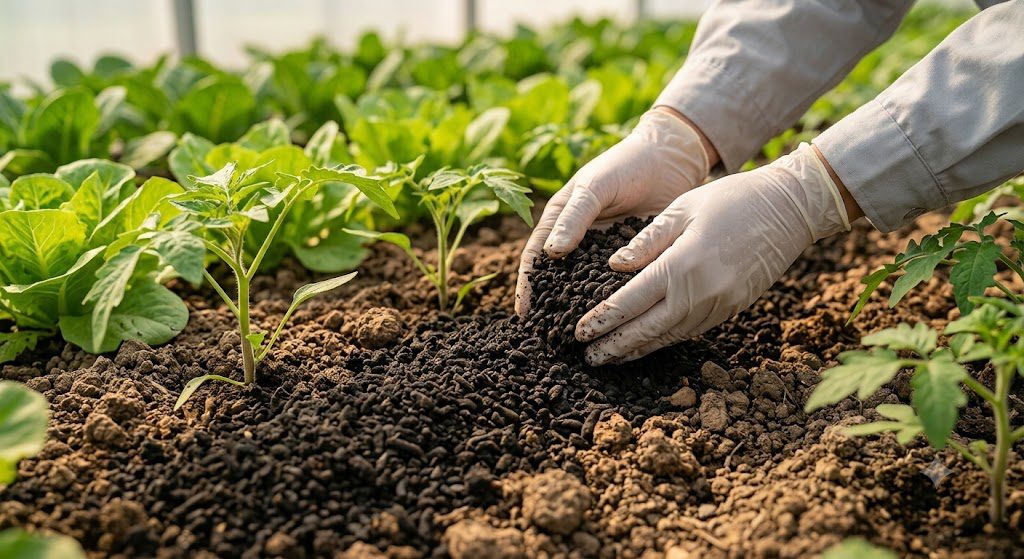
- Frass. The mix of larval droppings, shed skins, and leftover substrate. Studies report nitrogen at 3.5 to 6.0 percent, phosphorus at 1.5 to 3.0 percent, and potassium at 1.2 to 2.0 percent. The same review also cites a separate study that measured only 1.2 to 2.3 percent nitrogen. In other words, frass quality is not a fixed number. It changes with what the larvae ate.
In a trial cited in that review, 1,000 kg of organic waste produced 163 kg of fresh larvae and 469 kg of frass. That is a useful reality check. Black soldier fly farming moves a lot of material to make a modest amount of larvae.
The 9 Critical Facts
Fact 1: The Waste-Processing Biology Is Real
The environmental case for black soldier fly farming has solid support in the literature. The Discover Sustainability review reports life cycle assessments showing up to 90 percent lower greenhouse gas emissions than conventional waste treatment. In the single trial it cites, larvae processing came in at 25.2 kg CO2-equivalent per functional unit, versus 53.3 for composting and 39.5 for anaerobic digestion.
Two cautions apply. First, “up to 90 percent” is a best case, not an average. Second, the carbon comparison comes from one trial, and results shift with transport distance, energy source, and substrate. Use these figures to understand direction, not to promise outcomes.
Fact 2: Lab Success Is Not Factory Success
This is the central tension in black soldier fly farming, and most blog posts skip it.
Many studies show larvae thriving on food waste, manure, and agricultural residues. But a 2024 peer-reviewed review in Sustainable Production and Consumption looked at what commercial insect companies actually feed their animals.
It found that the industry leaders, including Ÿnsect and Innovafeed, mainly use grain-based by-products from food manufacturing and bioethanol production. A Cargill executive quoted in the review said most insect factories use corn and wheat starch by-products.
An industry survey cited in the review found that only 38 percent of European members used waste products at all, and even that count likely overstates the volume. In a study of 13 Dutch insect farms, none used food waste.
The consequence is serious. If larvae eat cereal by-products that livestock could already eat, insect protein adds an expensive step to the chain instead of removing waste from it.
One disclosure matters here. The corresponding author lists the Insect Institute as his affiliation, and we did not independently assess that organization’s stance. The paper declares no competing interests, and its claims are anchored in company statements and earlier studies, which is why we weight them. You should still know where the authors sit.
Fact 3: Capital, Not Biology, Sank the Biggest Player
Ÿnsect, once the poster child of insect farming, entered judicial liquidation in December 2025 after raising more than $600 million. TechCrunch’s post-mortem reports that the company’s revenue from its main entity peaked at €17.8 million in 2021, a figure reportedly inflated by transfers between subsidiaries, and that it lost €79.7 million in 2023.
The same article makes a point that every prospective farmer should absorb. A business school professor quoted there argues that the failure was mostly a mismatch of industrial ambition, capital markets, and timing, not a verdict on insects.
The company spent hundreds of millions on a giga-factory before it had proven its unit economics. A competitor, Innovafeed, reportedly held up better partly because it started smaller and ramped up in steps.
The lesson for anyone starting black soldier fly farming at any scale is to prove the economics before you build the capacity.
Fact 4: Animal Feed Is a Price Market
TechCrunch’s analysis describes animal feed as a commodity market driven by price, not by sustainability premiums. That is the structural problem behind black soldier fly larvae feed. A farmer buying poultry or fish feed will pick the cheaper bag, and larvae meal has to compete with soybean meal and fishmeal on cost.
The trade press agrees on the near-term outlook. When the EU opened pig and poultry feed to insect protein, an industry association cited by Feed Strategy did not expect insect protein to be cost-effective in those feeds in the foreseeable future. Ÿnsect itself shifted toward pet food, where margins are better, but that pivot arrived too late.
Fact 5: Regulation Decides What You Can Feed and Sell
Black soldier fly farming is regulated as animal production, and the rules differ sharply by region.
In the EU, insect-derived processed animal protein was authorized for aquaculture feed in 2017, and Commission Regulation (EU) 2021/1372 extended it to pig and poultry feed, entering into force on 7 September 2021.
The Sustainable Production and Consumption review adds that the EU and UK forbid substrates such as consumer food waste, slaughterhouse products, manure, and household waste, so the cheapest waste streams are legally off the menu.
The review also reports that in the US, the larvae approved for animal feed must be raised on feed-grade materials, based on a 2021 industry committee report.
Those descriptions come from sources dated 2021 to 2024, and rules change. We did not verify current rules in India or other countries. Check with your national or state feed regulator before you build anything.
Fact 6: Frass Is Useful, But It Needs Handling
Frass is the part of black soldier fly farming that small farms find most attractive, and the evidence is genuinely positive.
A 2023 peer-reviewed study in the journal Plants found that an insect frass fertilizer made from black soldier flies improved shoot growth in several cereal seedlings, while biochar did much less.
The Discover Sustainability review reports yield gains of up to 30 percent when frass is properly composted, at application rates of 7.5 to 15 tonnes per hectare in the studies it cites.
The fine print is important. The same review notes that fresh frass caused phytotoxic effects in cress seed tests, and that immature frass may do little or nothing for crops.
It also reports a study in which more than 95 percent of Ascaris suum (roundworm) eggs stayed viable after larval treatment, which raises a pathogen question when waste-fed frass is reused.
The Sustainable Production and Consumption review adds that heat-treating frass to kill pathogens can also destroy beneficial microbes. Treat frass as a product that needs composting and testing, not a bag you can spread on the day it comes out of the bin.
Fact 7: The Small-Farm Labor Math Is the Hidden Problem
Most of the optimistic literature describes industrial plants. What about a farm with a few hundred kilograms of waste a week?
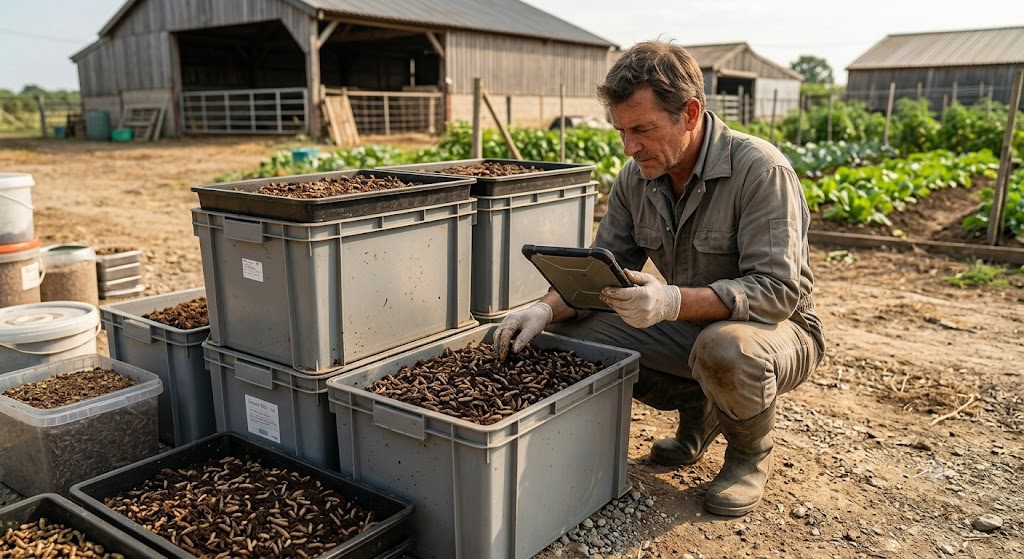
A USDA National Agricultural Library record for a University of California, Riverside project states the problem directly. Commercial black soldier fly farming has so far been confined to large entities, because the standard batch method needs manual labor that would outweigh the savings on a farm.
The researchers were working on a semi-automated, continuous-rearing prototype for small and mid-sized farms, funded for 2023 to 2025. Even that gentler system still needs human labor for feeding the bioreactors, moving bins, removing frass, and monitoring heat, moisture, ammonia, and pH.
If you plan black soldier fly farming on a small holding, price your own time honestly. If the daily labor costs more than the feed and fertilizer it replaces, the project loses money no matter how well the larvae grow.
Fact 8: Contamination and Survival Are Real Risks
Larvae are not a magic filter. The Sustainable Production and Consumption review reports that metals such as cadmium, lead, and zinc in the substrate can accumulate in the larvae. It also cites survival rates on manure that were well below those on a control diet: 45 percent on dairy manure, 78 percent on poultry manure, and 73 percent on swine manure.
Bad substrate means contaminated feed ingredients, and contaminated feed ingredients can end up in the meat, eggs, or fish that people eat. This is why regulators restrict what larvae may be fed, and why anyone running black soldier fly farming should know exactly where the waste comes from.
Fact 9: The Best Evidence Favors Small, Local, Specific Uses
The clearest successes in the research are local. A 2024 CGIAR and International Water Management Institute practical guide, written with partners including the University of Ghana and a Nairobi enterprise, targets farmers, small businesses, and extension agents who want to produce feed and biofertilizer from black soldier fly farming.
The Discover Sustainability review cites modeling for Kenya suggesting that replacing 5 to 50 percent of conventional poultry feed with larvae meal could generate between USD 69 million and USD 687 million a year and up to 252,000 jobs. That is a projection, not an observed result, and the spread between the low and high figures shows how much depends on assumptions.
Putting the evidence together, the stronger use cases are those where waste is local, consistent, and legally allowed, and where the larvae feed animals on the same farm or nearby. That is a smaller story than the venture-capital version, but it is the one the evidence supports.
Black Soldier Fly Farming vs Composting vs Anaerobic Digestion
| Factor | Black Soldier Fly Farming | Composting | Anaerobic Digestion |
|---|---|---|---|
| Main outputs | Larvae (feed, oil) and frass | Compost | Biogas and digestate |
| Carbon footprint in one cited trial (kg CO2-eq per functional unit) | 25.2 | 53.3 | 39.5 |
| Revenue potential | Feed and fertilizer sales | Soil amendment | Energy |
| Main limitation | Needs consistent, legal substrate and labor | Slower, higher emissions in the trial | Needs infrastructure and competes for the same waste |
| Regulatory burden | High when larvae enter the feed chain | Low | Moderate |
The carbon figures come from a single trial summarized in the Discover Sustainability review, so use them as a rough guide. The rows on revenue potential and regulatory burden are our own general assessment, not figures from that trial. The takeaway is simple: black soldier fly farming can beat the alternatives on emissions, but it carries the most regulatory and operational complexity.
Seven Questions to Answer Before You Invest
- Where will your substrate come from, and who else wants it? Consistent quality at a steady volume matters more than a one-off supply. Other sectors, including biogas and conventional livestock feed, compete for the same material.
- Is that substrate legal for the animals and markets you want? Check the feed rules for your region before buying equipment.
- Who will buy the larvae meal, and at what price versus soy or fishmeal? Get written interest from a buyer, not a verbal one.
- Can you meet 25 to 35 degrees Celsius cheaply? In cool regions, heating can erase your margin.
- How many hours per week will the system need, and what is your labor worth? Use the USDA record’s list of manual tasks as a checklist.
- How will you handle frass? Plan for composting and testing before any sales or field use.
- What is the smallest version that proves the economics? Ÿnsect’s story shows what happens when capacity comes before proof.
FAQ
1. What is black soldier fly farming?
Black soldier fly farming is the controlled rearing of Hermetia illucens larvae to convert suitable organic material into useful products such as insect larvae for animal feed, insect oil, and frass fertilizer.
2. Is black soldier fly farming profitable?
Black soldier fly farming can be profitable, but profitability depends on substrate costs, labor, energy, regulations, production efficiency, and reliable buyers. The biology may work well while the business still loses money, so a detailed cost and market analysis is essential before investing.
3. What do black soldier fly larvae eat?
Black soldier fly larvae can consume various organic materials, including some food waste, agricultural residues, and manure. However, not every substrate is legally or nutritionally suitable for producing feed-grade larvae. Local regulations and the intended end market must be checked first.
4. What are the main products of black soldier fly farming?
The main products are black soldier fly larvae or larvae meal, insect oil, and frass. Larvae can be processed for animal feed, oil can have feed or industrial applications, and frass can be processed and used as a soil amendment or fertilizer.
5. Can black soldier fly larvae replace soybean meal or fishmeal?
Black soldier fly larvae can replace part of conventional protein sources such as soybean meal or fishmeal in some animal diets. However, inclusion levels depend on the animal species, growth stage, formulation, and processing method. Complete replacement should not be assumed.
6. What is insect frass fertilizer?
Insect frass fertilizer is a material consisting primarily of insect droppings, shed skins, and residual growing substrate. Black soldier fly frass can contain useful nutrients and has shown potential as a soil amendment, but its quality depends heavily on the substrate and processing conditions.
7. Is black soldier fly frass safe for crops?
Properly processed and tested frass can be useful for crops, but fresh or immature frass may cause phytotoxic effects. Potential pathogen and contamination risks also mean that frass should be appropriately processed and tested before agricultural use.
8. How long does it take black soldier fly larvae to grow?
The development period varies considerably depending on temperature, moisture, and feed quality. Research reviewed in this article reports development times ranging from roughly 10 days on high-quality feed to about 35 days on potato peels.
9. What temperature is best for black soldier fly farming?
Black soldier fly production generally performs well under warm conditions. The review discussed in this article reports approximately 25°C to 35°C as a favorable range for adult mating and egg-laying, although specific production stages have their own environmental requirements.
10. Do black soldier fly farms smell?
Black soldier fly farms can produce odors if organic substrates are poorly managed, overloaded, or allowed to decompose improperly. Good substrate management, ventilation, moisture control, and regular removal of residue are important for controlling odor and maintaining a stable production environment.
Final Thought
Black soldier fly farming is neither a scam nor a miracle. The larvae reliably turn organic material into feed and fertilizer, and the best-supported uses are small, local, and carefully regulated. The sector’s biggest failure, however, shows that biology does not pay the bills. Capital discipline, legal substrate, a real buyer, and honest labor math do.
If you are weighing black soldier fly farming, start with one bin, one steady waste stream, and one buyer. Prove that loop works. Then decide whether to grow it.
For related reading on this site, see our guides to goat and poultry farming, the six types of animal husbandry, agric technology in 2026, AI soil carbon monitoring and how to judge its claims, and robotic fruit harvesting and farm labor costs.