
Table of Contents
Robotic fruit harvesting is being called the last unsolved problem in farm automation and 2026 is the year it stopped being a research demo and started showing up in commercial orchards with real invoices attached.
Planting, spraying, and weeding have all been automated at commercial scale for years. Picking fruit without bruising it, reaching around leaves, and judging ripeness the way an experienced human picker does has been the much harder problem.
That gap is finally closing. The global robotic fruit harvesting market hit roughly $2.24 billion in 2024, is estimated at $2.31 billion in 2026, and is projected to reach $7.64 billion by 2033 an 18.7% compound annual growth rate that outpaces almost every other agritech category.
This guide breaks down how robotic fruit harvesting actually works, what it costs, which companies are shipping real machines, and where the technology still genuinely struggles without the investor-deck gloss.
What Is Robotic Fruit Harvesting?
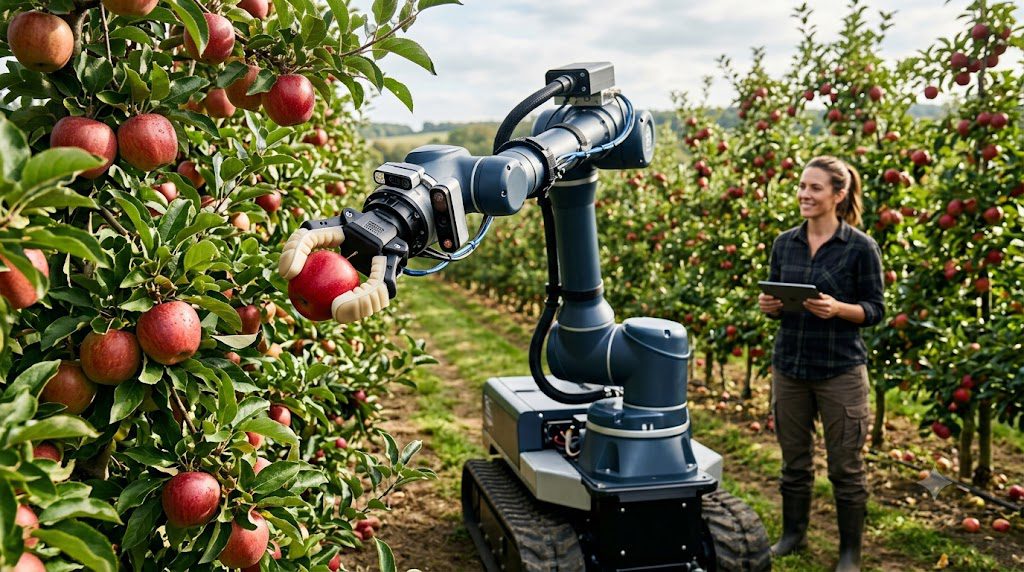
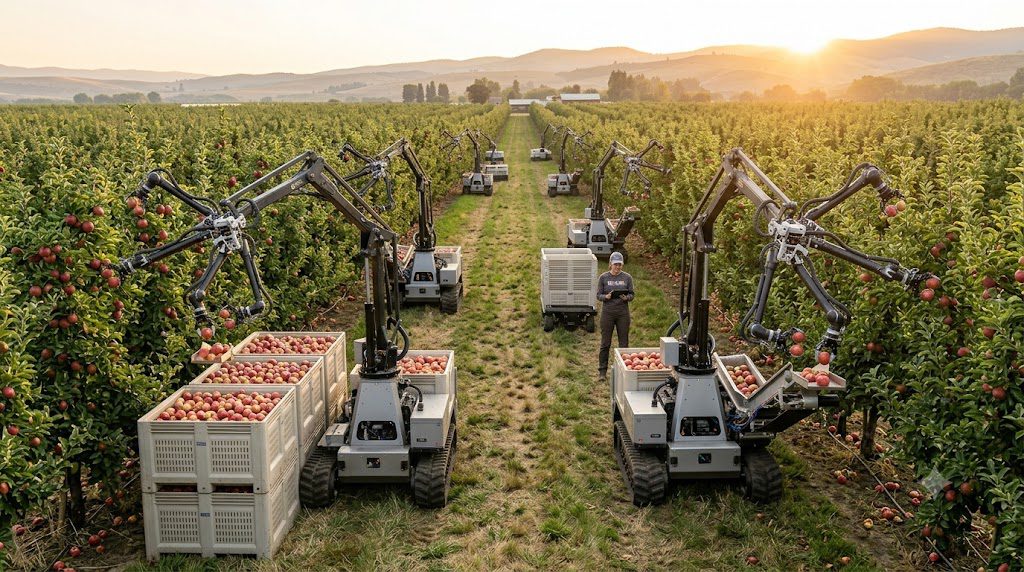
Robotic fruit harvesting is the use of AI-powered robotic arms, soft grippers, and computer vision systems to identify ripe fruit and pick it from trees, vines, or bushes without human hands doing the work.
A typical system pairs cameras and sensors often RGB, multispectral, or depth-sensing with a machine-learning model trained to judge ripeness by color, size, and firmness.
Once a fruit is confirmed ready, a robotic arm with a soft, pressure-sensitive gripper reaches in, detaches the fruit with the right rotation or pull force, and places it in a bin without bruising it.
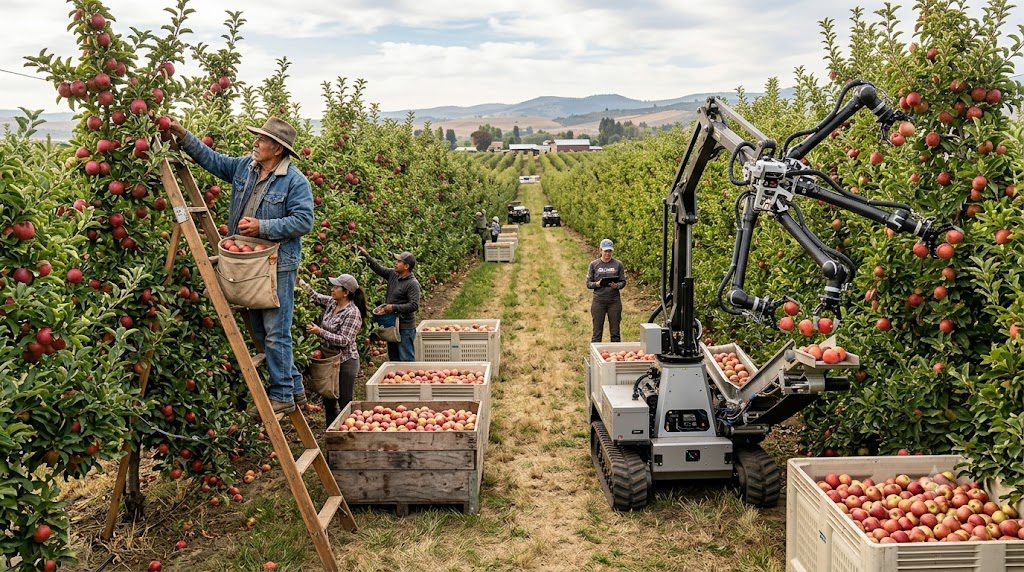
The pitch behind robotic fruit harvesting is simple: hand-picking is one of the most labor-intensive, hardest-to-staff jobs in agriculture, and it has almost no automation history compared to planting or spraying. Solving it addresses the single biggest remaining labor cost in fruit production.
Why Robotic Fruit Harvesting Is Trending Right Now
1. The labor gap has become existential, not just expensive. Hand-harvesting labor costs an estimated $50 billion a year globally, and robotic fruit harvesting currently captures less than 5% of that spend meaning the addressable opportunity is still almost entirely untapped.
2. Machine costs are dropping fast. Berry-harvesting robot systems are approaching the $150,000 price point, and apple-harvesting systems are moving closer to $250,000, pulling the minimum economically viable farm size down from more than 200 acres to roughly 75 acres.
3. AI vision and soft robotics finally caught up. Reliably telling a ripe strawberry from an unripe one, in variable light, without crushing it on the way out, required advances in both computer vision and gripper engineering that only became commercially reliable in the last two to three years.
4. Investment capital is accelerating deployment. Tevel Aerobotics recently closed an $18 million Series C round specifically to scale its flying autonomous harvesting robots, and it’s far from the only company raising serious capital in this category right now.
5. Apple orchards are leading adoption. The apple-picking segment alone is expected to generate the highest market share of any fruit category in 2026, as large orchard operators lean into automation to offset shrinking seasonal labor pools.
6. Quality consistency is becoming a selling point, not just a cost play. Because vision systems can be tuned to pick at a precise, consistent ripeness threshold every time, some growers report more uniform fruit quality across a harvest compared to variable human judgment across a large seasonal crew a secondary benefit that’s starting to show up in buyer conversations, not just labor spreadsheets.
How Robotic Fruit Harvesting Actually Works
The Vision and Ripeness Detection System
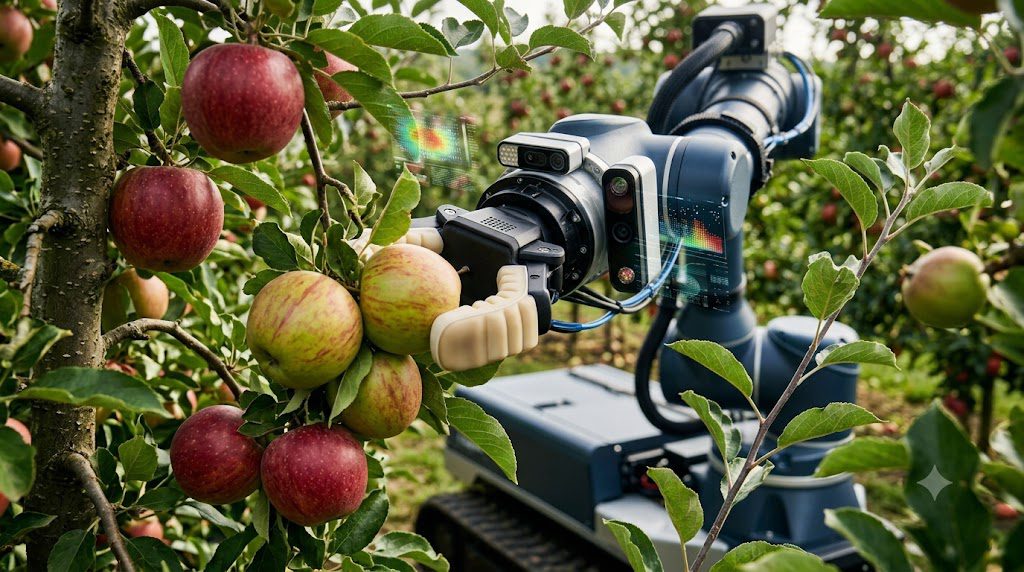
Cameras mounted on the robot continuously scan the canopy, using computer vision models trained on thousands of images of the specific fruit variety to judge ripeness by color, size, and sometimes firmness data from depth sensors.
The Picking Mechanism
Once a target is confirmed, a robotic arm reaches toward the fruit using a soft, pressure-calibrated gripper designed to detach it without bruising a mechanically harder problem than it sounds, since fruit grows at unpredictable angles and detachment force varies by ripeness and variety.
Navigation and Platform Type
Some robotic fruit harvesting systems are ground-based platforms that drive down orchard rows. Others, like Tevel’s Alpha-bot, use tethered flying drone arms that fly directly into the canopy a design specifically built to solve the problem of fruit hidden deep inside dense foliage that ground-based arms can’t reach.
Sorting and Placement
Advanced systems sort fruit by size and quality grade as they pick, placing it directly into bins organized for packing, which reduces a second sorting labor step that traditional hand-harvesting still requires afterward.
Robotic Fruit Harvesting vs. Manual Picking
| Method | Labor Dependency | Bruising Risk | Cost Structure | Works in Dense Canopy |
|---|---|---|---|---|
| Manual picking | High needs seasonal crews | Low with trained pickers | Ongoing wage cost every season | Yes |
| Robotic fruit harvesting | Low needs supervisors, not pickers | Improving, still variable by system | High upfront/lease cost, low ongoing labor cost | Limited still the biggest technical gap |
The honest takeaway: robotic fruit harvesting doesn’t yet match a skilled human crew’s reliability in a thick canopy, but it removes the single biggest recurring cost and staffing headache in fruit production seasonal hand-picking labor for operations that can afford the upfront investment.
Real Costs and Market Numbers
Treat every figure here as a planning starting point, not a guarantee pricing varies significantly by crop, system, and region.
Machine pricing: Berry-harvesting robot systems are approaching roughly $150,000, while apple-harvesting systems are moving closer to $250,000, according to 2026 market analysis from GII Research.
Falling minimum farm size: As those prices drop, the minimum economically viable farm size for robotic fruit harvesting is declining from more than 200 acres to roughly 75 acres a meaningful shift that opens the technology to a much larger pool of mid-sized growers.
Market scale: The global fruit-picking robot market is valued at roughly $2.31 billion in 2026 and is forecast to reach $7.64 billion by 2033, a compound annual growth rate of 18.7%.
The size of the opportunity still untapped: Robotic fruit harvesting currently captures less than 5% of the $50 billion global hand-harvesting labor market the single clearest indicator of how early this category still is, despite the funding and headlines.
Regional adoption: North America is projected to lead the robotic fruit harvesting market in 2026 with roughly a 38% share, driven by mature agricultural infrastructure and acute seasonal labor shortages in orchard regions.
9 Robots Leading Robotic Fruit Harvesting in 2026
- Tevel Aerobotics (Alpha-bot) : Flying autonomous robots with eight drone arms tethered to a ground cart, built specifically to solve canopy occlusion for peaches, nectarines, plums, and apples. Already deployed commercially with HMC Farms in California, Unifrutti in Chile, and orchards in Italy.
- Advanced Farm Technologies : A ground-based robotic harvesting platform focused on high-value orchard and vine crops, positioned as one of the most commercially mature systems in North America.
- Agrobot : Purpose-built for strawberry harvesting, using an array of small robotic arms working in parallel across a wide picking platform.
- FFRobotics : An Israeli company building multi-arm robotic harvesters designed for apples and other tree fruit at commercial orchard scale.
- Four Growers : Focused on robotic harvesting for greenhouse tomatoes, a controlled-environment use case where lighting and canopy structure are easier to standardize than open-field orchards.
- Ripe Robotics : An Australian company explicitly focused on driving down the cost side of robotic fruit harvesting to make it accessible to smaller operations sooner.
- Harvest CROO Robotics : Built specifically for strawberry harvesting at scale, targeting one of the most labor-intensive hand-picking crops in U.S. agriculture.
- Root AI / Root Robotics : Vision-driven robotic harvesting systems originally developed for greenhouse tomato production.
- Muddy Machines : A UK company tackling asparagus, widely considered one of the highest-value, least-automated harvesting segments still left untouched by most competitors.
If you’re evaluating vendors, ask each one directly which crop varieties and canopy structures their system has been field-validated on, rather than relying on general marketing claims performance varies enormously by fruit type and orchard design.
Best Crops for Robotic Fruit Harvesting Today
Robotic fruit harvesting currently performs best on:
- Apples, which hold the largest market share of any fruit category in 2026 due to relatively predictable canopy structure and strong ROI at scale
- Strawberries, where multiple dedicated systems (Agrobot, Harvest CROO) have been built specifically around the crop’s low-growing, repetitive picking pattern
- Greenhouse tomatoes, where controlled lighting and standardized plant structure make vision-based picking significantly more reliable than open-field conditions
- Stone fruit such as peaches, nectarines, and plums, particularly with flying drone-arm systems designed to reach into denser canopies
It remains a weaker fit for crops with highly irregular growth patterns, extremely dense closed canopies, or delicate skin that bruises easily under current gripper technology though nearly every company on this list is actively working to close that gap.
The Hardest Unsolved Problem: Closed Canopy Picking
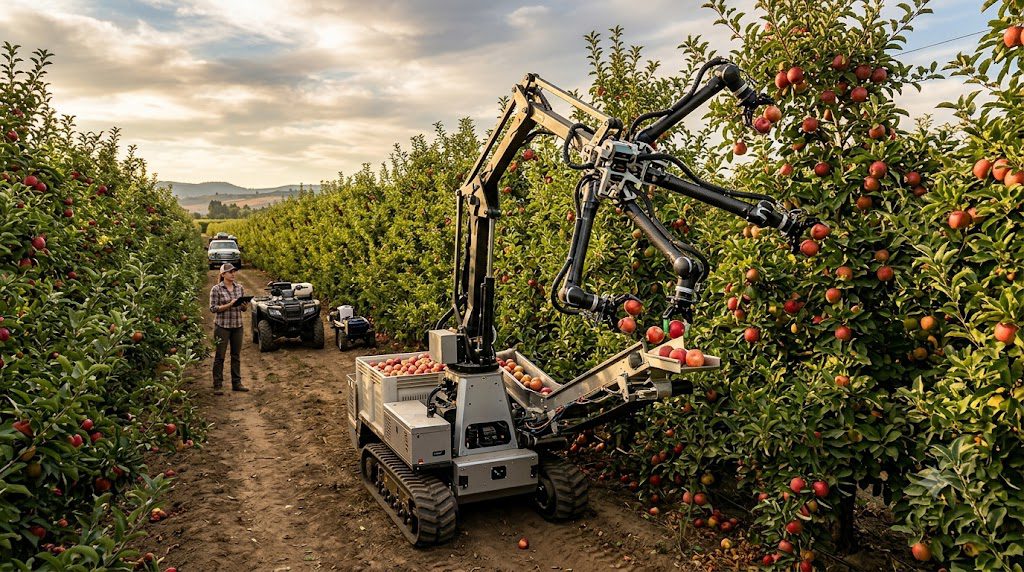
Industry analysts are blunt about this: pick rate under closed canopy is still the primary technical barrier holding robotic fruit harvesting back from full-scale replacement of hand labor. Dense foliage blocks cameras from seeing fruit clearly, and even when vision systems identify a target, reaching it without damaging surrounding branches or the fruit itself remains mechanically difficult.
This is precisely why Tevel’s flying drone-arm approach exists it’s a structural workaround to the occlusion problem that ground-based arms can’t fully solve on their own. It’s also why analysts describe harvesting as the genuinely hardest remaining frontier in agricultural robotics, even as planting, spraying, and weeding have already reached mainstream commercial adoption.
Any vendor claiming their robotic fruit harvesting system matches a skilled human picker’s reliability in a fully mature, dense canopy is currently overstating where the technology stands industry-wide.
Labor, Cost, and ROI: What to Actually Expect
The clearest ROI case for robotic fruit harvesting today is on farms already struggling to find and retain seasonal picking crews not necessarily farms simply looking to cut costs on a labor supply that’s currently stable.
Where it pencils out fastest: Mid-to-large orchard and berry operations facing chronic seasonal labor shortages, where the cost of an unpicked or late-picked crop already outweighs the upfront investment in a robotic system.
Where the payback is slower: Small operations under the roughly 75-acre threshold, and crops without a purpose-built commercial system yet available, where leasing or robot-as-a-service pricing increasingly offered by newer entrants like Ripe Robotics may make more financial sense than an outright purchase.
What to budget beyond the machine itself: Operator training, ongoing software updates as vision models improve, and a transition season where output likely runs below the manufacturer’s advertised pick rate while the system calibrates to your specific orchard layout and fruit variety.
For farms already investing in automation elsewhere, robotic fruit harvesting increasingly complements technology like agricultural drones for crop scouting and even laser weeding technology for row maintenance the broader trend across agritech in 2026 is stacking multiple automation layers rather than adopting any single system in isolation.
Financing Options: Buying, Leasing, or Robot-as-a-Service
The upfront cost conversation around robotic fruit harvesting has changed shape in the last year, and it’s worth understanding the three paths before assuming outright purchase is the only option.
Outright purchase still makes the most sense for large operations with predictable, high-volume harvests year after year, where the machine will run near capacity for most of the season and the capital cost amortizes quickly against labor savings.
Leasing is increasingly offered by manufacturers directly, spreading the roughly $150,000–$250,000 machine cost across multiple seasons rather than requiring it upfront a meaningful shift for growers near the newly lowered 75-acre viability threshold.
Robot-as-a-service, the model companies like Ripe Robotics are explicitly building around, charges growers per acre or per volume harvested rather than requiring ownership at all. This removes the capital-allocation decision entirely and shifts the risk of underperformance back onto the vendor, which is worth weighing carefully against a purchase or lease if you’re testing robotic fruit harvesting for the first time.
Whichever path you consider, ask directly what happens if the pick rate underperforms the advertised number in your specific canopy a purchase model leaves that risk entirely with you, while a service model typically doesn’t.
Limitations and Risks Worth Knowing
No credible source on robotic fruit harvesting claims it’s a finished, universal solution. The real limitations include:
- High upfront capital cost, with apple systems approaching $250,000 and few financing options yet standardized across the industry
- Closed-canopy pick rate remains the core unsolved problem, meaning current systems typically can’t match a human crew’s total yield capture in dense orchards
- Crop-specific validation gaps, since most commercially mature systems are built around apples, strawberries, and greenhouse tomatoes rather than a universal platform
- Bruising risk that varies by system, particularly on delicate, thin-skinned fruit varieties
- Weather and lighting sensitivity, especially for vision-dependent systems operating in variable outdoor field conditions
How to Evaluate Robotic Fruit Harvesting for Your Farm
- Calculate your current seasonal labor cost and reliability risk as a baseline, including years where you couldn’t find enough pickers at all.
- Identify which of your crops has a purpose-built commercial system available today rather than assuming a general-purpose robot will work across your whole operation.
- Request field-validation data specific to your fruit variety and canopy structure, not general marketing claims.
- Ask about lease or robot-as-a-service pricing if the outright purchase cost is a barrier, since several newer entrants are building their business model specifically around this.
- Pilot on a limited block for one full harvest season before committing to a full-orchard rollout.
- Track total yield captured, not just labor hours saved, since closed-canopy pick rate is still the metric most likely to fall short of vendor claims.
Common Mistakes Farmers Make
- Assuming one robotic system works across every crop they grow, when most commercially mature platforms are still built around a single fruit type.
- Comparing sticker price only, without factoring in the falling minimum viable farm size, which has made mid-sized operations financially viable candidates far sooner than expected.
- Skipping a pilot season and rolling out farm-wide immediately, then discovering the pick rate in their specific canopy structure underperforms the manufacturer’s published number.
- Underestimating the closed-canopy limitation, expecting near-total yield capture in year one rather than treating it as a genuine, still-unsolved technical constraint industry-wide.
FAQs About Robotic Fruit Harvesting
How much does robotic fruit harvesting cost? Berry-harvesting systems are approaching roughly $150,000, and apple-harvesting systems are moving closer to $250,000 as of 2026, with lease and robot-as-a-service pricing increasingly available from newer entrants.
What fruit works best with robotic harvesting today? Apples currently hold the largest market share, with strawberries and greenhouse tomatoes close behind due to more predictable growing structures than open-field stone fruit or berries with dense foliage.
Can robotic fruit harvesting fully replace hand-picking crews? Not yet, for most operations. Closed-canopy pick rate remains the industry’s core unsolved problem, meaning most current systems supplement rather than fully replace human labor, particularly in dense orchards.
Is robotic fruit harvesting only for large farms? No longer. Falling machine prices have pushed the minimum economically viable farm size down from more than 200 acres to roughly 75 acres, opening the technology to a much wider range of mid-sized growers.
How is robotic fruit harvesting different from robotic weeding? Weeding robots identify and remove unwanted plants, which is a comparatively simpler detection-and-destroy task. Robotic fruit harvesting must judge ripeness, reach around obstacles, and detach delicate produce without damaging it widely considered the harder engineering problem of the two.
Which companies are leading robotic fruit harvesting in 2026? Tevel Aerobotics, Advanced Farm Technologies, Agrobot, FFRobotics, and Harvest CROO Robotics are among the most commercially deployed names, alongside newer entrants like Ripe Robotics focused specifically on driving costs down.
Should I buy, lease, or use a robot-as-a-service model? It depends on your harvest volume and risk tolerance. Large, high-volume operations often get the fastest payback from outright purchase, while growers testing robotic fruit harvesting for the first time may prefer a service model that shifts underperformance risk onto the vendor.
Final Thought
Robotic fruit harvesting is real, funded, and shipping commercially in 2026 but it’s still solving the hardest remaining problem in farm automation, and closed-canopy pick rate is the honest limitation every buyer should ask about directly.
It works best today on apples, strawberries, and greenhouse tomatoes, and it’s becoming viable for far smaller operations than it was even two years ago. If chronic seasonal labor shortages are already costing you unpicked yield, it’s worth requesting a field-validated quote for your specific crop. If your labor supply is currently stable, it’s worth watching the closed-canopy gap close before committing capital.
Pingback: Microbial Biofertilizers: 7 Powerful Ways to Reduce Fertilizer Costs in 2026 -