
Editorial note: This article summarizes publicly available market research, company-reported field results, and agricultural trade reporting. FarmSutras has not independently replicated the commercial field trials discussed below. Product performance can vary by crop, soil, climate, management practices, and application method.
Table of Contents
What Are Microbial Biofertilizers?
Microbial biofertilizers are agricultural products containing living microorganisms that can help plants obtain nutrients or improve nutrient availability.
Depending on the product, the microorganisms may help fix atmospheric nitrogen, make phosphorus or potassium more available, or support nutrient-use efficiency around the plant root system.
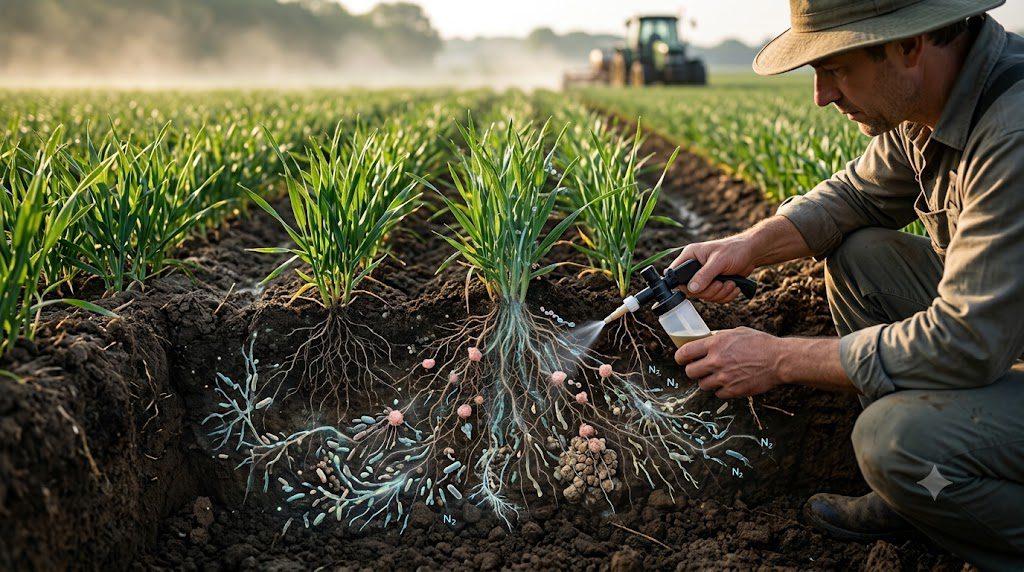
One of the oldest and best-established examples is Rhizobium, a group of bacteria that forms a symbiotic relationship with legume crops. These bacteria live in root nodules and help convert atmospheric nitrogen into forms that plants can use.
Newer microbial products are being developed for crops that do not naturally form the same type of nitrogen-fixing relationship. These products are attracting attention because farmers want to improve nutrient efficiency while managing fertilizer costs.
However, microbial biofertilizers should not automatically be treated as a complete replacement for synthetic fertilizer. Their performance depends heavily on the microorganism, crop, soil conditions, application method, and management system.

Why Are Microbial Biofertilizers Gaining Attention in 2026?
Several factors are increasing interest in microbial products.
1. Fertilizer costs remain a major farm-management concern
Nitrogen fertilizer production is closely connected to energy and commodity markets. Price fluctuations can therefore create uncertainty for farmers planning input budgets.
Microbial products are being marketed partly as a way to reduce dependence on some synthetic nutrients rather than eliminating fertilizer altogether.
2. Nutrient-use efficiency matters more than simply applying more fertilizer
Adding more fertilizer does not automatically mean a crop will use more of it efficiently.
Nutrient losses can occur through processes such as leaching, runoff, volatilization, or immobilization. Microbial products attempt to influence nutrient availability or nutrient cycling closer to the plant.
The practical question is therefore not simply:
“Can microbes replace fertilizer?”
A better question is:
“Can this particular microbial product help my crop use nutrients more efficiently at an acceptable cost?”
3. Biological agriculture is attracting more investment
Agricultural biotechnology companies and established input companies are investing in biological products, including microbial fertilizers, biostimulants, and biological crop-protection technologies.
This growing commercial interest has helped move microbial products from a niche category into a more visible part of modern agriculture.
4. Precision agriculture creates new opportunities
Microbial products can fit into broader precision-agriculture systems when farmers already collect information about soil, crop condition, fertilizer application, and yield.
Instead of treating every acre identically, farmers can use field data to identify where a biological product should be tested and where it may not provide enough economic value.
5. Farmers are demanding measurable results
The biological-input market has also faced an important credibility challenge: performance can vary considerably between locations and growing conditions.
That means farmers increasingly need field data rather than broad marketing statements.
How Do Microbial Biofertilizers Work?
Microbial biofertilizers do not all work in the same way.
Nitrogen fixation
Certain microorganisms can convert atmospheric nitrogen into forms that plants can use.
Rhizobium is the classic example in legumes. Newer microbial products are attempting to provide nitrogen-related benefits to non-legume crops as well.
Phosphate solubilization
Some microorganisms can help make phosphorus already present in the soil more available to plants.
This is different from nitrogen fixation. A product designed primarily for phosphorus availability should not automatically be evaluated using the same expectations as a microbial nitrogen product.
Potassium mobilization
Some microorganisms can contribute to the release or mobilization of potassium from soil minerals.
Again, the actual effect depends on the microorganism, soil chemistry, environmental conditions, and product formulation.
Root-zone activity
Many microbial products are intended to work around the plant root system.
This is why application method matters. Depending on the product, microbes may be applied to seed, soil, irrigation systems, or directly into the planting zone.
Microbial Biofertilizers vs. Synthetic Fertilizer
| Factor | Synthetic fertilizer | Microbial biofertilizers |
|---|---|---|
| Nutrient source | Direct nutrient supply | Biological processes affecting nutrient availability |
| Speed | Generally predictable and relatively immediate | Dependent on biological activity |
| Environmental sensitivity | Varies by product and application | Often strongly affected by soil and environmental conditions |
| Consistency | Generally more predictable | Can vary between fields and seasons |
| Main advantage | Reliable nutrient delivery | Potential improvement in nutrient efficiency |
| Main limitation | Nutrient losses and price volatility | Variable field performance |
| Best approach | Rate based on crop and soil requirements | Evaluate with crop-specific field testing |
The important point is that these are not necessarily competing systems.
For many farms, the more realistic question is whether a microbial product can reduce or optimize part of the synthetic fertilizer program rather than replace it completely.
What Does the Current Market Data Show?
Market research companies estimate that the global biofertilizer market is growing rapidly, although the exact market size differs substantially between reports.
Your research cites estimates ranging from approximately $2.4 billion to $3.1 billion in 2026, with forecasts reaching several billion dollars more by the early 2030s.
These figures should be treated as market estimates rather than exact measurements because research firms use different definitions, datasets, geographic coverage, and forecasting methods.
The same caution applies to company performance claims.
For example, Pivot Bio has published field results involving its microbial nitrogen products. Your source material reports trials involving more than 100 fields and reductions in synthetic nitrogen use alongside reported yield differences.
Those results are useful evidence that the technology is being tested commercially, but they should not be presented as a guaranteed result for every farmer.
That distinction is critical.
Company-reported field results demonstrate what happened in the reported trials. They do not guarantee what will happen on your farm.

7 Ways Microbial Biofertilizers May Reduce Fertilizer Costs
1. They may reduce the amount of synthetic nitrogen required
Nitrogen-fixing microbial products are designed to provide plants with additional nitrogen through biological processes.
If a product consistently allows a farmer to maintain yield while reducing synthetic nitrogen application, the avoided fertilizer cost can contribute to its economic value.
The key word is consistently.
A single successful trial is not enough to justify replacing a large portion of a farm’s fertilizer program.
2. They may improve nutrient-use efficiency
A microbial product may help plants access nutrients that are already present in the soil.
If this improves nutrient-use efficiency, farmers may potentially achieve acceptable crop performance with a more efficient nutrient program.
However, nutrient-use efficiency should be measured through actual field results rather than assumed from the presence of microbes alone.
3. They can complement precision agriculture
Farmers already using GPS guidance, soil testing, sensors, yield mapping, or variable-rate technology may have better tools for evaluating microbial products.
For example, a farmer could establish treated and untreated strips and compare:
- fertilizer applied
- crop establishment
- crop health
- yield
- grain or produce quality
- product cost
- total input cost
- return per acre
This produces much stronger evidence than comparing two unrelated fields.
4. They may reduce exposure to fertilizer price volatility
If a microbial product successfully reduces the amount of synthetic fertilizer required, the farmer may become less exposed to sudden fertilizer price increases.
This does not mean microbial products are immune to price changes. It simply creates another input option within the farm’s nutrient-management strategy.
5. They may help farmers use existing soil nutrients more effectively
Some microbial products are designed to improve nutrient availability rather than add large quantities of nutrients themselves.
This can be particularly relevant when soil testing indicates that nutrients are present, but their availability to crops may be limited.
6. They can support integrated nutrient management
The strongest use case may not be biological products versus synthetic fertilizer.
It may be biological products plus synthetic fertilizer plus organic matter plus soil testing plus precision application.
Integrated nutrient management allows farmers to use different tools according to the crop and field requirements.
7. They create another option for long-term input management
Agriculture is becoming more data-driven.
Farmers are increasingly comparing inputs based on cost per acre, yield response, return on investment, environmental conditions, and repeatability.
Microbial biofertilizers are another category that can be evaluated using the same economic framework.
Companies and Products in the Microbial Biofertilizer Market
Several companies are active in agricultural biologicals.
Pivot Bio
Pivot Bio develops microbial nitrogen products designed for crops including corn, sorghum, and wheat.
Its commercial materials include field results showing reductions in synthetic nitrogen use alongside reported crop-performance outcomes.
Because these are company-reported results, farmers should compare them with independent trials and local field performance before making large-scale changes.
Sound Agriculture
Sound Agriculture markets SOURCE, a microbial product positioned around nutrient availability and crop nutrient efficiency.
The company has promoted potential reductions in conventional nutrient requirements, but farmers should examine the assumptions behind those claims and determine whether they apply to their own crop and production system.
Kula Bio
Kula Bio has developed microbial nitrogen technology using naturally occurring microorganisms.
Its approach illustrates the diversity of technologies being developed in the microbial agriculture market.
Other biological-input companies
Companies including Novozymes, Rizobacter, Lallemand, and Loam Bio are also active in broader biological, microbial, or soil-health markets.
The products are not identical, so farmers should avoid treating all biological products as one category.

Which Crops and Conditions Are Most Relevant?
Microbial biofertilizers do not have equal evidence across every crop.
Legumes
Legume crops have the longest history of microbial nitrogen fixation through Rhizobium and related organisms.
This makes them one of the most established areas for microbial fertilizer use.
Corn, sorghum and wheat
Newer microbial nitrogen products are being developed and tested for non-legume crops.
However, evidence should be evaluated product by product rather than assuming that results from one crop automatically transfer to another.
Soil conditions
Microbial performance can be influenced by:
- soil moisture
- temperature
- pH
- nutrient availability
- microbial survival
- application method
- crop variety
- farming practices
This is one reason local testing matters.
Limitations of Microbial Biofertilizers
Microbial biofertilizers have potential, but there are several reasons farmers should avoid treating them as a guaranteed fertilizer replacement.
Performance can vary
Biological systems are influenced by environmental conditions.
A product that performs well under one set of conditions may produce a different result under another.
Independent evidence is uneven.
Some microbial technologies have extensive agronomic histories, while newer commercial products have a shorter track record.
Company field trials can provide useful information, but independent replication provides an additional level of confidence.
Marketing claims can be difficult to compare.
Different companies may calculate fertilizer savings, yield improvement, or return on investment differently.
A “30% reduction” from one company may not be directly comparable with a “30% reduction” reported by another.
Regulatory requirements differ
The regulatory treatment of microbial products varies by country and can also depend on the organism, formulation, intended use, and production technology.
Farmers should check the legal registration and approved use of a product in their own jurisdiction.
Long-term economics remain important.
A product may perform well for one season but still fail to produce an attractive long-term return.
Farmers should therefore examine repeat performance rather than relying on a single successful season.
How Farmers Should Evaluate a Microbial Biofertilizer
Before purchasing a product for large-scale use, ask the supplier these questions:
- What microorganism or strain does the product contain?
- What is the specific mechanism of action?
- Which crops has it been tested on?
- Where were the trials conducted?
- What soil and weather conditions existed during the trials?
- Was there an untreated control?
- Was the comparison made against the farmer’s normal fertilizer program?
- Are independent third-party trials available?
- What was the yield response?
- What was the total cost per acre?
- How many seasons of data are available?
- Is the product legally registered for the intended crop and use in your country?
Do not judge a product only by its microbial count, laboratory performance, or marketing percentage.
The important question is:
What measurable economic benefit does it provide under conditions similar to yours?
A Simple Farm Trial Method
Instead of immediately treating an entire farm, consider testing the product on a limited area where practical and legally appropriate.
Create a comparison between:
Control: your normal fertilizer and crop-management program.
Treatment: the same program plus the microbial product, or the reduced-fertilizer program recommended by the supplier.
Record:
- fertilizer quantity
- microbial product cost
- application cost
- crop establishment
- crop health
- yield
- produce quality
- total input cost
- gross return
- net return
Repeat the comparison across different fields or seasons when possible.
This will give you much more useful information than a national market statistic.

Common Mistakes Farmers Make
Mistake 1: Assuming every biofertilizer works the same way
Nitrogen-fixing microbes, phosphate-solubilizing microbes, and biostimulants have different purposes.
Mistake 2: Believing the largest percentage claim
A large percentage in an advertisement is not automatically the largest economic benefit.
Mistake 3: Ignoring the control
Without a control treatment, it becomes difficult to determine whether the product caused the difference.
Mistake 4: Measuring only yield
A product can increase yield but still reduce profit if its cost is too high.
Always calculate the economics.
Mistake 5: Expecting immediate universal replacement
Microbial products should not automatically be treated as a one-for-one substitute for synthetic fertilizer.
Mistake 6: Ignoring local conditions
Soil, climate, crop, irrigation, application timing, and farm-management practices can all influence performance.
Frequently Asked Questions
Do microbial biofertilizers actually work?
Some microbial technologies have strong and long-established evidence, particularly Rhizobium-based nitrogen fixation in legumes.
Newer products for non-legume crops are still being evaluated across different environments. Their performance should therefore be assessed using product-specific and location-specific evidence.
Can microbial biofertilizers completely replace synthetic fertilizer?
For most cropping systems, they should not currently be treated as a universal replacement.
The more practical approach is to determine whether a particular product can reduce synthetic fertilizer requirements while maintaining acceptable yield and profitability.
Which crops benefit most?
Legumes have some of the strongest historical evidence because of their natural relationship with nitrogen-fixing bacteria.
Newer microbial products are also being developed for crops such as corn, sorghum, and wheat.
Are microbial biofertilizers the same as organic fertilizer?
No.
Organic fertilizers are materials such as compost, manure, or other organic nutrient sources.
Microbial biofertilizers contain microorganisms intended to perform specific biological functions.
Are microbial biofertilizers safe?
Safety depends on the specific microorganism, formulation, manufacturing process, application method, and regulatory approval.
Farmers should use products that are legally registered or approved for their intended use and follow the manufacturer’s label and local agricultural regulations.
How much fertilizer can they replace?
There is no single percentage that applies to every product or farm.
Replacement potential depends on the crop, product, soil, climate, fertilizer program, and trial conditions.
That is why local field testing is more useful than applying a universal replacement percentage.
Final Takeaway
Microbial biofertilizers are becoming an increasingly important part of agricultural biotechnology.
The strongest case for them is not that microbes will suddenly eliminate synthetic fertilizer.
The stronger and more practical question is whether they can help farmers produce the same or better crop performance with a more efficient nutrient-management program.
Some microbial technologies have a long agronomic history. Newer products are generating commercial field data, but the quality and independence of that evidence vary.
For farmers, the best approach is therefore neither blind adoption nor automatic rejection.
Test the product.
Measure the result.
Calculate the economics.
Compare it with your normal fertilizer program.
And repeat the evaluation across seasons and field conditions before making a large-scale change.
That is where microbial biofertilizers move from an interesting agricultural technology to a genuinely useful farm-management tool.
Related Reading
- Precision Farming: How GPS, Sensors and Data Are Changing Modern Agriculture
- Carbon Credits for Farmers: 7 Ways to Earn in 2026
- Autonomous Tractors: How Farm Automation Is Changing Field Operations
- Robotic Fruit Harvesting: The Future of Orchard Automation
Research and Source Transparency
This article draws on publicly available market research, company publications, agricultural trade reporting, and other publicly reported information.
Commercial performance figures should be treated as reported results rather than guarantees. Farmers should seek independent field evidence and evaluate products under conditions comparable to their own farms before changing a fertilizer program.