
This article was compiled and fact-checked directly against official Ministry of New and Renewable Energy (MNRE) documentation, Press Information Bureau (PIB) releases, and independent industry reporting listed in the Sources section below. It reflects publicly available scheme data current as of the publication date and does not substitute for confirmation from your state’s designated implementing agency.
The PM-KUSUM scheme is one of the largest government efforts anywhere in the world to move farm irrigation off diesel and onto solar power. But it’s also one of the most misrepresented schemes online — subsidy percentages get rounded up, application deadlines get quoted from outdated pages, and fraudulent websites actively impersonate the official registration portal.
This guide walks through exactly what the PM-KUSUM scheme covers, the real subsidy math by component, what the scheme has actually delivered against its targets, and the specific fraud risks the government itself has publicly warned about.
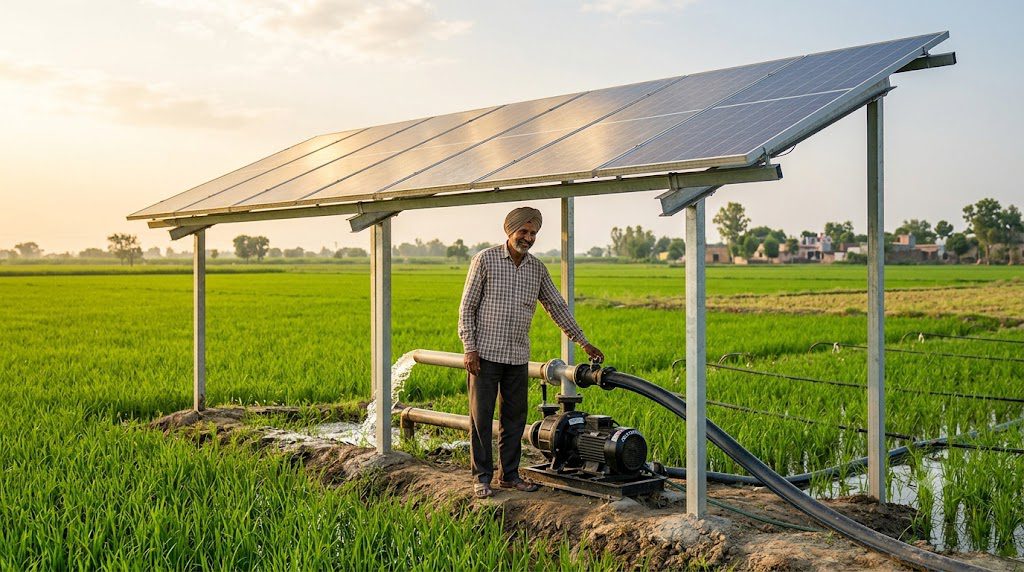
Table of Contents
What Is the PM-KUSUM Scheme?
The PM-KUSUM scheme — formally the Pradhan Mantri Kisan Urja Suraksha evam Utthaan Mahabhiyaan — is a Government of India program implemented by the Ministry of New and Renewable Energy (MNRE) that subsidizes solar-powered irrigation infrastructure for farmers.
According to MNRE’s own program documentation, the scheme was designed to add tens of thousands of megawatts of decentralized solar capacity, with total central financial assistance originally budgeted at ₹34,422 crore. Independent industry coverage has since reported the target scaled up to 34,800 MW with the same funding envelope as the scheme was expanded and extended over several revisions.
The core objective, as MNRE states directly, is to reduce farmer dependence on diesel for irrigation, cut farming input costs, and give farmers a path to earn additional income by selling surplus solar power back to the grid — objectives that align closely with the broader input-efficiency goals outlined in our sustainable farming practices guide.
The Three Components of the PM-KUSUM Scheme, Explained
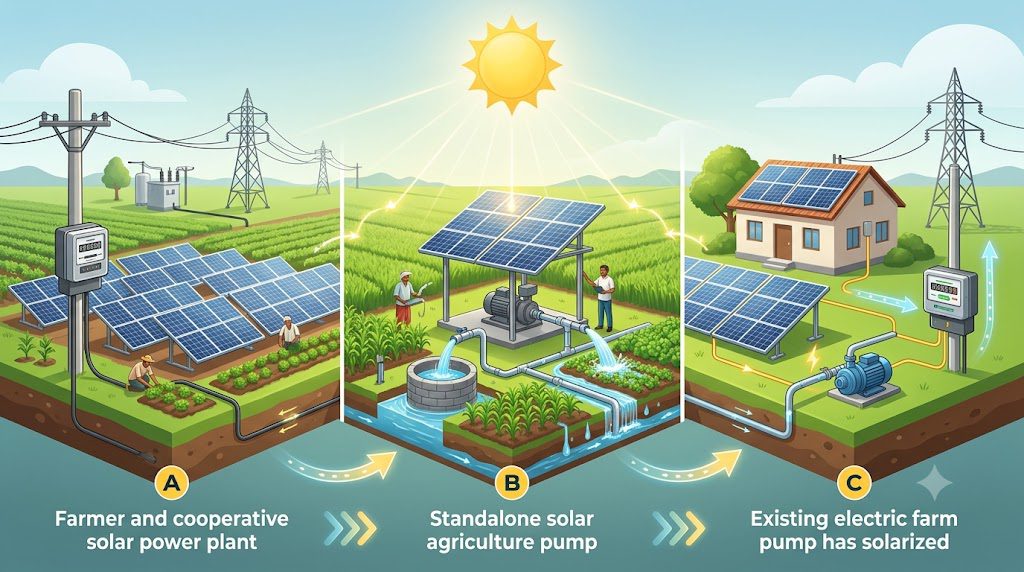
The PM-KUSUM scheme is not a single product — it’s three distinct programs bundled under one name, and confusing them is one of the most common mistakes farmers make when researching it.
Component A: Grid-Connected Solar Power Plants
Individual farmers, farmer cooperatives, panchayats, or Farmer Producer Organisations can set up small solar power plants of 500 kW to 2 MW capacity on barren or fallow land. The electricity generated is purchased by the local electricity distribution company (DISCOM) at a feed-in tariff fixed by the state’s electricity regulator — meaning this component functions more like a land-based income stream than a farming input.
Component B: Standalone Solar Agriculture Pumps
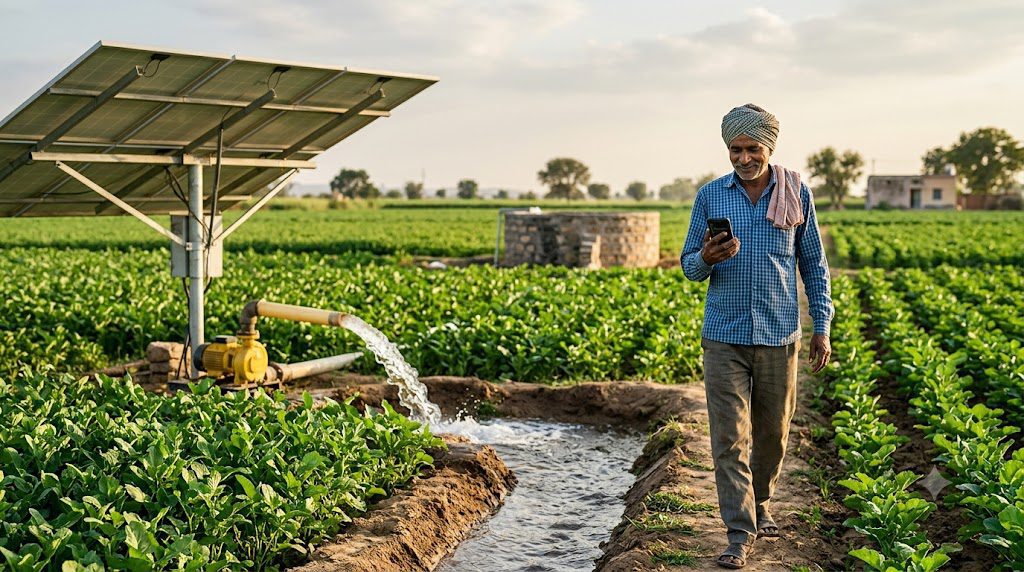
Designed for farmers in off-grid areas with no existing electricity connection, this component subsidizes new standalone solar-powered pumps up to 7.5 HP capacity, replacing diesel pumps entirely.
Component C: Solarisation of Existing Grid-Connected Pumps
For farmers who already have a grid-connected electric pump, this component subsidizes adding solar panels to power that same pump, with any excess solar generation sellable back to the DISCOM.
Real Subsidy Math: What You Actually Pay
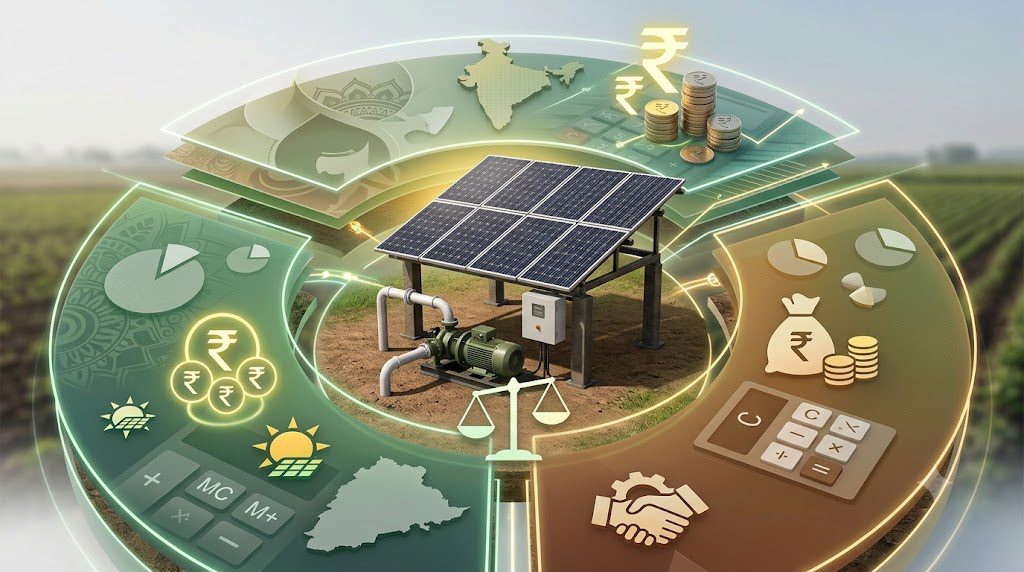
Online summaries of the PM-KUSUM scheme frequently cite a vague “30% to 90% subsidy” range without explaining how that range actually applies. The real breakdown, per MNRE’s official guidelines, is more specific than that.
For Component B and Component C in most states:
- Central Financial Assistance (CFA): 30% of the benchmark or tender cost, whichever is lower
- State government subsidy: at least 30%
- Farmer’s own contribution: at most 40%, of which up to 30% can be covered through bank financing — meaning the farmer’s actual upfront cash outlay can be as low as 10%
For North Eastern states, Sikkim, Jammu & Kashmir, Himachal Pradesh, Uttarakhand, Lakshadweep, and the Andaman & Nicobar Islands specifically, the subsidy structure improves:
- Central Financial Assistance: 50%
- State government subsidy: at least 30%
- Farmer’s own contribution: at most 20%
This is where the widely quoted “90% subsidy” figure actually comes from — it applies specifically to these designated special-category states and union territories, not to farmers nationwide, a distinction that gets lost in most secondary coverage of the scheme.
9 Powerful Facts About the PM-KUSUM Scheme
- It’s structured in three genuinely different components, and applying for the wrong one is a common, avoidable mistake.
- Bank financing is built into the model. Farmers under Component B and C are not expected to pay their full contribution upfront — financing arrangements exist so initial cash outlay can be as low as 10%.
- Surplus power generation is monetizable, not wasted — solar power beyond a farmer’s own irrigation needs is purchased by the local DISCOM.
- Special-category states get meaningfully better terms, with total subsidy coverage reaching up to 80% before farmer financing is even applied.
- The scheme has an active fraud problem, serious enough that MNRE has issued repeated public advisories about fake registration websites.
- Feeder-level solarisation is a separate track under Component C, aimed at entire agricultural electricity feeders rather than individual farm pumps, often requiring coordination with NABARD-financed feeder separation projects.
- Project completion has a fixed government deadline, typically 24 months from sanction, with limited extension provisions for delays.
- The scheme has not hit its original targets on schedule. Independent industry reporting indicates installed capacity reached only a fraction of the original megawatt target by the original deadline, prompting a formal timeline extension.
- A successor framework, PM-KUSUM 2.0, is already in formulation, meaning the terms and budget structure described in this article may shift for new applicants going forward.
How Farmers Actually Navigate the Application Process
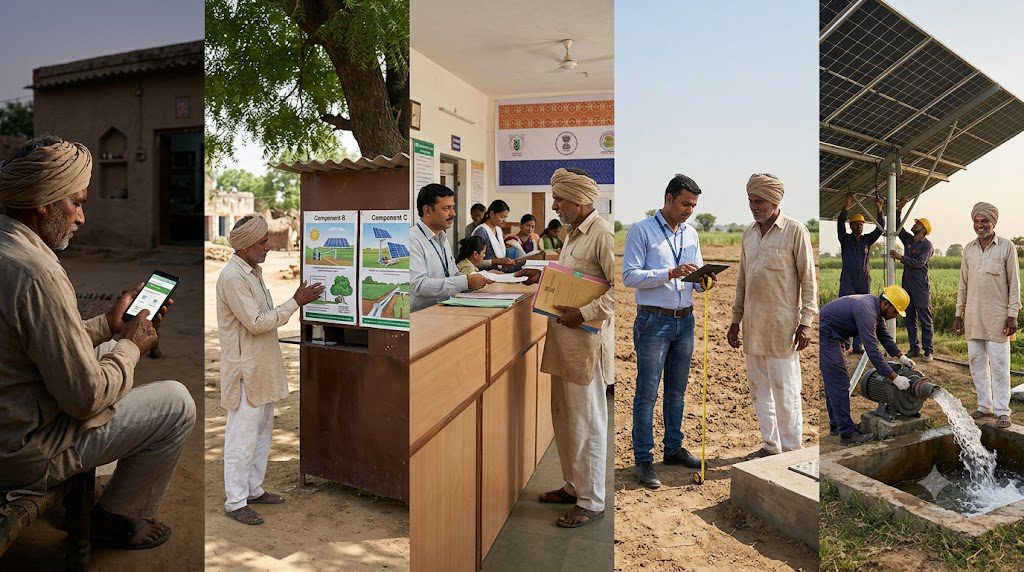
Based on the government’s own published implementation guidelines and documented state-level rollout reports, the practical path through the PM-KUSUM scheme typically looks like this, rather than the simplified “apply online and get a pump” narrative many secondary sources present.
State governments, not the central government, run the actual day-to-day implementation. MNRE issues state-wise allocation quantities for solar pumps after approval from a screening committee, and it is the state’s designated implementing agency — not a single national office — that farmers ultimately deal with for empanelled vendor selection, site verification, and installation scheduling.
This state-level layer is where real-world friction most often shows up. Reporting from Haryana, for instance, shows the state setting explicit annual installation targets for solar pumps and actively campaigning to get farmers to apply, which reflects how much variation exists between states in how aggressively the scheme is promoted and processed.
Farmers in states with a more established implementation pipeline — where empanelled vendors and processing timelines are already well-established — generally report a smoother path from application to commissioning than farmers in states still building out that infrastructure.
The practical lesson: a farmer’s actual experience with PM-KUSUM depends heavily on which state agency is implementing it locally, not just on the national scheme guidelines. Checking with neighboring farmers or a local agricultural extension office about realistic processing timelines in your specific district is more useful than relying solely on the national portal’s stated timelines.
A related practical detail that rarely appears in summary articles: the empanelled vendor you’re assigned or select can materially affect your experience, since installation quality, response time for post-installation issues, and adherence to the promised commissioning timeline vary between vendors even within the same state program.
Where a state publishes its list of empanelled vendors publicly, it’s worth asking other farmers in your area — through a cooperative, a farmer producer organisation, or simply word of mouth in your village — about their actual experience with a specific vendor before you’re assigned one by default.
This kind of on-the-ground due diligence isn’t mentioned in official guidelines, but it’s precisely the sort of practical knowledge that separates a smooth installation from a frustrating, drawn-out one.
Has the PM-KUSUM Scheme Delivered on Its Targets?
A genuinely trustworthy account of this scheme has to include this section, even though it complicates the promotional narrative.
Independent industry analysis has reported that installed capacity under the scheme reached roughly 10,950 MW by December 2025 — approximately 31% of the original target capacity the scheme was designed to reach. This shortfall has been attributed to structural financing problems: banks have reportedly been reluctant to extend project loans against farmer-held land, particularly for the larger Component A power-plant projects, and high margin-money requirements have discouraged farmer participation in some regions.
This isn’t a reason to dismiss the scheme — the subsidy terms and the underlying goal remain genuine, and millions of farmers have benefited, including a government-reported 2.46 lakh farmers under an earlier progress update.
But it is a reason to enter the application process with realistic expectations about processing timelines and financing friction — the same reason it’s worth pairing a long-lead-time investment like this with a safety net such as crop insurance for farmers, rather than assuming a fast, frictionless rollout based on the scheme’s headline subsidy numbers alone.
What’s Changing: PM-KUSUM 2.0
In response to the financing bottlenecks described above, the government extended the completion deadline for eligible existing projects to March 31, 2027, applying specifically to projects where power purchase agreements or notices to proceed were issued on or before December 31, 2025.
Beyond the extension, a successor framework — informally referred to as PM-KUSUM 2.0 — is reportedly under formulation, with industry reporting citing a substantially larger proposed budget and a new agrivoltaics component combining solar power generation with continued crop cultivation on the same land — a pairing that complements the water-and-heat-stress planning covered in our guide to climate-resilient crops, since shaded agrivoltaic land can reduce moisture loss for certain shade-tolerant crop varieties.
As of this article’s publication, formal MNRE notification of PM-KUSUM 2.0’s guidelines and benchmark costs had not yet been issued, so farmers should treat specific figures associated with the successor scheme as provisional until MNRE publishes official guidelines.
Fraud Warning: Fake PM-KUSUM Websites
This is not a hypothetical caution — it’s a documented, government-flagged problem, and it deserves direct attention in any trustworthy account of this scheme.
MNRE has issued a formal public advisory confirmed via the Press Information Bureau warning that fraudulent websites and WhatsApp messages have impersonated the official PM-KUSUM registration portal, collecting registration fees and personal information from farmers under false pretenses. The Ministry has confirmed it has taken action against several such fake portals after receiving complaints.
The only legitimate channels for PM-KUSUM information and application are the official MNRE website, the central PM-KUSUM portal, your state’s officially designated implementing department, or the government’s toll-free helpline. Never pay a registration fee to a website you found through an unsolicited WhatsApp or SMS link claiming to be the PM-KUSUM portal.
How to Apply for PM-KUSUM Safely
- Start only from official sources. Use the MNRE website or the central PM-KUSUM portal directly rather than a link sent to you through WhatsApp or SMS.
- Identify your correct component first. Off-grid farmers need Component B; farmers with an existing grid connection need Component C; those interested in land-based solar income need Component A.
- Confirm your state’s implementing agency. Contact your state’s designated department directly to confirm current empanelled vendors and processing timelines rather than relying solely on national-level information.
- Ask about financing options upfront. Since bank financing can reduce your initial cash outlay to as little as 10%, ask your implementing agency and local bank branch about available loan arrangements before assuming you need the full farmer-contribution amount in cash — and if you already hold a Kisan Credit Card scheme account, ask your bank whether that existing credit relationship can speed up approval for your PM-KUSUM margin-money loan.
- Never pay unofficial registration fees. Legitimate scheme processing does not require payment to a third-party website for basic registration.
- Track your project’s 24-month completion window. Since project completion timelines are capped with limited extension provisions, staying engaged with your implementing agency throughout the process matters as much as the initial application.
Common Mistakes Farmers Make With the PM-KUSUM Scheme
- Applying for the wrong component. Off-grid farmers sometimes apply under Component C by mistake, and grid-connected farmers occasionally apply under Component B — both mismatches cause processing delays once discovered.
- Assuming the 90% subsidy figure applies everywhere. As detailed above, that combined rate is specific to special-category states; applying with that expectation in a standard-category state leads to budgeting shortfalls.
- Paying any party before official sanction. Legitimate government processing does not require upfront registration fees paid to a third-party website.
- Not confirming empanelled vendor status. Working with a vendor who isn’t officially empanelled under your state’s program can jeopardize subsidy eligibility entirely.
- Underestimating the 24-month completion pressure. Farmers who delay engaging with land preparation, documentation, or bank financing steps early risk running against the project completion deadline.
- Ignoring the surplus-power income opportunity. Some farmers treat the scheme purely as a cost-saving irrigation upgrade and never pursue the DISCOM metering arrangement needed to actually monetize excess solar generation.
PM-KUSUM Scheme vs Buying a Diesel Pump
| Factor | PM-KUSUM Solar Pump | Conventional Diesel Pump |
|---|---|---|
| Upfront cost to farmer | As low as 10% with financing | Full purchase cost |
| Ongoing fuel cost | None | Recurring diesel expense |
| Income potential | Surplus power sellable to DISCOM | None |
| Environmental impact | Low | Higher emissions |
| Processing/installation time | Weeks to months, state-dependent | Immediate on purchase |
| Long-term cost trajectory | Lower after initial investment | Rises with fuel price volatility |
This trade-off — a longer setup timeline in exchange for eliminated fuel costs and a new income stream — is why the PM-KUSUM scheme is increasingly considered alongside broader input-cost reduction strategies like the ones covered in our guide to nano fertilizer benefits for crop nutrition, where the underlying goal is the same: lowering the ongoing cost of running a farm.
FAQs About the PM-KUSUM Scheme
1. What is the PM-KUSUM scheme?
The PM-KUSUM scheme is a Government of India program that promotes solar energy for agricultural use. It supports solar power plants, standalone solar agriculture pumps, and solarisation of existing grid-connected farm pumps. The scheme aims to reduce farmers’ dependence on diesel, lower irrigation costs, and create opportunities to earn from surplus solar power.
2. Who is eligible for the PM-KUSUM scheme?
Eligibility depends on the PM-KUSUM component and the rules implemented by the farmer’s state. Farmers in off-grid areas may apply for standalone solar pumps under Component B, while farmers with existing grid-connected pumps may be eligible under Component C. Farmers, cooperatives, panchayats, and Farmer Producer Organisations can also participate in Component A for eligible solar power projects.
3. How much subsidy is available under PM-KUSUM?
Under Components B and C, the Central Financial Assistance is generally 30% of the benchmark or tender cost, whichever is lower, while the state government provides at least 30% subsidy in most states. The remaining farmer contribution can be up to 40%. Special-category states and union territories can receive higher central assistance.
4. Is the PM-KUSUM subsidy really up to 90%?
The commonly quoted 90% subsidy figure does not apply to farmers across India. Under the special-category structure, central assistance can be 50% and state subsidy at least 30%, while the farmer contribution can be up to 20%. Farmers should check their state’s current subsidy structure before calculating the actual cost.
5. How can farmers apply for the PM-KUSUM scheme?
Farmers should first identify the correct PM-KUSUM component and then contact their state’s designated implementing agency. Applications should be made only through official government channels such as the MNRE website, the central PM-KUSUM portal, or the officially designated state department. Farmers should also verify current application windows, vendors, documentation requirements, and financing options.
6. What are the three components of the PM-KUSUM scheme?
PM-KUSUM has three main components. Component A supports grid-connected solar power plants, generally between 500 kW and 2 MW. Component B supports standalone solar agriculture pumps for eligible off-grid areas. Component C supports the solarisation of existing grid-connected agricultural pumps and can allow eligible surplus solar power to be sold to the local DISCOM.
7. What is PM-KUSUM Component B?
PM-KUSUM Component B supports standalone solar-powered agriculture pumps for eligible farmers, particularly in areas without an existing electricity connection. The scheme covers new solar pumps up to 7.5 HP under the described guidelines. It is intended to help farmers replace diesel-powered irrigation with solar energy and reduce recurring fuel costs.
8. Can farmers sell surplus solar power under PM-KUSUM?
Yes, eligible surplus solar power can be sold to the local electricity distribution company, or DISCOM, under applicable PM-KUSUM arrangements. This can create an additional income opportunity for participating farmers. However, the actual process depends on the applicable component, state regulations, metering arrangements, tariffs, and the requirements of the local DISCOM.
9. Is the PM-KUSUM scheme available for new applications in 2026?
The availability of new applications depends on the current implementation status in each state. The article notes that eligible existing projects have a completion deadline extension to March 31, 2027. Farmers looking to apply in 2026 should confirm the current application status, available component, and deadlines directly with their state’s designated implementing agency.
10. How can farmers avoid fake PM-KUSUM websites?
Farmers should use only official government sources for PM-KUSUM information and applications. MNRE has warned about fake websites and WhatsApp messages that impersonate the official registration process. Avoid paying registration fees to third-party websites or sharing personal information through unsolicited links. Always verify the website through the official MNRE website, central PM-KUSUM portal, or state government department.
Sources Cited in This Article
- Ministry of New and Renewable Energy — Official PM-KUSUM Scheme Page
- Press Information Bureau — MNRE Advisory on Fraudulent PM-KUSUM Websites
- Energetica India Magazine — MNRE Extends PM-KUSUM Project Completion Deadline to March 31, 2027
- News on AIR (Government of India) — 2.46 Lakh Farmers Benefitted from PM-KUSUM Scheme
- The Tribune — Minister Urges Farmers to Adopt Solar Pumps Under PM Kusum
- Wikipedia — Pradhan Mantri Kisan Urja Suraksha evam Utthan Mahabhiyan Yojana
Final Thought
The PM-KUSUM scheme’s underlying value proposition is real: government-backed, heavily subsidized financing to eliminate diesel irrigation costs and open a new income stream from surplus power generation.
But the scheme’s actual on-the-ground performance — a documented shortfall against its original targets, meaningful state-by-state variation in processing speed, and an active fraud problem serious enough for repeated government warnings — is just as real, and a farmer evaluating this scheme deserves both halves of that picture.
Start by confirming your correct component and your state’s specific implementing agency, apply only through verified official channels, and treat any online source’s subsidy percentages with enough skepticism to verify them against MNRE’s own published guidelines before assuming they apply to your situation.