
Table of Contents
Introduction
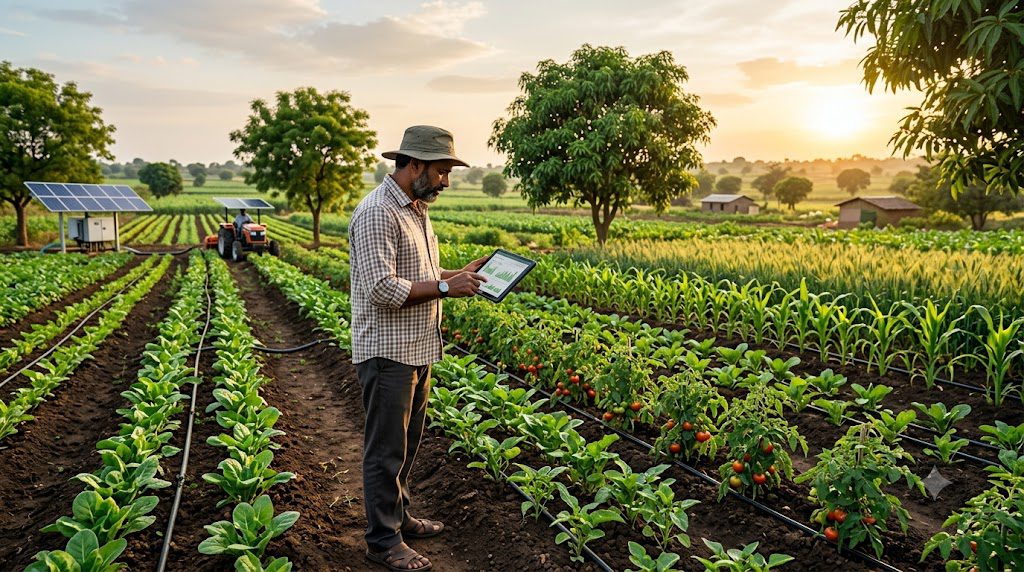
If you’ve spent any time on a farm in the last few years, you’ve probably noticed something. The old playbook spray more, till more, pump more water isn’t working the way it used to. Soil gets tired. Input costs climb every season. And the weather doesn’t follow the calendar anymore.
That’s exactly why sustainable farming has stopped being a buzzword for conferences and turned into something farmers are actually doing, out of necessity as much as principle. It’s not about giving something up. It’s about farming in a way that still works ten years from now, not just this season.
This guide walks through what sustainable farming actually looks like on the ground in 2026 the practices, the real benefits, the honest challenges, and how to start without turning your whole operation upside down.
What Does Sustainable Farming Actually Mean?
Let’s clear something up first, because the term gets thrown around loosely.
Sustainable farming isn’t a single method. It’s a goal growing food in a way that protects soil, water, and biodiversity while still being profitable enough to keep the farm running. It borrows from several approaches: organic farming, regenerative agriculture, climate-smart farming, and precision resource management. None of these are identical, but they all point in the same direction.
Here’s the simplest way to think about it: conventional farming often asks, “how do I get the most out of this field this year?” Sustainable farming asks, “how do I keep getting a good yield from this field for the next twenty years?” Those are two very different questions, and they lead to very different decisions.
The Food and Agriculture Organization of the United Nations frames it well: sustainable agriculture has to meet the needs of today without compromising profitability, environmental health, or social equity for the future. That’s the balancing act every practice in this guide is trying to solve for.
Why Sustainable Farming Is Getting So Much Attention Right Now
A few things are pushing sustainable farming from “nice idea” to “necessary shift” this year.
Soil is running out of patience. Decades of intensive tillage and heavy chemical input have left a lot of farmland with degraded structure and thinning topsoil. You can mask that problem with more fertilizer for a while, but eventually the soil stops cooperating no matter how much you add.
Water is getting harder to count on. Whether it’s drought in one region or unpredictable monsoons in another, water scarcity is now a planning problem, not just a bad-year problem. Farms that rely on efficient, low-waste water use are simply more resilient when the rains don’t show up on schedule.
Buyers and regulators are asking harder questions. From export markets to local retailers, more of the supply chain now wants proof of sustainable practices not just a claim on a label. Farms that can actually show it have an easier time accessing premium markets and staying ahead of tightening environmental rules.
Input costs aren’t going back down. Fertilizer, diesel, and pesticide prices have all been volatile. Sustainable methods that reduce dependency on purchased inputs aren’t just good for the environment they’re a direct hedge against cost spikes.
Global organic and sustainable farmland is genuinely growing. This isn’t a niche trend anymore. Certified organic and sustainably managed farmland has been expanding steadily worldwide, which tells you this shift has real market backing, not just good intentions.
Core Sustainable Farming Practices Worth Adopting
Let’s get practical. These are the methods doing the most work in 2026, and most of them can be adopted gradually rather than all at once.
1. Crop Rotation and Diversification
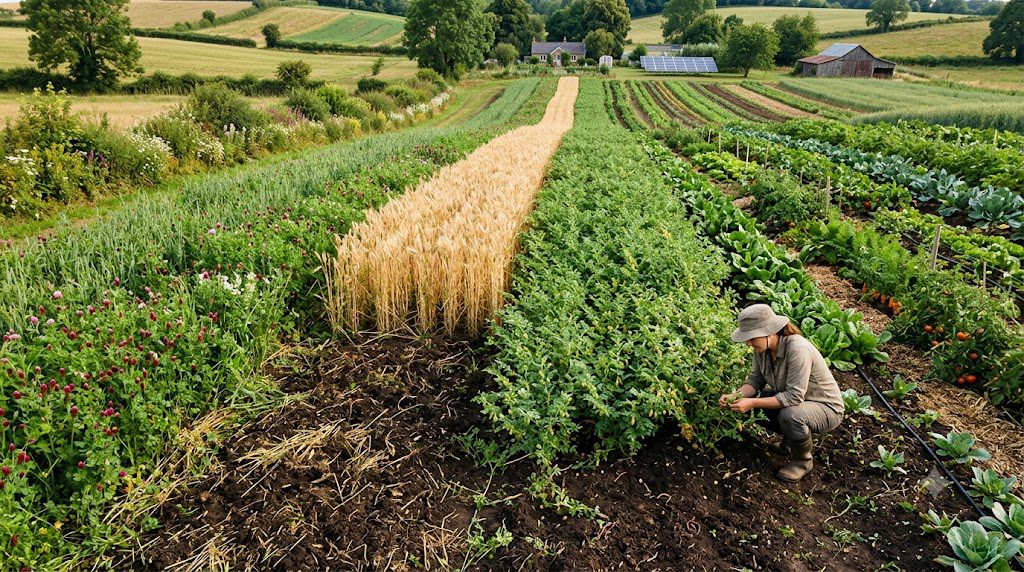
Planting the same crop in the same field year after year drains specific nutrients and gives pests and diseases a predictable target. Rotating crops say, alternating a nitrogen-hungry crop with a nitrogen-fixing legume naturally restores soil balance and breaks pest cycles without extra chemical input.
Diversification takes this further. A farm growing a mix of cereals, pulses, and vegetables is far less exposed to a single price crash or a single pest outbreak than a farm betting everything on one crop. If you want to go deeper on this specific practice, our guide on multiple cropping and mixed cultivation breaks down exactly how rotation sequences like wheat-to-legume work to rebuild soil nitrogen naturally.
2. Cover Cropping
Bare soil between growing seasons is a missed opportunity and a risk. It erodes, loses moisture, and lets weeds take over. Cover crops, planted specifically to protect and enrich the soil rather than to harvest, keep the ground covered, add organic matter, and suppress weeds naturally.
Legume cover crops like clover or vetch have the added benefit of fixing nitrogen in the soil, cutting down on how much synthetic fertilizer you need for the next cash crop.
3. No-Till and Reduced Tillage
Every time soil is heavily tilled, its structure breaks down a little more. Microbial life gets disrupted, organic matter oxidizes faster, and erosion risk climbs. No-till and reduced-tillage systems leave soil structure largely intact, which over time improves water retention and builds up organic carbon.
This isn’t an overnight switch for every operation soil type and crop matter a lot here but even partial reduced-tillage adoption tends to show soil health improvements within a few seasons. The USDA Natural Resources Conservation Service defines soil health as the soil’s ongoing capacity to function as a living ecosystem, not just a growing medium a useful reminder that healthy soil is doing far more work than most farms give it credit for.
4. Efficient Water Management
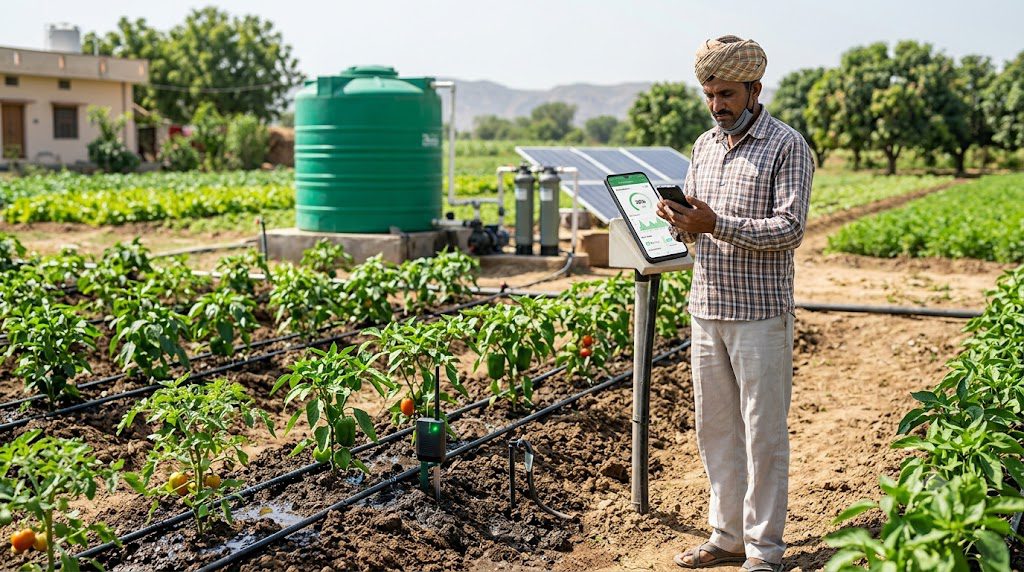
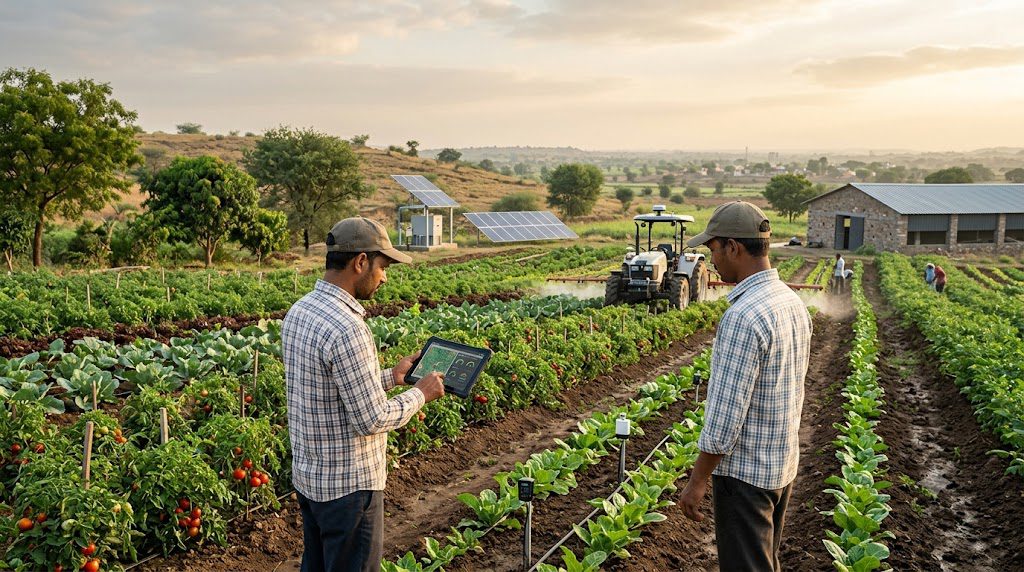
Drip irrigation and precision water scheduling deliver water directly to the root zone instead of flooding an entire field. That single change alone can cut water usage significantly compared to traditional flood irrigation, while often improving yield consistency because plants get water more evenly.
Pairing this with rainwater harvesting or soil-moisture-based scheduling makes the system even more resilient during dry spells. We’ve covered the specific hardware side of this in our roundup of top farm-tech tools for agriculture, including how sensor-driven irrigation systems decide exactly when and where to water.
5. Integrated Pest and Nutrient Management
Instead of routine, calendar-based spraying, integrated pest management (IPM) uses monitoring, natural predators, resistant crop varieties, and targeted intervention only when pest levels actually cross a damage threshold. It reduces chemical use, cuts cost, and slows down pest resistance a problem that gets worse the more blanket spraying you do.
The same logic applies to nutrients: testing soil and applying exactly what’s needed, rather than a standard dose across the whole field, avoids both waste and runoff pollution.
6. Composting and Circular Waste Systems
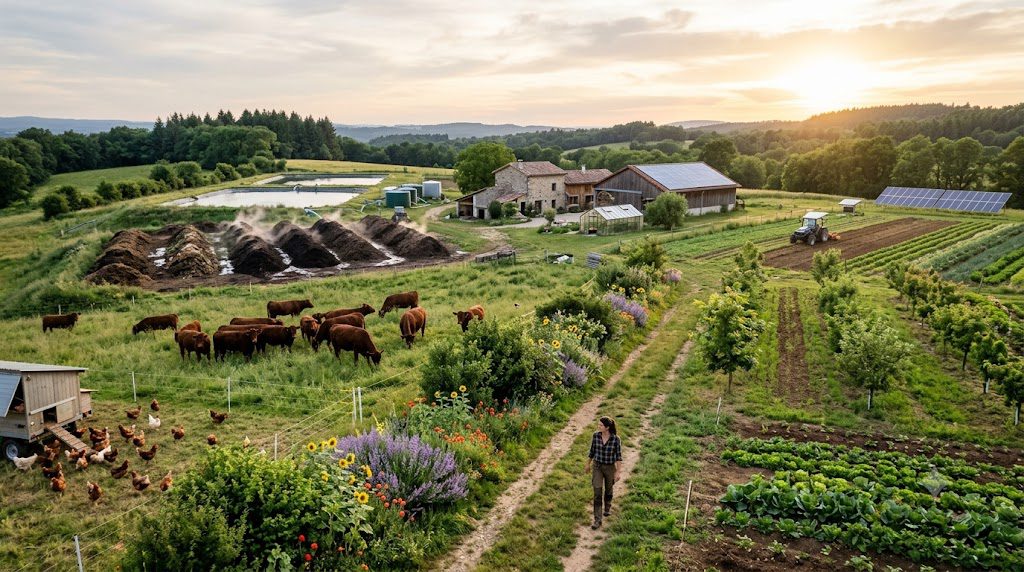
Crop residue, livestock manure, and farm processing waste don’t have to be a disposal problem. Composted and returned to the field, they close the nutrient loop, cut fertilizer costs, and reduce greenhouse gas emissions that come from waste left to decompose unmanaged.
Anaerobic digestion takes this a step further on larger operations, turning organic waste into both fertilizer and usable biogas energy. Composting and biofertilizers are also central to certified organic systems our beginner’s guide to organic farming in India covers how these inputs translate into a viable business model, not just an environmental one.
7. Agroforestry and Biodiversity Integration
Mixing trees, shrubs, or hedgerows into a farming system isn’t just about aesthetics. Trees stabilize soil, provide windbreaks, support pollinators, and can add a secondary income stream through fruit, timber, or fodder. Farms with more biodiversity built into their layout also tend to bounce back faster after a bad season, simply because they’re not depending on one single output.
8. Rotational Grazing for Livestock
For livestock operations, sustainable farming often means rotational grazing regularly moving animals between paddocks so pastures get time to regenerate instead of being grazed down to bare ground. This improves pasture health, reduces methane-heavy overgrazing, and tends to improve animal health outcomes as a side benefit.
9. Digital Monitoring for Resource Efficiency
Sustainable farming and technology aren’t in competition they work together. Soil sensors, satellite-based crop health monitoring, and simple mobile-based advisory tools let farmers apply exactly what’s needed, exactly when it’s needed.
That precision is often what separates sustainable practices that pencil out financially from ones that sound good but quietly cost more to run. Pairing this monitoring with renewable power like the solar-powered farm machinery now becoming more accessible through subsidy programs cuts the fuel-cost side of sustainability too, not just the input side.
Smaller operations aren’t locked out of any of this. Many of the same monitoring and diversification principles behind large-scale sustainable farming are things smallholders have practiced by necessity for generations our piece on subsistence farming and its core insights is a good look at how small parcels of land use crop diversity and water conservation to stay resilient without industrial-scale budgets.
The Real Benefits of Sustainable Farming
It’s worth being specific here, because “good for the planet” isn’t enough of a reason for most working farms. The benefits need to show up on the balance sheet too.
- Lower long-term input costs : healthier soil and better nutrient cycling reduce dependence on purchased fertilizer over time
- More stable yields : diversified, resilient systems handle a bad weather year better than a single-crop, high-input system
- Improved soil value : healthier soil is a genuine long-term asset, not just an environmental talking point
- Better access to premium and export markets : more buyers now specifically seek out sustainably grown produce
- Reduced water and input waste : precision practices cut cost while cutting resource use, not one or the other
- Stronger resilience to climate volatility : diversified, soil-healthy systems recover faster from drought, flood, or heat stress
- Potential new income streams : carbon credit programs and sustainability-linked payment schemes are increasingly rewarding farms that can document these practices
Honest Challenges of Switching to Sustainable Farming
This wouldn’t be a fair guide if it skipped the hard parts.
The transition period can be rough. Soil that’s been intensively farmed for years doesn’t bounce back to full health in one season. Yields can dip temporarily during the shift toward practices like reduced tillage or organic input systems, before they recover and often exceed previous levels.
Upfront costs exist. Drip irrigation systems, soil sensors, and even the labor of building compost systems all cost money and time before they pay off. For smaller farms operating on tight margins, that upfront investment is a genuine barrier, not just a mindset issue.
Certification and documentation take effort. If you want to access premium sustainable or organic markets, you’ll usually need to prove your practices through certification and that process takes time, paperwork, and sometimes inspection costs.
Knowledge gaps are real. Not every region has strong extension services or local expertise in regenerative and sustainable methods. Farmers switching practices often have to learn through trial, error, and whatever community knowledge they can access.
None of these challenges are reasons to avoid sustainable farming. They’re reasons to go into it with a realistic plan instead of an all-or-nothing mindset.
How to Start Transitioning Toward Sustainable Farming
You don’t need to convert your entire farm overnight. In fact, trying to do that is one of the most common reasons transitions fail.
- Pick one practice with a fast payoff. Cover cropping or basic drip irrigation tend to show visible benefits within one or two seasons, which builds confidence for bigger changes later.
- Test on a portion of your land first. Run the new practice on a section of your fields while keeping the rest under your current system, so you have a direct before-and-after comparison.
- Get your soil tested before you start. You can’t measure improvement if you don’t know your starting point. A baseline soil test is one of the cheapest, highest-value steps in this whole process.
- Layer in practices gradually. Add cover cropping this season, reduced tillage next season, integrated pest management the season after. Stacking changes slowly is far more manageable than switching everything at once.
- Track the numbers, not just the soil. Input costs, yield, and water usage before and after each change tell you what’s actually working on your specific land not just what worked somewhere else.
Funding, Subsidies, and Support Worth Knowing About
One of the biggest myths about sustainable farming is that farmers have to absorb the entire cost of transition on their own. That’s rarely true anymore, though the support varies a lot by region and isn’t always easy to find without asking.
Government subsidy schemes. Many countries now offer direct subsidies for equipment like drip irrigation systems, solar-powered pumps, and soil-testing services, specifically because governments have an interest in reducing water stress and fossil fuel dependency in agriculture.
These programs are often underused simply because farmers don’t know they exist or find the application process confusing. A conversation with your local agricultural extension office is usually the fastest way to find out what’s actually available in your area.
Carbon credit and sustainability payment programs. These are still relatively new, but they’re growing. Some agribusinesses and retailers now pay farmers directly for verified practices reduced tillage, cover cropping, or measurable reductions in emissions that support their own sustainability commitments.
The catch is that most of these programs require documentation and, in some cases, third-party verification, so it helps to start tracking your practices now even if you’re not enrolled in a program yet.
Cooperative and community-based support. Not every solution has to come from government or agribusiness. Farming cooperatives increasingly pool resources for shared equipment a community-owned drip irrigation system or composting facility can make sustainable practices financially viable for smallholders who couldn’t afford the equipment individually.
If a cooperative in your area doesn’t already do this, it’s worth raising as an idea; the collective economics often work out better than anyone expects.
Bank and lender-backed sustainability loans. Some agricultural lenders now offer better loan terms for equipment tied to sustainable or water-efficient practices, treating it as lower-risk lending because these farms tend to be more resilient during bad seasons. It’s worth asking your lender directly rather than assuming standard loan terms are the only option.
None of this makes the transition free. But it does mean the upfront cost barrier is usually smaller than it first appears, provided you’re willing to spend a bit of time finding out what’s actually on offer in your specific region.
What’s Next for Sustainable Farming
A few things are likely to shape where this goes over the next few years. Carbon farming getting paid for practices that capture and store carbon in soil is moving from pilot programs into more mainstream payment schemes. Digital traceability is becoming a real market requirement rather than a nice-to-have, especially for farms selling into export or premium retail channels.
And climate-smart crop varieties, bred specifically for drought or heat resilience, are becoming more accessible to everyday farmers rather than just research stations.
The direction is consistent: sustainable farming is shifting from something farmers do because it’s the right thing, to something the market and the climate are increasingly requiring.
Frequently Asked Questions
Is sustainable farming more expensive than conventional farming? It can involve higher upfront costs for things like irrigation upgrades or soil testing, but it typically reduces ongoing input costs over time. Most farms see the financial benefit show up over several seasons, not immediately.
Does sustainable farming mean lower yields? Not necessarily, and often the opposite over the long run. There can be a temporary dip during the transition period as soil health rebuilds, but many sustainable systems match or exceed conventional yields once established, while being more resilient in bad weather years.
What’s the difference between sustainable farming and organic farming? Organic farming is a certified, regulated practice that avoids synthetic inputs entirely. Sustainable farming is a broader goal that can include organic methods but also covers things like precision resource use, integrated pest management, and soil health practices that don’t require formal organic certification.
Can smallholder farmers realistically adopt sustainable farming practices? Yes, and often more easily than large operations, since practices like composting, cover cropping, and crop rotation don’t require expensive equipment. The bigger barrier for smallholders is usually access to knowledge and initial capital, not the practices themselves.
How long does it take to see results from sustainable farming practices? Some changes, like cover cropping, show visible soil improvement within one season. Deeper changes, like rebuilding organic matter through reduced tillage, typically take three to five years to fully show up in yield and soil-health data.
Are there subsidies or funding available to help farmers switch to sustainable practices? Yes, in most regions. Government agricultural departments frequently offer subsidies for drip irrigation, solar pumps, and soil testing, and some agribusinesses now run direct sustainability payment programs. Availability varies significantly by region, so checking with a local agricultural extension office is the most reliable way to find out what applies to your farm specifically.
Final Thoughts
Sustainable farming isn’t about farming less. It’s about farming smarter, with an eye on what your land will still be capable of a decade from now. The farms that get ahead of this shift even gradually, even one practice at a time are the ones that’ll be in the best position when water gets tighter, input costs climb again, or buyers start asking harder questions about how their food was grown.
Start small, measure honestly, and build from there. That’s really the whole strategy.
Pingback: Laser Weeding Technology: 7 Incredible Ways It's Changing Farming in 2026 -
Pingback: Crop Insurance for Farmers: 10 Essential Facts to Protect Your Harvest in 2026 -
Pingback: PM-KUSUM Scheme: 9 Powerful Facts Farmers Should Verify Before Applying in 2026 -