
Table of Contents
Why Heat Stress Deserves More Attention Than It Gets
Heat stress in cattle is one of the most economically significant, best-documented, and most preventable production losses in the industry yet every summer, producers still watch milk tanks read lighter and conception rates slip, often chalking it up to “just a hot year.” That framing undersells what’s actually happening. The research quantifying this problem goes back more than two decades and leaves little ambiguity about the cause.
The foundational estimate still cited across extension literature comes from a 2003 Journal of Dairy Science analysis by St-Pierre, Cobanov, and Schnitkey, which put total annual heat stress losses to U.S.
livestock industries at roughly $1.7 to $2.3 billion, with dairy cattle absorbing more than half of that figure. Adjusted for inflation, researchers at Washington State University’s veterinary extension program have since noted that figure would exceed $2.9 billion in 2024 dollars and that’s before accounting for more frequent extreme-heat events in recent years.
This isn’t an abstract risk. In June 2022, a sudden heat spike in southwestern Kansas combining temperatures over 100°F, a sharp humidity increase, and an unusual drop in wind speed killed an estimated 2,000 to 10,000 feedlot cattle in a matter of days, according to reporting from the Associated Press and the Kansas Department of Health and Environment.
At roughly $2,000 per head, that single event represented tens of millions of dollars in direct losses, on top of the chronic, less visible costs discussed throughout this article.
This piece walks through what heat stress actually does physiologically, what documented on-farm trials have found when producers implemented cooling systems, what the real economics look like for both dairy and beef operations, and where the science is still uncertain. The goal isn’t to sell you a fan system it’s to give you enough grounded information to make that call yourself.
What Heat Stress Actually Is: The Science Behind the Temperature-Humidity Index
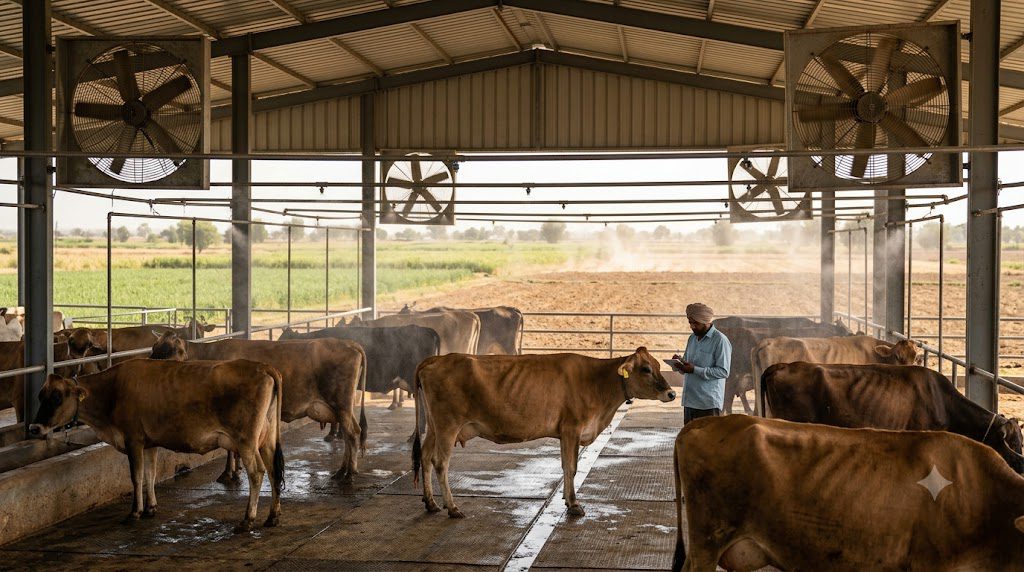
Heat stress in cattle isn’t simply “when it’s hot outside.” It’s a measurable physiological state triggered once a combination of ambient temperature and humidity expressed as the Temperature-Humidity Index (THI) crosses a threshold at which an animal can no longer dissipate body heat efficiently.
Research by Ravagnolo et al. (2000) and Jordan (2003) established that heat stress in dairy cattle begins at a THI of approximately 72. In practical terms, that threshold translates to roughly:
| Humidity | Temperature at which THI = 72 |
|---|---|
| 100% | 72°F |
| 50% | 77°F |
| 20% | 82°F |
More recent work by Collier et al. (2011) found that high-producing modern dairy cows which generate substantially more metabolic heat than cows of even 20 years ago due to genetic selection for milk yield may begin experiencing measurable heat stress at a THI as low as 68, meaningfully lower than the older 72 threshold most extension guides still reference.
This is a genuinely nuanced, practitioner-level detail: a herd manager relying only on the older 72-threshold guidance may be underestimating how early in the season abatement needs to start.
A related but distinct point, elaborated on further below: cattle are homeotherms, meaning they actively regulate body temperature across a range of conditions but that regulatory capacity has limits, and those limits are also shaped by breed, hide color, body condition, and acclimation to prior weather patterns, not just current-day temperature.
Once a cow crosses the relevant threshold, several things happen in sequence:
- Feed intake drops, as the animal reduces consumption to lower metabolic heat production.
- Respiration rate and standing time increase, both energy-costly behaviors the animal uses to shed heat.
- Blood is redirected to the skin for heat dissipation, away from the digestive tract and reproductive organs.
- Milk synthesis and conception rates decline, sometimes with a lag effect that shows up weeks after the actual heat event.
The American Association of Bovine Practitioners’ heat stress handbook notes that the THI threshold for reproductive performance (65) is actually lower than the threshold for milk production (72) meaning fertility problems can begin before a producer notices any drop in the tank.
What Real Farms Have Found When They Tested Cooling Systems
Published estimates only tell part of the story. What separates genuinely useful guidance from theoretical advice is what happens when real operations test these systems under commercial conditions and there’s a solid body of documented on-farm research to draw from.
The Miner Institute / Northern New York study. A multi-farm research program funded by the Northern New York Agricultural Development Program and conducted by the W.H. Miner Agricultural Research Institute tested heat abatement changes across four commercial dairy farms.
On one participating farm, simply adjusting fan angle and closing barn-end doors to improve airflow direction increased cow lying time by one hour during hot weather. According to Miner Institute Director of Research Katie Ballard, that single change represented “the opportunity for 2 to 3-and-a-half more pounds of milk per day per cow” a meaningful return from a change that cost the farm nothing beyond adjusting existing equipment.
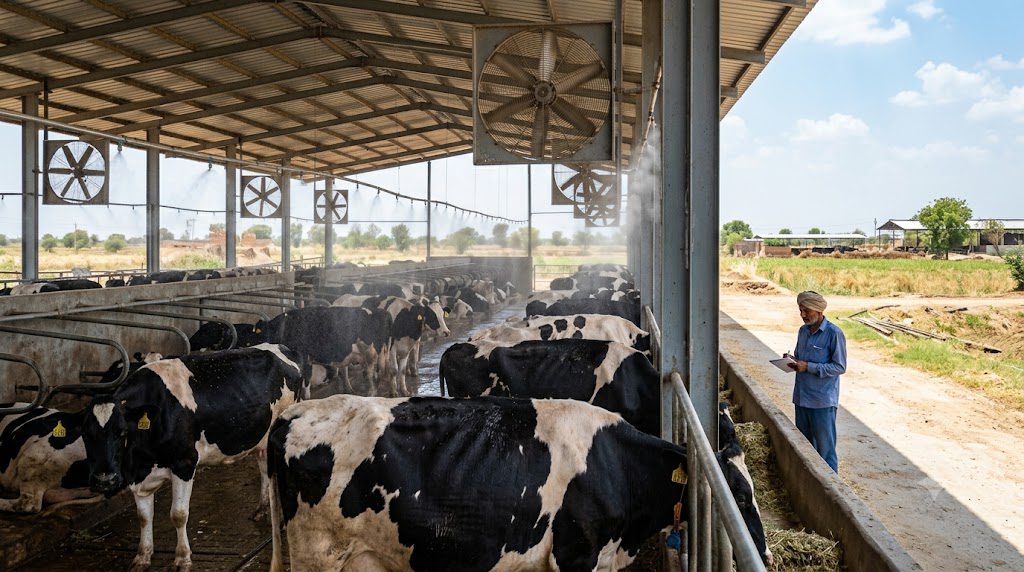
The Kansas State University freestall trials. Researchers at Kansas State evaluated three different fan configurations across a commercial four-row freestall barn in northeast Kansas, using 93 multiparous Holstein cows. Cows cooled by fans placed over both the freestalls and the feed line produced significantly more milk (98.8 lb/cow/day) than cows cooled by freestall fans alone (93.9 lb/cow/day) a difference of nearly 5 lbs/cow/day purely from fan placement, not fan quantity.
A related two-row barn trial found that properly designed sprinkler-and-fan systems returned over $10,000 per pen per year above ownership and operating costs, based on the well-documented 20% milk production decline that occurs in uncooled herds during summer months.
UF/IFAS Extension’s producer survey. A University of Florida survey of commercial dairies found that two-thirds of producers ran their fan and sprinkler systems on automated temperature controls rather than fixed schedules fans triggering around 66°F on average, sprinklers around 71°F allowing them to avoid running (and paying for) cooling systems when they weren’t actually needed.
Producers cited milk production, cow comfort, and herd health nearly unanimously as their reasons for investing in abatement, but notably, most were not extending the same cooling investment to dry cows and heifers a gap the same research flags as a missed opportunity, discussed below.
The consistent thread across all three: placement, timing, and automation mattered more than raw equipment spend. A farm that installs the right number of fans in the wrong location, or runs sprinklers on a fixed schedule instead of a temperature trigger, leaves real money and cow comfort on the table.
The Economic Case: What the Research Says It Actually Costs
Here’s where a lot of livestock content gets vague, so let’s stay specific.
St-Pierre et al. (2003) calculated that even with optimal heat abatement systems already in place, the U.S. dairy industry still lost an estimated $897 million annually to heat stress equivalent to roughly $100 per cow per year in unavoidable loss. Without any abatement systems, that annual loss rose to $1.5 billion, or about $167 per cow per year, based on a national dairy herd of roughly 9.2 million cows at the time of the study.
A separate breakdown, published in the Brazilian Journal of Animal Science and drawing on the same underlying research, puts average U.S. summer-season heat stress losses across all livestock species at approximately $2.4 billion, of which $369 million is specifically attributed to feedlot cattle a useful figure for beef-side operations that don’t map cleanly onto dairy-focused cost estimates.
Put simply: heat abatement doesn’t eliminate the cost of heat stress, but the research indicates it can cut per-cow losses by roughly 40% in dairy operations. Scaled across a 500-cow herd, that’s the difference between an estimated $50,000 and $83,500 in annual heat-related losses a gap of over $33,000 a year that a properly designed cooling system is working to close.
The cost side varies far more by region, facility design, and existing infrastructure than any single number can capture responsibly. What the research does support consistently:
- Fan and sprinkler retrofits to existing freestall barns tend to pay back within a single cooling season when milk price and herd size are favorable, based on the Kansas State pen-level economics.
- Simple, no-cost adjustments (fan angle, airflow direction, closing barn openings to direct air where cows congregate) can produce measurable gains before any capital investment is made the Miner Institute finding above is a good example.
- Automated temperature/humidity-triggered controls reduce operating costs relative to fixed-schedule systems, per the UF/IFAS survey data.
- For feedlot operations, the largest financial risk isn’t chronic productivity loss it’s acute mortality events during sudden heat spikes, which the Kansas 2022 event illustrates can eclipse an entire season’s worth of gradual losses in a single week.
Heat Abatement Methods, Ranked by What the Data Supports
Shade and Airflow
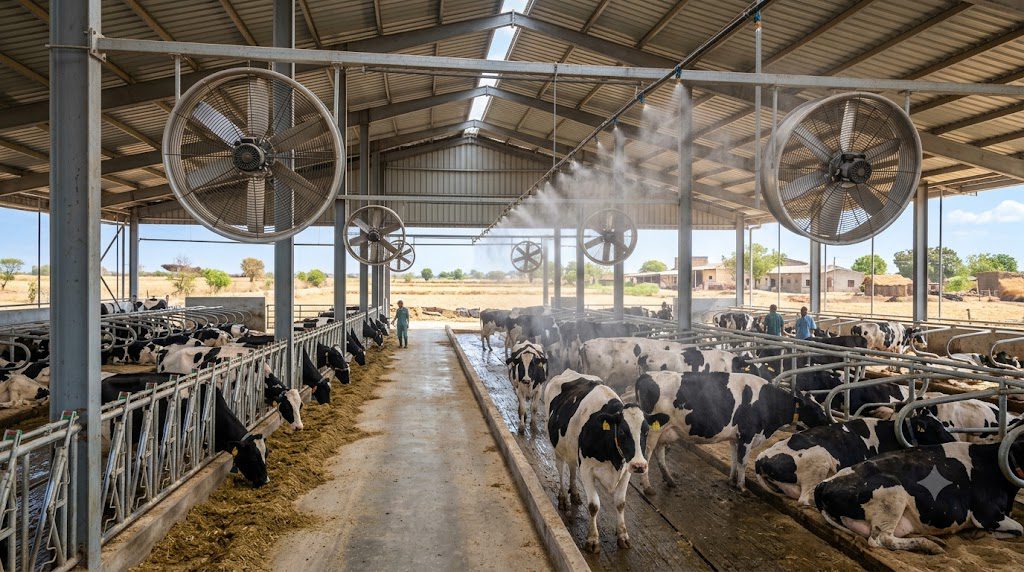
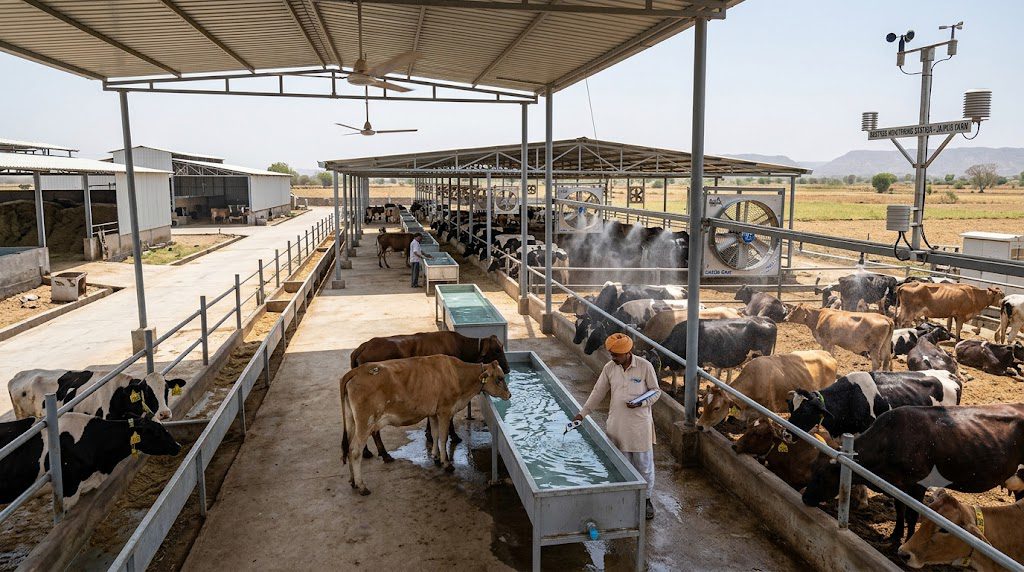
The AABP heat stress handbook lists shade and passive ventilation (open sidewalls, ridge vents, added circulation) as the foundational, lowest-cost interventions, recommending fans begin running continuously once temperatures reach 68°F, delivering 4–5 mph airspeed over cow beds and feed alleys.
Fan and Sprinkler Combinations
Turner et al. (1992), cited widely across extension literature, found that combined fan-and-sprinkler systems increased feed intake by 9.2% and milk yield by 15.9% relative to no cooling. A separate 30-farm survey in Padova, Italy found a more modest but still meaningful 5.0% milk yield increase specifically attributable to adding sprinklers to farms that already had fan cooling a useful, realistic benchmark rather than a best-case number.
Water Access
Cattle under heat stress can increase water intake to 50–60 gallons per cow per day. The AABP handbook recommends 2–3 feet of linear water space per 10 cows and a minimum of two waterers per group an infrastructure detail that’s cheap to check and easy to overlook.
Feeding Schedule Adjustments
The Padova, Italy survey also found that shifting to twice-daily feed distribution (morning and evening, avoiding peak heat) increased dry matter intake by 9.0% and milk yield by 15.0% compared to once-daily feeding a zero-capital-cost intervention available to nearly any operation.
Beef Cattle and Feedlots: A Different Risk Profile
Most heat stress research and most extension guidance centers on dairy cattle, because that’s where the deepest body of published economic data exists. But beef cattle, particularly in feedlot settings, face a meaningfully different risk profile that deserves its own discussion.
The core distinction: dairy heat stress losses are largely chronic a gradual drop in milk yield and fertility across a hot summer. Feedlot heat stress losses are more often acute and catastrophic, concentrated into short, severe weather events.
The June 2022 southwestern Kansas heat wave is the clearest recent example. According to Kansas State University veterinarian Dr. A.J. Tarpoff, the deaths weren’t caused by high temperature alone they resulted from a rare combination of a sudden temperature spike (from the 70s and 80s into the triple digits within days), a sharp increase in humidity, and an unusual drop in wind speed, which together prevented cattle from acclimating or dissipating heat overnight. Iowa State University veterinarian
Dr. Dan Thomson noted that the absence of nighttime cooling was a critical compounding factor cattle that can’t recover overnight enter the next hot day already heat-loaded.
This acclimation dynamic explains why some of the worst feedlot heat events occur relatively early in summer, when cattle haven’t yet shed their winter coats or adjusted to rising temperatures a detail Kansas Livestock Association spokesperson Scarlett Hagins specifically flagged as a contributing factor in the 2022 event.
Breed and individual animal risk also matter more in feedlot settings than general guidance often acknowledges.
A USDA Agricultural Research Service study conducted with the University of Nebraska-Lincoln, published in Livestock Science (2006), tracked 256 feedlot heifers across four breeds over two summers specifically to identify risk factors for heat stress mortality and morbidity reflecting a well-established pattern in the industry that cattle with darker hides, heavier body condition, and less Bos indicus genetic influence (breeds like Brahman, which evolved in tropical climates and carry greater innate heat tolerance) face measurably higher heat stress risk than lighter-hided, leaner, or Bos indicus-influenced cattle under identical conditions.
Practical feedlot-specific mitigation, per Kansas Livestock Association guidance following the 2022 event, includes providing additional water access points during heat events, shifting feed delivery to avoid digestion coinciding with peak afternoon heat, and using sprinkler systems for direct cooling the same underlying principles as dairy abatement, but deployed with more urgency around short-notice weather forecasting rather than as a fixed seasonal program.
The Overlooked Groups: Dry Cows, Heifers, and In-Utero Effects
Most farms concentrate heat abatement spending on the lactating herd, since that’s where the immediate production loss is visible in the milk tank. But a growing body of research shows this leaves real value and welfare on the table.
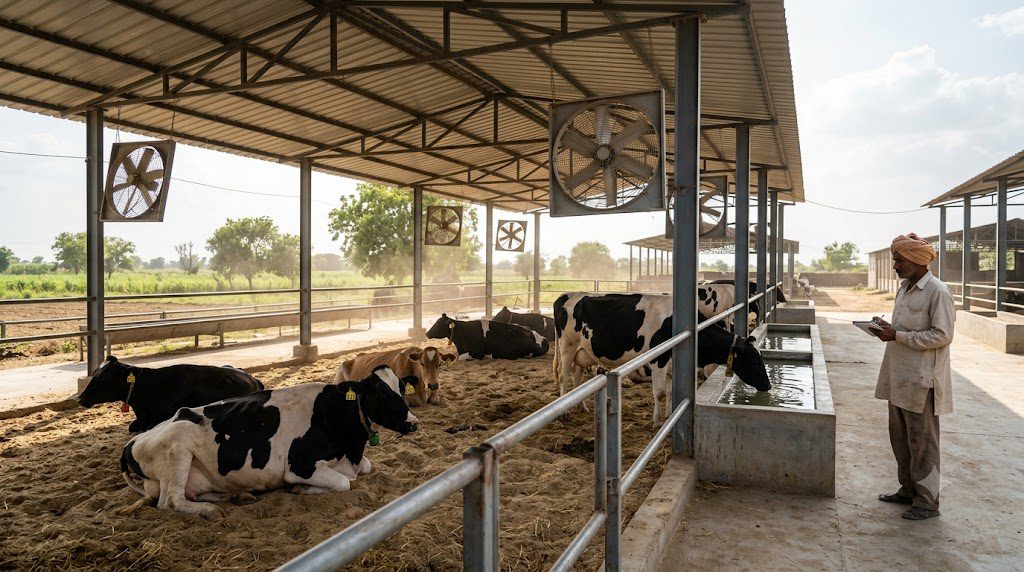
Multiple controlled studies compiled in a Danish dairy extension review found consistent, measurable benefits to cooling dry (non-lactating) cows:
- Avendaño-Reyes et al. (2006): cooled dry cows produced 28.1 kg milk/day in the subsequent lactation vs. 25.4 kg for uncooled cows.
- Adin et al. (2009): cooled dry cows produced 41.4 kg/day vs. 39.3 kg/day, and notably produced significantly more colostrum (8.6 L vs. 6.1 L) with higher colostrum IgG concentration (77.5 g/L vs. 56.8 g/L), directly benefiting calf immunity.
Perhaps the most striking research concerns in-utero heat stress. Work by Laporta et al. (2020), published in the Journal of Dairy Science, found that late-gestation heat stress in dams reduced calf birth weight by an average of 4.6 kg and weaning weight by 7.1 kg, and shortened the animal’s longevity effects that carried into the next generation as well. Monteiro et al. (2016) similarly found in-utero heat stress reduced calf survival and first-lactation performance.
Yet the UF/IFAS producer survey found dry cows and pre-weaned heifers were routinely excluded from heat abatement investment, largely because the payoff isn’t visible in the same billing cycle. This is a genuine expertise-level insight most general content on this topic misses entirely: the highest-leverage, least-implemented heat stress intervention on many farms isn’t a better sprinkler nozzle it’s simply extending existing cooling infrastructure to the dry pen.
Where the Evidence Is Weaker: Limitations and Open Questions
In the interest of balance, a few caveats worth stating plainly:
- Most economic figures are estimates, not guarantees. The St-Pierre figures are now over two decades old; while WSU Extension’s inflation-adjusted update is a reasonable approximation, actual losses depend heavily on current milk prices, herd genetics, and regional climate, which have all shifted since 2003.
- On-farm trial results don’t always generalize. The Kansas State and Padova studies were conducted on specific barn designs and herd sizes; a tie-stall or pasture-based operation will see different absolute numbers, even if the underlying physiology holds.
- THI thresholds are still being refined. The shift from a 72 to a 68 THI threshold in high-producing cows (Collier et al., 2011) suggests genetics may be outpacing some standard guidance, and further threshold revisions are plausible as herd genetics continue to change.
- Feedlot mortality events are statistically rare but high-consequence, which makes them harder to model with the same rigor as chronic dairy productivity loss the 2022 Kansas event was explicitly described by feedlot operators as a “one in 10-to-20-year” occurrence, not a typical summer outcome, so producers should weight it as tail risk rather than expected annual loss.
- Breed-related risk data is directional, not individualized. Broad breed-level heat tolerance patterns are well documented, but they don’t substitute for monitoring individual animal condition, since body condition, hide color, and prior acclimation vary meaningfully within any breed.
A Practical Heat Stress Action Plan
Based on the research above, a reasonable sequence for evaluating your own operation:
- Install temperature/humidity monitoring in barns, pens, and holding areas rather than relying solely on outdoor weather station data, which can differ meaningfully from in-barn or in-pen conditions.
- Audit current fan placement against the Kansas State findings fans over both freestalls and feed lines outperform freestall-only coverage.
- Switch fixed-schedule sprinklers to temperature-triggered controls if not already automated, per UF/IFAS’s finding that most successful operations use ~66°F (fans) and ~71°F (sprinklers) triggers.
- Extend cooling to the dry pen, prioritizing the last three weeks of gestation given the in-utero research above.
- Reassess water access against the AABP’s 2–3 ft linear space per 10 cows benchmark.
- Revisit your THI threshold assumptions if your herd has high genetic merit for milk production the 68 threshold may apply before the traditional 72 threshold does.
- For feedlot operations, build a short-notice heat response protocol distinct from routine summer management monitor multi-day weather forecasts for the temperature-spike-plus-humidity-plus-low-wind combination that preceded the 2022 Kansas event, and pre-stage additional water access and sprinkler capacity before, not during, a forecast heat spike.
For related management topics, see our guides on barn ventilation design for freestall dairies and transition cow nutrition management.
Frequently Asked Questions
At what temperature does heat stress start in cattle?
There’s no single temperature it depends on humidity, expressed through the Temperature-Humidity Index (THI). Heat stress traditionally begins at a THI of 72 (equivalent to roughly 82°F at 20% humidity, or 72°F at 100% humidity), though research on high-producing dairy cows suggests the effective threshold may be as low as THI 68.
How much does heat stress cost the cattle industry?
Foundational research from St-Pierre et al. (2003) estimated $1.7–2.3 billion annually across U.S. livestock industries, with dairy cattle accounting for over half. A separate breakdown attributes approximately $369 million per summer specifically to feedlot cattle.
Do beef cattle and dairy cattle need different heat stress management?
Yes. Dairy heat stress is typically chronic and gradual, showing up as reduced milk yield and fertility across a season. Feedlot heat stress risk is more often acute, concentrated in short, severe weather events combining high temperature, high humidity, and low wind as seen in the 2022 southwestern Kansas feedlot losses.
Are some cattle breeds more heat-tolerant than others?
Yes, this is well established in the research. Cattle with Bos indicus genetic influence (such as Brahman), lighter hide color, and leaner body condition generally show greater heat tolerance than heavier-bodied, darker-hided Bos taurus cattle under equivalent conditions.
Is it worth cooling dry (non-lactating) cows?
The research says yes, even though it’s the most commonly skipped intervention. Studies show cooled dry cows produce more milk in their next lactation and better-quality colostrum, and avoiding in-utero heat stress protects calf birth weight, survival, and long-term productivity.
Key Takeaways and Next Steps
Heat stress is not a “some summers are just bad” problem it’s a quantifiable, well-researched cost center with genuinely actionable, and often low-cost, interventions, whether you’re managing a dairy herd or a feedlot. The research consistently shows that placement and timing of existing equipment matter as much as capital investment, that the dry pen is an underused lever, that beef and dairy operations face meaningfully different risk profiles, and that genetics may be shifting the temperature threshold at which action is needed.
Your next steps: pull your barn or pen’s THI data against the 68–72°F thresholds discussed above, audit your current fan and sprinkler placement against the Kansas State benchmarks, extend your cooling plan to dry cows before next summer’s heat arrives, and if you operate a feedlot build a short-notice extreme-heat response protocol separate from your routine seasonal management.
Disclaimer: This article is intended for general educational purposes and does not replace veterinary consultation for individual herd health decisions. Economic figures cited reflect published research estimates and will vary by operation, region, and current market conditions.