
Table of Contents
What Are Agricultural Spray Drones?
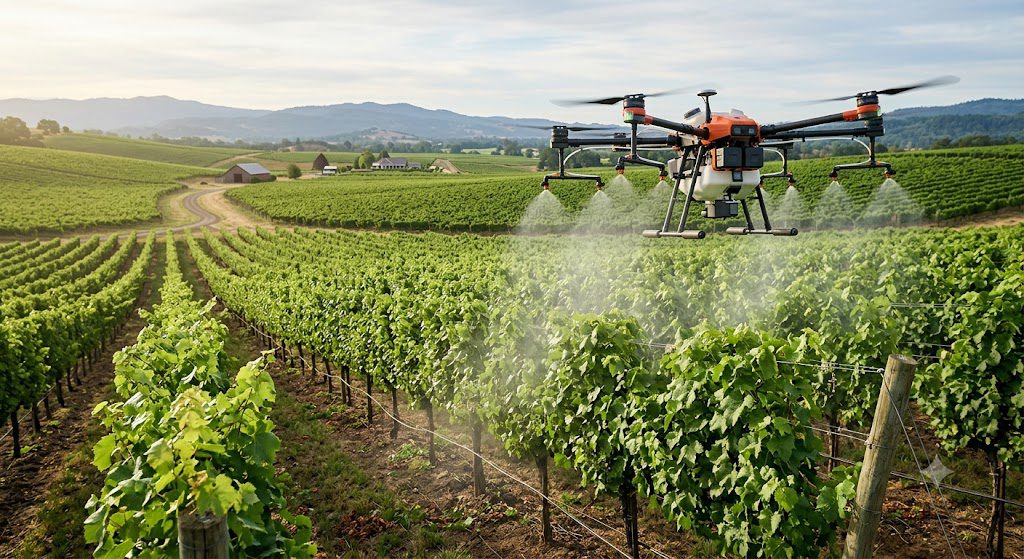
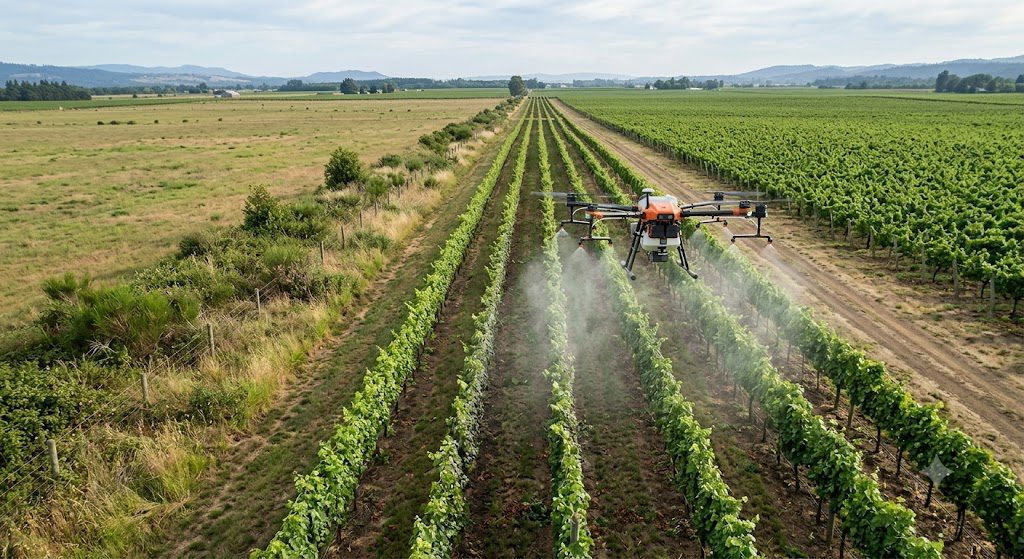
An agricultural spray drone is an unmanned aircraft, usually a multi-rotor, that carries a tank and nozzles and applies crop-protection products over a field or orchard. A flight plan is programmed in advance, and the aircraft flies low and follows it.
Farmers and researchers like agricultural spray drones for a few reasons set out in the peer-reviewed literature. They can fly over steep or uneven ground, they do not compact soil because they never touch it, and the operator does not sit in a tractor cab or drive through treated rows. The published studies also describe low-volume applications, with carrier water volumes far below those of ground sprayers.
That is the case for them. The case against, or at least the case for caution, is mostly about drift: the portion of a spray that leaves the target area on the wind and lands where it should not.
Why Agricultural Spray Drones Are in the Headlines Right Now
Two things are happening at once.
In the United States, the Federal Aviation Administration published a proposed rule in August 2025 for routine flights beyond the pilot’s line of sight, called Part 108.
The proposal says agricultural spraying makes up the vast majority of existing exemptions for drones over 55 pounds, with over 1,700 operator certificates already issued for agricultural operations at the time of publication. The federal docket has since drawn more than one million public comments, and the comment period was reopened in February 2026.
In the European Union, the picture is nearly the opposite. Spraying pesticides from the air is banned by default, and EU law treats a drone as an aircraft for this purpose. A December 2025 European Commission proposal would let member states exempt certain types of drones from that ban.
So agricultural spray drones are booming under one regulatory regime and legally restricted under another. That makes the evidence on whether drones are actually safer more important, not less.
The Claim: “Agricultural Spray Drones Cut Drift by 65–70%”
Search for drone spray drift and you will find a number repeated across the internet: agricultural spray drones reduce drift by roughly 65 to 70 percent compared with conventional sprayers.
The number is real. It comes from a peer-reviewed field study. But as it travels, a condition falls off: it applies “under optimised conditions.” Whether that condition survives in your field is the question this article is built around.
What the Study Actually Measured
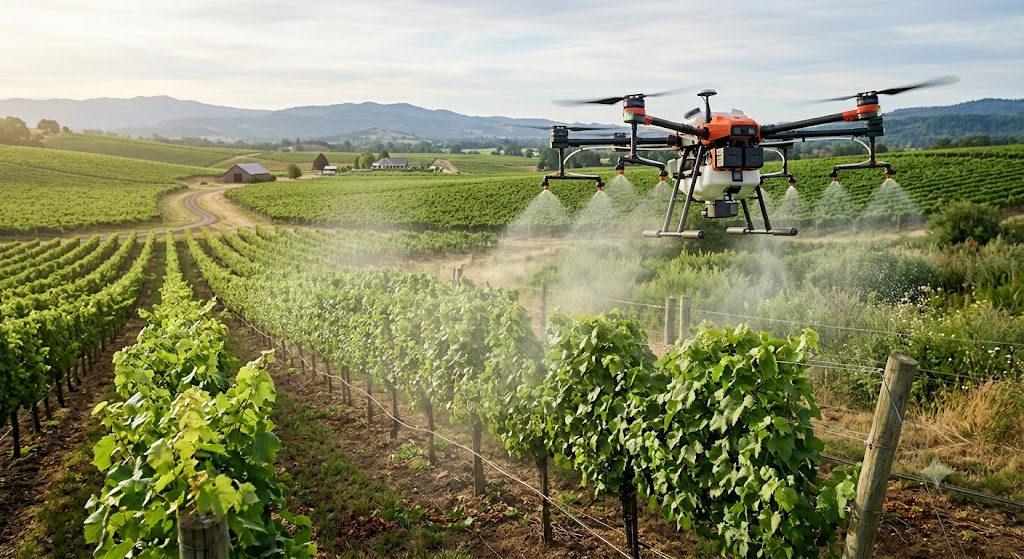
The study behind the number was published in March 2026 in the journal Smart Agricultural Technology, by researchers at the Agricultural University of Athens. It is open access, which means anyone can read it in full. You can find it through its ScienceDirect page.
Here is what the team did:
- Where and when: the university’s experimental vineyard in Spata, Greece, in late July and early August 2024.
- The drone: a DJI Agras T16 hexacopter applying 80 litres per hectare.
- What it was compared with: a conventional trailed air-assisted sprayer, the type commonly called an airblast sprayer, which is the standard tool in vineyards and orchards.
- What varied: two flight altitudes (2.0 m and 2.5 m above ground), two flight speeds (1.0 and 1.5 m/s) and three application strategies (flying between rows with or without an unsprayed buffer line, or flying over the rows with a buffer line).
- How drift was measured: filter-paper collectors set at distances from the field edge out to 30 metres downwind, following the ISO 22866 field-measurement method.
- What was sprayed: water with a dye tracer, not a real pesticide.
That last point is a standard practice in drift research, because it lets scientists measure where spray goes without putting chemicals in the environment. It also means the study measures movement of the spray, not the biological effect on pests or non-target organisms.
Truth 1: The Headline Number Only Holds Under Tuned Settings
Here is the most important finding, and it is the one that rarely makes it into summaries.
Under the best tested settings, the drone drifted far less than the airblast sprayer. The authors report that, compared with the conventional sprayer, optimised drone applications cut drift at the closest sampling point by roughly 65 to 70 percent, and drift became negligible beyond 10 metres downwind.
But under the worst tested settings, the picture changes. The study reports the highest drone drift at 2.5 m altitude, 1.5 m/s speed, flying between rows without a buffer: about 18 percent of the applied spray at the closest sampling point.
The airblast sprayer in the same trial reached almost 17.5 percent at its first sampling location. The authors state that the conventional sprayer produced higher drift in almost all replicates, with the exception of the two least favourable drone trials at 2.5 m altitude with no buffer.
In plain terms: a drone set up badly drifted about as much as the conventional machine it was supposed to improve on. The technology did not fix drift. The settings did.
Truth 2: Altitude Is the Biggest Lever
For agricultural spray drones in this trial, flight altitude was the dominant driver of drift. Raising the aircraft from 2.0 m to 2.5 m increased drift at the closest sampling point by 30 to 70 percent, depending on the configuration.
That is half a metre, easy to drift by without noticing.
The authors explain the mechanism in terms of rotor downwash, the column of air pushed down by the propellers. At lower altitude it is stronger and helps hold droplets against the canopy. Higher up it weakens, and droplets are more exposed to crosswind.
This is why the result matters for farmers hiring a contractor. Altitude is not a marketing spec. It is a setting someone chooses, field by field, and it measurably changes what lands next door.
Truth 3: Buffers Do a Lot of the Work
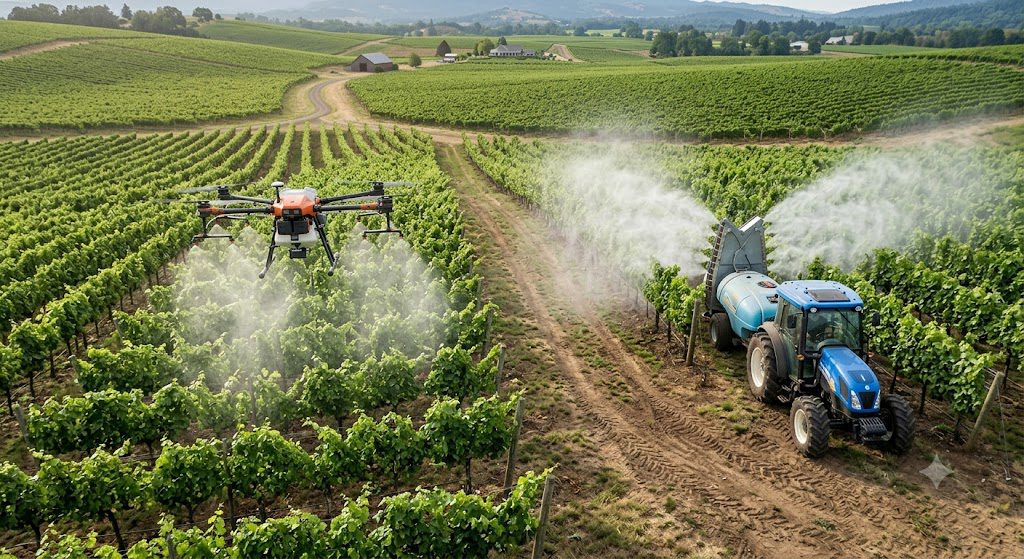
A buffer line, which means leaving the outermost row or corridor unsprayed by the aircraft’s direct path, reduced drift by up to 60 percent in the study, particularly for flying between rows.
The numbers show how much it matters. For the least favourable setting (2.5 m, 1.5 m/s), maximum drift at the nearest sampling point was around 6 percent with a buffer, almost one-third of the figure without one.
Buffers are not unique to agricultural spray drones. They are a long-standing drift-mitigation measure for conventional sprayers too. The study’s conclusion is that they work for drones as well. For a farmer, that is useful and low-tech: ask whether a buffer strategy is part of the flight plan.
Truth 4: Speed Matters, but Less
Flying at 1.5 m/s instead of 1.0 m/s increased drift at the closest sampling point by 10 to 20 percent. The authors link this to finer droplets and greater horizontal momentum at higher speed, with the application volume held constant.
Speed therefore comes second to altitude in this study. It is a smaller lever, but it adds up with the others. The best combination in the trial was low and slow with a buffer: 2.0 m altitude, 1.0 m/s speed and a buffer line. That was the setting under which drift became negligible beyond 10 metres.
Truth 5: One Vineyard, One Drone, One Season
Now the part that should limit how far anyone, including this article, stretches the finding.
- One site. A single experimental vineyard in Greece, with vines about 1.5 m tall and 2 m row spacing.
- One drone model. The DJI Agras T16. Other agricultural spray drones have different rotor designs, nozzles and downwash patterns.
- One short period. Late July to early August 2024, at one growth stage.
- Three replicates per setting. Small by field-trial standards, though normal for this type of work.
- Low wind only. The trial protocol required wind speeds of roughly 1 to 3 m/s, and the recorded averages across treatments ranged from about 1.5 to 2.6 m/s. The study says nothing about stronger wind.
- Dye, not product. It measures spray movement, not pesticide effects.
- Data on request. The paper states data will be made available on request, so outside readers cannot download the raw measurements.
None of this makes the study weak. It is peer-reviewed, open access and carefully designed. But a different crop, canopy density, drone or wind speed could give different numbers.
The study also reports something worth noting: within the tested low-wind range, the aircraft’s settings and the application strategy mattered more than small differences in wind speed. That is the authors’ observation under their conditions, not a licence to spray in the wind.
Truth 6: Rules Are the Real Bottleneck
Even if the drift numbers are good, whether you can legally use agricultural spray drones depends heavily on where you are.
European Union. Article 9 of Directive 2009/128/EC on the sustainable use of pesticides prohibits aerial spraying by aircraft, with limited derogations for special cases. The European Commission’s December 2025 proposal, COM(2025) 1021, would let member states grant a general exemption for certain types of drones identified by the Commission in a delegated act.
It adds a condition: pesticides used this way must be explicitly authorised for drone application under the EU plant-protection-products regulation, following a specific risk assessment. A Council of the EU document from December 2025 (ST 17055/25) discusses the same change.
News coverage in May 2026 reported the Council backing a version of it. As far as I could find, it had not been finalised. Check the current status before relying on this.
A peer-reviewed assessment of drone spraying in Greek viticulture notes that, even with the derogation system, drone spraying is further constrained by other legal texts, which makes the derogation route impractical for many farmers. Regulation also involves multiple authorities, including aviation rules and product-approval rules.
United States. Drone spraying already happens at scale, mostly under individual exemptions and operator certificates. The FAA’s proposed Part 108 would create a standing framework for flying beyond visual line of sight instead of case-by-case approvals.
In its proposal, agricultural operations would sit under a permit system, with permitted agricultural operations limited to the lowest population-density category unless the FAA authorises otherwise.
A third-party regulatory tracker reported on September 18, 2026 that the final rule was still under White House review and had not been published. I could not confirm that against an official source, so check the Federal Register for the latest.
Elsewhere. This article does not cover India, China, Brazil, Australia or other large markets for agricultural spray drones. Rules differ, sometimes sharply, and are not summarised here.
The practical point is simple: for agricultural spray drones, legal status, pesticide-label status and operator certification are separate questions from drift performance. A product may be labelled for ground application but not for drone application, and a drone may be physically capable of an application that the law does not allow.
Truth 7: Efficiency Gains Depend on What You Compare Against
Agricultural spray drones are often described as more efficient, and the research literature gives some support. The Athens paper’s literature review reports that in US trials, drone applications used 50 to 100 litres per hectare while ground sprayers used 500 to 1,000 litres per hectare, according to product label recommendations.
It also notes that in Switzerland, more than half of the roughly 15,700 hectares of vineyards are inaccessible to tractors, and drones are used there in place of helicopter spraying.
These advantages of agricultural spray drones are comparisons against specific alternatives in specific settings. A drone replacing a helicopter on a steep terraced vineyard is a different story from one replacing a tractor on flat farmland. This article has no verified cost data, so it makes no claim about whether drones are cheaper.
Agricultural Spray Drones vs Airblast Sprayers: Side by Side
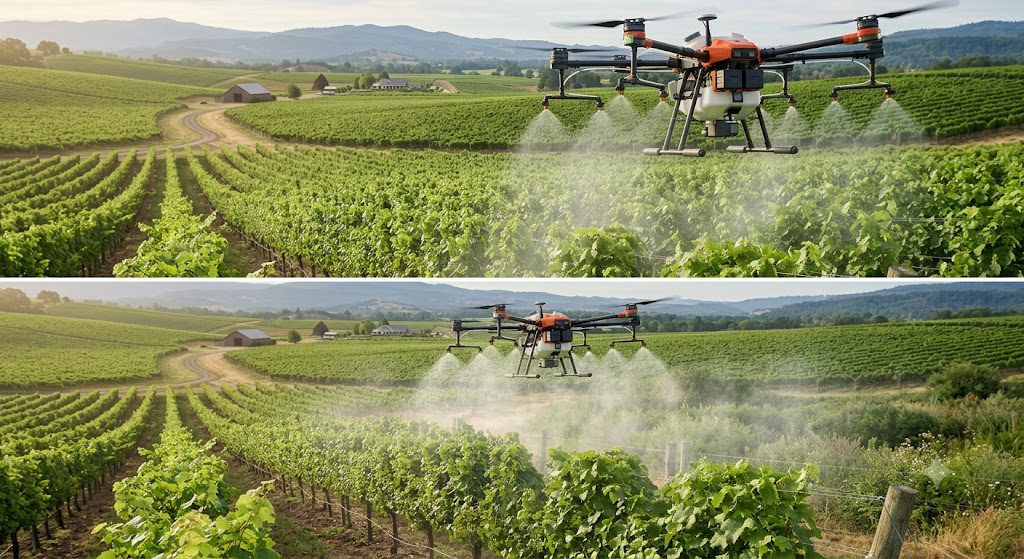
The table summarises what the sources above report. It is a qualitative guide. It is not a purchasing or compliance guide.
| Factor | Agricultural spray drones, tuned settings | Agricultural spray drones, poor settings | Airblast sprayer |
|---|---|---|---|
| Drift at nearest sampling point (Athens vineyard trial) | About 65–70% lower than airblast | About 18% of spray, similar to airblast | Almost 17.5% |
| Key controls | Low altitude, slow speed, buffer line | High altitude, fast speed, no buffer | Nozzles, fan settings, shields, buffers |
| Soil compaction | None (stays airborne) | None | Possible (tractor traffic) |
| Terrain | Suits steep or uneven ground | Same | Limited on steep slopes |
| Typical application volume (per literature review) | Roughly 50–100 L/ha | Same | Roughly 500–1,000 L/ha |
| Legal status | Varies widely by country | Same | Generally established |
| Evidence base | Growing, mostly short-term trials | Same | Long-established |
A Practical Checklist Before You Hire or Buy
If you are a farmer weighing agricultural spray drones or a drone contractor, these questions come straight from what the evidence says matters most. They are conversation starters, not a substitute for professional advice. For wider background, see our drone farming guide, our precision farming guide and our roundup of farm-tech tools.
- Is it legal here? Check aviation rules and whether your jurisdiction allows pesticide application by agricultural spray drones at all.
- Is the product allowed? Confirm that the label and local rules permit that product to be applied by drone.
- What are the flight settings? Ask the operator what altitude, speed and volume they will use, and why.
- Is there a buffer plan? Ask how the edges of your field, and any neighbouring crops, water or homes, will be protected.
- What are the wind limits? Ask what wind conditions stop the operation. The Athens trial of agricultural spray drones covered only low wind.
- Is the operator certified and insured? Ask for proof.
- Can they show results? Ask for coverage and efficacy evidence on crops like yours, not just general claims.
- Who is liable if spray drifts? Get it in writing.
Frequently Asked Questions
Do agricultural spray drones reduce pesticide drift?
They can, under the right settings. In a 2026 peer-reviewed vineyard study in Greece, agricultural spray drones set to low altitude and slow speed with a buffer line cut drift at the closest sampling point by roughly 65 to 70 percent compared with an airblast sprayer. At the worst tested settings, drone drift was about the same as the airblast sprayer.
What matters most for drift from agricultural spray drones?
In that study, flight altitude mattered most. Raising the drone from 2.0 m to 2.5 m increased drift at the nearest point by 30 to 70 percent. Speed and the use of a buffer line also mattered.
Is it legal to use agricultural spray drones?
It depends on the country. In the EU, aerial spraying including by drones is banned by default, with limited derogations, and a Commission proposal from December 2025 would let member states exempt certain drones. In the United States, drone spraying operates under FAA exemptions and operator certificates, and a proposed rule (Part 108) is pending. Check local law.
Can any pesticide be applied by agricultural spray drones?
No. In the EU proposal, products must be explicitly authorised for drone application after a specific risk assessment. Elsewhere, product labels and local rules decide what can be applied this way. Always check the label.
Are agricultural spray drones better than tractors?
It depends on the setting. Drones suit steep or hard-to-access ground and avoid soil compaction, and the literature reports much lower carrier volumes. On flat ground with good tractor access, the advantage is less clear, and this article has no verified cost comparison.
Does wind matter for agricultural spray drones?
Yes, in general. In the Athens trial, wind was kept within a low range of roughly 1 to 3 m/s, and within that range settings mattered more than small wind differences. The study does not tell us what happens in stronger wind.
Final Thought
The most useful lesson from the drift research is that “agricultural spray drones reduce drift” is not a property of the machine. It is a result of how the machine is flown. The same aircraft produced drift roughly equal to a conventional sprayer on its worst settings and far less than it on its best. A half-metre of altitude and an unsprayed buffer row made much of the difference.
For farmers, that shifts the question from “should I use a drone?” to “who is flying it, at what settings, under which rules, and with which product?” Where those have good answers, agricultural spray drones look promising, especially on steep ground. Where nobody can answer them, the technology offers no protection by itself.