
Livestock insurance in India pays compensation when an insured animal dies from disease, accident or another covered cause. Under the National Livestock Mission (NLM), the farmer pays 15 per cent of the premium, the Centre and state share the remaining 85 per cent, and a new central portal now handles enrolment and claims.
This guide explains how livestock insurance works, which animals it covers, how the premium is split, the seven steps to get a policy and how to claim. The figures come from a Business Standard report dated 30 September 2026, which cites NLM guidelines and data given to Parliament.
Subsidy rules and premium rates change by state and by policy year. Check with your state animal husbandry department before you pay anything.
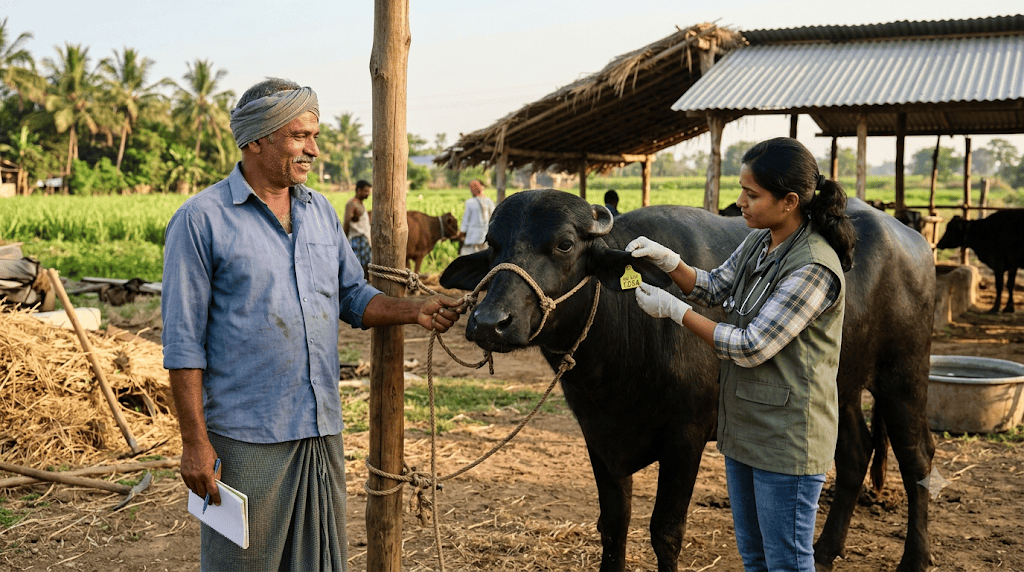
Table of Contents
What Is Livestock Insurance?
Livestock insurance is a policy that compensates you if an insured animal dies. The government-supported version runs as the Livestock Insurance activity of the National Livestock Mission, which the Department of Animal Husbandry and Dairying (DAHD) oversees.
The scheme is built to protect farmers from losses caused by the death of insured animals. Read your policy document before you assume it covers anything else.
States appoint insurance companies through tenders. So the insurer in your district depends on your state, not on your choice.
The NLM began in 2014-15 and was revised in 2021-22. Livestock insurance is not new. What is new is the way it is now administered.
Why Livestock Insurance Matters for Small Farmers
For a household with two or three animals, one death is a large loss. There is no second income waiting behind it.
Uptake of livestock insurance has grown, but it is still low. A research paper cited by Business Standard put coverage at 0.98 per cent. The same report lists the number of animals insured each year:
| Year | Animals insured |
|---|---|
| 2021-22 | 4,63,046 |
| 2022-23 | 11,85,740 |
| 2023-24 | 9,67,632 |
| 2024-25 | 26,69,711 |
The numbers jumped in 2024-25, but they move up and down from year to year. That tells you the scheme depends on funding and on whether your state pushes it.
The research paper named high premiums, slow and labour-intensive claims, low awareness and a lack of region-specific products as the main barriers. The department told a parliamentary committee that shortage of funds and low insurer participation caused the shortfall against targets. It also said insurers are reluctant to work in high-risk North-Eastern and Himalayan regions.
There is a funding gap too. For 2025-26 up to December, states sent proposals worth ₹765.55 crore, and ₹43.60 crore was released because of limited funds. DAHD says there is no fixed outlay. Money goes out based on state demand and availability.
What this means for you: the scheme can exist on paper in your state and still be short of money. Ask your district office if it is active this year.
The New Livestock Insurance Portal
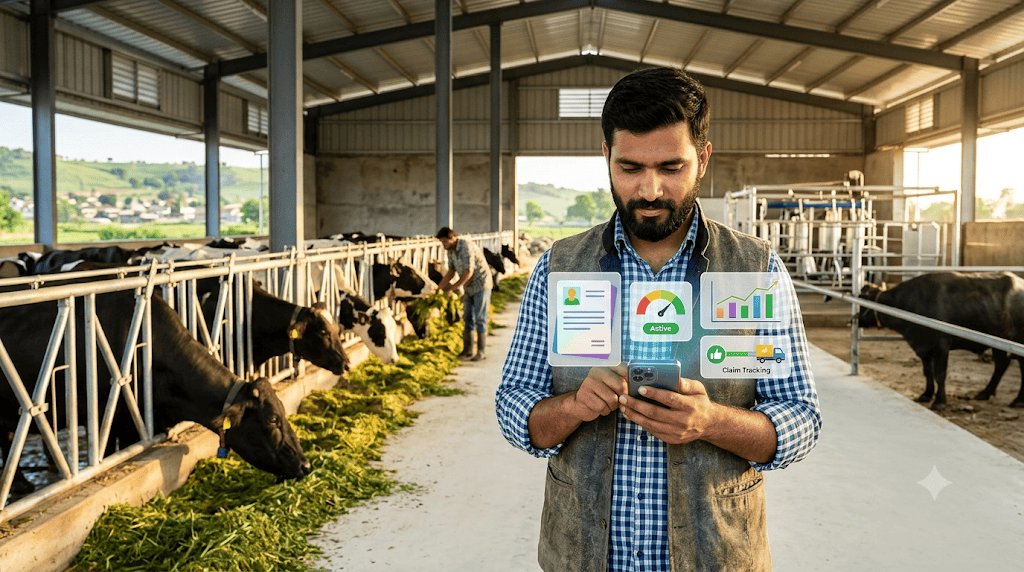
The Centre launched a dedicated portal in the last week of September 2026. It puts policy issuance, premium management, claim processing, beneficiary verification and monitoring on one digital platform.
Before this, the stakeholders handled each stage separately. The government says the portal will:
- simplify and speed up enrolment
- make claim settlement more transparent
- allow real-time tracking of policies
- give farmers and insurers easier access
- improve data for monitoring
The portal is available in Hindi, English and 11 regional languages.
The portal changes how the programme is run, not what it offers. The farmer’s premium share, eligible animals, subsidised limits and Centre-state funding pattern still follow NLM guidelines.
If your state has not onboarded yet, enrolment may still go through the local veterinary office. Ask there first.
Which Animals Does Livestock Insurance Cover?
Livestock insurance covers a wide range of animals under the NLM guidelines:
- Indigenous and crossbred milch animals
- Male cattle and buffaloes
- Pack animals: horses, donkeys, mules, camels and ponies
- Goats, sheep, pigs and rabbits
- Yaks and mithuns
Subsidised cover is limited to 10 cattle units per household. One cattle unit equals 10 small animals such as sheep, goats, pigs or rabbits. For pigs and rabbits, the subsidised limit is five cattle units.
By that arithmetic, the cap is ten cattle, or up to 100 sheep or goats. You can insure more animals by paying the full premium for the extra ones.
State rules can be stricter. An Odisha district document for 2022-23, for example, limited the subsidy to five animals per beneficiary. Treat that as an older example, not today’s rule for your state.
Not sure which animal group your farm falls under? Our guide to livestock categories explains the main types.
How the Livestock Insurance Premium and Subsidy Work
Under current NLM guidelines, the farmer pays 15 per cent of the premium. The other 85 per cent is shared between the Centre and the state.
- Most states: the Centre and state share 60:40.
- North-Eastern and Himalayan states: the split is 90:10.
- Union Territories: the Centre bears the entire government share.
Maximum premium rates depend on the policy period and region, so we are not quoting a rate here. Ask your insurer for the exact amount in rupees before you sign.
You may find older pages quoting 50 or 70 per cent subsidy. Earlier versions of the scheme varied the subsidy by the farmer’s economic category, and some states add their own top-up. Use the current guideline and your state’s notice, not an old web page.
7 Steps to Get Livestock Insurance in India
These seven steps follow the NLM process described in the guidelines. Your state may add its own forms.
Step 1: Check That Livestock Insurance Is Active in Your State
Visit your veterinary hospital or district animal husbandry office. Ask three things: is the scheme running this year, which insurer holds the contract, and where do I enrol.
Step 2: Confirm Your Animals Are Eligible
Match your animals against the covered list above. Check the household limit too. If you keep more than the limit, ask what the full premium would be for the rest.
Step 3: Apply Through the Local Office or Portal
Submit your application with your identity details and animal details. Ask whether your state enrols through the new portal or through the local office.
Step 4: Get the Animal Examined by a Veterinarian
Guidelines require the animal to be identified and examined by a veterinary practitioner before cover starts. An animal that is already sick may not be accepted, so insure early.
Step 5: Agree the Animal’s Value
The market value is assessed jointly by you and the insurer, in front of a veterinary officer. The insured value is set here. Agree a fair market price and get it written down.
Step 6: Tag the Animal and Take Photographs
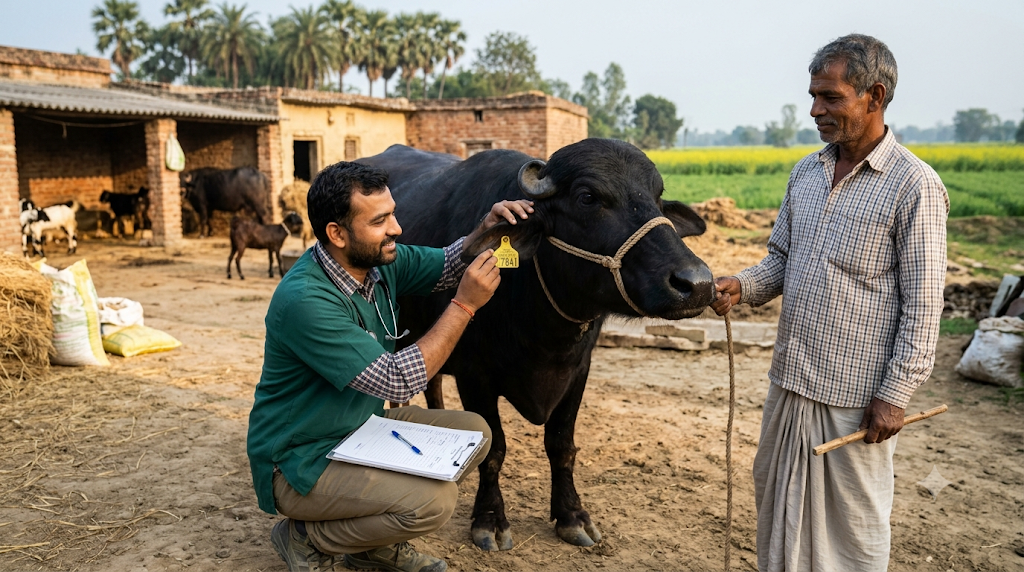
The animal gets an ear tag. Two photographs are needed: one of the animal with you, and one showing the ear tag. Keep copies. Check the tag regularly, because a lost tag can create trouble at claim time.
Step 7: Pay Your Share and Collect the Policy
Pay your 15 per cent premium share and take a receipt. Collect the policy document. Note the policy period, the insurer’s claim number and the veterinary officer’s contact.
How to Claim Livestock Insurance After an Animal Dies
Act on the same day. A delay in telling the insurer is the easiest way to weaken a claim.
- Inform the insurer. Give a claim intimation and note the date and time.
- Call the veterinary officer. A post-mortem report is required, so arrange it before the body is disposed of.
- Collect four documents. The guidelines prescribe the claim intimation, the insurance policy, the claim form and the post-mortem report.
- Submit them and keep a stamped copy. Take photographs of the tagged animal as well.
- Follow up in writing. Keep every receipt and message.
The guidelines say claims should be settled within 15 days of submitting the required documents. If the insurer is late, it is liable to pay 12 per cent compound interest per year to the beneficiary. A delayed or rejected claim must be justified to you.
If you get no answer, write to the insurer and then to your state animal husbandry department. You can also raise a complaint with the insurance regulator, IRDAI.
Is Livestock Insurance Worth the Effort?
For valuable animals, usually yes. Your share of the premium is small compared with the loss of an animal, and the government pays the rest. It works best when one death would hurt your household badly.
But be honest about the weak points. Funds are limited, claims have been described as slow, and the subsidy may not reach your district. If nothing happens, your premium is gone. That is how insurance works.
Start with the animals whose loss would hurt most, usually your milch animals. Keep your paperwork clean, because paperwork decides whether the claim is paid.
Common Livestock Insurance Mistakes
- Insuring an animal only after it falls sick.
- Agreeing a low value just to reduce the premium.
- Losing or removing the ear tag.
- Not keeping photographs and receipts.
- Telling the insurer late.
- Burying the animal before the post-mortem.
- Trusting an old web page for subsidy figures instead of your state notice.
Farmers who also run poultry or goats should check which of their animals qualify. See our guides on dairy farming, goat farming and poultry farming for care and housing practices that keep losses low.
FAQs on Livestock Insurance
1. What is livestock insurance in India?
Livestock insurance in India is a policy that compensates a farmer when an insured animal dies. The subsidised version runs under the National Livestock Mission.
2. Who pays the premium for livestock insurance?
Under current NLM guidelines, the farmer pays 15 per cent. The Centre and the state share the remaining 85 per cent.
3. Does livestock insurance cover goats and sheep?
Yes. Goats, sheep, pigs and rabbits are covered, along with cattle, buffaloes, pack animals, yaks and mithuns.
4. How many animals can I insure with a subsidy?
The subsidised limit is 10 cattle units per household. One unit equals 10 small animals. Pigs and rabbits are capped at five cattle units. Your state may set lower limits.
5. What documents do I need to claim?
You need the claim intimation, the insurance policy, the claim form and the post-mortem report.
6. How long does a claim take?
The guidelines say claims should be settled within 15 days of submitting the required documents. Late payment attracts 12 per cent compound interest per year.
7. Do I need to tag my animal?
Yes. The animal must be examined, valued and tagged before cover begins, and two photographs are needed.
8. What is the new livestock insurance portal?
It is a digital platform launched by the Centre that handles policy issuance, premium management, claims, verification and monitoring in one place. It works in Hindi, English and 11 regional languages.
9. Why is livestock insurance not available in some areas?
Funds depend on state demand and availability, and insurers are appointed by states through tenders. Insurers have been reluctant to work in high-risk North-Eastern and Himalayan regions.
10. Where can I get the latest scheme details?
Check the DAHD website and your state animal husbandry department. Rules, limits and rates change by state and by year.
11. Can I insure an already sick animal under livestock insurance?
Generally, no. Animals that are already sick or suffering from a health condition may not be eligible for livestock insurance. A veterinary practitioner must examine the animal and confirm its health before the insurance coverage begins. Farmers should get their animals insured while they are healthy to avoid problems during enrolment and future claims.
12. How is the insured value of an animal decided?
The insured value of an animal is decided based on its current market value. The farmer and the insurance company jointly assess the animal’s value in the presence of a veterinary officer. Farmers should ensure that the agreed value is fair and properly recorded in the insurance policy, as it determines the compensation they may receive in case of a covered loss.
13. What happens if my insured animal loses its ear tag?
A missing or damaged ear tag can create difficulties during claim verification. Farmers should report the missing tag to the concerned veterinary officer or insurer immediately and follow their instructions.
14. Can I insure more animals than the subsidised limit?
Yes. Farmers can insure additional eligible animals by paying the full premium for animals exceeding the subsidised limit, subject to the applicable insurance arrangements.
15. Does livestock insurance cover every cause of animal death?
No. Coverage depends on the terms and conditions of the insurance policy. Farmers should check the covered risks, exclusions and claim conditions before purchasing the policy.
Conclusion
Livestock insurance is an important way for farmers to protect their animals and reduce financial losses. Under the National Livestock Mission, farmers pay 15% of the premium, while the Centre and state governments cover the remaining 85%.
The new livestock insurance portal is expected to make the process of applying for insurance and tracking claims easier. However, farmers should check the scheme’s availability in their state and understand the policy rules before enrolling.
If you own cattle, buffaloes, goats or other eligible animals, consider getting them insured before an unexpected loss occurs. Keep their ear tags, photographs and insurance documents safe, and inform the insurer immediately if an insured animal dies.
A healthy livestock business needs proper care as well as financial protection. A little preparation today can help farmers handle unexpected losses tomorrow.