
Agritech categories in India fall into nine groups: advisory apps, sensors, drones, digital markets, machinery rental, farm finance, supply chain tools, government platforms, and soil and input technology. A smallholder does not need all nine. Start with the one that fixes your biggest loss.
I wrote this guide as a plain map. The nine agritech categories below explain what each type does, who it suits, what to check before you pay, and which government scheme sits behind it.
No hype here. Many agritech products are built for large farms with good internet. If you farm two acres, your choices look different.
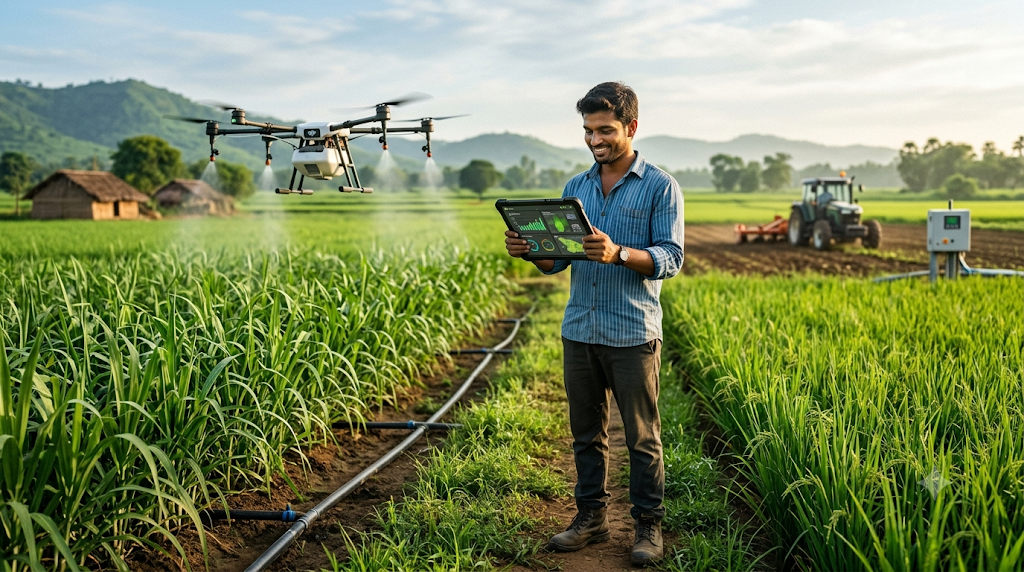
What Are Agritech Categories and Why Do They Matter?
Agritech means any technology used in farming, from a soil-testing kit to a satellite-based crop advisory. Agritech categories are the groups we use to sort that technology by the job it does.
Sorting matters because a farmer’s problems arrive one at a time. Which seed to buy. When to spray. Where to sell. How to get a loan. Each question has a matching category. Mixing them up is how people waste money on the wrong app or device.
The Union Cabinet approved the Digital Agriculture Mission on 2 September 2024 with an outlay of Rs 2,817 crore, as per the PIB document. That mission sits behind several agritech categories in this guide, mainly the digital identity, survey and advisory tools.
Agritech Categories at a Glance
The table gives the short version. Details follow after it.
| # | Category | Problem it solves | Example | Best for |
|---|---|---|---|---|
| 1 | Advisory and AI apps | What to do and when | Kisan Suvidha, mKisan SMS | Every farmer with a phone |
| 2 | Precision farming and sensors | Water and input waste | Soil moisture sensors | Vegetables, orchards, polyhouses |
| 3 | Drones | Slow, costly spraying | Namo Drone Didi service | Farmer groups, SHGs |
| 4 | Digital markets | Poor price access | e-NAM, ONDC | Farmers near integrated mandis |
| 5 | Machinery rental | High machine cost | Custom Hiring Centres | Small and medium holdings |
| 6 | Farm finance and insurance | Credit and risk | KCC, PMFBY, PM-KISAN | All farmers |
| 7 | Supply chain and storage | Post-harvest loss | Warehouses, cold chain | Perishable crop growers |
| 8 | Government digital platforms | Records and scheme access | AgriStack, Farmer ID | All farmers |
| 9 | Soil, seed and input tech | Wrong inputs | Soil Health Card portal | All farmers |
Category 1: Advisory and AI Apps
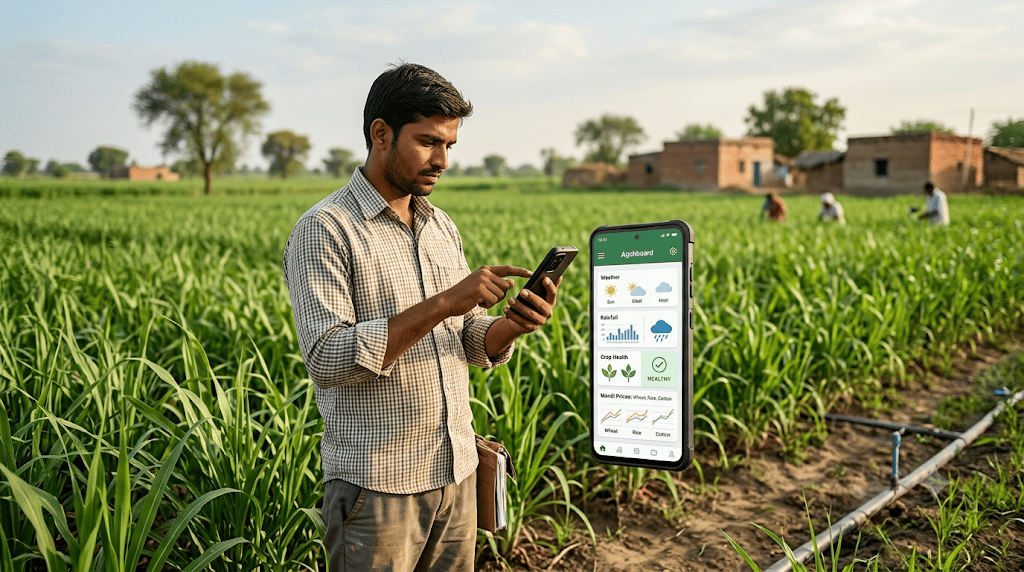
This category answers one question: what should I do in my field this week? Apps give weather alerts, crop advice, mandi prices and pest warnings, often in Hindi and regional languages.
Government options include the Kisan Suvidha app, which combines weather, prices and advisory, and mKisan SMS alerts. Private apps such as Cropin and Fasal sell paid advisory, mostly to FPOs, companies and large growers rather than single farmers.
It is the cheapest entry point among all agritech categories, and many tools are free.
Check before you use it:
- Is the advice in your language?
- Is the weather data for your block or only the district?
- Does it name its source, such as ICAR or a state agriculture university?
Treat any app that guarantees a yield as a warning sign.
Category 2: Precision Farming and Sensors
This group covers soil moisture sensors, small weather stations and automated drip systems. A sensor-based setup can switch off a pump when the soil has enough water. That saves electricity, water and your time at night.
It suits vegetable, orchard and polyhouse growers where water or labour is the main cost. It rarely makes sense for one acre of rain-fed wheat.
Check before you buy:
- Who services the device in your district?
- Does it work during power cuts?
- Do you own the data?
- What is the yearly running cost, not just the installation price?
Ask for a demo on a real farm nearby. A shop demo proves nothing.
For the water side of this, read our guide on drip irrigation for small farms.
Category 3: Drones
Drones are the most talked-about of all agritech categories, and the most misunderstood. Their main farm use today is spraying. A drone covers a field far faster than a person with a knapsack sprayer.
Under the Namo Drone Didi scheme, the government aims to give drones to 15,000 women self-help groups. Reports on the scheme mention an 80% central subsidy, up to Rs 8 lakh per drone. Confirm current terms on the official portal before planning anything.
Most smallholders should not buy a drone. Hire a service instead, ideally from a trained local SHG or operator.
Check before you hire:
- Is the operator trained and certified?
- Does the service follow DGCA drone rules?
- Which pesticide and dose will they use, and who decides?
- What happens if the spray drifts onto a neighbour’s crop?
Category 4: Digital Markets
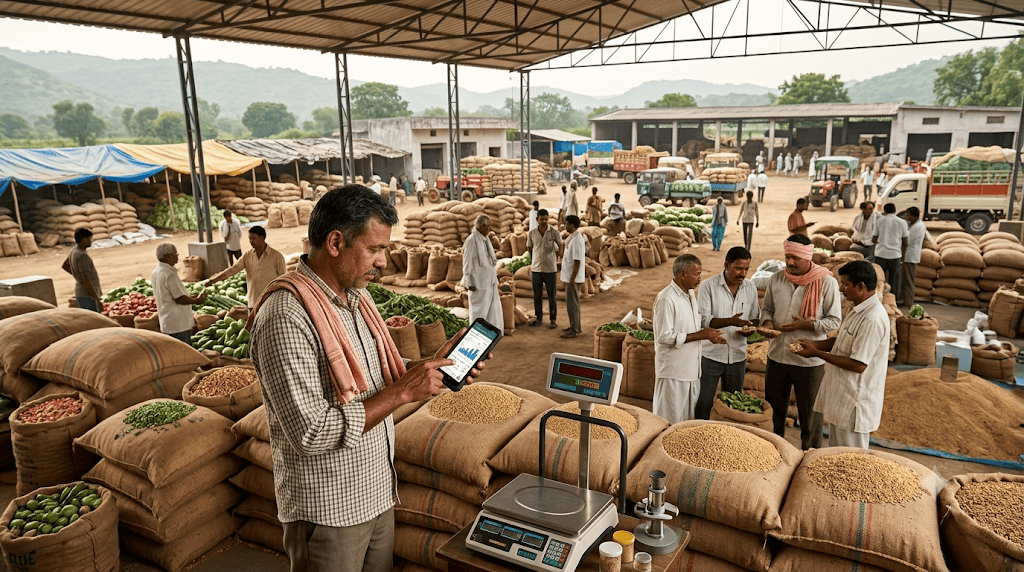
Digital markets connect you to more buyers than your local mandi. The best-known example is e-NAM, launched on 14 April 2016. It works alongside physical mandis rather than replacing them. ONDC is a newer network that also has an agriculture side.
Payment can go straight to your bank account, which removes the delay and cash handling of old arhatiya deals.
Check before you register:
- Is your nearest mandi actually integrated?
- Does the mandi have grading and testing facilities?
- How many days does payment take?
Our post on how to check mandi prices online explains the first step.
Category 5: Machinery Rental
Most small farmers cannot afford a tractor, rotavator or harvester. This category fixes that through rental. It includes Custom Hiring Centres, FPO machinery banks and phone apps that match you with a nearby owner.
Government support for mechanisation runs through schemes such as SMAM, and subsidy rules differ by state.
Check before you book:
- Is the rate per hour or per acre?
- Who pays for diesel?
- What is the cancellation rule if rain delays work?
Agree on the price in writing. A WhatsApp message counts.
Category 6: Farm Finance and Insurance
This group covers credit, insurance and direct benefit transfers. Examples include Kisan Credit Card (KCC), PMFBY crop insurance and PM-KISAN income support. Their digital side means faster applications, bank-linked payments and claim tracking.
AgriStack-linked credit scoring is being discussed as a way to help farmers with thin paperwork. Treat it as a direction, not a guarantee.
Check before you borrow:
- Is the lender a bank, a cooperative or an RBI-regulated NBFC?
- What is the total interest and fee, written clearly?
- Do you really need the loan?
Be careful with random loan apps. Never share your Aadhaar OTP or bank PIN with anyone.
Related reading: crop insurance claim process.
Category 7: Supply Chain and Storage
Post-harvest loss hurts perishable crops most. This category includes warehouses, cold storage, grading and packing units, traceability tools and aggregator platforms that collect produce from many farmers.
For smallholders the practical path is usually through an FPO. One farmer cannot fill a cold-storage truck. A group can.
Check before you sign up:
- What are the storage charges per quintal per month?
- Who is liable if produce spoils?
- How is the quality graded, and by whom?
Category 8: Government Digital Platforms
This is the most important of the agritech categories for scheme access, because it decides whether benefits reach you. The core idea is AgriStack, a digital public infrastructure for agriculture.
As per PIB, AgriStack has three registries: the Farmer Registry, Geo-referenced Village Maps and the Crop Sown Registry. The Farmer ID works like an Aadhaar for your farming profile. It links your details with digitised land records.
The Ministry of Agriculture’s target was 11 crore Farmer IDs, and reports citing PIB say it has been achieved.
What you should do:
- Get your Farmer ID through your state’s registration drive or the nearest CSC.
- Check that your land record details are correct.
- Keep a copy of the registration.
Fix record errors early. A wrong survey number can block a payment later.
Category 9: Soil, Seed and Input Technology
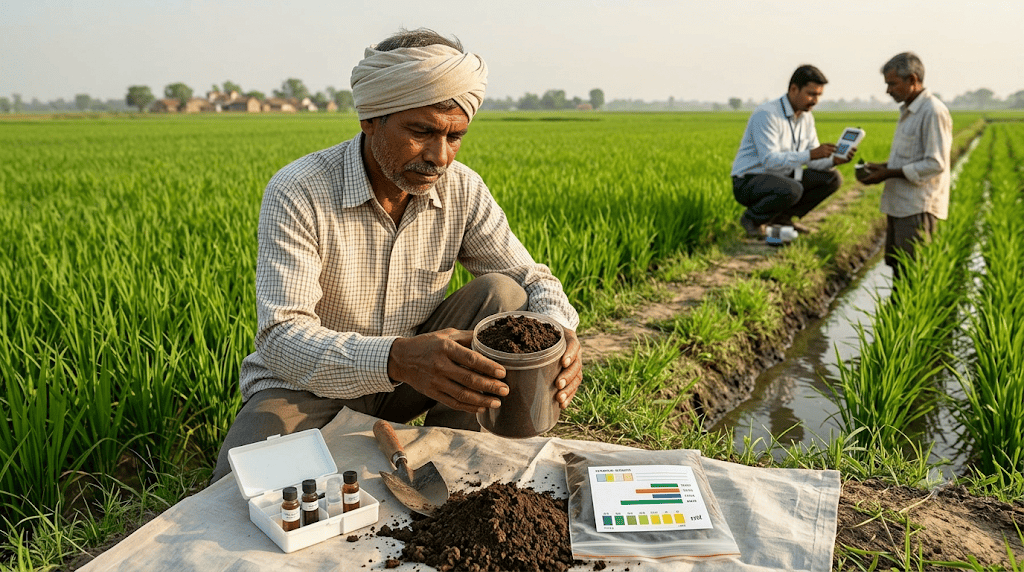
The last category looks at what goes into the soil. It includes soil testing, the Soil Health Card portal (started in 2015), improved seed, biological inputs and low-cost testing kits.
Soil testing is the best value of all the nine. A test tells you what the soil lacks, so you stop guessing on fertiliser.
Check before you buy:
- Is the lab government or NABL accredited?
- Does the report give crop-wise recommendations?
- Is the seller pushing a product with the report?
Your nearest Krishi Vigyan Kendra can guide you at no cost. Our guide on reading a soil health card walks through the report step by step.
How to Choose Between Agritech Categories
Do not buy from every one of the agritech categories at once. Match the category to your land and your biggest loss.
| Your situation | Start with | Add later |
|---|---|---|
| Under 2 acres, rain-fed | Advisory apps, Farmer ID, soil test | Digital markets, insurance |
| 2 to 10 acres | Machinery rental, soil test, finance tools | Drone service, storage via FPO |
| High-value crop (vegetables, orchard) | Sensors, drip automation, markets | Supply chain, drone service |
| Farmer group or FPO | Storage, aggregation, markets | Drones, credit tools |
Ask three questions before spending money:
- What exact loss will this stop?
- Who fixes it when it breaks?
- Will it still make sense if the subsidy ends?
If you cannot answer all three, wait.
Government Schemes Behind Agritech Categories
Several agritech categories run on public schemes. Knowing the scheme name helps you check claims made by sellers.
- Digital Agriculture Mission: the umbrella for AgriStack, crop surveys and advisory tools.
- Namo Drone Didi: drone services through women SHGs.
- e-NAM: the national digital market for produce.
- PM-KISAN: direct income support to farmers’ bank accounts.
- PMFBY: crop insurance with digital enrolment.
- Soil Health Card: soil testing and recommendations.
Scheme rules, subsidy rates and portals change. Always check the official site or your block agriculture office. Do not rely on a dealer’s brochure.
Mistakes to Avoid with Agritech Categories
These are the errors I see most often with agritech categories.
- Buying hardware first. Fix water, seed and soil basics before you buy a gadget.
- Ignoring the network. An app that needs 4G is useless where signal drops.
- Trusting social media sellers. Check the company, address and service centre.
- Not reading subsidy terms. Some subsidies are reimbursed late, so you pay first.
- Sharing OTPs and documents. Scheme fraud often starts with a “helpful” caller.
- Skipping the trial. Test on a small plot or a rented service first.
Limits of Agritech Categories
Technology does not fix everything. Agritech categories help most when the basics already work.
Connectivity is uneven in many villages. Language and literacy limits what an app can do. Women farmers and tenant farmers often have less access to records and devices, so Farmer ID and similar systems can leave them out unless the state handles registration carefully.
Data privacy is another open question. Your Farmer ID links land, crops and benefits. Ask what data is stored, who can see it and for how long.
Do not treat any one tool as a replacement for a good extension officer or an experienced neighbour.
A Practical Starter Plan
Here is a simple order I would follow with agritech categories if I farmed a few acres:
- Register for Farmer ID and fix any land record errors.
- Get a soil test and read the report with your KVK.
- Install one advisory app and one price app. Use them for a full season.
- Check whether your mandi is on e-NAM.
- Confirm KCC and crop insurance enrolment before sowing.
- Rent machinery or a drone service instead of buying.
- Consider sensors or storage only when you have a clear, repeating loss.
This costs little and builds records that every later tool needs.
Frequently Asked Questions (FAQs)
1. What are the main agritech categories in India?
The nine main agritech categories in India include advisory and AI apps, precision farming and sensors, drones, digital markets, machinery rental, farm finance and insurance, supply chain and storage, government digital platforms, and soil, seed and input technology.
2. Which agritech category is best for small farmers?
For small farmers, advisory apps, soil testing, Farmer ID and digital market access are good starting points. These options are affordable and do not require expensive machinery or equipment.
3. What is AgriStack?
AgriStack is the Indian government’s digital infrastructure for agriculture, developed to make farming-related services more accessible and organised. It includes three main parts: the Farmer Registry, Geo-referenced Village Maps and the Crop Sown Registry. These digital records can help farmers access government schemes, agricultural services and other benefits more easily.
4. What is a Farmer ID?
A Farmer ID is a unique digital identity created for farmers under the Farmer Registry of AgriStack. It connects a farmer’s details with digitised land records and other relevant agricultural information. It helps simplify farmer registration, improve access to government schemes and make the delivery of agricultural benefits more organised.
5. Do farmers need to buy a drone for spraying crops?
No, buying a drone is not necessary for most small farmers because the initial investment and maintenance costs can be high. Instead, farmers can hire trained drone operators or use services provided by local women self-help groups (SHGs). This allows them to benefit from faster crop spraying without having to purchase and maintain expensive equipment.
6. What is e-NAM and how can farmers use it?
e-NAM (National Agriculture Market) is an online platform that connects agricultural mandis across India. Farmers can register through an integrated mandi, access more buyers and sell their produce through the platform.
7. Are agritech apps free to use?
Some government agritech apps, such as Kisan Suvidha, are free to use. However, many private platforms charge for premium services, crop advisory and other features. Farmers should always check the pricing and terms before paying.
8. Do agritech tools require an internet connection?
Many agritech tools need an internet connection, but not all of them. Services such as SMS-based weather alerts, soil testing and machinery rental can also work with limited internet access. Always check the requirements before choosing a tool.
9. How can farmers avoid agritech fraud?
Farmers should verify the company or service provider before making payments. Never share Aadhaar OTPs, bank PINs or other sensitive details with unknown people. It is also important to check subsidy information through official government portals rather than relying on social media messages or dealers.
10. Where can farmers get free guidance about agritech?
Farmers can visit their nearest Krishi Vigyan Kendra (KVK), block agriculture office or state agricultural university. These institutions can help them understand suitable farming technologies, soil testing, improved practices and available government support.
Conclusion
Agritech is not about using expensive machines or downloading every new farming app. It is about finding simple ways to make farming easier, reduce losses and improve productivity.
From soil testing and mobile advisory apps to drones, digital markets and modern machinery, each technology has something different to offer. Small farmers do not need to adopt everything at once. Start with what your farm actually needs, understand the benefits and costs, and then take the next step.
At the end of the day, good farming is not about using more technology; it is about using the right technology at the right time.