
Chana farming is the cultivation of chickpea (Bengal gram), a rabi pulse sown from mid-October to mid-November in north India and harvested in spring. For the crop going into the field now, the government has fixed the gram MSP at ₹5,958 per quintal for marketing season 2027-28.
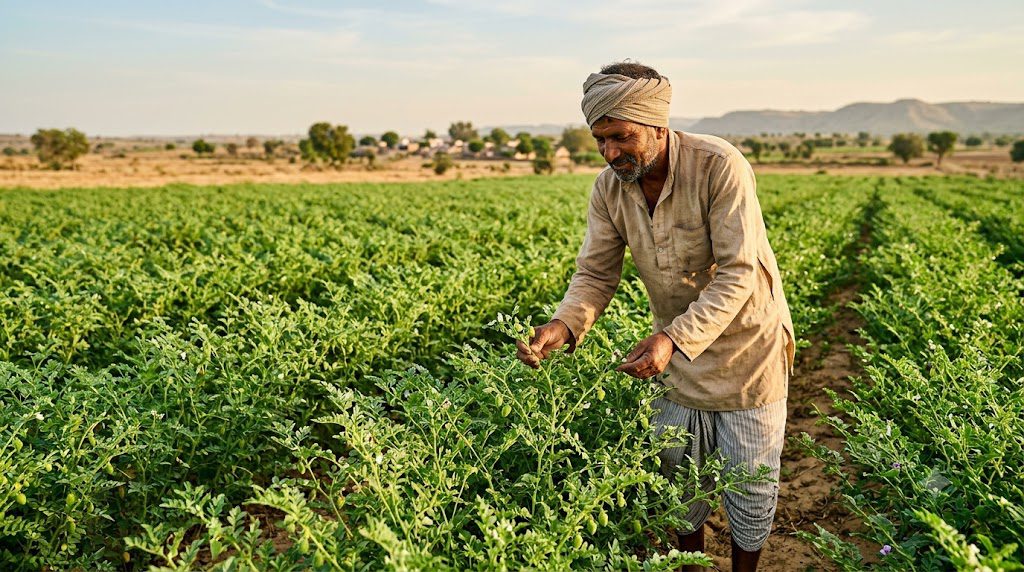
Most problems in chana farming begin in the first three weeks: a wrong sowing date, untreated seed and weeds that nobody removed. This guide follows the nine steps in the order you will actually do them, with doses and dates taken from government and agricultural university sources. Where a number comes from one state’s package of practices, we say so, because advice that works in Punjab can fail in Maharashtra.
Table of Contents
Chana Farming at a Glance
Use this table as a quick check before you buy seed. Every row is explained in the steps below.
| Item | Recommendation | Where it comes from |
|---|---|---|
| Sowing, north India, rainfed | Second fortnight of October | Vikaspedia chickpea guide |
| Sowing, north India, irrigated | First fortnight of November | Vikaspedia chickpea guide |
| Sowing, Punjab (variety PBG 7) | 25 October to 10 November | Punjab package of practices, Vikaspedia |
| Seed rate | 15 to 18 kg per acre | Punjab package of practices |
| Spacing | 30 x 10 cm | Punjab package of practices |
| Basal fertilizer | 6 kg N (13 kg urea) and 8 kg P2O5 (50 kg SSP) per acre | Punjab package of practices |
| Irrigation | One, between mid-December and mid-January | Punjab package of practices |
| Average yield | 15 to 20 quintal per hectare with good management | Vikaspedia chickpea guide |
| MSP, marketing season 2027-28 | ₹5,958 per quintal | All India Radio report on the Cabinet decision |
Step 1: Pick the Right Chickpea Type and Variety
Chana farming starts with two seed choices: the type and the variety.
Desi chickpea has small, light yellow to dark brown grains with a thick seed coat. Kabuli chickpea has larger, whitish-cream grains with a thin coat. Both are sown in the same season, but they differ in seed size, and seed size changes your seed rate. Kabuli needs more seed per hectare than desi.
For varieties, do not copy a neighbour in another district. PBG 7 is listed for irrigated conditions across Punjab. In a pod borer screening study published by ICAR, the varieties GJG 3, Dahod Yellow, GG 1, RJG 0904 and JG 16 fell in the resistant category, although none was found highly resistant. That study was run in Gujarat, so treat it as a clue, not a recommendation for your field.
The practical move is simple. Visit your Krishi Vigyan Kendra or state seed corporation and ask which wilt-resistant variety they recommend for your district. Buy certified seed and keep the bill.
Step 2: Prepare the Field
Chickpea does best on well-drained, light to medium soil. The Punjab package says the land should be free from clods and weeds. Other guidance notes that the soil should be near neutral and free from excess soluble salts, and that chickpea is sensitive to poor soil aeration.
That last point matters. Waterlogged patches cause more trouble in chana farming than a dry spell does. If a corner of your field holds water after rain, fix the drainage before sowing, not after the plants yellow.
If soil moisture is too low for sowing, give a pre-sowing irrigation. Do not sow into dry soil and hope for rain.
Get a soil test before you decide on phosphorus. Our guide to the Soil Health Card explains how to read yours and what to ask the lab. If your field was under rice, read Step 7 before you plan irrigation.
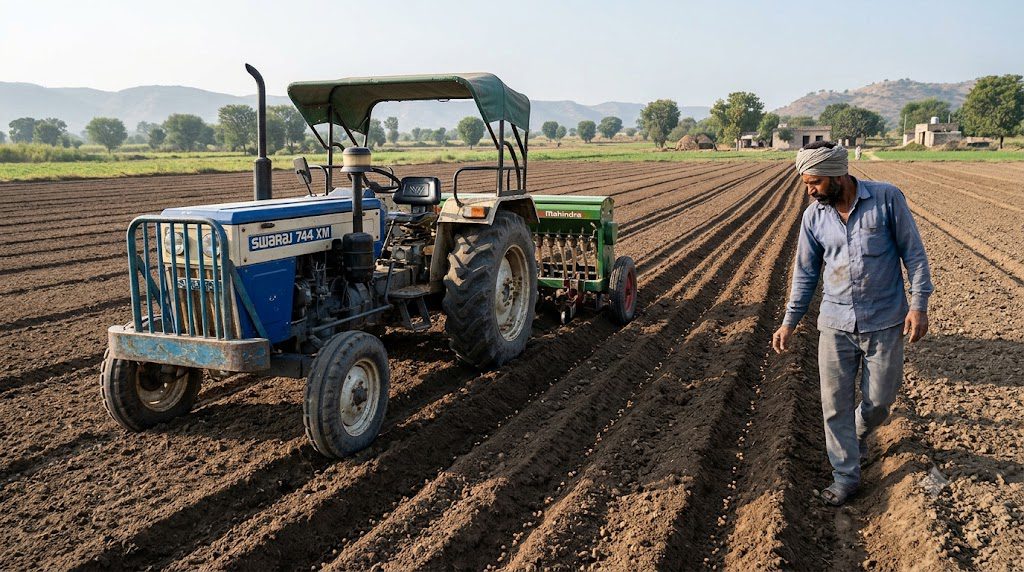
Step 3: Fix Your Chana Farming Sowing Window
Sowing date is the single decision in chana farming that you cannot correct later. The sources agree on the broad window and differ on the exact days, which is why local advice matters.
- North India, rainfed: second fortnight of October.
- North India, irrigated: first fortnight of November.
- Punjab, variety PBG 7: 25 October to 10 November.
- Peninsular India: first fortnight of October is considered ideal.
As of 23 October 2026, a rainfed farmer in north India is inside the window right now. An irrigated field can wait about a week or two more.
Both sides of the window carry a cost. Early sowing can cause excessive vegetative growth and poor pod setting. Late sowing in December or January should be avoided, because a late crop meets cold at flowering. Frost at flowering can make flowers fail to develop seed, or kill the seed inside the pod.
Step 4: Treat the Seed
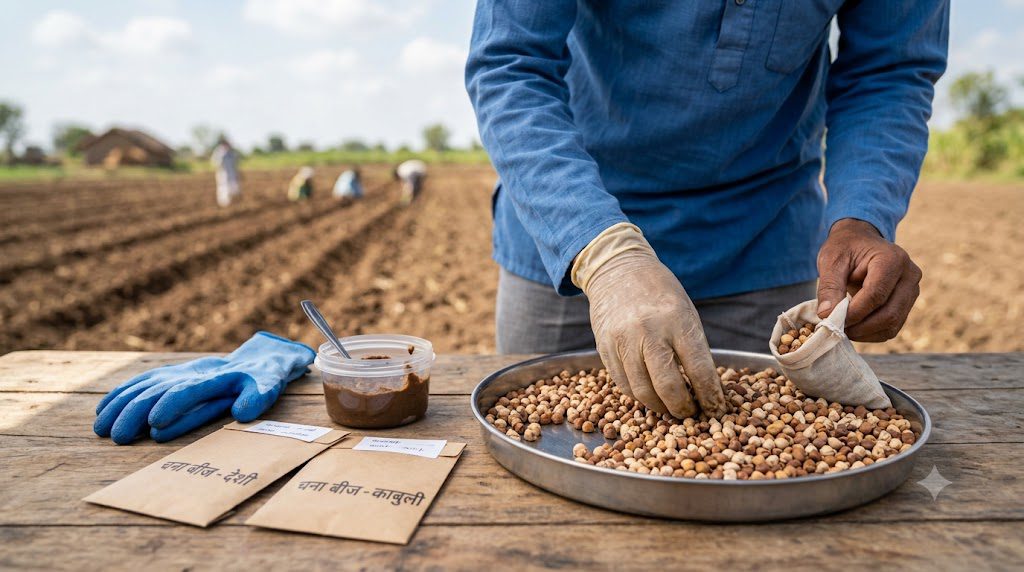
Seed treatment costs little compared with a failed stand, and it is the step farmers skip most. Chana farming needs three things on the seed: protection from disease, protection from termites, and the right bacteria.
Against wilt and blight: The Punjab package recommends Captan at 3 g or Bavistan at 2 g per kg of seed. Another state guidance sheet lists Trichoderma at 6 g per kg together with Carboxin (Vitavax) at 1 g per kg.
Against termites: Treat the seed with Chlorpyriphos 20 EC at 10 ml per kg before sowing.
Bacteria: Inoculate with Mesorhizobium and Rhizobacterium culture, one packet of each per acre of seed. If chickpea is new to the field, one guide gives a home method: mix 200 g of Rhizobium culture with 300 ml of 10 per cent jaggery solution for every 8 kg of seed.
Dry the treated seed in shade before sowing. Never dry it in direct sun, because heat can kill the bacteria.
Read the label and your state’s advisory before using any chemical. The doses above are what these sources state, and recommendations differ between states.
Step 5: Seed Rate, Spacing and Sowing Method
The Punjab package gives a seed rate of 15 to 18 kg per acre, sown with a seed drill at a spacing of 30 x 10 cm. Line sowing with a seed drill beats broadcasting because every seed sits at the same depth and weeding becomes possible.
Do not give planking after sowing. After rice, especially on heavy soils, the same package suggests sowing on raised beds, with two rows on a bed that is 67.5 cm wide.
Chana farming also fits into mixed systems. Recommended intercrops include chickpea with mustard in rows of 2:1 to 4:1, chickpea with linseed at 2:2, chickpea with wheat or barley at 2:2, and chickpea with safflower at 2:2. Read how mustard farming works before you commit rows to it, and see our guide on multiple cropping for the logic behind mixing crops.
Step 6: Fertilizer for Chana Farming
Chickpea is a legume, so it makes part of its own nitrogen when the root bacteria are working. That is the reason seed inoculation in Step 4 matters. It is also why chana farming needs far less urea than wheat.
The Punjab package for PBG 7 recommends 6 kg nitrogen (13 kg urea) and 8 kg P2O5 (50 kg SSP) per acre, drilled at sowing. A wider guidance sheet gives general doses of 15 to 20 kg nitrogen and 50 to 60 kg phosphorus per hectare, with the full amount applied as a basal dose.
These two recommendations look different because they use different units and different soils. Do not mix them. Pick the one that matches your state, then adjust using your soil test. Our pages on bio fertilizer and nano fertilizer cover options that can cut down on bagged fertilizer.
Step 7: Irrigation
Chickpea is mostly grown as a rainfed crop on stored soil moisture. Chana farming therefore asks for water carefully, not generously.
The Punjab package gives one irrigation between mid-December and mid-January, depending on sowing date and rainfall. It adds a warning: do not irrigate a crop sown after rice on heavy soil when it is sown flat. Excess water pushes growth and invites disease.
Compare this with wheat, which needs several irrigations. If you are deciding how to split your water between rabi crops, our guide to irrigation farming will help, and the wheat farming guide shows what wheat demands.
Step 8: Weed Control
Chickpea grows slowly at the start and stays short, so weeds beat it easily. An ICAR journal paper reports yield loss of 17 to 75 per cent from weed competition, depending on weed density and how long weeds stay.
The weeds that grow in the first weeks do the damage. The Punjab package suggests three actions:
- A pre-emergence spray of Stomp 30 EC at 1.0 litre per acre within two days of sowing.
- One hoeing at 30 days after sowing.
- A second hoeing at 60 days after sowing.
If you cannot afford the spray, the hoeings become more important, not less. Mark both dates on your calendar on the day you sow.
Step 9: Wilt and Pod Borer Management
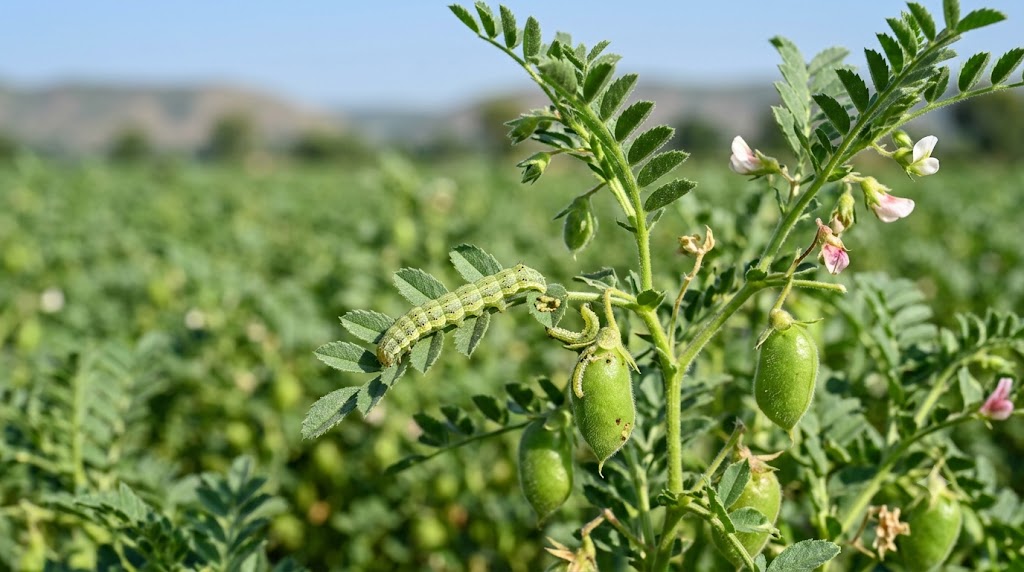
Wilt and pod borer are the two problems that most often decide the final yield in chana farming.
Wilt: Prevention happens before sowing. Use a resistant variety, treat the seed (Step 4), and avoid waterlogging (Step 2). Once plants wilt in patches, there is little to do.
Pod borer: An ICARDA review says the pod borer (Helicoverpa armigera) causes up to 90 per cent damage in chickpea, because it attacks from vegetative growth to pod formation. The same review calls resistant varieties the cheapest and best control, and recommends an integrated approach:
- Sow at the right time with the right plant density and fertilizer.
- Grow trap or inter crops such as coriander, mustard, linseed, sunflower, sorghum and marigold.
- Place T-perches at 2 m distance so birds can feed on caterpillars.
- Use pheromone traps to monitor the pest before spraying.
The review warns that spraying more and more pesticide leads to residues, resistance and pest resurgence. Spray only after monitoring shows a need, and use the product and dose that your KVK recommends.
Harvest and Yield
Rabi crops are generally harvested from April, and chickpea is ready when the leaves have dried and the pods have turned dry and brown. Harvest on a dry day and let the cut plants dry in the sun before threshing. Good chana farming does not end at the field edge, because careless drying and storage waste the work of five months.
With good management, an average yield of 15 to 20 quintal per hectare is achievable, according to the Vikaspedia chickpea guide. That is an average from a guidance document, not a promise. Your result depends on variety, sowing date, rainfall, weeds and pod borer.
Dry the grain well before bagging. Damp grain spoils in storage and sells for less.
Chana Farming Economics: MSP, Cost and Margin
The Cabinet approved the gram MSP for marketing season 2027-28 at ₹5,958 per quintal, up ₹83 from ₹5,875 for 2026-27. The Cabinet release puts the all-India weighted average cost of production at ₹3,751 per quintal, which gives an expected margin of 59 per cent.
| Item | Figure |
|---|---|
| Gram MSP, 2027-28 | ₹5,958 per quintal |
| Gram MSP, 2026-27 | ₹5,875 per quintal |
| Increase | ₹83 per quintal |
| Cost of production (all-India weighted average) | ₹3,751 per quintal |
| Expected margin over cost | 59 per cent |
Here is a simple calculation using only the figures above. At 15 to 20 quintal per hectare and ₹5,958 per quintal, gross value at MSP is about ₹89,370 to ₹1,19,160 per hectare. Subtracting the all-India average cost of ₹3,751 per quintal leaves about ₹33,105 to ₹44,140 per hectare. This is an illustration, not a forecast. Your own cost per quintal can be higher or lower, and the MSP applies only to grain that is actually procured.
Be honest about the comparison. On the government’s own numbers, gram’s expected margin of 59 per cent is lower than wheat (106 per cent), rapeseed and mustard (96 per cent) and lentil (92 per cent). Chana farming wins on other grounds: it needs little water, it adds nitrogen to the soil, and it works well in rotation. If you want to compare crops side by side, read our guide to the names of rabi crops and the lentil farming guide.
Government Support for Chana Farmers
The Mission for Aatmanirbharta in Pulses runs from 2025-26 to 2030-31 with an outlay of ₹11,440 crore. It promises 100 per cent procurement at MSP of tur, urad and masoor for four years, through NAFED and NCCF, from registered farmers in participating states.
Read that carefully. Chana is not on the 100 per cent list. Procurement of other pulses continues under the regular Price Support Scheme norms. A farmer who plants chana expecting the same guarantee as a masoor farmer may be disappointed. Before you sow, ask your block agriculture office how gram procurement works in your state and whether you need to register.
Other schemes can help with the cost of the crop and the risk. Check the guides on the Kisan Credit Card scheme for crop loans, crop insurance for farmers for frost and hail risk, the PM-KISAN scheme for income support, and the e-NAM platform for selling beyond your local mandi.
Common Mistakes in Chana Farming
These are the errors that the sources above warn against, listed so you can check yourself:
- Sowing too early and getting leafy plants with few pods.
- Sowing in December or January and meeting cold at flowering.
- Skipping seed treatment to save a small amount.
- Irrigating flat-sown chickpea on heavy soil after rice.
- Letting weeds grow through the first 30 days.
- Spraying pesticide on a schedule instead of on monitoring.
- Assuming chana carries the same procurement guarantee as masoor.
Chana Farming FAQs
1. What is chana farming?
Chana farming is growing chickpea (Bengal gram) as a rabi pulse. It is sown in October and November, grows on residual soil moisture with little irrigation, and is harvested in spring.
2. When should I sow chana in north India?
Rainfed chana is sown in the second fortnight of October. Irrigated chana is sown in the first fortnight of November. Punjab’s package for PBG 7 gives 25 October to 10 November.
3. How much seed does one acre need?
The Punjab package for PBG 7 gives 15 to 18 kg per acre with a seed drill. Kabuli types need more seed than desi types, so follow the rate for your variety.
4. How much fertilizer does chana need?
The Punjab package gives 6 kg nitrogen (13 kg urea) and 8 kg P2O5 (50 kg SSP) per acre at sowing. A general sheet gives 15 to 20 kg nitrogen and 50 to 60 kg phosphorus per hectare. Use your soil test to decide.
5. How many irrigations does chana need?
In the Punjab package, one irrigation between mid-December and mid-January, depending on sowing date and rainfall. Chana is mostly a rainfed crop.
6. What is the average yield of chana?
With good management, an average of 15 to 20 quintal per hectare is achievable, according to the Vikaspedia guide. Actual yield depends on variety, weather and pest control.
7. What is the MSP of gram for 2027-28?
₹5,958 per quintal, up ₹83 from ₹5,875 in 2026-27.
8. Is chana covered by the 100 per cent procurement promise?
No. The Pulses Mission guarantees 100 per cent procurement for tur, urad and masoor. Other pulses follow regular Price Support Scheme norms.
9. What is the biggest pest in chana farming?
The pod borer. An ICARDA review says it can cause up to 90 per cent damage, and recommends resistant varieties, trap crops, bird perches and pheromone traps.
10. Can I grow chana with another crop?
Yes. Recommended mixes include chickpea with mustard (2:1 to 4:1), with linseed (2:2), with wheat or barley (2:2) and with safflower (2:2). Intercrops such as coriander and mustard also help reduce pod borer, which makes mixed chana farming worth testing on a small plot first.
Conclusion
Chana farming takes proper planning and a little extra care at every stage, from sowing the seeds to harvesting the crop. Choosing the right variety, controlling weeds on time, and protecting the plants from pests can help farmers get a better harvest. Every season teaches us something new, so pay attention to your soil, weather, and crop needs. A little care at the right time can save both money and hard work.