
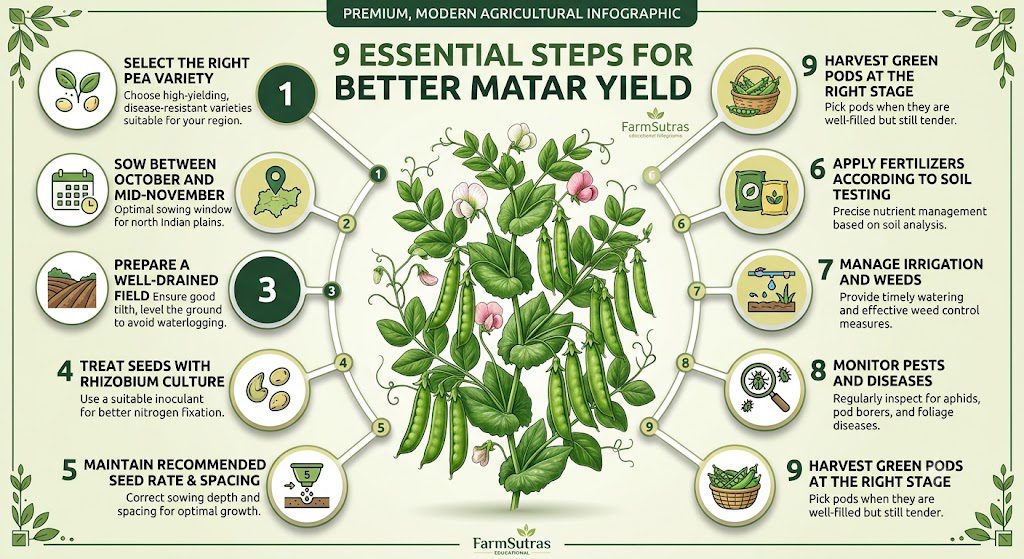
Pea farming in the north Indian plains starts with sowing treated seed in rows between mid-October and mid-November, when temperatures sit between 15°C and 30°C. Coat the seed with Rhizobium culture, sow in lines, and pick green pods while they are full but still tender.
That is the short answer. The rest of this guide covers each step in order, using figures from ICAR publications and agricultural research papers. Where researchers give different numbers, I show the range instead of picking one for you.
If you are reading this in late October, the window for pea farming is still open, but it closes by mid-November. Late sowing costs yield, and Step 2 shows the evidence.
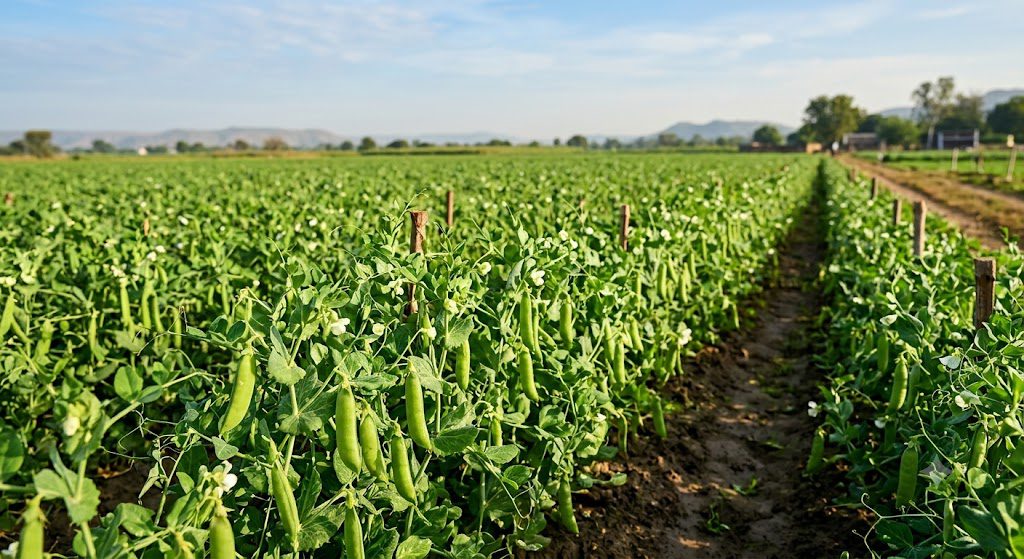
Table of Contents
What Is Pea Farming?
Pea farming is the cultivation of Pisum sativum, a cool-season legume grown either for green pods or for dry grain. Two types matter to Indian farmers:
- Garden pea (sabji matar): picked green and sold fresh or to processors.
- Field pea (dry pea): harvested dry and used mainly for dal.
Most online advice mixes the two. That mistake costs money, because seed rate, variety and harvest time differ. Decide which one you are growing before you buy seed.
Pea is a pulse, so it fixes nitrogen from the air with the help of Rhizobium bacteria in its roots. A research paper from Patiala lists Rajasthan, Uttar Pradesh, Odisha, Haryana, Bihar, Maharashtra and Madhya Pradesh among the main pea-growing states.
Pea farming fits a rabi rotation. If you already grow chana or lentil, compare their water and market needs with peas before you split your land. Our guide to the names of rabi crops shows where pea sits in the season.
Climate and Soil Needs for Pea Farming
Pea is a cool-season crop. The Patiala paper gives the optimum temperature for pea farming as 15–30°C. It says the crop tolerates frost in its early stage, but flowers and pods are damaged by frost later.
Heat is the bigger risk. A Punjab Agricultural University (PAU) article in Indian Horticulture says temperatures above 27°C shorten the growing period and hurt pollination. So the cooler end of the range is safer for pod set.
Pea does not like waterlogged ground, so choose a well-drained plot. Before you decide on manure or fertilizer, get your soil tested. If you do not have a report yet, our guide to the soil health card explains how to get one free.
9 Essential Steps in Pea Farming
Step 1: Choose a Variety That Suits Your Pea Farming Goal
Variety depends on region and purpose, and names change often, so ask your Krishi Vigyan Kendra (KVK) what is recommended for your district.
Here is what the published sources report:
- VL Sabji Matar 14: a medium-maturity garden pea developed for the hills of Uttarakhand, with resistance to powdery mildew.
- VL Sabji Matar 13: an early garden pea released and notified in February 2019 for the Uttarakhand hills.
- PSM-3: the improved variety used in an on-farm testing programme.
- IPFD 12-2: a semi-leafless dwarf field pea used for split dal in an ICAR-reported demonstration with 25 farmers.
Do not buy seed because a neighbour had one good year. Check the label for variety, germination percentage and purity.
Step 2: Fix the Sowing Window for Pea Farming
For the plains, sow from October to mid-November. Delay is expensive.
A Patiala study compared sowing in the second fortnight of October with the first and second fortnights of November. The second-fortnight-of-November sowing had the lowest emergence count. A separate ICAR-published trial sowed on 26 October, 18 November and 4 December, and noted that pod yield drops drastically when sowing runs past the optimum time.
One caveat: a West Bengal coastal trial on field pea found slightly higher yield for 24 November than 4 November sowing (about 785 kg/ha against 741 kg/ha). Timing depends on your location, so use your KVK’s calendar and not a single trial.
Step 3: Prepare the Field
Deep ploughing and harrowing give a fine seedbed. Course material from a horticulture college recommends 15–20 tonnes of well-decomposed farmyard manure per hectare, added about a month before sowing.
If you are trying organic matter beyond manure, read our piece on biochar before spending money on it.
Step 4: Treat the Seed
Seed treatment is the cheapest step in pea farming, and the one farmers skip most often.
The sources use different doses:
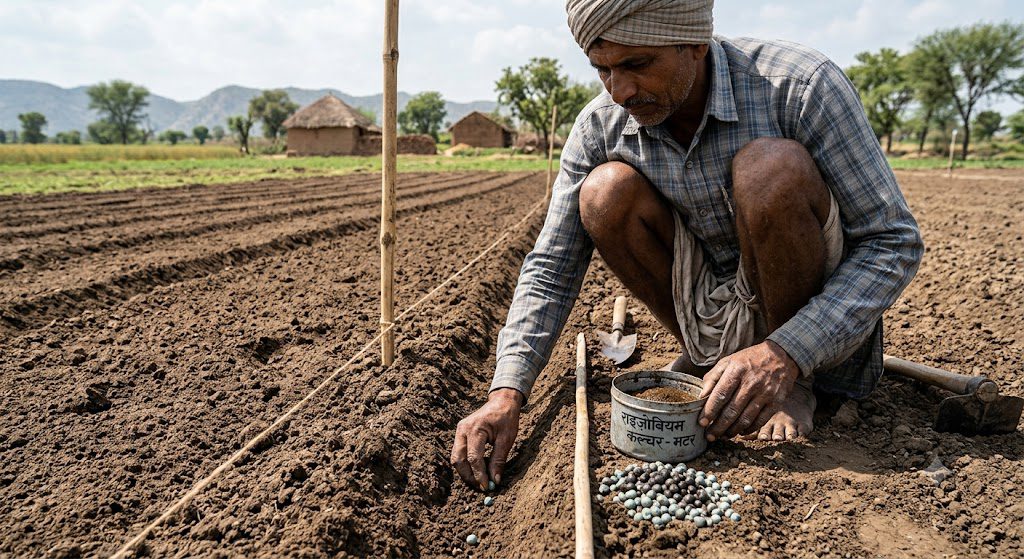
- Rhizobium leguminosarum: 250 g per 10 kg seed in one on-farm testing programme, 100 g per 10 kg in a phosphorus-zinc trial, and 10 g per kg seed in a field pea demonstration.
- Phosphate-solubilising bacteria (PSB): 5 g per kg seed in the on-farm programme.
- Fungicide: carboxin plus thiram at 2 g per kg seed in the field pea demonstration.
Do not average these numbers. Use the dose printed on your culture packet, and check the expiry date. PAU calls Rhizobium seed treatment the simplest way to raise pea production and quality, because it speeds up nodulation on the roots.
Step 5: Seed Rate and Spacing in Pea Farming
Seed rate is where broadcasting wastes the most money. The on-farm programme found that farmers who broadcast used a higher seed rate than recommended, and also skipped line sowing.
Recommended figures from the sources:
- PAU: 45 kg per acre for early varieties (about 111 kg/ha) and 30 kg per acre for main-season varieties (about 74 kg/ha). Row-to-plant spacing is 30 × 7.5 cm for early and 30 × 10 cm for main-season types.
- Horticulture college notes: 100–120 kg/ha for early and 80–90 kg/ha for mid-season varieties, at 30 cm × 5–10 cm.
- IPFD 12-2 field pea demonstration: 80 kg/ha, 45 cm row spacing, 4–5 cm seed depth.
PAU also mentions a seed-cum-fertiliser drill that sows one acre in an hour. If your village has a custom-hire centre, ask about it.
Step 6: Feed the Crop Without Overdoing Nitrogen
Published trials used different nutrient doses for pea farming (N:P:K in kg/ha):
- 24:40:50 as a basal dose, in horticulture college notes.
- 20–30:50–60:50 in an on-farm testing programme.
- 20:60:20 at 75% of the recommended dose in the IPFD 12-2 field pea demonstration.
These differ because soils, varieties and goals differ. The trial figures are a range, not a prescription. Your soil test decides your dose.
Because pea fixes its own nitrogen, heavy urea mostly wastes money. Spend on phosphorus and on good seed treatment first.
Step 7: Irrigate Lightly and Weed on Time
Pea suffers from both drought at flowering and standing water. Give light irrigation when the crop needs it, and drain any water that collects.
For weeds, the ICAR note on VL Sabji Matar 14 recommends hoeing at 30 and 60 days after sowing. That recommendation is for hill conditions, so adjust it for your field, but the principle holds: weed early, before weeds take light and nutrients from the young crop.
Step 8: Protect the Crop From Disease and Pests
Start with prevention. Use a resistant variety where one exists (VL Sabji Matar 14 resists powdery mildew), treat seed, and sow on time so the crop avoids stress.
Then scout the field every week. Look under leaves and along the pod line. Do not spray on a calendar. If you see damage, take a leaf or pod sample to your KVK or agriculture officer and ask what to spray, and at what dose.
Step 9: Harvest at the Right Stage
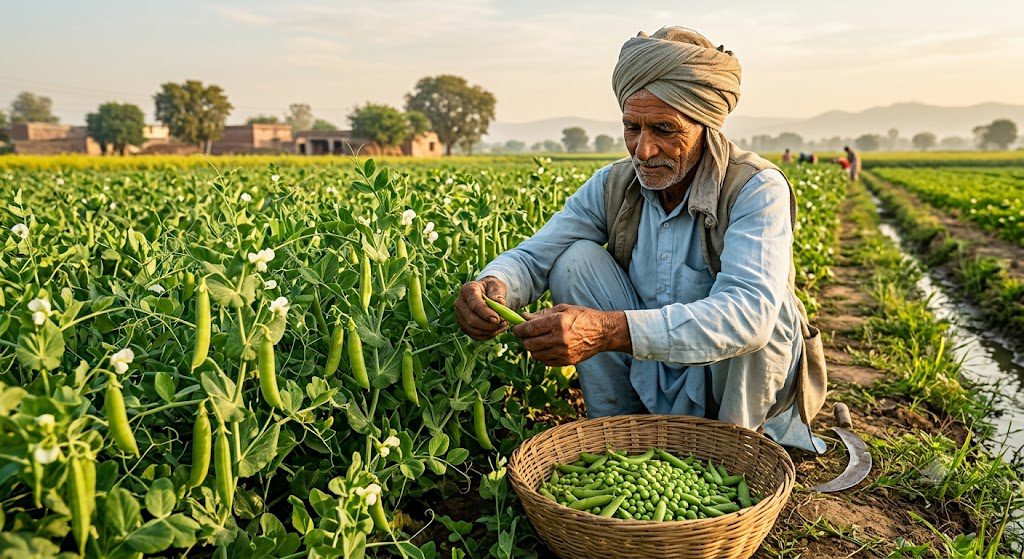
For green peas, harvest when pods are full but still green and tender. PAU explains why timing matters: as pods age, sugars in the seed turn into hemicellulose and starch, so the pea loses sweetness and market quality.
For field pea grown as dry grain, wait until pods dry on the plant.
Pea Farming Cost, Yield and Income: What the Data Shows
No honest all-India average exists for pea farming returns. Cost, variety, mandi price and picking labour change from village to village. Here is what the published trials show:
- An on-farm testing programme on 4 ha over two years raised pea yield by 31.53% when farmers adopted the full package, compared with their usual practice. The package included an improved variety, timely sowing, seed treatment, balanced fertilizer and plant protection.
- In the IPFD 12-2 demonstration with 25 farmers, improved field pea technology gave 19.2 q/ha and a net income of ₹45,050/ha. The existing variety and practices gave 9.0 q/ha and ₹9,000/ha.
Note that the second result is for field pea sold as dry grain, not fresh matar. Green pea prices swing by week and mandi, and I will not quote one. Check live prices on your local mandi or through the e-NAM platform before you decide how much area to sow.
Both trials point the same way: the gap between average and good results in pea farming comes mostly from basic practices (timely sowing, line sowing, seed treatment), not from expensive inputs.
Common Mistakes in Pea Farming
- Sowing late. Every trial cited above shows a cost for delay.
- Broadcasting seed. It raises seed use and gives uneven plant stands.
- Skipping Rhizobium. It is a cheap input with a direct effect on nodulation.
- Copying a fertilizer dose. Test your soil first.
- Using old, mixed seed. The on-farm programme found farmers used degenerated local seed instead of recommended varieties.
- Picking pods late. Quality falls as sugars turn to starch.
- Mixing up garden pea and field pea advice. Their seed rates and harvest stages differ.
Government Schemes That Help Pea Farming
Pea farming needs cash upfront for seed, culture and picking labour. These schemes can help:
- Soil testing: apply for a Soil Health Card through the Soil Health Card portal and read our soil health card guide.
- Input credit: a Kisan Credit Card can cover seasonal costs at lower interest than informal loans.
- Crop insurance: check whether pea is notified for your district and season under PMFBY, and read our crop insurance guide.
- Direct support: verify your status under the PM-KISAN scheme.
- Registration: a Farmer ID is increasingly the key to scheme access, so register now.
Pea Farming FAQs
1. What is the best month to start pea farming?
The best time to start pea farming in the north Indian plains is from October to mid-November. Sowing during this period helps the crop grow in favourable weather conditions. Farmers in hilly and peninsular regions should follow their local agricultural calendar and consult their nearest Krishi Vigyan Kendra (KVK).
2. How much seed is needed for pea farming per acre?
The seed requirement depends on the variety of pea being cultivated. According to Punjab Agricultural University (PAU), farmers should use around 45 kg of seed per acre for early varieties and 30 kg per acre for main-season varieties. Always select certified seeds with good germination quality.
3. Is pea farming profitable for small farmers?
Yes, pea farming can be a profitable option for small farmers when proper cultivation practices are followed. An ICAR-reported field pea demonstration recorded a net income of ₹45,050 per hectare using improved farming practices, compared with ₹9,000 per hectare under traditional practices. However, actual profit depends on production costs, variety, labour expenses and market prices.
4. Can pea farming be done without Rhizobium?
Yes, peas can be cultivated without Rhizobium treatment, but using it can improve crop performance. Rhizobium bacteria help pea plants fix atmospheric nitrogen by developing nodules on their roots. Seed treatment with suitable Rhizobium culture can support better nodulation and improve crop growth and productivity.
5. What is the difference between garden pea and field pea?
Garden pea and field pea are two different types of pea crops grown for different purposes. Garden peas are harvested while the pods are green, fresh and tender, mainly for vegetable consumption. Field peas are allowed to mature and dry on the plant before harvesting and are commonly used for dal. Their seed requirements and harvesting methods also differ.
6. What spacing should I use in pea farming?
The recommended spacing depends on the pea variety and growing conditions. Generally, farmers can maintain around 30 cm between rows and 5–10 cm between plants. However, some semi-leafless field pea varieties require wider row spacing of approximately 45 cm. Follow the spacing recommendations provided for your selected variety.
7. Which fertilizer dose is right for pea farming?
The fertilizer requirement depends on soil fertility, variety and crop conditions. Agricultural trials have reported different NPK doses, including 20:60:20 and 30:60:50 kg per hectare. Since pea plants can fix atmospheric nitrogen through Rhizobium bacteria, excessive nitrogen application should be avoided. Farmers should get their soil tested and apply fertilizers according to their Soil Health Card recommendations.
8. When should I harvest green peas?
Green peas should be harvested when the pods become fully developed, green and tender. Harvesting at the correct stage helps maintain their sweetness, freshness and market quality. If pods are left on the plant for too long, the sugars inside the seeds gradually convert into starch, reducing their taste and quality.
9. Which states grow the most pea?
Peas are cultivated in several Indian states, particularly during the rabi season. According to the research paper referenced in this guide, major pea-growing states include Rajasthan, Uttar Pradesh, Odisha, Haryana, Bihar, Maharashtra and Madhya Pradesh. Climatic conditions and regional farming practices influence pea cultivation in these areas.
10. Where can I get seed and Rhizobium culture?
Farmers can purchase quality pea seeds and Rhizobium culture from government-approved seed centres, Krishi Vigyan Kendras (KVKs), state agricultural universities and authorised agricultural input dealers. Before purchasing, check the seed variety, germination percentage, packaging details and expiry date of the Rhizobium culture to ensure good quality.
Final Word
Pea farming rewards farmers who get the basics right: a recommended variety, timely sowing, line sowing, treated seed and harvest at the right stage. The ICAR-published trials cited here show the biggest gains came from these steps, not from costly inputs.
Before sowing this season, do three things: test your soil, buy labelled seed with Rhizobium culture, and fix your sowing date inside the mid-October to mid-November window. Then keep notes on your own yield, because your plot data is worth more than any average.