
Biochar is a charcoal-like material made by heating farm waste with very little oxygen, then mixing the result into soil. Farmers and researchers around the world are testing it as a way to improve crops and store carbon at the same time.
The results are promising, but they are not uniform. Some soils respond strongly, while others barely change. This guide explains how the material works, what large reviews of research found, where it fails, and how to test it safely on your own land. Every claim links to a source.
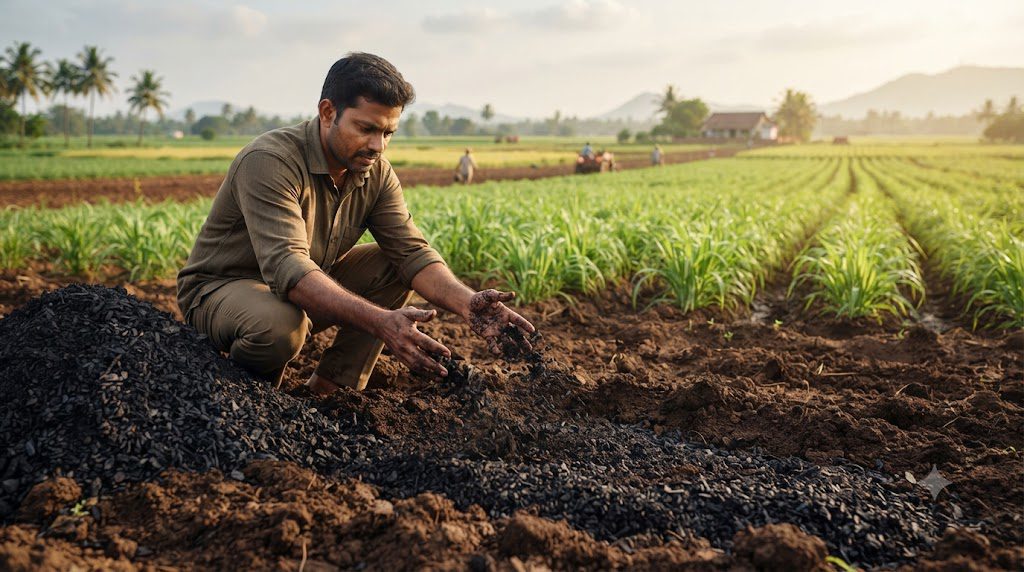
Table of Contents
What Is Biochar?
Researchers describe biochar as charred biomass applied to soil. One research article defines it as a kind of charcoal used for soil improvement, produced by heating biomass in low-oxygen or no-oxygen conditions, a process called pyrolysis. You can read that definition in the Roskilde University research record.
Common raw materials include crop straw, wood chips, nut shells, rice husks and manure. The raw material is called the feedstock, and it strongly shapes the final product.
The key point is that it is not ash and it is not compost. Compost feeds soil life and breaks down within months. The char is mostly stable carbon that stays in the soil for a very long time.
Biochar Versus Ordinary Charcoal
Barbecue charcoal and agricultural char are chemically similar, but quality control differs. Fuel charcoal may carry additives, while soil-grade material should be clean and tested. Never put fuel briquettes on food land.
A Short History of Biochar
The idea is old. The same Roskilde University abstract notes that the Amazonians historically used the technique, smoldering agricultural waste to improve soil productivity.
Those dark, fertile soils still exist in the Amazon basin today. Modern research began partly by asking how they formed and whether the effect could be repeated.
Interest grew sharply once scientists linked the material to carbon storage. If farm waste becomes stable carbon instead of releasing carbon dioxide as it rots or burns, the soil becomes a carbon store.
How Biochar Is Made
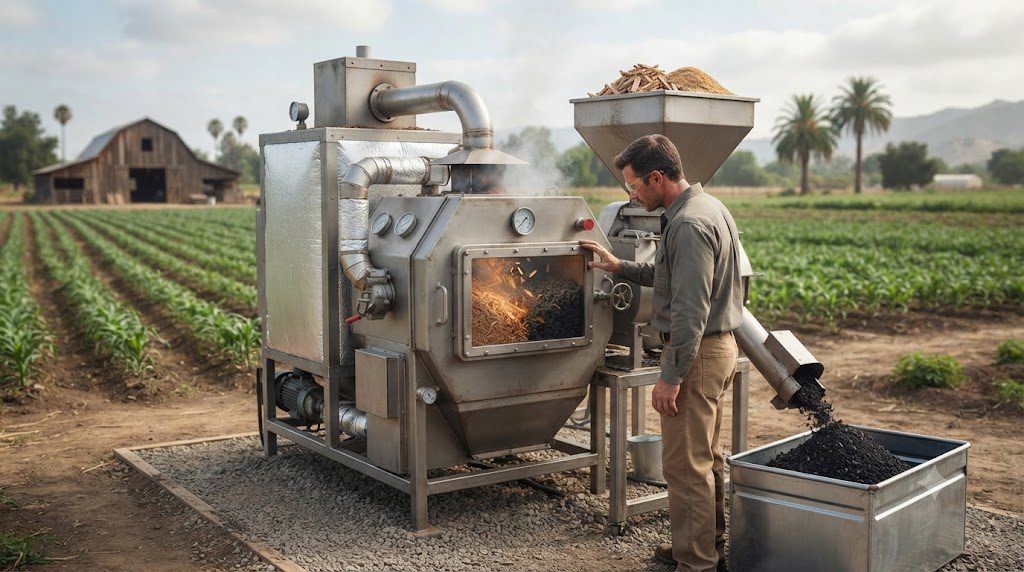
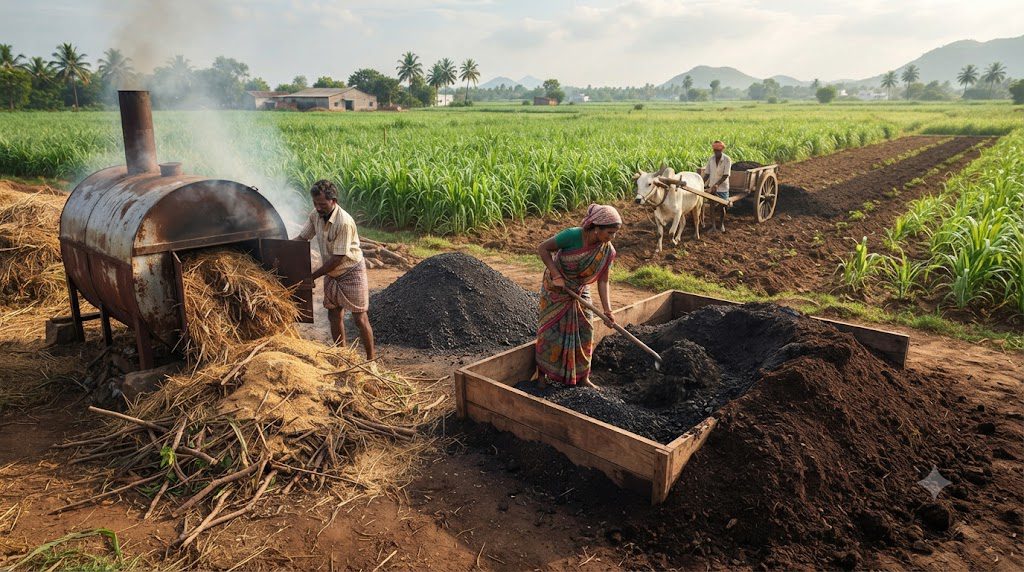
The process is pyrolysis: heating biomass at high temperature with little or no oxygen. The material does not burn into ash. It turns into a porous, carbon-rich solid.
Feedstock and Temperature Matter
An Australian National University review of 20 years of research states that the properties of the product and its effects in farm ecosystems depend largely on the feedstock and the pyrolysis conditions. You can read it at the ANU research portal.
Different studies disagree on the best temperature. One Chinese meta-analysis found that the yield benefit declined as pyrolysis temperature rose, while a Danish-hosted analysis recommended about 550 degrees Celsius for crop yield. A third global analysis found that no single production parameter in its dataset was a significant predictor of yield impact.
The honest takeaway is simple. There is no universal recipe, so match the product to your soil and test it.
A Safety Note on Home Production
Open burning of crop residue produces smoke and can release harmful particles. If you make your own material, use a proper kiln or retort, follow local air-quality rules and keep people away from smoke. Many farmers buy tested product instead.
7 Proven Ways Biochar Can Improve Your Soil
The word “proven” needs care. Some effects are consistent across many studies, while others depend on soil and climate. Each point notes how strong the evidence is.
1. Biochar Can Raise Crop Yields on Some Soils
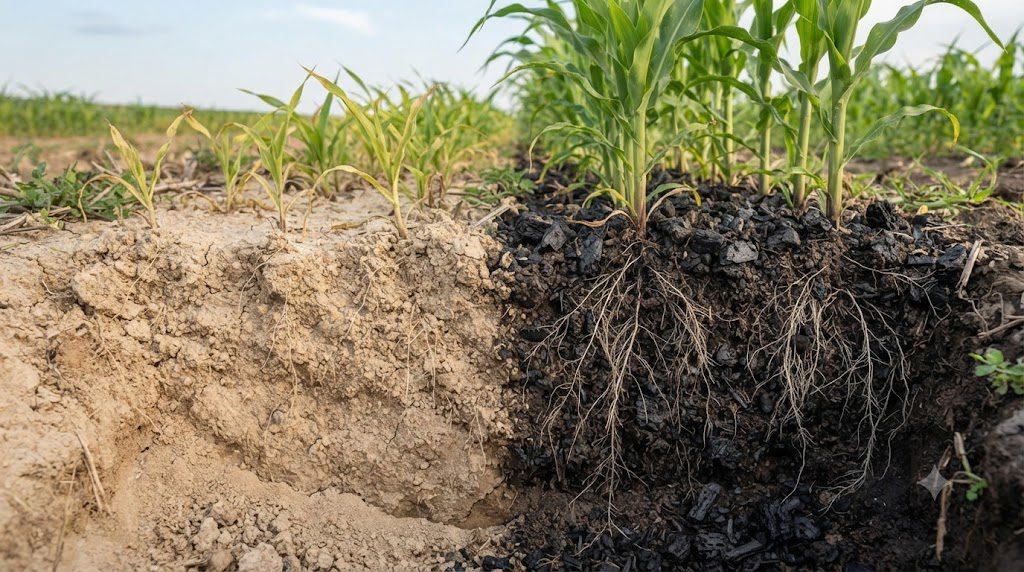
The ANU review reports that meta-analyses show average crop yield increases of 10% to 42% when it is added, with the largest gains in low-nutrient, acidic soils common in the tropics and in sandy dryland soils.
A separate Chinese meta-analysis found an average yield improvement of 15.0% compared with untreated controls. That analysis also found that the effect was strongest in clay soil, followed by sandy soil, then loamy soil. The details are in Scientia Agricultura Sinica.
Evidence strength: good on average, but your own soil decides the result.
2. It Stores Carbon for a Very Long Time
According to the ANU review, the carbon in the char persists in soil for hundreds to thousands of years. That is far longer than the carbon in fresh crop residue.
This is why it is discussed as a climate tool. Locking farm waste into stable carbon takes it out of the short-term carbon cycle.
Evidence strength: strong for the carbon’s stability, though real-world climate benefit depends on how the material is made and what the feedstock would otherwise have done.
3. It Can Make Phosphorus More Available
The same review reports that meta-analyses found it increases phosphorus availability on average by a factor of 4.6. Phosphorus is often locked up in acidic or alkaline soils, so this matters for many farms.
Evidence strength: promising, but an average across studies does not guarantee the same jump on your land.
4. It Improves Water and Nutrient Holding in Sandy Soil
Sandy soils drain fast and lose nutrients. The porous structure of the char helps hold both. The ANU review attributes gains in sandy dryland soils to improved nutrient retention and water-holding capacity.
If your fields drain too quickly, this is where a trial makes the most sense.
Evidence strength: good for sandy and degraded soils, weaker for heavy clay that already holds water.
5. It May Cut Greenhouse Gas Emissions From Soil
The ANU review reports that meta-analyses found reductions in non-carbon-dioxide greenhouse gas emissions from soil of 12% to 50%. These gases include nitrous oxide, which is far more potent than carbon dioxide per unit.
Evidence strength: a wide range, which tells you the effect depends on conditions.
6. It Can Lower Heavy Metal Uptake by Plants
The same review reports that plant tissue concentrations of heavy metals fell by 17% to 39% in meta-analyses. A rice-paddy meta-analysis also examined cadmium and lead availability alongside yield and soil acidity. See the European Commission summary of that rice study.
This does not make polluted land safe to farm. Test soil and crops, and follow food safety rules.
Evidence strength: encouraging, but never a substitute for cleaning up contaminated land.
7. It Turns Farm Waste Into a Useful Product
Straw, prunings and shells often get burned in the open or left to rot. Converting them to a stable soil product gives waste a second use and supports a circular farm economy.
A 2021 review in GCB Bioenergy notes that the materials can also be used in animal feeding, manure treatment, composting and as a fertilizer component, not only as a direct soil application. Read the abstract at DOAJ.
Evidence strength: practical and well supported, though economics depend on local labor, energy and transport costs.
When Biochar Does Not Work
Honest advice needs this section. The product is not magic, and it can disappoint.
Soils That Are Already Fertile
The biggest yield gains show up in poor, acidic or sandy soils. Rich, well-managed soils often show small or zero yield gains. Spending money there may not pay back.
Poor Quality Product
The GCB Bioenergy review of 26 meta-analyses reports compelling evidence of beneficial effects across all the agronomic parameters it investigated. It also warns that incomplete characterization of the material increases uncertainty, because adverse results in some studies may come from low-quality products with contaminants, high salinity or incomplete pyrolysis.
In other words, bad material gives bad results, and some trial failures may reflect that.
Weak or Inconsistent Prediction
A global meta-regression using 84 studies and 365 yield response ratios found that none of the production parameters in its dataset were significant predictors of yield. It also found that yield response increased over time after the first application. You can read it at Environmental Research Letters.
That means even experts cannot yet predict your result from a lab sheet alone. A field trial is the only reliable test.
Cost and Logistics
Application usually involves tonnes per hectare in research trials, so transport and spreading costs can be large. Fine dust is also a handling hazard, so wet it or incorporate it promptly and wear a dust mask.
How to Judge Biochar Quality
You cannot judge quality by color alone. Ask for documentation before you buy.
- Feedstock: what was it made from, and was it clean?
- Production temperature and method: was it made in a controlled kiln or retort?
- Lab analysis: ask for carbon content, pH, salinity and contaminant tests.
- Certification: voluntary standards exist in several countries, and the 2021 review notes that low-quality products would not qualify for certification.
- Particle size and moisture: these affect handling and spreading.
A reputable seller will share this information. If a seller cannot or will not, walk away.
Charging the Material Before Use
Fresh char can hold nutrients tightly and may temporarily tie up nitrogen. Many growers mix it with compost or manure before applying so it starts loaded with nutrients. Ask your supplier or local extension service what suits your crop.
How to Run a Safe Farm Trial of Biochar
Start small. A well-run trial costs little and teaches you more than any brochure.
- Test your soil first. Record pH, organic carbon and nutrient levels so you have a baseline. See our guide on reading a soil test report.
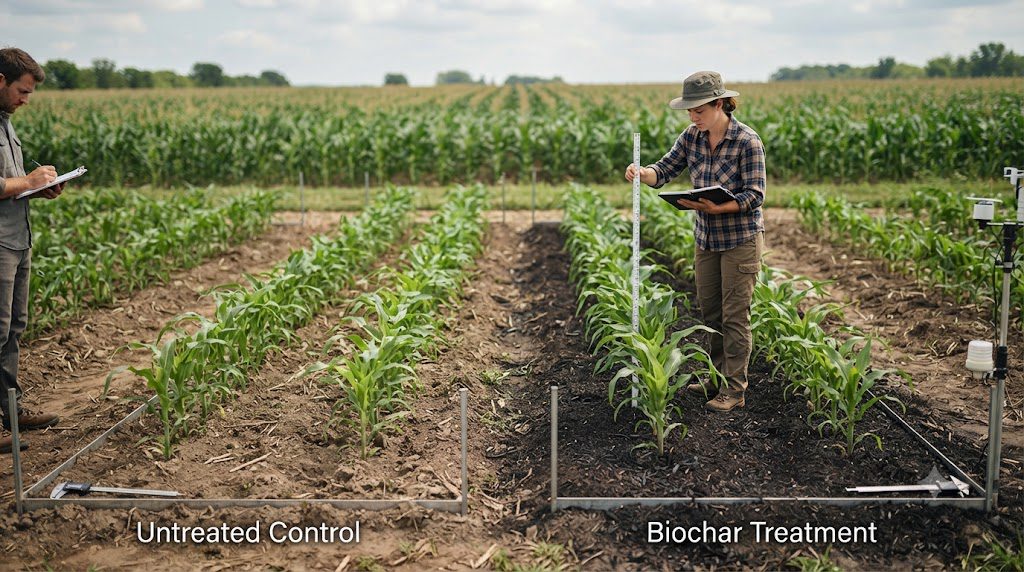
- Pick two matched plots. Choose areas with the same soil, slope and history.
- Treat one plot only. Keep the other as an untreated control.
- Mix it into the soil. Incorporate it rather than leaving it on the surface, and consider pre-mixing with compost.
- Manage both plots the same way. Same seed, water, fertilizer and timing.
- Record yields and costs. Weigh the harvest from each plot and note all expenses.
- Repeat for several seasons. The global analysis above found that response can grow over time, so one season may not tell the full story.
For related reading, see our posts on making compost at home and saving irrigation water in dry seasons.
Do Not Skip the Control Plot
Without a control plot you cannot tell whether yield changed because of the treatment or because of weather. This is the most common trial mistake.
Biochar and the Bigger Farm Picture
This material is one tool, not a full strategy. It works best alongside good crop rotation, organic matter, balanced fertilizer and sound water management.
Think of it as a long-term soil investment, not a fertilizer. A fertilizer feeds this season’s crop. The char changes soil structure for years.
Carbon Markets and Incentives
Some programs pay for verified carbon storage. Rules, prices and verification costs vary widely and change often. Read any contract carefully and confirm that payments cover your costs.
Common Myths About Biochar
Because the topic is trendy, hype spreads quickly. Sorting myth from fact will save you money.
Myth: Biochar Replaces Fertilizer
It does not. The material is mostly carbon and holds few nutrients on its own. Crops still need nitrogen, phosphorus, potassium and the rest. At best, it helps your soil hold and use those nutrients more efficiently.
Myth: Biochar Works Everywhere
The research above shows the opposite. Gains are largest in poor, acidic and sandy soils and smaller in fertile ones. Anyone promising the same result on every farm is selling, not teaching.
Myth: Any Black Powder Counts as Biochar
Ash, soot and fuel charcoal are not the same product. Quality depends on feedstock, temperature and testing, which is why documentation matters so much.
Myth: One Application Fixes the Soil Forever
The carbon lasts a long time, but your soil still needs regular care. Crop rotation, organic matter and balanced nutrition remain essential. Good management is part of a larger plan.
Matching Biochar to Your Soil Type
Different soils have different problems, and biochar solves some of them better than others.
Sandy Soils and Biochar
These lose water and nutrients quickly. Reviews suggest they are among the best candidates because the porous structure improves retention. Start here if drainage is your main problem.
Acidic, Low-Nutrient Soils
Tropical and heavily weathered soils often fit this description. The ANU review lists them among the soils with the greatest yield responses, so it deserves a trial on such land.
Heavy Clay and Fertile Loam
Results here are less certain. The Chinese meta-analysis ranked clay soil highest for yield response, while other work suggests fertile soils gain little. That mixed picture is a reason to trial small before you commit money.
Questions to Ask Your Biochar Supplier
- What feedstock and temperature did you use?
- Can I see a lab analysis, including contaminant tests?
- Is it certified under any recognized standard?
- Can you recommend a rate for my soil and crop, and what is the evidence?
Frequently Asked Questions About Biochar
1. What is biochar?
Biochar is a charcoal-like, carbon-rich material made by heating biomass such as crop straw, wood chips, rice husks, nut shells, or manure with little or no oxygen. It can be added to soil to improve certain soil properties and store stable carbon.
2. What are the main benefits of biochar for soil?
Biochar may improve crop yields, increase phosphorus availability, improve water and nutrient retention, reduce some soil greenhouse gas emissions, lower plant uptake of certain heavy metals, and convert farm waste into a useful soil amendment.
3. Does biochar increase crop yield?
It can. Research reviews cited in the article report average yield increases ranging from about 10% to 42%, but results vary considerably depending on soil type, climate, feedstock, and biochar production conditions.
4. Which soils benefit most from biochar?
Poor, acidic, sandy, and degraded soils are among the strongest candidates. The article notes that fertile, well-managed soils may show smaller or negligible yield improvements.
5. Is biochar the same as compost?
No. Compost is decomposed organic matter that feeds soil life, while biochar is a relatively stable carbon-rich material that can remain in soil for a very long time.
6. Can biochar replace fertilizer?
No. Biochar should not be considered a replacement for fertilizer. Crops still require essential nutrients such as nitrogen, phosphorus, and potassium. Biochar may help soil retain and use nutrients more efficiently.
7. How long does biochar last in soil?
The article cites research reporting that biochar carbon can persist in soil for hundreds to thousands of years, although its effects on nutrients and soil properties can change as it ages.
8. Can biochar improve water retention in sandy soil?
Yes. Its porous structure can help sandy soils retain water and nutrients that would otherwise drain quickly. The article identifies sandy and degraded soils as particularly promising candidates for trials.
9. Does biochar improve phosphorus availability?
Research cited in the article found an average increase in phosphorus availability, although the size of the effect can vary substantially between soils and conditions.
10. Can farmers make biochar at home?
Biochar can be produced using a controlled low-oxygen process such as pyrolysis, but the article warns against open burning because it can produce smoke and harmful particles. Proper equipment, emissions control, and local regulations should be considered.
Final Thoughts on Biochar
The research is encouraging. Large reviews show average gains in yield, nutrient availability and carbon storage, especially in poor, acidic and sandy soils.
But averages hide wide variation, and quality varies from seller to seller. Test your soil, buy documented material, run a controlled trial for several seasons and let your own data decide.