
Agritech apps for farmers let you check mandi prices, weather, crop insurance and soil data from your phone. The most useful are free government tools like Kisan Suvidha, Meghdoot and e-NAM, plus a few private apps for inputs and advice.
This guide is for smallholders with a basic Android phone, agriculture students, and anyone looking for scheme tools. For each app I say what it does, what it does not do, and where it fails.
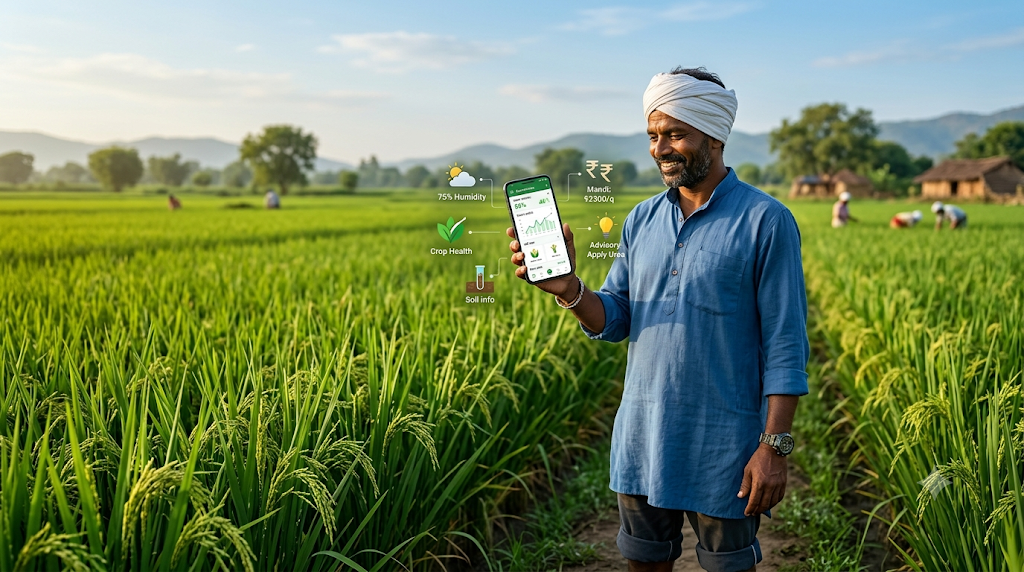
Table of Contents
What Are Agritech Apps for Farmers?
Agritech apps for farmers are mobile apps and web portals that give farmers farming information or services. Agritech is short for agricultural technology.
They usually cover one or more of these jobs:
- Weather forecasts and crop advisories
- Mandi prices and online selling
- Crop insurance and loss reporting
- Soil test records and fertiliser advice
- Scheme registration and status checks
Government tools are free to use. Private apps may charge for inputs or services, so read the price before you pay.
Apps are one part of this sector. Our guide to agritech categories covers the other groups, such as sensors, drones and farm finance.
Why These Apps Matter for Small Farms
A smallholder rarely has an agronomist on call. Nobody tells you which mandi pays more today. Agritech apps for farmers fill part of that gap.
Selling. Checking prices before you load a trolley saves diesel and a wasted trip.
Weather. Spray timing, irrigation and harvest all depend on the forecast.
Paperwork. Insurance and scheme payments run on digital records. If you cannot check your own status, you depend on someone else.
Inputs. A soil report shows what the field needs, so you do not apply fertiliser by habit.
Timing. Insurance and weather alerts only help if you see them on the day. A phone notification reaches you faster than a notice board at the panchayat office.
An app does not replace your experience. It gives you one more source to check before you spend. Treat what the screen says as a second opinion, and keep your own judgement as the first.
Which App for Which Job
Start here if you want the short answer. The next section explains each app and its limits.
| Your job | App to try first |
|---|---|
| Prices, dealers, weather in one place | Kisan Suvidha |
| Weather advice for your district | Meghdoot |
| Selling through connected mandis | e-NAM |
| Expert advice on a crop problem | Kisan Sarathi |
| Voice-based advice | Bharat VISTAAR |
| Scheme payment status | PM-KISAN portal |
| Reporting crop loss | Crop Insurance App |
| Fertiliser planning | Soil Health Card portal |
| No smartphone | Kisan Call Centre |
9 Agritech Apps for Farmers You Can Start Using
Features change over time. Confirm each app on its official page before you rely on it.
1. Kisan Suvidha
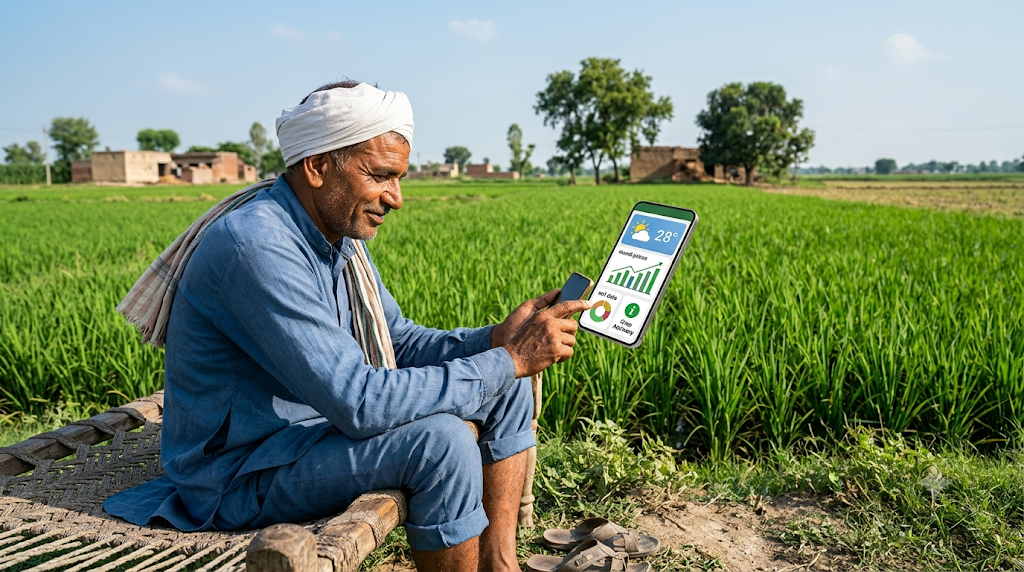
Kisan Suvidha is a Ministry of Agriculture app. It shows weather for the current day and the next five days, extreme weather alerts, dealers, market prices, agro advisories, plant protection and IPM practices, as the official PPQS page describes.
Best for: one app that covers the basics.
Limit: it needs internet, and prices depend on what mandis report.
2. Meghdoot
Meghdoot carries weather forecasts and crop-wise advisories for your district. A CGIAR report on Meghdoot explains that IITM, ICAR and state university units prepare these advisories twice a week, and the app shows them next to IMD forecasts.
Best for: timing irrigation, spraying and harvest.
Limit: a forecast is guidance, not a promise. Watch the sky as well.
3. e-NAM
e-NAM is the government’s online platform linking APMC mandis. You create a farmer account on the e-NAM portal and view prices from connected mandis. Our post on eNAM registration covers the account setup step by step.
Best for: farmers whose nearest mandi is connected.
Limit: it gives you little if your mandi is not on the platform.
4. Kisan Sarathi
Kisan Sarathi connects farmers with scientists at Krishi Vigyan Kendras for crop and livestock advice. The value is a human expert, not a generic tip. Read our post on Kisan Sarathi before you trust any single answer.
Best for: a specific crop problem.
Limit: advice quality depends on the details you give.
5. Bharat VISTAAR
Bharat VISTAAR is the government’s AI-powered, voice-first advisory platform. A farmer can ask about crops, weather and mandi rates by speaking. Our guide on Bharat VISTAAR explains how it works.
Best for: farmers who find typing hard.
Limit: AI answers can be wrong. Check anything that costs money with an expert.
6. PM-KISAN Portal
The PM-KISAN portal lets you check beneficiary and payment status. If the record shows an error, fixing it means a visit to your agriculture office or CSC. A correct digital identity helps, and our guide on Farmer ID registration explains it.
Best for: finding out why a payment is stuck.
Limit: it shows status, but it does not fix the record for you.
7. Crop Insurance App (PMFBY)
Under PMFBY, you must report localised crop loss and post-harvest loss within 72 hours of the event. You can use the Crop Insurance App, the Krishi Rakshak helpline 14447, your bank, or the local agriculture office. The PMFBY portal hosts the scheme, and SBI General’s claim page lists the same reporting channels.
Your crop record matters here too. Our guide on the digital crop survey explains how plot-wise crop entries are made.
Best for: reporting hail, flood or storm damage fast.
Limit: a report starts the process but does not guarantee a claim.
8. Soil Health Card Portal
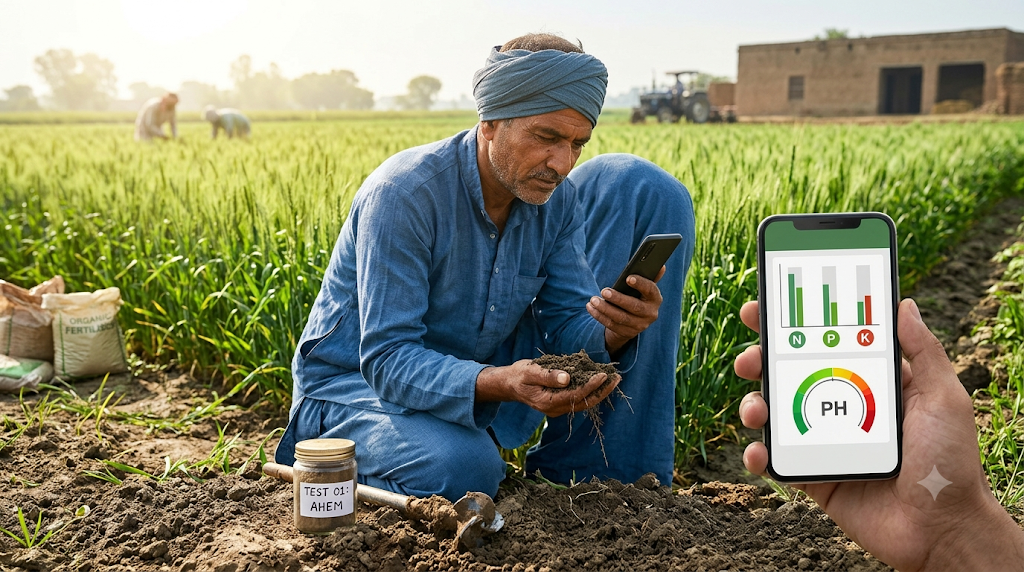
The Soil Health Card portal handles soil sample registration, test results and card generation. A PIB document on the scheme says the card gives your soil’s nutrient status and recommended nutrient doses.
Best for: cutting fertiliser guesswork.
Limit: it works only if your soil was sampled. Ask your agriculture office.
9. mKisan Apps, Kisan Call Centre and Private Apps
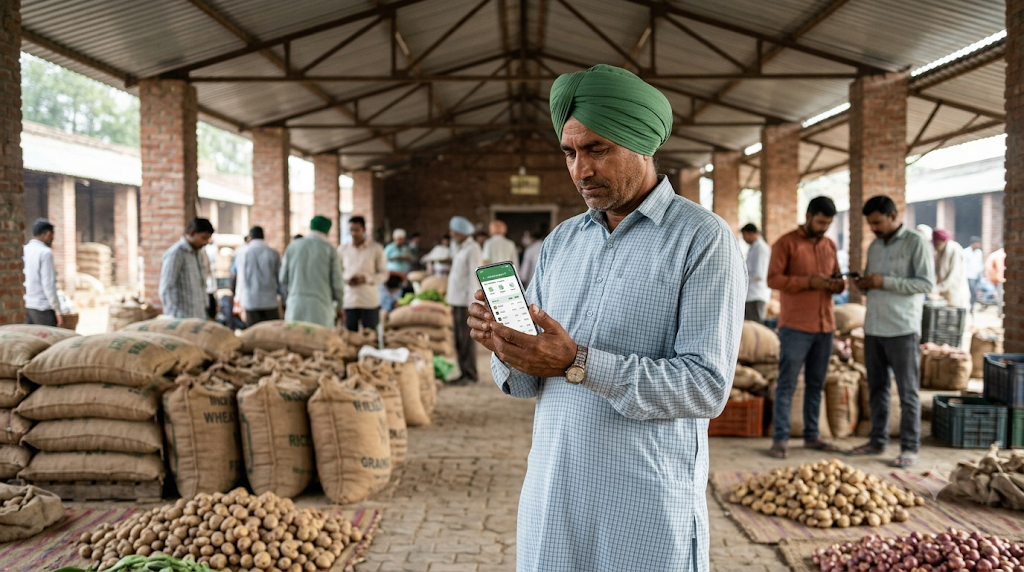
The mKisan download page lists government apps, including Kisan Suvidha, Pusa Krishi and AgriMarket. AgriMarket shows crop prices in markets within 50 km of your location.
Without a smartphone, call the Kisan Call Centre on 1800-180-1551. The mKisan KCC page says the service runs from 6 am to 10 pm, all seven days.
Private companies such as DeHaat and AgroStar sell inputs and give advice. Compare their prices with your local dealer.
Best for: phone-only access and input delivery.
Limit: private apps are businesses, so check the price and return policy.
Government vs Private Agritech Apps for Farmers
| Point | Government apps | Private apps |
|---|---|---|
| Cost | Free to use | Free to install; inputs and services cost money |
| Main goal | Information and scheme access | Sales of inputs and advice |
| Data | Official, sometimes slow to update | Varies by company |
| Support | Helplines and local offices | In-app support, call centres |
| Best use | Prices, weather, schemes, records | Convenience and delivery |
Neither type wins every time. I use government tools for records and data. I use a private app only when its price and delivery clearly beat my local shop. That rule keeps agritech apps for farmers useful instead of expensive.
How to Choose the Right App
You do not need nine apps. Pick by the problem you have.
Selling problem: start with Kisan Suvidha and e-NAM.
Weather problem: use Meghdoot and cross-check locally.
Payment problem: use the PM-KISAN portal and keep records correct.
Crop loss problem: learn the insurance steps before the season, not after the damage.
Fertiliser cost problem: get your soil tested.
Ask three questions before installing any app:
- Who owns it: a government department, a known company or an unknown developer?
- What permissions does it ask for? A weather app has no need for your contacts.
- Does it work in my language and on my phone?
If you cannot answer these, skip the app.
Two more checks help. First, see when the app last updated. An app that has not changed in years may show old data. Second, ask another farmer in your block whether it worked for them during a real problem, such as a hailstorm or a price crash. One honest answer from a neighbour tells you more than a rating.
For a smallholder, fewer agritech apps for farmers is better. Each app you add is one more login, one more update and one more place where data can go wrong.
Honest Problems With Agritech Apps for Farmers
Most blogs only praise apps. Here is the other side.
Network. Weak signal in many villages makes apps that need constant data fail in the field.
Language. Not every app handles every regional language well. Test before you rely on one.
Digital skills. Older farmers often find apps hard, so a family member or CSC operator ends up doing the work.
Old data. A price on the screen is not a price offered to you. Confirm at the mandi.
Offices still matter. Many tasks still end at a block or district office.
Private bias. A company that sells inputs may lean towards its own inputs. Ask who benefits.
Phone cost. Data packs cost money, and a cheap phone may run slowly or run out of storage. A heavy app can be worse than no app.
Wrong advice has a price. A bad spray recommendation or a wrong sowing date costs you a season. Always match app advice with your KVK or agriculture office before you act on a big decision.
None of this means you should skip agritech apps for farmers. Use them as tools, not as the final word.
Start in One Week
Do not install everything at once.
Day 1: Install Kisan Suvidha. Set your district and crops.
Day 2: Install Meghdoot. Check your district’s advisory.
Day 3: Check your PM-KISAN status.
Day 4: See whether your nearest mandi is on e-NAM.
Day 5: Look for your Soil Health Card on the portal.
Day 6: Save the 14447 helpline number and note the 72-hour rule.
Day 7: Delete any app you did not use.
After one week, you know which agritech apps for farmers deserve space on your phone.
If you grow rabi pulses, pair the weather tools with our chana farming guide. A forecast makes more sense when you know the crop calendar.
How to Avoid Fake Farming Apps
Fake apps and links target farmers because of scheme money.
- Download only from the official store listing and check the developer name.
- Government portals end in .gov.in. Watch for look-alike domains.
- No genuine scheme app asks for your bank PIN or OTP. Never share either.
- Do not pay anyone “registration fees” for free government services.
If something feels wrong, call the Kisan Call Centre on 1800-180-1551 before you act.
Related Reading on Farm Sutras
Apps are one part of farm technology. These posts go deeper:
- Agricultural spray drones: drift, rules and real results
- Solar-powered cold storage for farmers: cutting post-harvest loss
- All Agritech posts
Final Word on Agritech Apps for Farmers
Agritech apps for farmers work when each one solves a real problem. Use Kisan Suvidha for prices, Meghdoot for weather, the 72-hour rule for crop loss, and the Soil Health Card before buying fertiliser.
Keep paper copies of your land record, bank passbook and insurance receipt. In a dispute, those count more than a screen.
If an app gives you advice that looks wrong, do not act on it. Call the Kisan Call Centre on 1800-180-1551 or visit your nearest Krishi Vigyan Kendra. If a crop loss is already happening, report it within 72 hours first and ask questions after.
These tools save trips for simple checks. Registration fixes, soil sampling and claim disputes still run through local offices, so agritech apps for farmers support your visits and do not replace them.
Start with two apps. Use them for a month. Add more only with a clear reason.
FAQs
1. What are the best agritech apps for farmers in India?
Some of the best agritech apps include Kisan Suvidha, Meghdoot, e-NAM, Kisan Sarathi and the Crop Insurance App. They help farmers check mandi prices, weather forecasts, crop insurance and agricultural advice.
2. Are these agritech apps free to use?
Most government agritech apps are free to use. However, private apps may charge for agricultural products, expert consultations and additional services.
3. Can farmers use agricultural apps without a smartphone?
Yes, farmers without smartphones can contact the Kisan Call Centre at 1800-180-1551. They can receive agricultural information and expert advice through a regular phone call.
4. Which agritech app shows mandi prices in India?
Kisan Suvidha, AgriMarket and e-NAM provide mandi price information. Farmers can compare market rates before selling their crops and choosing a suitable mandi.
5. Which app provides weather forecasts and farming advice?
The Meghdoot app provides district-level weather forecasts and crop-specific advisories. It helps farmers plan irrigation, spraying and harvesting according to weather conditions.
6. How can farmers check their PM-KISAN payment status online?
Farmers can visit the official PM-KISAN portal to check their beneficiary and payment status. If they find errors, they can contact a CSC or local agriculture office.
7. How quickly must farmers report crop damage under PMFBY?
Farmers must report eligible localised and post-harvest crop losses within 72 hours under PMFBY. They can use the Crop Insurance App or call the Krishi Rakshak helpline at 14447.
8. Do agritech apps for farmers support regional languages?
Yes, some agritech apps provide information in regional languages. However, language options vary between apps. Farmers should check availability before installing them.
9. Is it safe to share Aadhaar and bank details on farming apps?
Share Aadhaar and bank details only through verified government portals or authorised services. Never share your OTP, ATM PIN or UPI PIN with anyone.
10. How many agritech apps should a farmer install?
Starting with two or three useful apps is enough. Farmers can choose apps for weather updates, mandi prices and government services according to their farming needs.
Conclusion
Agritech apps are helping farmers make everyday farming decisions easier. Whether it is checking mandi prices, getting weather updates or managing soil health, the right app can save time and provide useful information. Start with a few apps that meet your needs, verify the information and use technology to make your farming decisions smarter.