
Pashu Aadhaar is a unique 12-digit, bar-coded ear tag that gives each cow, buffalo or other animal a permanent digital ID. Vaccination, breeding and treatment records are saved against that number.
If your animal has this tag, its health history sits in one national database that you and your vet can both see. This guide explains how Pashu Aadhaar works, how to get the tag, and what it does and does not do for you.
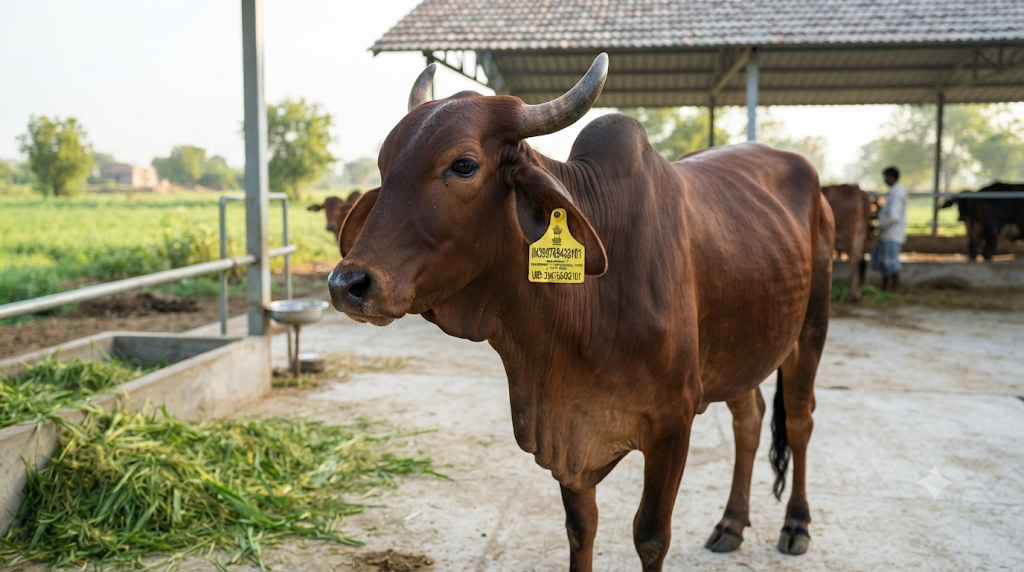
Table of Contents
What Is Pashu Aadhaar?
Pashu Aadhaar is the name given to the unique 12-digit code on a livestock ear tag. The Bharat Pashudhan portal describes it as a bar-coded tag ID issued to livestock animals. It acts as the primary key for every transaction on that animal, such as vaccination, breeding and treatment.
“Pashu” means animal. The name copies the idea of the human Aadhaar number: one ID, one record. But Pashu Aadhaar belongs to the animal, and every animal is linked to a registered owner.
The system sits under the National Digital Livestock Mission (NDLM). NDDB runs it with the Department of Animal Husbandry and Dairying (DAHD). The database behind it is called Bharat Pashudhan.
Before this system, records lived in a vet’s notebook or a farmer’s memory. If you changed your vet or sold the animal, the history was gone. Pashu Aadhaar is built to stop that.
Pashu Aadhaar at a Glance
| Feature | Detail |
|---|---|
| What it is | 12-digit bar-coded ear tag ID for livestock |
| Run by | DAHD and NDDB under the National Digital Livestock Mission |
| Database | Bharat Pashudhan |
| Records linked | Vaccination, breeding, artificial insemination, treatment |
| Who sees records | The farmer, field veterinarians and workers for that animal or area |
| Owner link | Each animal must be tagged against a registered owner |
| Verification | OTP sent to the owner’s registered mobile (as per an NDDB presentation) |
| Issued so far | Over 35.68 crore animals till November 2025 (PIB) |
What Records Does Pashu Aadhaar Hold?
Per PIB and the Bharat Pashudhan portal, the database records:
- Vaccination: which vaccine, and when.
- Breeding and artificial insemination: service dates and breeding events.
- Treatment: health services given by field vets and workers.
- Ownership: which registered owner the animal belongs to.
PIB says the database has logged over 84 crore field transactions. Field workers record them through the Bharat Pashudhan app.
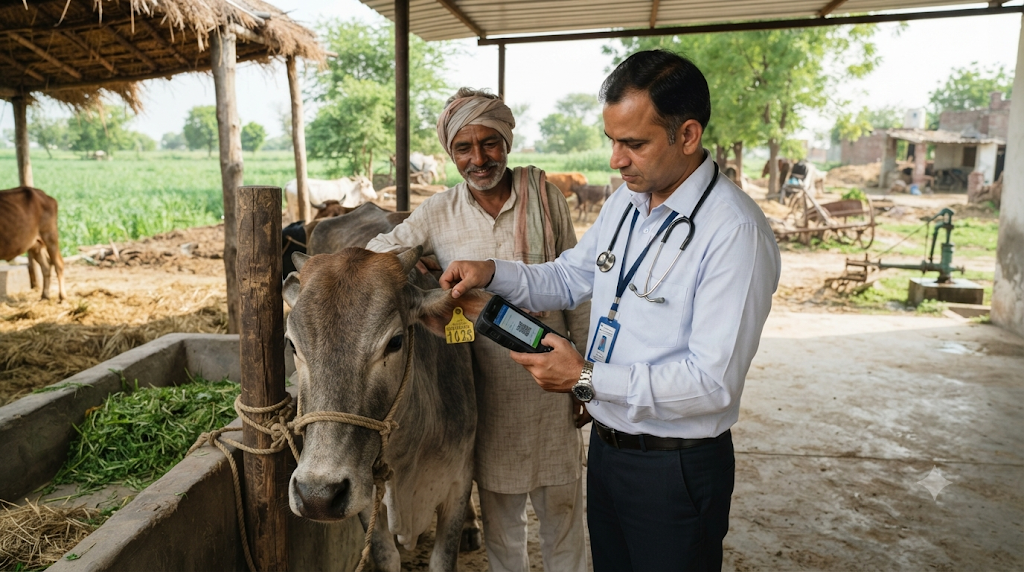
All records appear against the tag ID, so one number pulls up one animal’s full history. That is the real value: one scan or one number, and a vet sees what has already been done.
Why Pashu Aadhaar Matters on Your Farm
Let me be direct. Pashu Aadhaar is an identity and record system. It is not a subsidy or a loan. You get no cash for tagging an animal.
So why bother? Here is what it gives you in practice:
- Vaccination proof. During an outbreak, you can show which animals were vaccinated. See our guides on foot and mouth disease and lumpy skin disease in cattle.
- Breeding records. You can track insemination dates without a notebook.
- Treatment history. A new vet sees what the last vet did.
- Resale and disputes. A tag tied to an owner ID makes it harder to argue over whose animal it is.
What I could not confirm is a central rule that makes the tag mandatory for every scheme benefit. Some state programmes may ask for it. Ask your block veterinary officer before you assume either way.
How to Get Pashu Aadhaar: 7 Steps
The steps below follow NDDB’s published process and the portal description. The details at your village can differ.
Step 1: Contact your local vet or field worker
Tagging is done by registered users, meaning veterinary staff and field workers who use the Bharat Pashudhan app. Ask at the nearest veterinary dispensary or animal husbandry office.
Step 2: Get yourself registered as an owner
Every animal is attached to a registered owner. There can be no animal in the system without one. The field worker registers you first, using your details.
Step 3: Keep your mobile number active
The system sends an OTP to the owner’s registered mobile to confirm each tag entry. Use a number you actually carry.
Step 4: The tag is fixed in the animal’s ear
The animal receives a 12-digit bar-coded ear tag. The code is generated centrally by NDDB, so no one can invent a number locally.
Step 5: Animal details are entered
The field worker enters data for that animal against its 12-digit ID, such as species and breed details as the app requires.
Step 6: A photo is taken with the tag visible
The app asks for a photo of the animal with the tag in view, as confirmation.
Step 7: Confirm with the OTP and note the number
The owner confirms the entry with the OTP. Then write down the 12-digit number somewhere safe.
Pashu Aadhaar for Newborn Calves
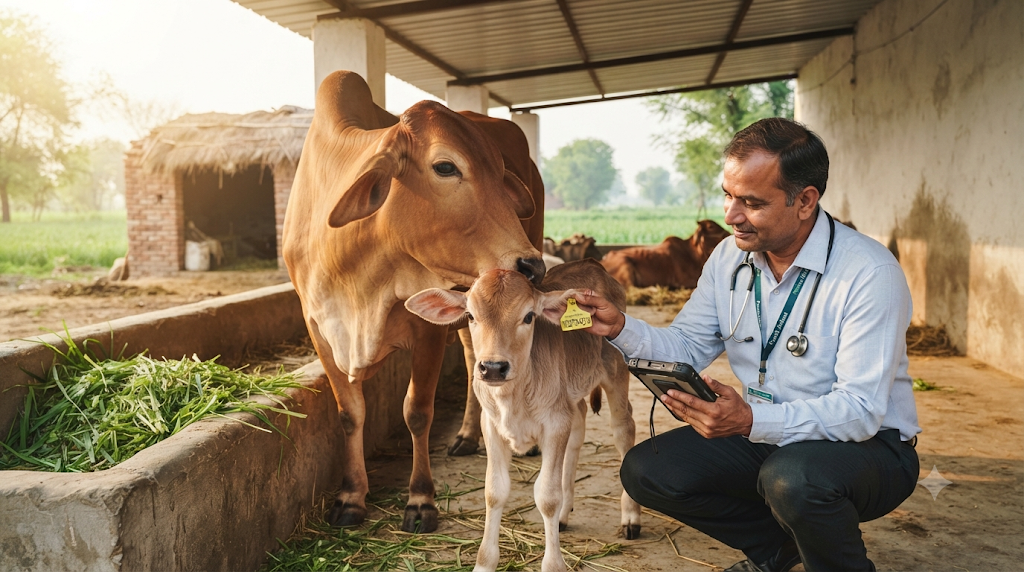
A newborn calf needs an ID too. As per an NDDB presentation shared with WOAH in 2023, calves are registered at the time of calving. The system uses a temporary virtual ID so vaccination and other records can start right away.
Within 90 days, that virtual ID is converted into a permanent 12-digit tag ID through an ear tag change entry. The vaccination history then carries over.
That presentation is from 2023, so ask your vet whether the same process applies in your state today. But the rule of thumb holds: do not wait months to register a calf.
Pashu Aadhaar and the 1962 Livestock Owner App
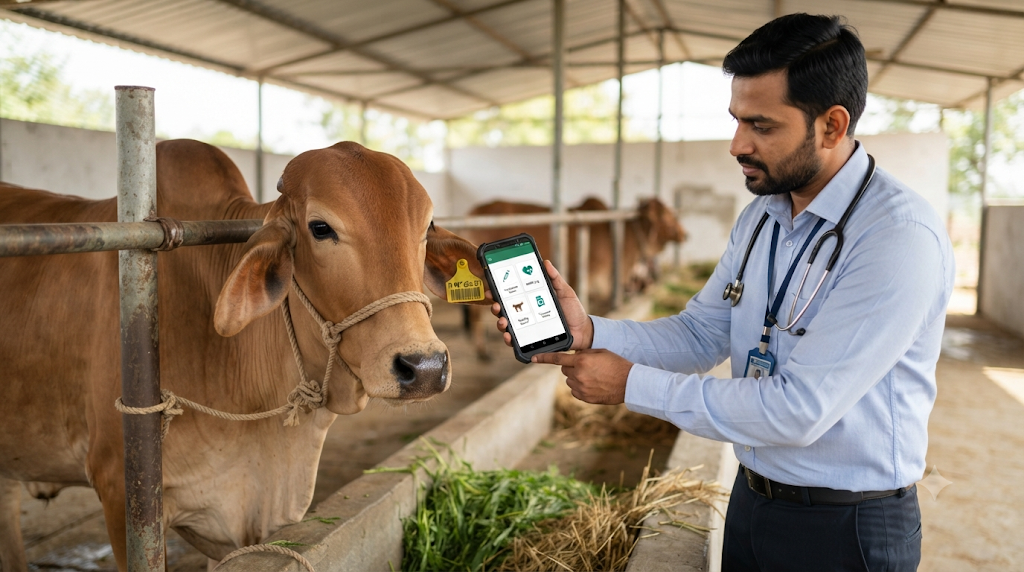
Reports on the NDLM describe a “1962 Livestock Owner App.” It replaced the older e-Gopala app and lets farmers see their animals’ records and track health services.
Treat the app as a viewing tool for you, while field workers use the Bharat Pashudhan app to record entries. Since app names and features change, check the DAHD website or your local vet for the current version before you download anything.
Two safety points:
- Download only from the official app store listing named by DAHD or your vet.
- Never share your OTP with anyone who calls offering “tag benefits.”
How Big Is the Pashu Aadhaar Rollout?
The numbers show how large this system is:
- 35.68 crore animals had been issued Pashu Aadhaar till November 2025, per PIB.
- Over 84 crore transactions were logged in the Bharat Pashudhan database, per the same PIB document.
- A later report in Rural Voice puts the count at about 35.96 crore animals and around 9.5 crore registered livestock owners.
- The NDDB presentation of 2023 reported about 286.5 million of 303 million bovines (95%) tagged at that time.
The reports use different dates, which explains the different totals. Compare them with care. For the freshest figure, check the Bharat Pashudhan portal or the latest PIB release.
For context, our post on livestock population in India shows how large the animal count is.
6 Pashu Aadhaar Mistakes to Avoid
1. Giving a wrong or dead mobile number
The OTP goes to your registered number. If it is wrong, the entry stalls and you cannot confirm records later.
2. Not writing down the 12-digit number
Tags can be damaged or hard to read. Keep the number in a notebook and on your phone.
3. Delaying calf registration
Without an ID, a calf’s vaccination records have nowhere to go. Register at birth.
4. Believing the tag gives you money
Pashu Aadhaar identifies the animal. Loans and subsidies are separate schemes with their own forms.
5. Sharing your OTP or details with strangers
Only your vet or registered field worker should handle your tagging entries. No one needs your OTP for any “benefit.”
6. Paying agents for tagging
I found no published fee notice for tagging in the sources I read. Ask your vet in writing whether any charge applies in your state before you pay anyone.
Pashu Aadhaar vs Other Livestock Schemes
These schemes do different jobs. Mixing them up wastes time.
| Scheme | What it does | Read more |
|---|---|---|
| Pashu Aadhaar | Gives each animal a digital ID and record | This guide |
| Pashu Kisan Credit Card | Working capital credit for animal keepers | Pashu Kisan Credit Card |
| Livestock insurance | Compensation when an insured animal dies | Livestock insurance |
| National Livestock Mission | Capital subsidy for livestock units | National Livestock Mission |
| AHIDF scheme | Interest subvention on loans for processing and feed units | AHIDF scheme |
Think of Pashu Aadhaar as the base layer. A clean record helps you in any conversation with a vet, a bank or an insurer. But each scheme has its own paperwork.
What Smallholder Farmers Should Do Now
Most of our readers keep two to ten animals. Here is a plain plan:
- Ask your vet whether all your animals are tagged and in the system.
- Register any untagged animal and every new calf.
- Keep the 12-digit numbers in one notebook.
- Check that your mobile number in the system is current.
- Use the vaccination record before the next outbreak season. Our post on FMD in cattle and sheep pox and goat pox explain why timing matters.
- Learn the basics of rearing before you scale up. Start with dairy farming in India and livestock categories.
Be honest with yourself on one point. Pashu Aadhaar only helps if the records are filled in. A tag with an empty history is just plastic in an ear.
Pashu Aadhaar FAQs
1. What is Pashu Aadhaar?
Pashu Aadhaar is a unique 12-digit bar-coded ear tag ID given to livestock animals such as cows, buffaloes and goats. It works like an identity number for each animal. Vaccination, breeding, treatment and other health records are linked to this number, making it easier for farmers and veterinarians to track an animal’s health history.
2. Who runs Pashu Aadhaar?
Pashu Aadhaar is implemented by the National Dairy Development Board (NDDB) in partnership with the Department of Animal Husbandry and Dairying (DAHD). The system works under the National Digital Livestock Mission (NDLM), and animal records are maintained through the Bharat Pashudhan database.
3. Is Pashu Aadhaar the same as my Aadhaar card?
No, Pashu Aadhaar is completely different from your personal Aadhaar card. Your Aadhaar card is used to identify you, while Pashu Aadhaar gives a unique identification number to each livestock animal. However, every tagged animal is linked to its registered owner’s details in the database.
4. How many animals have Pashu Aadhaar?
According to the Press Information Bureau (PIB), more than 35.68 crore livestock animals had received Pashu Aadhaar tags by November 2025. A later report mentioned that the number had increased to around 35.96 crore animals. These figures show the growing use of digital identification in India’s livestock sector.
5. How do I get Pashu Aadhaar for my cow or buffalo?
To get Pashu Aadhaar for your cow or buffalo, visit your nearest veterinary hospital, animal husbandry office or contact a registered field worker. They will register you as the animal’s owner, attach a 12-digit ear tag, enter the animal’s details and take a photograph with the tag visible. You may also need to confirm the registration using an OTP sent to your registered mobile number.
6. Do newborn calves need Pashu Aadhaar?
Yes, newborn calves also need to be registered under the Pashu Aadhaar system. According to an NDDB presentation, calves can initially receive a temporary virtual ID at birth. This ID is later converted into a permanent 12-digit ear tag within 90 days, helping farmers maintain vaccination and health records from an early age. Confirm the current procedure with your local veterinarian.
7. What records are stored under Pashu Aadhaar?
Pashu Aadhaar stores important information about an animal’s health and care. These records include vaccination details, breeding history, artificial insemination dates and medical treatments. The information is linked to the animal’s unique 12-digit ID, helping veterinarians and registered field workers check its previous health records whenever needed.
8. Is Pashu Aadhaar a subsidy or loan scheme?
No, Pashu Aadhaar is not a government subsidy, loan or financial assistance scheme. It is a digital identification system designed to maintain livestock records and track animal health. Farmers who need loans or financial support can explore separate schemes such as Pashu Kisan Credit Card and the National Livestock Mission, which have their own eligibility rules and application processes.
9. Can I see my animal’s records on my phone?
Yes, reports about the 1962 Livestock Owner App indicate that farmers can use it to view their animals’ records and check available health service information. This can help farmers keep track of vaccination and other livestock details without depending only on paper records. However, check the current app name and available features with DAHD or your local veterinary officer before downloading it.
10. Is there a fee for tagging?
There is no confirmed general tagging fee mentioned in the sources used for this article. The cost or payment rules may depend on the programme and state-level instructions. Before paying anyone, contact your nearest veterinary hospital or animal husbandry office and ask whether any official charges apply. Avoid paying unauthorised agents who promise quick registration.
11. Can Pashu Aadhaar help farmers during livestock disease outbreaks?
Yes, Pashu Aadhaar can help farmers and veterinarians check an animal’s vaccination and treatment history during disease outbreaks. Since health records are linked to the animal’s unique 12-digit ID, veterinarians can better understand which vaccinations or treatments have already been given. This information can support timely animal healthcare and better livestock disease management.
Conclusion
Pashu Aadhaar gives every animal a permanent digital ID and one place for its health history. It will not put money in your account, but it can save you time at every vet visit and during an outbreak.
Tag every animal, register each calf at birth, keep your mobile number current and write down the 12-digit numbers. Then use the records. Check the Bharat Pashudhan portal or DAHD for the latest rules in your state.