
Linseed farming works best as a cool-season rabi crop, sown from early October to mid-November at 20 to 30 kg seed per hectare in rows 25 to 30 cm apart. Rainfed fields should finish sowing by 15 November, and irrigated fields by 25 November.
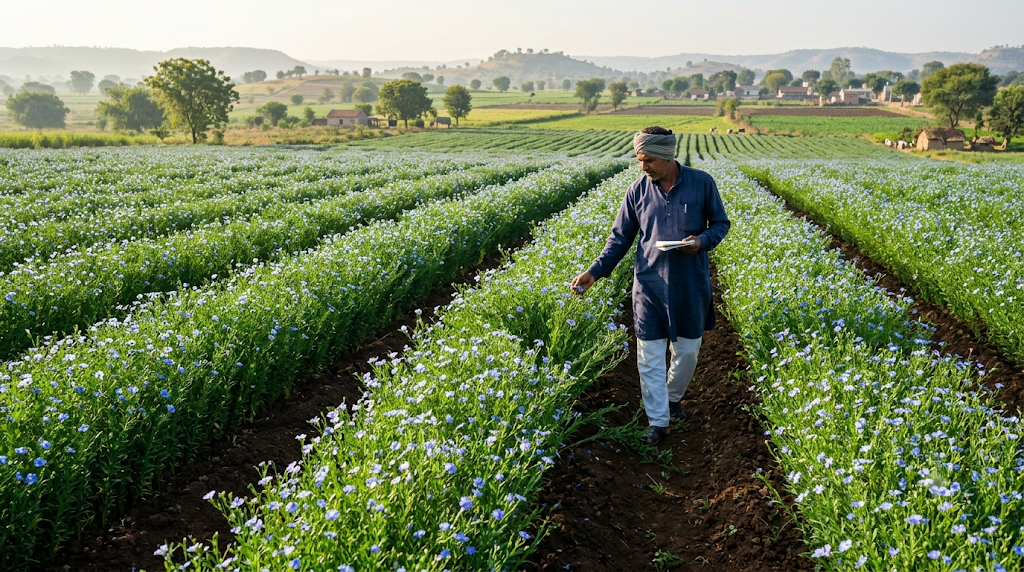
Table of Contents
What Is Linseed Farming?
Linseed farming means growing flax (Linum usitatissimum) for seed, oil or fibre. In India, farmers grow it mainly for seed. The seed holds 33 to 47 per cent oil.
The oil is a drying oil. Industry uses it in paints and varnishes, and some areas use it as edible oil. The cake left after crushing works as manure and animal feed.
Linseed is a self-pollinated crop. Among rabi oilseeds in India, it comes next to rapeseed and mustard.
Varieties fall into two broad types:
- Peninsular types: deep roots, suited to drier soils.
- Alluvial types: shallow roots with profuse tillering.
Some double-purpose varieties give both seed and fibre. Most farmers in our region grow seed types.
Why Linseed Farming Looks Promising for 2027
We do not have a reliable price forecast for 2027, and nobody should sell you one. What we can say comes from published research and field practice.
- Health demand: An ICAR review notes that linseed in the diet raises alpha-linolenic acid (ALA), an omega-3 fatty acid. This is why flaxseed products keep showing up in shops.
- Edible oil work: Researchers are developing edible-grade linseed oil for direct use or blending. If this succeeds, the crop gets a new market.
- Low-input option: The crop does well under rainfed conditions and in paddy fallows where many fields stay empty after rice.
- Diversification: ICAR’s Indian Farming magazine describes linseed as an option for crop diversification and income.
So the case for linseed farming rests on low input cost and land that would otherwise sit idle. Check mandi rates in your district before you commit acres.
Where Linseed Farming Is Done in India
Linseed is grown mostly in these states:
- Madhya Pradesh
- Karnataka
- Chhattisgarh
- Jharkhand
- Bihar
- Maharashtra
- Odisha
- Uttar Pradesh
- West Bengal
- Assam
In the eastern states, farmers commonly sow linseed in standing paddy under the utera system. The system covers about 25 per cent of linseed area in India. A later section explains it.
Arunachal Pradesh has also tested linseed. There, the crop is harvested in April, and late sowing hurts seed setting because pre-monsoon showers coincide with flowering.
Soil and Climate for Linseed Farming
Linseed is purely a cool-season rabi crop. It wants cool weather during growth and dry weather at harvest.
Well-structured soils suit it. A Victorian agriculture department guide says heavier-textured soils beat light sands. A fine, even seedbed helps the small seed to germinate.
Moisture is the main limit in rainfed fields. Create a soil mulch with a hoe after each good shower to hold moisture.
Do not plant linseed in waterlogged fields. If your field holds water after rain, choose another crop or fix drainage first.
Best Sowing Time for Linseed Farming
Sowing date decides more in linseed farming than most farmers expect. Early sowing helps the crop escape powdery mildew, rust and bud fly.
Recommended dates from the sources we checked:
- Rainfed pure crop: finish sowing by 15 November.
- Irrigated crop: finish sowing by 25 November.
- Utera crop: broadcast seed about 15 days before paddy harvest, when soil is moist.
- Bihar, rainfed: around 15 October.
- Uttar Pradesh (excluding Bundelkhand), rainfed: first fortnight of October.
A trial at Chatha, Jammu, found that sowing on 20 October gave the highest seed yield (1.11 t/ha) and the best returns among the dates tested. Later sowing did worse.
If you read this in mid-November 2026, the rainfed window has just closed and irrigated fields still have about ten days. Use this season to plan fields for October 2027.
Choosing Varieties for Linseed Farming
Pick a variety that fits your district and cropping system. Names listed in a published package of practices include:
- Shekhar
- T-397
- Surabhi
- Sweta
- Shubra
- Garima
- Parvati
- Ruchi
- BAUP 101 and RLC-143 (listed for utera)
In a Jharkhand sowing-date study, the variety Divya recorded more capsules per plant (34.20) than the others tested.
Do not buy on a neighbour’s word alone. Ask your Krishi Vigyan Kendra (KVK) or state seed agency which variety suits your block. Buy seed from a licensed source and keep the bill.
Seed Treatment, Seed Rate and Spacing in Linseed Farming
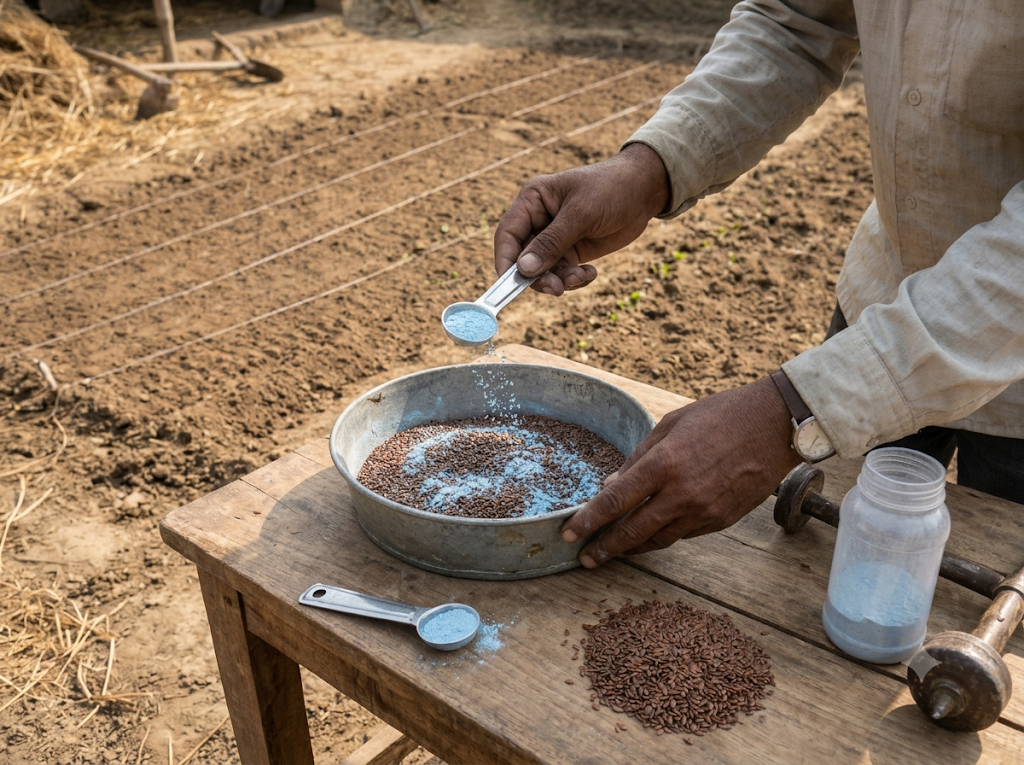
Treat seed before sowing. It protects seedlings from seed-borne disease and, to some extent, soil-borne disease. Options listed by Vikaspedia:
- Bavistin at 1.5 g per kg seed
- Thiram at 3 g per kg seed
- Topsin-M at 2.5 g per kg seed
Use one, not all three together.
For seed rate and spacing, drill sowing is preferred because seed spreads evenly.
| Method | Seed rate | Spacing |
|---|---|---|
| Line sowing | 20 to 30 kg/ha | 20 to 30 cm between rows, about 10 cm between plants |
| Broadcast / utera | 35 to 40 kg/ha | Not applicable |
Bold-seeded varieties need more seed. Place seed 2 to 5 cm deep depending on soil moisture. Shallow sowing is better if moisture is adequate.
Fertilizer Plan for Linseed Farming
Linseed responds well to fertilizer, but doses vary by region. Run a soil test first. The numbers below come from published packages of practices and are a starting point.
| Situation | Dose (kg/ha) |
|---|---|
| Rainfed (one package) | 40 N : 20 P : 20 K |
| Rainfed (another package) | 30 N and 15 P |
| Irrigated | 90 N : 40 P : 30 K |
| Utera | 10 to 20 N |
How to apply:
- Apply fertilizer at sowing, placed 5 cm below and away from the seed in moist soil.
- Split nitrogen in two parts. Give half as basal dose and half 40 to 50 days after sowing.
- Add 5 tonnes of farmyard manure per hectare. It can save about 25 per cent of inorganic fertilizer.
- If your soil is sulphur-deficient, give 30 kg sulphur per hectare through gypsum.
Linseed is moderately susceptible to boron and zinc deficiency, so watch for these in light soils. Nutrient demand peaks from bud formation to full flowering.
A 2026 study in the International Journal of Agriculture and Food Science reported that combining micronutrients with seed inoculation (Azotobacter and phosphate-solubilising bacteria) improved growth and yield traits in linseed. It is worth asking your KVK whether local trials back this.
Irrigation and Weed Control in Linseed Farming
Most linseed farming in India is rainfed, so yield depends on stored soil moisture and winter showers. Under the sources we checked, expected seed yield changes with water:
| Condition | Seed yield |
|---|---|
| Rainfed | 800 to 1,000 kg/ha |
| Protective irrigation | 1,200 to 1,500 kg/ha |
| Fully irrigated | 1,600 to 2,000 kg/ha |
Our sources do not give a fixed number of irrigations, so ask your KVK for the schedule that matches your soil and variety. Do not copy one from a video made for a different state.
Weeds hurt young linseed because the crop grows slowly at first. If the crop is irrigated, one weeding is essential.
One package of practices lists pendimethalin at 1.0 kg per hectare before emergence, followed by metsulfuron methyl at 4 g per hectare after emergence. Read the label, confirm the dose with your KVK and wear protective gear.
Pests and Diseases in Linseed Farming
Three problems cause most trouble in linseed farming.
1. Gall midge (bud fly). This is a widespread and serious pest. Growing early varieties and mixed cropping reduce its incidence. Early sowing also helps.
You can use a bait of 1 kg gur (jaggery) in 75 litres of water to attract bud fly, as one package suggests. Bamboo or wooden pegs serve as perches for predatory birds.
2. Rust. It is among the most serious diseases. Resistant varieties are the standard advice.
3. Wilt. This is the other major disease. Again, resistant varieties are recommended. Seed treatment gives some help against soil-borne causes.
Powdery mildew also appears in late-sown crops. Prevention beats cure here. Sow on time, treat seed and choose a resistant variety. Walk the field every week and check the underside of leaves. Spray only when your KVK or agriculture officer confirms the problem.
Harvesting and Yield in Linseed Farming
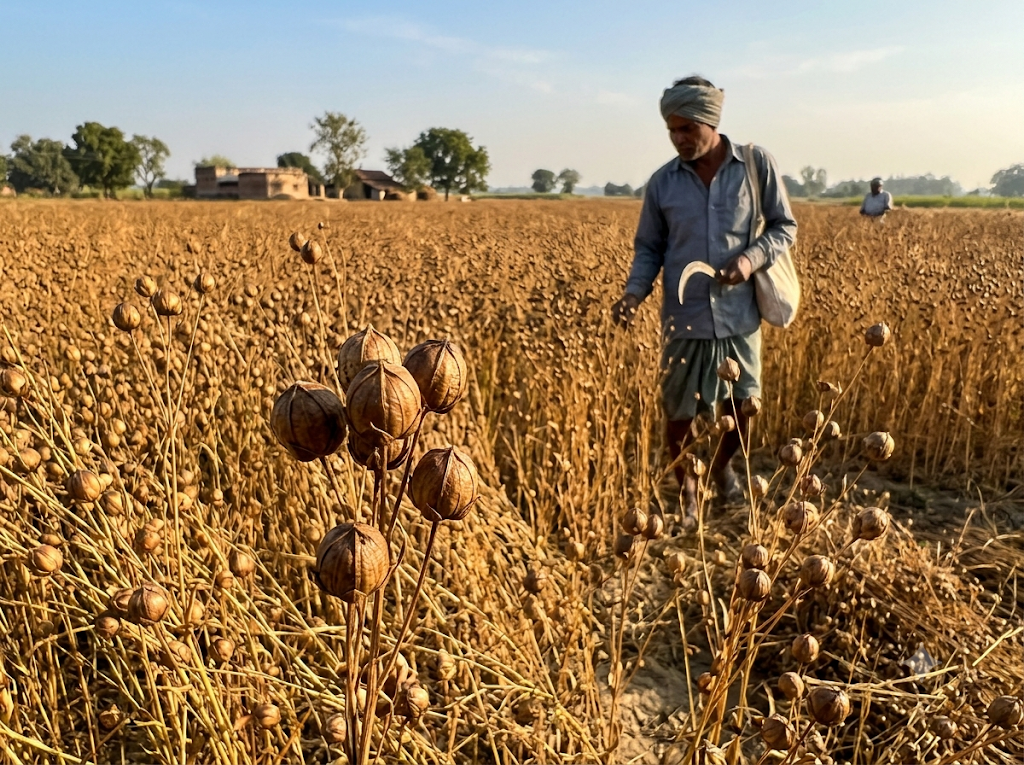
Harvest when most capsules turn brown and the plant dries. Cut early in the morning to reduce seed shattering. Dry the bundles in the sun and then thresh.
Yields depend on the system. With recommended practices, one package reports:
- Rainfed pure rabi crop: 10 to 15 quintals per hectare
- Utera crop: 5 to 9 quintals per hectare
These are targets under good management, not a promise. Poor seed, late sowing and skipped fertilizer will pull you below them. An older paper noted that India has the second-largest linseed area but ranks third in production, because productivity is low. The gap comes mostly from management, which means you can close part of it.
Store seed in clean, dry bags. Moist seed loses quality quickly.
Utera Linseed Farming in Paddy Fields
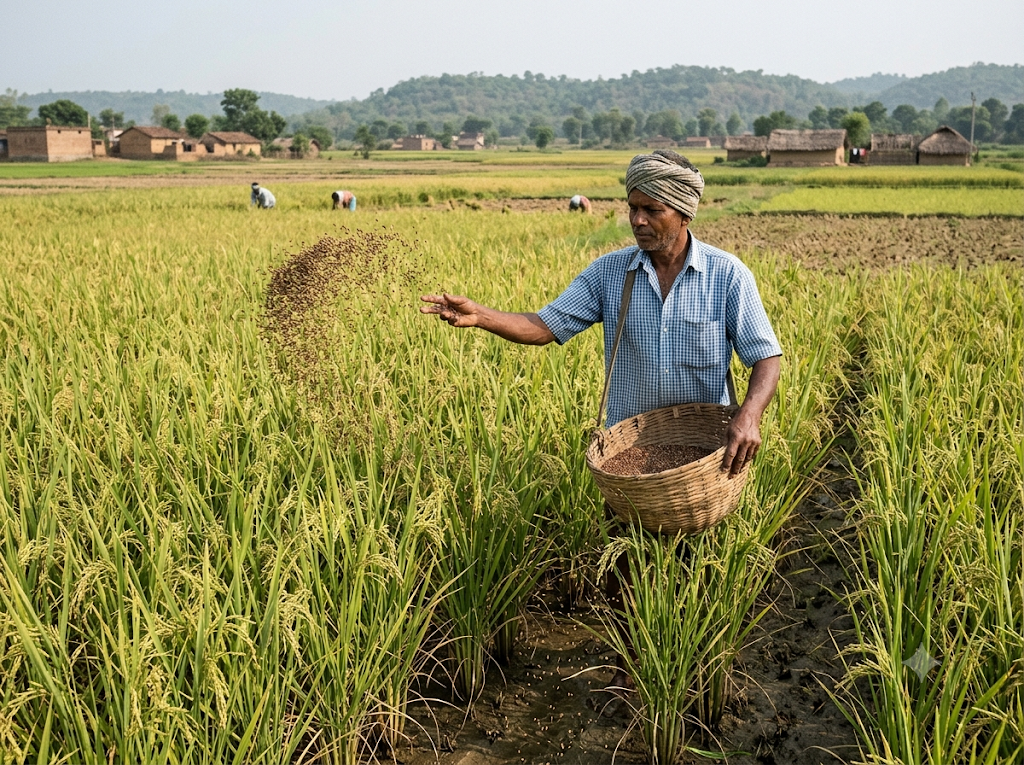
Utera (also called paira) means broadcasting linseed seed into a standing paddy crop. It is the main method in the eastern states.
Why farmers use it: after rice harvest, land preparation takes time. Late sowing or leaving the rabi crop out is common. Utera avoids this wait.
Basics of utera linseed farming:
- Broadcast about 15 days before paddy harvest, when soil is moist.
- Use 35 to 40 kg seed per hectare.
- Apply 10 to 20 kg nitrogen per hectare.
- Choose varieties listed for utera, such as BAUP 101 and RLC-143.
- Expect lower yield than a pure crop (5 to 9 quintals per hectare under the package above).
The trade is lower yield for almost no extra land cost. For many small farmers, that math works.
Cost and Income in Linseed Farming
We will not quote a profit figure. Costs and prices differ by district and year, and a made-up number helps nobody.
Build your own sheet before you sow:
- Seed: 20 to 30 kg per hectare, plus seed treatment.
- Fertilizer and manure: use your soil test, not a neighbour’s habit.
- Labour: sowing, weeding, harvesting and threshing.
- Transport and bags.
- Expected yield: use the rainfed or irrigated range that fits your field.
- Expected price: check the current mandi rate and the minimum support price on the Department of Agriculture website.
Then compare the result with chana or mustard on the same plot. If linseed does not beat them on your numbers, do not grow it. Our guides on safflower farming and barley farming use the same approach.
To sell, register on eNAM. Our guide on eNAM registration explains the process.
Common Mistakes in Linseed Farming
These mistakes cost farmers yield every year:
- Late sowing. It invites rust, mildew and bud fly.
- Using too much seed in broadcast fields. Crowded plants compete for moisture.
- Skipping seed treatment. It costs little and protects the stand.
- Ignoring soil tests. You waste money or leave deficiencies unfixed.
- Forgetting sulphur, boron and zinc in soils that need them.
- Choosing a variety by hearsay. Match it to your district and system.
- Skipping early weeding.
- Letting the crop stand too long after maturity.
Government Support for Linseed Farming
We found no scheme in our sources written only for linseed, so check with your block agriculture office about oilseed programmes in your state, seed distribution and training. Your KVK can also run demonstrations.
These steps help any farmer, whatever the crop:
- Get your Farmer ID. See our guide on Farmer ID.
- Check subsidies for storage and processing under the Agriculture Infrastructure Fund.
- Visit your nearest Krishi Vigyan Kendra for seed, training and soil testing.
7-Step Linseed Farming Checklist for 2027
- Pick a field with good drainage and moisture.
- Choose a variety for your district and system.
- Treat seed with a fungicide.
- Sow on time: October for rainfed, by 25 November for irrigated.
- Apply fertilizer at sowing and split the nitrogen.
- Control weeds early and scout for bud fly, rust and wilt.
- Harvest at brown capsule stage and store seed dry.
Frequently Asked Questions About Linseed Farming
1. What is the best month to start linseed farming in India?
October to mid-November. Rainfed fields should finish sowing by 15 November and irrigated fields by 25 November.
2. How much seed does linseed need per hectare?
Line sowing needs 20 to 30 kg per hectare. Broadcasting or utera needs 35 to 40 kg per hectare.
3. What spacing should I use?
Keep 20 to 30 cm between rows and about 10 cm between plants.
4. How much yield can I expect?
Rainfed fields can give 800 to 1,000 kg per hectare, and irrigated fields 1,600 to 2,000 kg per hectare, according to one source. Another package reports 10 to 15 quintals per hectare under rainfed conditions with good practices.
5. Is linseed farming profitable for small farmers?
It can be, mainly because input costs are low on rainfed land. Calculate with your own costs and local prices before sowing.
6. Which soil suits linseed?
Well-structured soils with good drainage. Heavier-textured soils do better than light sands.
7. Can I grow linseed after paddy?
Yes. Broadcast seed into standing paddy about 15 days before harvest, or sow after harvest if soil moisture allows.
8. What are the main pests and diseases?
Gall midge (bud fly) is the main pest, while rust and wilt are the most serious diseases affecting linseed crops. Early sowing, seed treatment and resistant varieties help reduce these problems.
9. Does linseed need fertilizer?
Yes. It responds well. Rainfed fields often get around 40:20:20 NPK per hectare, and irrigated fields 90:40:30, but get a soil test first.
10. Where can I learn more about linseed farming in my district?
Visit your nearest KVK or block agriculture office. They know local varieties and sowing dates.
Conclusion
Linseed farming rewards farmers who sow on time, treat seed and match the variety to the land. It is a sensible crop for rainfed fields and paddy fallows, but only if your own cost sheet says so. Start your planning now so seed, fertilizer and field are ready by October 2027