
Safflower farming is the cultivation of kusum (Carthamus tinctorius), a rabi oilseed that grows on residual soil moisture and is sown from mid-September to mid-November, depending on the state. The Cabinet fixed its MSP for 2027-28 at Rs 7,215 per quintal, up Rs 675, the biggest rise among the six rabi crops with an MSP.
Quick answer
- Crop: safflower (kusum, kusumbha, kardi), a rabi oilseed
- Sowing: second week of September to second week of November, varies by state
- Spacing: 45 x 20 cm in most states
- Seed rate: 10 to 15 kg per hectare in normal conditions
- Water: 2 to 3 irrigations at rosette, flowering and seed development
- MSP 2027-28: Rs 7,215 per quintal (up Rs 675)
Table of Contents
What is safflower farming?
Safflower farming has two old uses in India. The orange-red dye (carthamin) comes from the florets, and the seed holds 24 to 36% oil. Farmers know the crop as kusum, kusumbha or kardi.
Maharashtra and Karnataka together give more than 90% of India’s production, according to Vikaspedia. The same source says India has a larger area under the crop than other major producers, but a lower yield.
The crop is fairly tolerant of saline conditions and grows on residual moisture in paddy fallows. That is why safflower farming suits dry, rainfed rabi fields where wheat would struggle.
ICAR-IIOR, Hyderabad, developed ISF-1, the first high oleic safflower variety in India, because industry demand for high oleic oil is rising.
Low yield is this crop’s main weakness, so it works best as a dryland crop with a decent MSP.
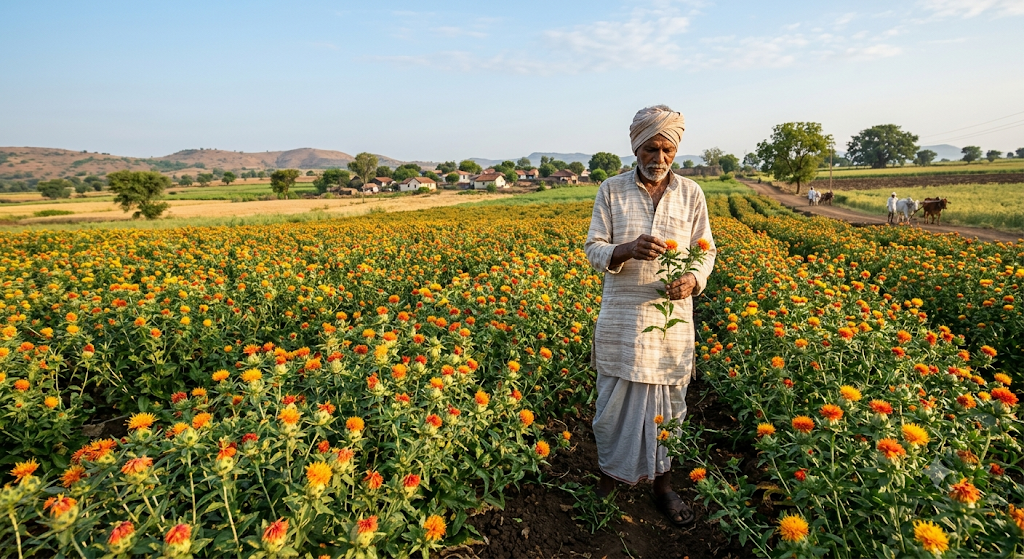
Safflower farming and MSP 2027-28
On 30 September 2026, the Cabinet approved new MSP for six rabi crops. Safflower farming got the largest increase in rupees. These figures match our guide on the names of rabi crops. All values are in Rs per quintal.
| Crop | MSP 2026-27 | MSP 2027-28 | Increase | Expected margin over cost |
|---|---|---|---|---|
| Safflower | 6,540 | 7,215 | 675 | 50% |
| Mustard | 6,200 | 6,613 | 413 | 96% |
| Lentil | 7,000 | 7,390 | 390 | 92% |
| Gram | 5,875 | 5,958 | 83 | 59% |
Safflower gained Rs 675, but the government’s expected margin over cost is 50%, the lowest of the six crops. Mustard shows 96% and lentil 92%, so the hike looks bigger than the margin.
MSP is a floor price. It helps only if your crop is actually procured at your mandi. Check your state procurement plan before moving acres, and read the official announcements on PIB.
Climate and soil for safflower farming
Safflower germinates at about 15°C and flowers best at 24 to 32°C. It is sensitive to frost during flowering and seed development, so cold-pocket fields are a risk.
The crop needs well-drained soil. ICAR-IIOR says rabi-season black soils (Vertisols) with proper drainage suit ISF-1. Commercial safflower farming is mostly on medium to deep black soils in peninsular India, though the crop also grows on other well-drained soils.
Test your soil first. A soil health card shows nitrogen, phosphorus and potash status, so you can apply the fertilizer figures below with sense.
Step 1: Choose the right safflower variety
Variety choice depends on your state.
| Variety | Where it is recommended | Notes |
|---|---|---|
| A-2, A-300, A-1, S-144 | Karnataka | State-recommended varieties |
| JSF-99 | Madhya Pradesh, Chhattisgarh | Extra early, 28% oil, 1.9 t/ha |
| NARI-H-15 | Irrigated conditions, all India | Hybrid, 28% oil, 2.3 t/ha, tolerant to aphids |
| DSH-185 | All India | CGMS-based hybrid from IIOR, released 2018 |
| ISF-1 | Black soils, rabi | High oleic, matures in 135 to 140 days |
Yields in the table come from research trials, and farm yields are usually lower. Some listed varieties are described as spiny, so ask your Krishi Vigyan Kendra (KVK) about spine type before you buy seed. Buy certified seed only.
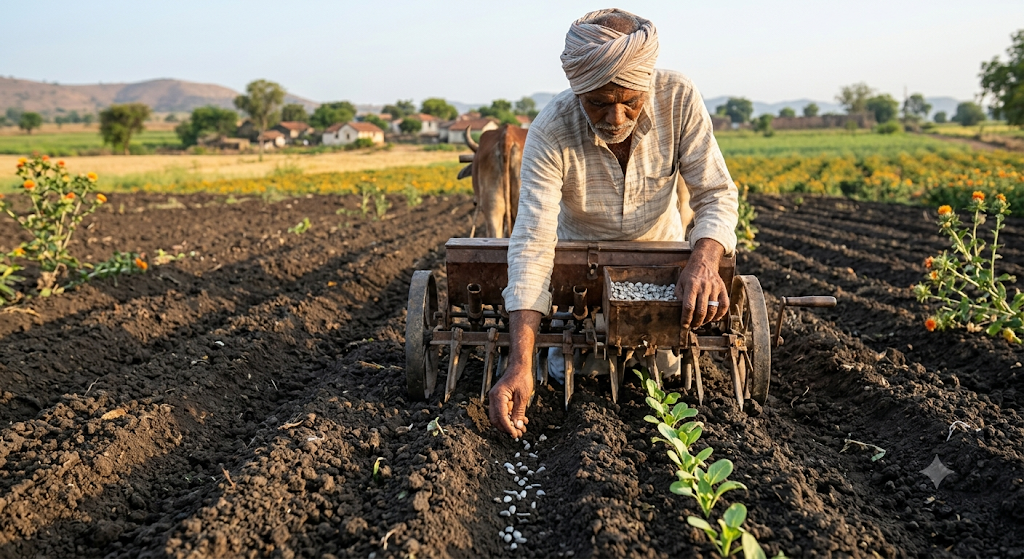
Step 2: Prepare the field
Plough, level and bring the soil to a fine tilth. An even field gives even germination and stops water from standing in low patches.
In sandy soils, Vikaspedia advises 15 to 20 tonnes per hectare of compost or farmyard manure at the last ploughing. If you want to cut chemical inputs on a trial plot, read our beginner’s guide to organic farming in India.
After paddy, sow on the residual moisture left in the field. Sources give a higher seed rate and closer spacing for rice fallows, covered in the next step.
Step 3: Sowing time, seed rate and spacing in safflower farming
AgriFarming puts the optimum sowing time at the second week of September to the second week of November, varying by state. In Karnataka, it names the second week of September for rainfed and mid-September to early November for irrigated crops. Another farm guide gives the last week of October to the first week of November for the plains.
Today is 10 November, so the window is closing in most states. If you have missed it, plan for next season instead of forcing a late sowing. Confirm dates with your state advisory.
| Situation | Seed rate | Spacing |
|---|---|---|
| Normal conditions | 10 to 15 kg/ha | 45 x 20 cm |
| Rice fallow, Odisha | 20 kg/ha | 30 x 15 cm |
| Karnataka | Per state advisory | 60 x 30 cm |
| Scanty moisture at sowing | 15 to 20 kg/ha | Per state advisory |
The optimum plant population is 1.0 to 1.1 lakh per hectare. Sow at about 5 cm depth with a seed drill. For month-wise sowing windows of other crops, see our rabi crops guide.
Step 4: Seed treatment and nutrients
Treat seed with thiram, captan or carbendazim at 3 g per kg for better germination. Treating seed with PSB at 200 g per 10 kg seed can save 25% of the phosphorus. For higher seed yield, Vikaspedia also suggests Azotobacter and Azospirillum at 20 g per kg seed along with 12.5 kg nitrogen per hectare.
Where irrigation is possible, apply 40:40:20 kg per hectare of N, P2O5 and K2O. Give half the nitrogen and all the phosphorus at sowing, and the other half of the nitrogen 30 days later. Place fertilizer in furrows 8 to 10 cm deep and 4 to 5 cm away from the seed.
Step 5: Irrigation and intercropping in safflower farming
Safflower manages with little water, but stress at the wrong stage cuts seed. ICAR-IIOR advises avoiding moisture stress at every stage, especially from budding to flowering.
One farm guide lists 2 to 3 irrigations: at the rosette stage (30 to 35 days after sowing), flowering (70 to 75 days) and seed development (100 to 105 days). ISF-1 can also grow rainfed in black soils.
For rainfed fields, the same guide names chickpea plus safflower in a 6:3 row ratio. Read our chana farming guide before you try it. If your water is limited, see how sprinkler and drip systems stretch it.
Step 6: Pests, disease and frost
Fusarium wilt is the disease to plan for. A farm guide advises rotating with chickpea, growing resistant varieties such as TSF-1, NARI and SH-1, and treating seed with carbendazim at 1 g per kg. NARI-H-15 is tolerant to aphids.
Frost at flowering is the main weather risk. For sprays, ask your KVK for the current recommendation for your pest and stage. ICAR-IIOR adds one rule for seed plots: avoid plant protection during peak honeybee visits.
A bad season can still wipe out the margin, so look at crop insurance for farmers before sowing.
Step 7: Harvest, storage and selling
Dry the seed until moisture is no more than 8% before storing it. If you use a combine harvester, clean it well first, as ICAR-IIOR advises for seed production.
One guide says petals picked 15 to 20 days after flowering can be sold for herbal tea. Confirm a buyer before you plan around this.
For selling, ask your mandi whether MSP procurement is running for safflower. Check e-NAM for online mandi options. If you need working capital, the Kisan Credit Card scheme is the usual route.
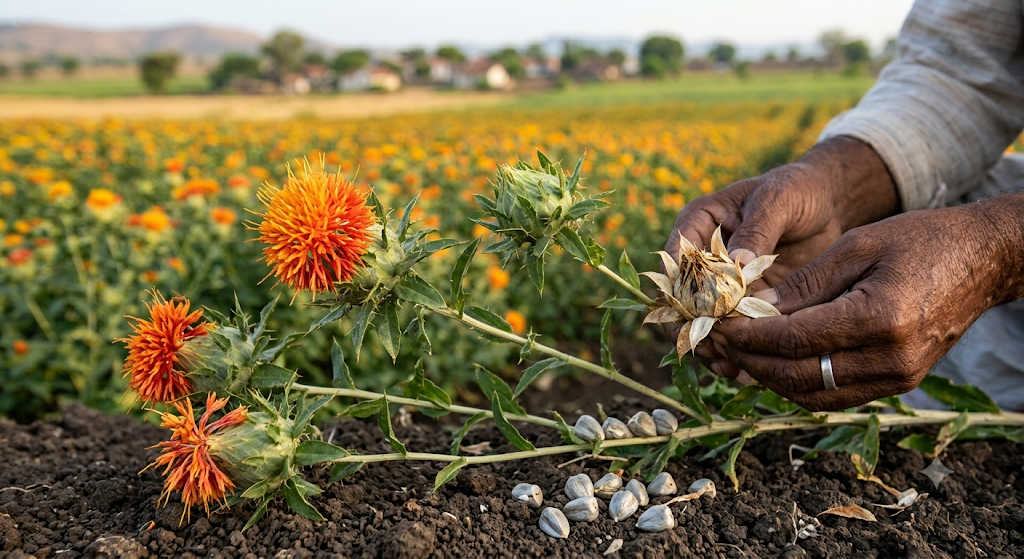
Safflower farming income: simple MSP arithmetic
The table multiplies the research yields above by the 2027-28 MSP of Rs 7,215 per quintal. The result is gross value, not profit.
| Variety (research yield) | Yield in quintals/ha | Gross at MSP |
|---|---|---|
| JSF-99 (1.9 t/ha) | 19 | Rs 1,37,085 |
| NARI-H-15 (2.3 t/ha) | 23 | Rs 1,65,945 |
Costs for seed, fertilizer, labour and irrigation are not subtracted, because no verified cost figure for safflower farming is available here. Your own cost sheet decides the profit, and farm yields are usually lower than research yields.
Safflower vs mustard, gram and lentil
Our guide says gram, mustard, lentil, barley and safflower manage with less water than wheat. So the choice comes down to soil, sowing date and margin.
On the government’s own margin estimate, mustard (96%) and lentil (92%) beat safflower (50%). Safflower makes sense on dry black soils where a September or October sowing is possible. Otherwise compare it with mustard farming and lentil farming first.
Common mistakes in safflower farming
Watch for these:
- Sowing after the state window, then expecting the MSP-level yield
- Copying another state’s spacing and seed rate
- Ignoring drainage on heavy soil
- Skipping seed treatment and crop rotation, which invites wilt
- Letting the field dry out between budding and flowering
- Counting on MSP without checking procurement at your mandi
- Planning only on the Rs 675 hike and ignoring the 50% margin estimate
FAQs on safflower farming
1. What is safflower farming?
Safflower farming is the cultivation of kusum, also known as kusumbha or kardi, a rabi oilseed crop grown mainly for its seeds and flowers. Its seeds contain around 24–36% oil, while its orange-red flowers are used to extract natural dye. The crop can grow with limited water and is suitable for dryland farming conditions.
2. What is the best time for sowing safflower?
The best time for safflower sowing generally ranges from the second week of September to the second week of November, depending on the state and growing conditions. Rainfed crops are usually sown earlier, while irrigated crops may have a slightly wider sowing window. Farmers should follow their state agricultural advisory for better germination and yield.
3. What is the safflower MSP for 2027-28?
The Minimum Support Price (MSP) of safflower for the 2027-28 marketing season is ₹7,215 per quintal. This represents an increase of ₹675 compared with the previous MSP of ₹6,540 per quintal. However, farmers should check the procurement arrangements in their state and local mandi before making cultivation decisions.
4. How much seed does safflower need per hectare?
Safflower generally requires around 10–15 kg of seed per hectare under normal growing conditions. However, the seed requirement can increase to 20 kg per hectare in rice-fallow areas of Odisha. When soil moisture is limited at sowing, a seed rate of 15–20 kg per hectare may be recommended to achieve a suitable plant population.
5. What spacing is used in safflower farming?
The commonly recommended spacing for safflower farming is 45 × 20 cm, which provides sufficient space for proper plant growth and development. However, spacing varies according to the region and cultivation conditions. Karnataka generally follows 60 × 30 cm, while Odisha uses 30 × 15 cm in rice-fallow conditions. Farmers should follow local agricultural recommendations.
6. Which soil is best for safflower?
Well-drained medium to deep black soils are considered suitable for safflower cultivation because they can retain moisture for crop growth. The crop can also perform well in other properly drained soils under suitable conditions. However, waterlogged fields should be avoided because excess moisture can damage roots and increase the risk of diseases.
7. How many irrigations does safflower need?
Safflower generally requires around 2–3 irrigations, depending on rainfall, soil moisture and crop conditions. Important irrigation stages include the rosette stage, flowering stage and seed development stage. Farmers should pay particular attention to moisture availability between budding and flowering because water stress during this period can reduce seed formation and overall yield.
8. Is safflower farming profitable?
Safflower farming can be profitable under suitable soil, rainfall and market conditions. At the 2027-28 MSP of ₹7,215 per quintal, research yields of 19–23 quintals per hectare indicate a potential gross return of approximately ₹1,37,085–₹1,65,945 per hectare. However, these are not guaranteed farmer earnings. Actual profit depends on yield, cultivation costs, labour expenses and access to MSP procurement.
9. Which safflower variety should I choose?
Farmers should select safflower varieties according to their state’s climate, soil type, irrigation facilities and sowing period. For example, JSF-99 is recommended for Madhya Pradesh and Chhattisgarh, while varieties such as NARI-H-15 and ISF-1 have specific cultivation advantages. Before purchasing seeds, farmers should consult their nearest Krishi Vigyan Kendra (KVK) for locally suitable and certified varieties.
10. Which states grow the most safflower?
Maharashtra and Karnataka are the leading safflower-producing states in India, together contributing more than 90% of the country’s total production, according to Vikaspedia. The crop is particularly important in these states because it can grow under rainfed conditions and utilise residual soil moisture. It is an important rabi oilseed for farmers in dryland agricultural regions.
11. How long does safflower take to mature?
Safflower generally takes around 120–150 days to mature, depending on the variety, climate and growing conditions. Some improved varieties, such as ISF-1, mature in approximately 135–140 days. Farmers should monitor flower drying and seed development to identify the right harvesting time.
12. Can safflower be grown without irrigation?
Yes, safflower can be cultivated under rainfed conditions because it can tolerate limited water availability and utilise residual soil moisture. It is particularly suitable for dryland farming and black soil regions. However, adequate moisture during budding, flowering and seed development is important for achieving better seed yield.
13. What are the major pests and diseases affecting safflower crops?
Safflower crops can be affected by pests such as aphids and diseases such as Fusarium wilt. These problems can damage plants and reduce seed production if not managed properly. Farmers should use resistant varieties, follow crop rotation, treat seeds with recommended products and consult their local Krishi Vigyan Kendra (KVK) for suitable pest management practices.
14. When should safflower be harvested?
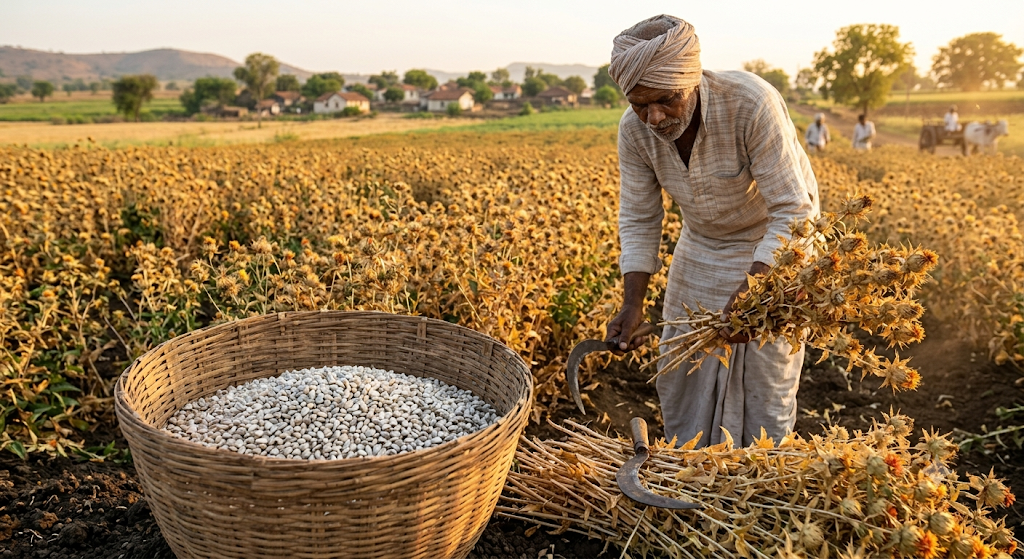
Safflower is generally harvested when the plants turn yellowish-brown and most flower heads become dry. The seeds should be properly matured before harvesting to minimise losses and maintain quality. After harvesting, seeds should be dried to approximately 8% moisture or less before storage to reduce the risk of spoilage.
15. Can safflower be grown as an intercrop with other crops?
Yes, safflower can be grown as an intercrop with suitable crops such as chickpea under recommended farming systems. One suggested combination for rainfed conditions is chickpea and safflower in a 6:3 row ratio. Intercropping can help farmers utilise available land and resources more efficiently, but the row arrangement should be selected according to local soil and rainfall conditions.
Conclusion
Safflower farming fits dry black soils and rainfed rabi fields where a September or October sowing is possible. The Rs 675 MSP rise is real, but the 50% expected margin trails mustard and lentil. Choose the variety recommended for your state, sow inside your state’s window, protect the crop from moisture stress and frost, and check procurement at your mandi before you sow. If this helped, share it with a farmer planning next season’s acres.