
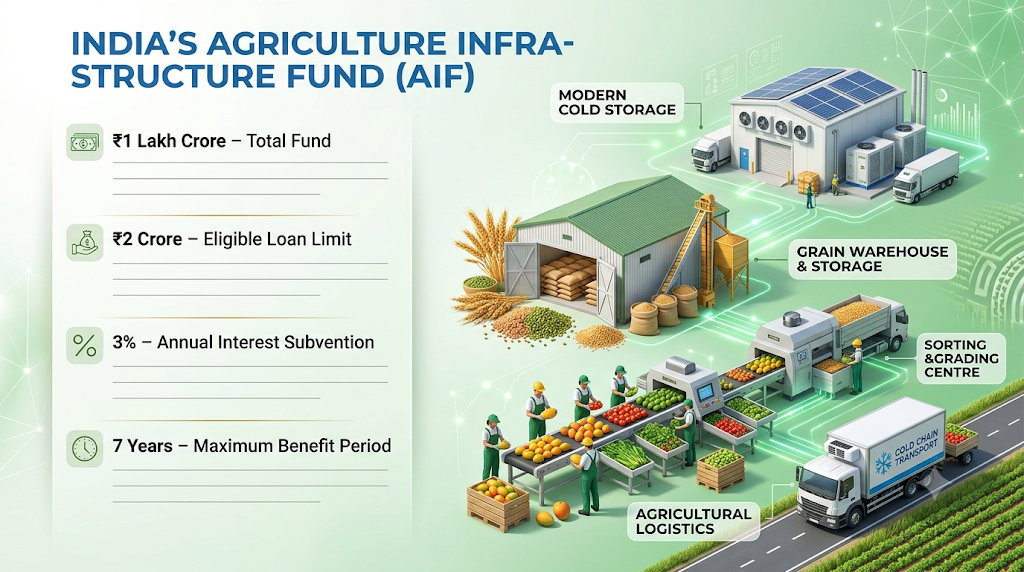
The Agriculture Infrastructure Fund (AIF) is a ₹1 lakh crore government financing facility that gives farmers, FPOs, cooperatives, SHGs and agri-startups bank loans for farm-gate and post-harvest infrastructure. Loans up to ₹2 crore get a 3% interest subvention for up to 7 years, plus a credit guarantee.
If you want a cold room, warehouse, sorting unit or processing line, this scheme can cut your interest cost. This guide explains how the Agriculture Infrastructure Fund works, what it funds, where it falls short, and what to check before you sign.
Table of Contents
What Is the Agriculture Infrastructure Fund?
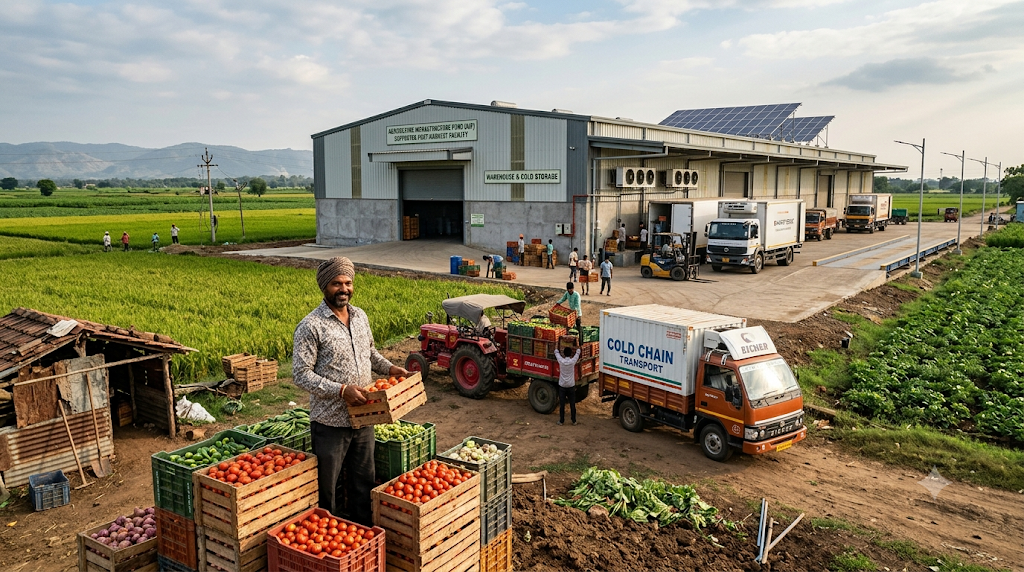
The Agriculture Infrastructure Fund is a Central Sector scheme of the Ministry of Agriculture and Farmers Welfare. It was announced by the Finance Minister on 15 May 2020, and it provides a ₹1 lakh crore financing facility for farm-gate and aggregation infrastructure.
The money does not come as a grant. Banks and financial institutions lend it, and the government supports the borrower with an interest subvention and a credit guarantee. That distinction matters. You still repay a loan, and the bank still decides whether your project is viable.
The idea behind the Agriculture Infrastructure Fund is that farmers lose produce and income because storage, sorting and processing facilities are missing near the field. A cold room or warehouse close to the farm lets you hold produce and sell when the price improves.
According to the revised scheme guidelines (July 2021), the facility was planned with ₹20,000 crore of loan sanctions per year for four years from 2022-23 to 2025-26. Bank pages state that the scheme runs from 2020-21 to 2032-33, with loan disbursement completed over six years.
Agriculture Infrastructure Fund Loan Terms
Here is the core of the Agriculture Infrastructure Fund in one table.
| Term | Detail |
|---|---|
| Total corpus | ₹1 lakh crore |
| Loan with scheme benefits | Up to ₹2 crore per project |
| Interest subvention | 3% per year, up to 7 years |
| Credit guarantee | CGTMSE cover for loans up to ₹2 crore, fee paid by the government |
| Repayment | Up to 7 years including moratorium |
| Moratorium | Minimum 6 months, maximum 2 years |
| Interest rate cap | 9% per year on loans up to ₹2 crore, as stated by one lender |
Loans above ₹2 crore are possible, but the scheme benefit does not apply to the extra amount. The subvention stays limited to the first ₹2 crore.
The 9% cap comes from a public sector bank’s scheme page, which lists the rate as 6-month MCLR plus 100 basis points, capped at 9%. Other lenders may quote differently, so ask for the rate in writing before you decide.
During the moratorium you do not repay principal, but you pay interest. Many first-time borrowers miss this and plan for a full payment holiday that does not exist.
How the 3% Interest Subvention Works
The government pays 3% of the interest on your behalf for up to 7 years. According to Bank of Maharashtra’s AIF page, the subvention is provided upfront to the bank.
Let us use two simple examples based on the scheme’s published limits. These are illustrations, not quotes from a lender.
Example 1: a ₹50 lakh loan. Three percent of ₹50 lakh is ₹1.5 lakh. That is the interest the government covers in the first year. As you repay principal, the outstanding amount falls, so the yearly benefit falls too.
Example 2: a ₹3 crore loan. The subvention applies only to the first ₹2 crore. Three percent of ₹2 crore is ₹6 lakh in the first year. The extra ₹1 crore carries normal interest.
So the Agriculture Infrastructure Fund helps most when your project is large enough to need a real loan, but small enough to stay within ₹2 crore. A bigger project is not a better deal under this scheme, because the benefit stops at ₹2 crore.
Who Can Borrow Under the Agriculture Infrastructure Fund?
A wide group qualifies. Scheme summaries list farmers, FPOs, PACS, cooperatives, SHGs, startups and agri-entrepreneurs. Marketing cooperatives, joint liability groups and APMCs are also named as eligible borrowers in the guidelines.
There is no minimum loan size under the scheme. The interest subvention applies to loans up to ₹2 crore.
One detail that surprises people: an individual borrower can get benefits for projects in different locations. One government scheme listing mentions up to 25 projects per individual in different locations. APMCs can take multiple projects of different types within their market area.
The Agriculture Infrastructure Fund is not a crop loan. You cannot use it for seeds, fertiliser or running costs. It funds assets, such as a building or machinery, that last for years.
If you are a tenant farmer, ownership of land and the right to build will be a hurdle. Read our post on tenant farmer ID before approaching a bank, because lenders will ask what right you have to the site.
Projects the Agriculture Infrastructure Fund Covers
The scheme covers two broad types of projects: post-harvest management projects and viable projects for community farming assets.
Typical examples in bank and scheme summaries include:
- Cold storage and cold chains
- Warehouses and silos
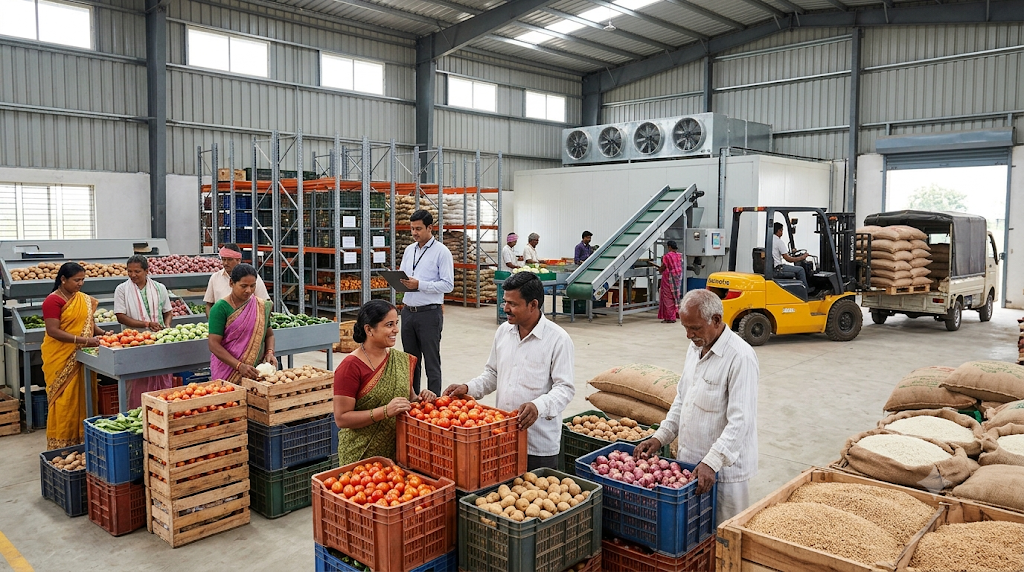
- Sorting and grading units
- Packhouses and primary processing centres
- Logistics facilities
- Assaying and ripening chambers
- Community farming assets such as farm machinery hubs and drone-based services
Projects built on a hub-and-spoke model are also listed. This suits FPOs that collect produce from many members and run one central facility.
Drones fit under community assets. A women’s group buying a drone under Namo Drone Didi, for example, can take its balance share as an AIF loan, according to scheme summaries. For the wider picture on drone costs, read our agricultural drones guide.
Projects the Agriculture Infrastructure Fund generally does not cover include working capital, land purchase on its own, and anything not tied to farm-gate or post-harvest assets. Ask your bank for the exact eligible list, since the guidelines have been revised more than once.
Agriculture Infrastructure Fund Application Steps
Banks run the process, so the route depends on the lender. Based on public bank pages and scheme summaries, the steps look like this:
- Choose a viable project. Decide what you will build, its size, and who will buy its services or products.
- Prepare a project report. Banks decide on viability, so the report must show costs, expected income and repayment from cash flow.
- Arrange land and permissions. Keep ownership or lease papers, local approvals and quotations ready.
- Approach a lender. Scheduled commercial banks, cooperative banks and other lending institutions take part. Some banks, such as HDFC, describe an online route under their MSME government schemes section.
- Get sanction and disbursement. Loans are disbursed in tranches linked to project progress, according to one scheme summary.
- Check the subvention. Ask the bank to show how the 3% benefit appears in your repayment schedule.
The national AIF portal also exists for applications and tracking. Check the official link on the Vikaspedia AIF page before you submit anything.
Never pay an agent to “approve” an AIF loan. Approval comes from the bank after it checks your project.
Mistakes That Get Loans Rejected
Most rejections come from the project, not the scheme. Here are the common problems to avoid.
No clear buyer. A cold room with no customers earns nothing. Line up users before you apply.
Weak project report. A report that guesses income without evidence makes the bank nervous.
Ignoring the moratorium interest. You pay interest during the moratorium. Plan cash for it.
Choosing a project above ₹2 crore without a reason. Anything beyond ₹2 crore loses the subvention on the extra amount.
Unclear land rights. Disputed or unclear land is an early stop at most banks.
Believing “no collateral” means “no checks.” The credit guarantee covers loans up to ₹2 crore, but the bank still checks your project, repayment ability and papers.
Before you start, complete your Farmer ID registration, because digital records now help in many farm-related applications.
Agriculture Infrastructure Fund and Other Schemes
The Agriculture Infrastructure Fund works alongside other schemes, not instead of them. Here is how it differs.
| Scheme | What it gives | Best for |
|---|---|---|
| Agriculture Infrastructure Fund | Loan with 3% subvention and credit guarantee for post-harvest and community assets | Storage, processing and logistics projects |
| Crop loans (KCC) | Short-term credit for crop expenses | Seasonal farming costs |
| Namo Drone Didi | Drone subsidy for women SHGs | Spraying services |
A project can sometimes combine support from more than one scheme. A guideline summary notes that the scheme is meant to converge with other government schemes, subject to rules on subsidy limits. Ask your bank which combinations are allowed, because stacking benefits wrongly can cause problems later.
For a larger view of the tools around you, read our guide to agritech categories and the list of agritech apps for farmers.
Is This Loan Right for a Small Farmer?
Honestly, not always. A smallholder with two acres may not need a ₹50 lakh storage unit. For many, the better route is joining an FPO or a cooperative that takes the loan and shares the facility.
Here is a simple test before you apply for an Agriculture Infrastructure Fund loan:
- Can the asset be used for more than one season?
- Will enough produce or customers use it throughout the year?
- Can your income cover the loan instalments after the moratorium ends?
- If prices or demand fall for a year, can you still repay?
If the answer to any is no, shrink the project or share it with others. A loan with a good interest rate is still a loan.
The scheme suits groups well. The credit guarantee and the ability to take multiple projects across locations are most useful to FPOs, cooperatives and entrepreneurs who can run a facility as a business.

What to Watch in 2027
Three things decide how useful the Agriculture Infrastructure Fund will be next year.
Scope changes. The government has expanded the scheme’s coverage before, and guideline revisions have added eligible projects and borrowers. Check the latest guideline before you finalise a project.
Bank rates. The 9% cap is a ceiling quoted by one lender. Compare at least two banks.
Timeline. Sources differ on the scheme’s disbursement and operating periods. The guidelines plan sanctions through 2025-26 and bank pages say the scheme runs until 2032-33. Confirm with your bank that sanctions are open for your project.
If you are planning a project now, start the paperwork early. A good project report takes time, and approvals take longer.
Agriculture Infrastructure Fund FAQs
What is the Agriculture Infrastructure Fund in simple words?
The Agriculture Infrastructure Fund (AIF) is a ₹1 lakh crore government financing scheme that provides loans for agricultural infrastructure such as cold storage, warehouses and processing units. It offers a 3% interest subvention and credit guarantee support.
What is the maximum loan under the Agriculture Infrastructure Fund?
Eligible borrowers can receive scheme benefits on loans of up to ₹2 crore per project. Loans above this amount are possible, but the extra amount does not receive the 3% interest subvention.
How long does the 3% interest subvention last?
The government provides a 3% annual interest subvention for up to 7 years. The benefit applies to the eligible loan amount and reduces as the outstanding principal is repaid.
Is collateral needed for an AIF loan?
Loans up to ₹2 crore are eligible for CGTMSE credit guarantee coverage, with the guarantee fee paid by the government. However, banks still check the borrower’s documents, project viability and repayment capacity.
Who can apply for the Agriculture Infrastructure Fund?
Farmers, FPOs, PACS, cooperatives, SHGs, startups and agri-entrepreneurs can apply. Other eligible organisations, including APMCs and marketing cooperatives, can also benefit.
What is the moratorium period under the Agriculture Infrastructure Fund?
The moratorium generally ranges from 6 months to 2 years, depending on the project and lender. Borrowers may not need to repay the principal during this period, but interest is payable.
Can I use an AIF loan for seeds or fertiliser?
No, the scheme does not cover regular farming expenses such as seeds, fertilisers or labour. It supports long-term agricultural assets like warehouses, cold storage and processing facilities.
What is the interest rate on an AIF loan?
The interest rate depends on the bank and borrower’s profile. Some public sector banks mention a maximum rate of 9% annually for eligible loans up to ₹2 crore. Confirm the current rate with your lender.
Can one person get more than one AIF project?
Yes, eligible individuals can undertake multiple projects at different locations, subject to scheme conditions. Some scheme listings mention a maximum of 25 projects per individual.
Is the Agriculture Infrastructure Fund still open in 2026-27?
Several bank websites describe the scheme as running until 2032-33. However, sanction timelines may differ, so check with a participating bank or the official AIF portal before applying.
How can I apply for an Agriculture Infrastructure Fund loan?
You can apply through a participating bank or the official Agriculture Infrastructure Fund portal. Prepare your project report, identity documents, land papers and estimated project costs before submitting your application.
What documents are required for an AIF loan?
Commonly required documents include Aadhaar, PAN, bank statements, land ownership or lease papers, project reports, cost estimates and business registration documents, where applicable. The exact list depends on the bank and borrower category.
Can an FPO take an Agriculture Infrastructure Fund loan?
Yes, Farmer Producer Organisations (FPOs) are eligible to apply under the scheme. They can use the loan to develop shared facilities such as warehouses, cold storage, grading units and primary processing centres.
Can I get an AIF loan to build a cold storage facility?
Yes, cold storage facilities and cold chain infrastructure are among the eligible project categories. Your project must meet the scheme guidelines and the bank’s requirements for financial viability and repayment.
Does the Agriculture Infrastructure Fund provide a direct subsidy to farmers?
No, the Agriculture Infrastructure Fund does not provide a direct cash subsidy to farmers. It offers bank loans with a 3% annual interest subvention and eligible credit guarantee support to reduce the cost of financing.
Conclusion
The Agriculture Infrastructure Fund can help farmers, FPOs and agri-entrepreneurs build facilities like cold storage, warehouses and processing units without bearing the full interest burden. The 3% interest subvention and credit guarantee make it a useful option for those planning to invest in agricultural infrastructure.
But remember, it is still a loan that you have to repay. Before applying, understand the terms, prepare a proper project report and make sure you can manage the repayments.
Good infrastructure means less wastage, better storage and more opportunities to earn from farming.