
The digital agriculture mission is a Rs 2,817 crore central scheme that gives every Indian farmer a digital identity and builds shared data systems for land, crops and soil. It was approved by the Union Cabinet in September 2024, and the Farmer ID is the part you will meet first.
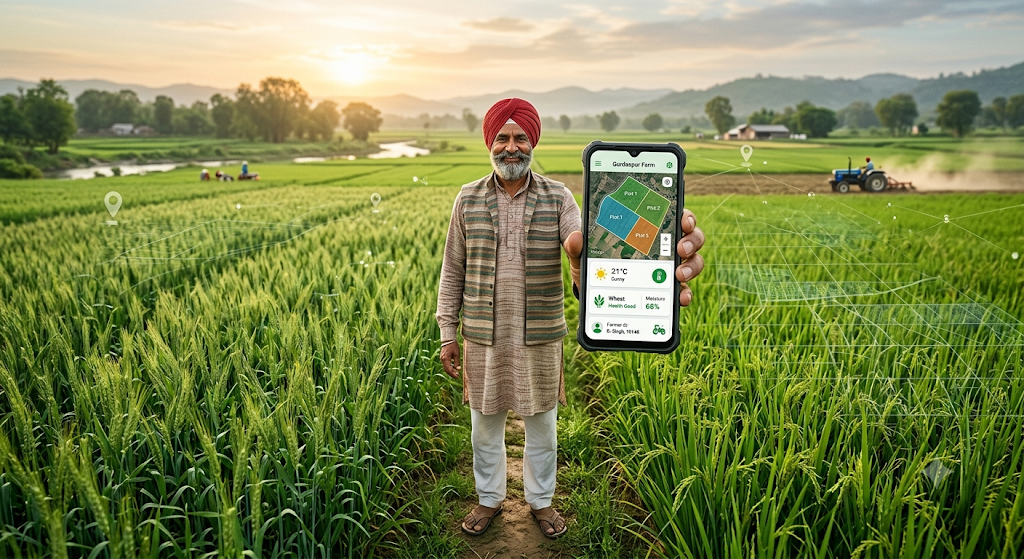
Table of Contents
What Is the Digital Agriculture Mission?
The digital agriculture mission is an umbrella scheme of the Ministry of Agriculture and Farmers Welfare. It does not give you cash or a subsidy directly. It builds the data systems that decide how quickly cash, loans, insurance and advice reach you.
The Cabinet approved it on 2 September 2024. The outlay is Rs 2,817 crore, including a central share of Rs 1,940 crore. The Press Information Bureau describes it as an umbrella scheme to support various digital agriculture initiatives. vikaspediapib
If you have ever stood in a queue with the same land papers for the third scheme in one year, this mission is aimed at that problem. The idea is to verify you once and let every department use that record.
The mission has three main parts:
- AgriStack, which covers farmer identity and land-linked records
- Krishi Decision Support System (Krishi-DSS), which gives advice from data
- Soil Fertility and Profile Maps, which show what your soil can support
A fourth piece, the Digital General Crop Estimation Survey, sits alongside them.
Digital Agriculture Mission at a Glance
| Item | Detail |
|---|---|
| Scheme name | Digital Agriculture Mission |
| Approved | September 2024, Union Cabinet |
| Total outlay | Rs 2,817 crore |
| Central share | Rs 1,940 crore |
| Core parts | AgriStack, Krishi-DSS, Soil Profile Maps |
| Nodal ministry | Ministry of Agriculture and Farmers Welfare |
| Farmer-facing output | Farmer ID (Kisan Pehchaan Patra) |
The outlay and central share are in the Vikaspedia mission summary. The component list is in the PIB explainer.
AgriStack: The Core of the Digital Agriculture Mission
AgriStack is the base layer of the digital agriculture mission. PIB calls it a farmer-centric Digital Public Infrastructure to streamline services and scheme delivery to farmers. pib
Think of it as three linked registers:
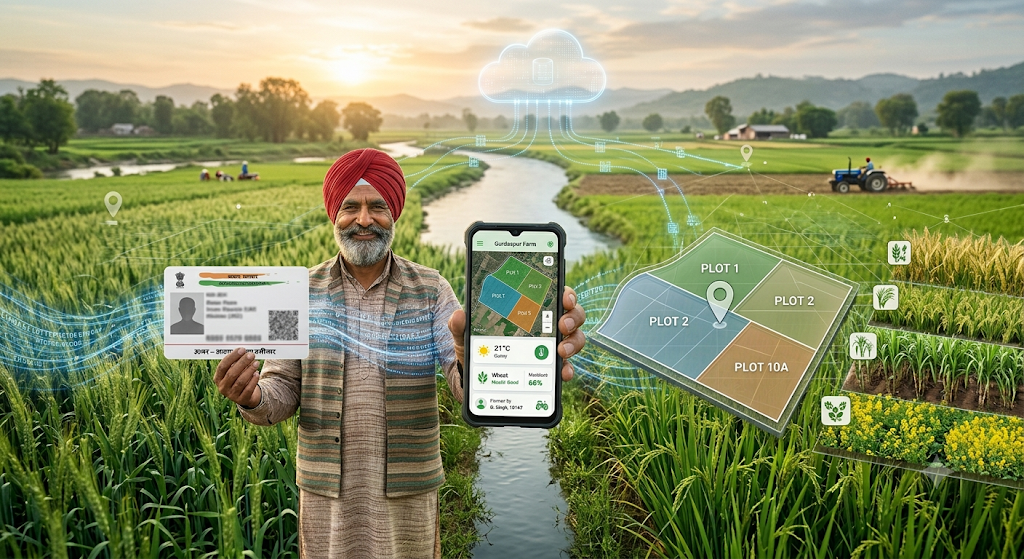
- Farmers’ Registry: who you are, verified through Aadhaar
- Geo-referenced village maps: where your plot sits
- Crop Sown Registry: what you planted, season by season
When these three are linked, an officer or a bank can check your land and crop without asking for paper copies. That is the promise. Whether it works at your tehsil depends on your state’s land records, which is the weak spot I cover later.
The official portal is AgriStack. Your state runs its own registration drive on top of it, so the process differs by state.
Farmer ID: What You Actually Get
The Farmer ID is the visible result of the digital agriculture mission. It is an 11-digit number, also called Kisan Pehchaan Patra, linked to your Aadhaar and land details.
On 24 October 2026, Union Agriculture Minister Shivraj Singh Chouhan said the Centre had created 11 crore unique 11-digit Farmer IDs under the AgriStack framework, five months ahead of the March 2027 deadline. The minister said the milestone was reached on the night of 23 October. You can read the report at Daily Excelsior. dailyexcelsior
The minister also said the ID will be the only document a farmer needs for bank loans, crop insurance, disaster relief and selling produce. Treat that as the government’s stated goal, not as today’s reality. Many bank branches and offices still ask for old documents, so carry both for now.
We have a separate step-by-step guide on how to get your Farmer ID. Read it if you have not registered yet.
Krishi-DSS and Soil Maps Under the Digital Agriculture Mission
The second and third parts of the digital agriculture mission are about advice, not identity.
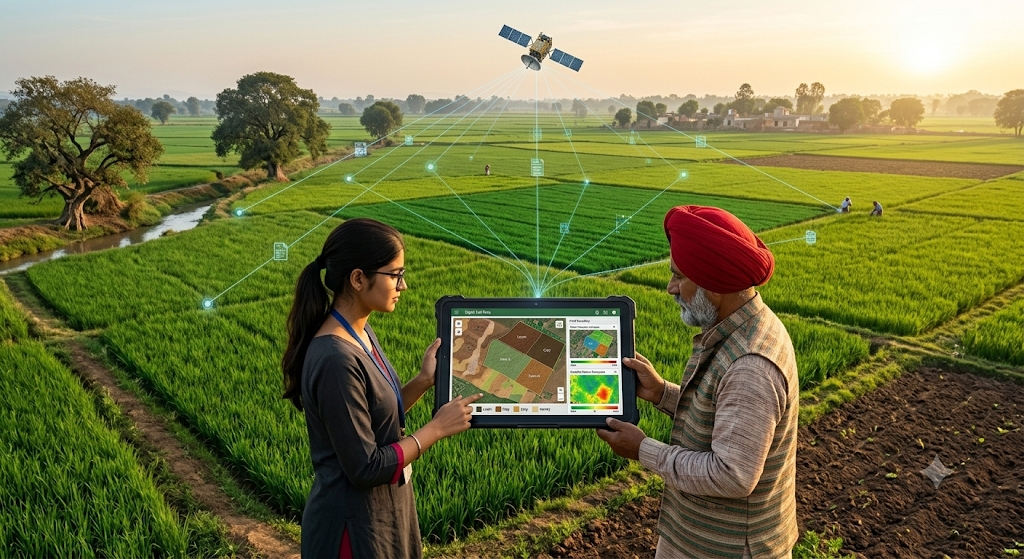
Krishi-DSS is a decision support system. It combines satellite data, weather, soil and crop information so that advisories can be location-specific. A sowing advisory for your block would, in theory, use your own soil and rainfall pattern instead of a district average.
Soil Fertility and Profile Maps are digital soil maps. The mission documents describe them as district-level maps meant to guide input recommendations. If they work, they help you apply fertiliser based on what the soil needs, not on what the dealer stocks.
I am cautious here. Soil maps are only as good as the sampling behind them. A map built from a few samples per block will not tell you what is happening in your own two acres. Keep using your Soil Health Card and your own observation alongside any app advisory.
Digital Crop Survey (DGCES) Explained
The Digital General Crop Estimation Survey is the part of the digital agriculture mission that most farmers never hear about. PIB says DGCES will be used for crop-cutting experiments to provide precise yield estimates, enhancing agricultural production accuracy. pib
This matters to you for a practical reason. Crop insurance claims depend on yield estimates. If yield data gets more accurate, claim settlement should depend less on guesswork and local disputes. That is a hope, not a guarantee, and you should watch how your own district’s claims behave.
For the insurance side, see our guide on PM Fasal Bima Yojana.
Where the Digital Agriculture Mission Stands in 2026
Two things are true at the same time.
First, the Farmer ID count is moving fast. The 11 crore mark in October 2026 came ahead of the March 2027 target.
Second, the rollout is uneven across states. Business Standard reported that the Centre questioned states over delays in implementing the Digital Agriculture Mission, with 61 per cent of India’s sown area linked to Farmer IDs. Read the full report at Business Standard. It shows that issuing an ID and linking your land to it are two separate tasks. business-standard
So the digital agriculture mission is not finished. The easy part, issuing numbers, is largely done. The harder part, making every department actually use them, is still under way.
Who Benefits from the Digital Agriculture Mission
Farmers who own land with clean records. Your name, plot number and Aadhaar already match. You will move through the system fastest.
Farmers who sell through organised channels. If you use eNAM or sell through a Farmer Producer Organisation, verified identity makes payments and records easier. See our eNAM registration guide.
Agriculture students and researchers. The mission is building shared data on crops, soil and farmers. That will shape project topics, jobs and agritech startups.
Agritech companies. The digital agriculture mission gives them common data rails instead of building a new farmer database each time. The ICTworks review says the mission invests in AgriStack, digital platforms, soil mapping, and connectivity to reach 120 million smallholder farming households. ictworks
Problems Smallholders Should Watch For
This is where I would push back on the brochure language. Here is what can go wrong.
1. Land record mismatch. If your land is still in your grandfather’s name, or the area on paper differs from the field, your registration can stall. Fix the record first. It is boring work, but it decides everything else.
2. Tenant farmers and sharecroppers. Many smallholders farm land they do not own. The mission documents say tenant farmers can be included depending on state policy. That means your state decides, so ask at your local agriculture office instead of assuming.
3. Connectivity. A digital system fails where the signal fails. If your village has poor network, you will depend on a CSC (Common Service Centre) or a block office.
4. Data consent and privacy. Your data sits in a shared system. Ask what you are consenting to before you click “agree” at any camp, and do not share your OTP with anyone who is not an official.
5. Fake agents. Wherever a new ID appears, middlemen appear too. Registration through official channels should not need a payment to a stranger. Check your state’s official instructions first.
6. Old paperwork still gets asked for. Until offices fully accept the Farmer ID, keep your land papers, Aadhaar, bank passbook and previous scheme records together.
How to Prepare Before 2027
You do not need to understand the technology to benefit from the digital agriculture mission. Do these in order.
- Check your land record. Confirm name, survey number and area on your state land portal.
- Link Aadhaar to your bank account and keep your mobile number active, since OTPs go there.
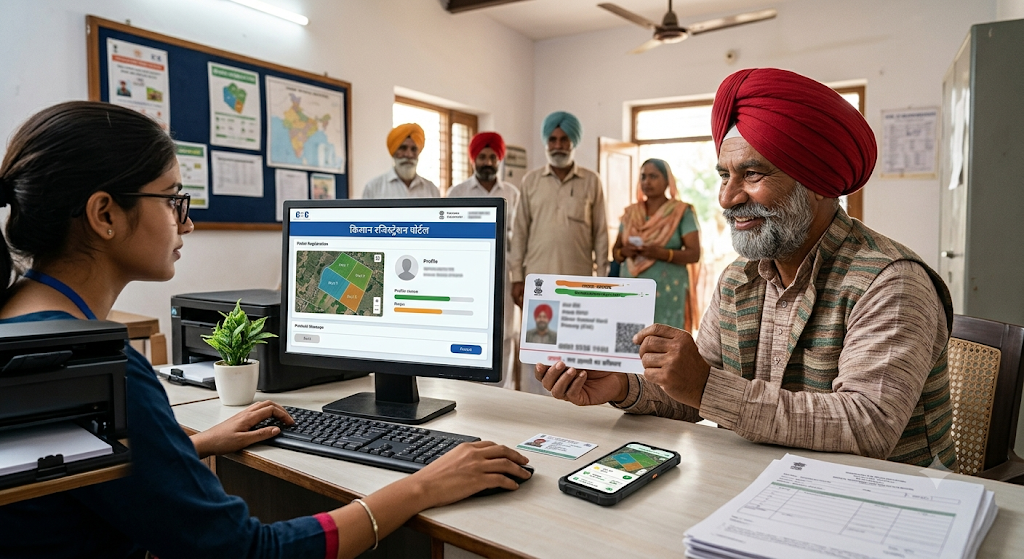
- Register for the Farmer ID through the official state process or your nearest CSC.
- Keep a copy of the ID on your phone and one printed.
- Ask your agriculture office whether your crop details (Crop Sown Registry) will be recorded by a field survey or by you.
- Keep old documents until your bank and insurer confirm they accept the ID.
- Report errors early. A wrong land area or a wrong name is easier to fix now than when you need a claim.
For farm credit linked to the same records, read our guide on Kisan Credit Card.
What the Digital Agriculture Mission Means for Agritech in 2027
The digital agriculture mission will shape the agritech space in the coming year for one reason. Shared data lowers the cost of building services for farmers. A drone-service startup, an input seller, a lender or an insurer can all use the same verified farmer record.
For you, that could mean faster loans, quicker claims and advice that fits your field. It could also mean more apps and more calls from people who have your details. Treat unknown callers with suspicion.
If you want to see where drones fit, read our posts on agricultural drones and Namo Drone Didi. For the wider technology picture, see agritech apps for farmers.
FAQs on the Digital Agriculture Mission
1. What is the digital agriculture mission in simple words?
It is a government scheme that builds a digital identity and data system for farmers, covering land, crops and soil. It was approved in September 2024 with an outlay of Rs 2,817 crore.
2. Who approved the digital agriculture mission?
The Union Cabinet approved it on 2 September 2024. The Ministry of Agriculture and Farmers Welfare runs it.
3. Does the digital agriculture mission give money to farmers?
No. It builds the identity and data systems. Payments from other schemes, such as PM-KISAN, can flow faster when your records are verified.
4. What is AgriStack?
AgriStack is the core digital public infrastructure under the digital agriculture mission. It links a Farmers’ Registry, geo-referenced village maps and a Crop Sown Registry.
5. What is a Farmer ID?
It is an 11-digit unique number, also called Kisan Pehchaan Patra, issued under AgriStack. The Centre announced 11 crore IDs on 24 October 2026.
6. Is the Farmer ID compulsory?
Rules differ by scheme and state. The Centre wants the ID to become the main document for schemes, so registering early avoids problems later. Confirm the current rule with your state agriculture office.
7. Can tenant farmers join the digital agriculture mission?
It depends on your state’s policy. Ask your block agriculture office about tenant registration rules.
8. What is Krishi-DSS?
Krishi Decision Support System is a tool under the mission that combines satellite, weather, soil and crop data to give location-based advisories.
9. What is DGCES?
The Digital General Crop Estimation Survey (DGCES) digitises crop-cutting experiments to provide more accurate and reliable crop yield estimates. It helps improve agricultural data collection, production assessments and crop insurance-related decision-making across India.
10. Is my data safe in the digital agriculture mission?
The mission describes consent-based data sharing, but I cannot verify how well each state applies it. Read what you consent to, and never share your OTP.
11. How can farmers register for the Digital Agriculture Mission?
Farmers can register for a Farmer ID through their state’s official AgriStack portal, designated registration camps or nearby Common Service Centres (CSCs). They may need Aadhaar, land records and a registered mobile number.
12. What documents are required for Farmer ID registration?
Farmers generally need an Aadhaar card, an Aadhaar-linked mobile number and land record details (such as Khasra, Khatauni or survey numbers) for Farmer ID registration. Additional documents may be requested depending on state-specific verification requirements.
13. How does the Digital Agriculture Mission help small farmers?
It aims to make government services more accessible through verified farmer records. Small farmers may benefit from easier scheme registration, improved access to agricultural credit, crop insurance services and location-based farming advisories.
14. Can farmers update incorrect details in their Farmer ID?
Yes. Farmers should contact their state’s designated AgriStack registration centre, CSC or agriculture office to report incorrect personal or land details. The correction process depends on the type of error and state guidelines.
15. What is the target of the Digital Agriculture Mission by 2027?
The Digital Agriculture Mission aims to create digital identities for 11 crore farmers across India by March 2027. Along with Farmer ID registration, the mission focuses on developing AgriStack, digitising crop surveys, preparing geo-referenced village maps and building digital soil databases. These initiatives aim to improve farmers’ access to government schemes, agricultural services, crop insurance and data-based farming advice.
Final Word
The Digital Agriculture Mission is a big step towards making Indian agriculture more digital and farmer-friendly. Through Farmer IDs, AgriStack, Krishi-DSS and digital crop surveys, the government is trying to make farming services easier to access and agricultural information more useful.
But the real success of this mission will not be measured by how many Farmer IDs are created. It will be measured by whether farmers actually get easier access to loans, crop insurance, government schemes and the right farming advice.
If you are a farmer, start by checking your land records, completing your Farmer ID registration through official channels and keeping your important documents safe. If you face any registration issues, contact your nearest CSC or agriculture office.
Technology can change the future of farming, but it matters only when farmers can see the benefits in their everyday lives.