
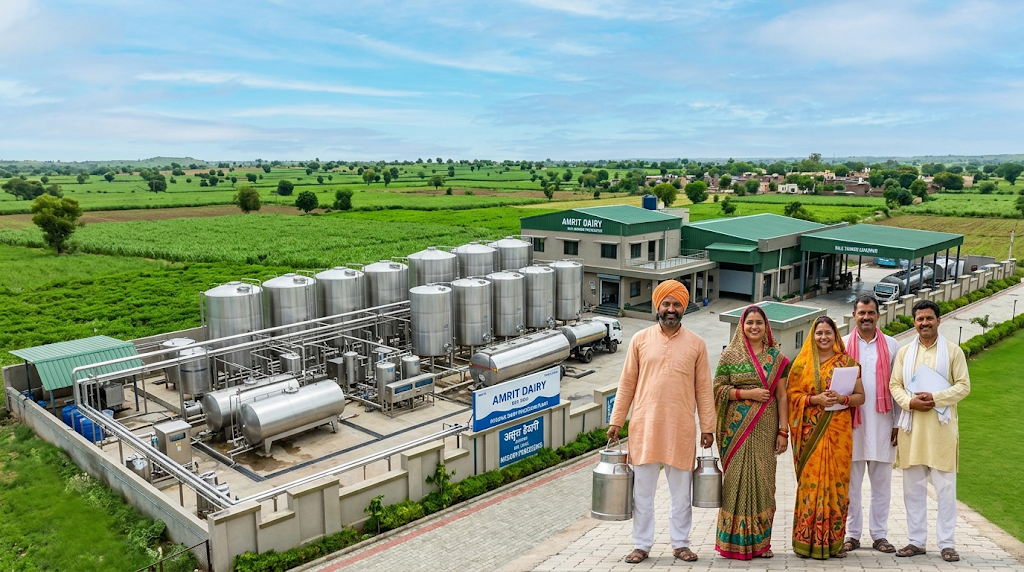
The AHIDF scheme is a central government scheme that pays a 3% interest subvention for 8 years, including a 2-year moratorium, on bank loans of up to 90% of project cost. It funds dairy and meat processing, animal feed plants, breed multiplication farms, vaccine units and animal waste projects. It does not fund buying a cow or building a cattle shed.
If you are a smallholder with two buffaloes, jump to the section on who should not use this fund. If you lead an FPO or plan a processing or feed unit, read the whole guide.
Table of Contents
What Is the AHIDF Scheme?
The Animal Husbandry Infrastructure Development Fund, shortened to AHIDF, is a central sector scheme. The Department of Animal Husbandry and Dairying runs it under the Ministry of Fisheries, Animal Husbandry and Dairying.
The AHIDF scheme was approved in June 2020 under the Atmanirbhar Bharat stimulus package with an outlay of ₹15,000 crore. On 1 February 2024, the Union Cabinet approved its continuation under the Infrastructure Development Fund for another three years, up to 2025-26, with an outlay of ₹29,610.25 crore.
One warning on numbers. DAHD’s own scheme page prints the revised outlay as ₹29,110.25 crore, while the Cabinet release says ₹29,610.25 crore. Older bank pages still show ₹15,000 crore. I use the Cabinet figure for the revised outlay and ₹15,000 crore only for the 2020 approval.
On the same date in 2024, the Dairy Processing and Infrastructure Development Fund (DIDF) was merged into AHIDF. That is why dairy cooperatives can now apply too.
In plain terms, the AHIDF scheme is not a grant. You borrow from a bank, and the government pays 3% of the interest. The Cabinet release says this approach should bring in about seven times as much private investment as the incentive itself.
The same release, as reported by Agriculture Post, says AHIDF had helped about 15 lakh farmers directly or indirectly and had raised processing capacity by 2 to 4 per cent in dairy, meat and feed. Treat these as the government’s own numbers, not an independent audit.
Why does processing matter? India had 535.78 million animals in the 20th Livestock Census (2019), not counting poultry, as we explain in our guide to livestock population in India. That is a large base of milk, meat and feed demand, and processing capacity is where this fund puts its money.

Is the AHIDF Scheme Still Open in 2026-27?
Short answer: unclear, and you should not assume it is open.
DAHD’s scheme page says the revised outlay runs up to 31 March 2026. SBI’s scheme page also says the scheme is implemented till 2025-26, up to 31.03.2026.
As of 14 November 2026, I could not find an official Cabinet notification that extends the AHIDF scheme into 2026-27. I also could not find an official notice that says it has closed. Both statements come from my search of public pages, not from a call to DAHD.
Here is what to do about it:
- Ask your bank in writing whether new AHIDF applications are being accepted today.
- Check the DAHD scheme page for any new notice before you spend money on a project report.
- If you already hold an AHIDF sanction, your sanction letter and your bank decide how your subvention runs. This guide does not replace them.
A detailed project report costs time and money. Do not order one until you have a written answer.
Who Can Apply for the AHIDF Scheme?
The Cabinet release and the DAHD page name these eligible entities:
- Individual entrepreneurs
- Private companies
- Micro, small and medium enterprises (MSMEs)
- Farmer producer organisations (FPOs)
- Section 8 companies
- Dairy cooperatives (eligible after the 2024 merger of DIDF)
Notice the word entrepreneur. An individual entrepreneur under the AHIDF scheme is someone setting up one of the projects listed below, not any person who owns animals.
Government departments and government bodies are not on the eligible list.
If you are an FPO member and your FPO wants to build something, the FPO is the applicant, not you personally. Talk to your FPO board first.
Who Should Not Use the AHIDF Scheme
Many people search for this fund because they want money for a dairy farm. For most of them, it is the wrong tool.
Based on the list of eligible projects, the AHIDF scheme does not cover buying animals, building a cattle shed, buying fodder or meeting day-to-day running costs. It pays for infrastructure that processes, breeds, feeds or protects animals at scale.
If that is your situation, these guides fit better:
- Pashu Kisan Credit Card: a short-term loan card for farmers who rear animals or birds.
- National Livestock Mission: a central scheme that pays 50% of the project cost as a capital subsidy.
- Livestock insurance in India: compensation when an insured animal dies from a covered cause.
- Dairy farming in India and goat farming in India: start-up steps for a farm-level business.
The honest test is simple. If your project can be run by your own family on your own land, AHIDF is probably not for you. If it needs a plant, machinery, staff and a licence, read on.
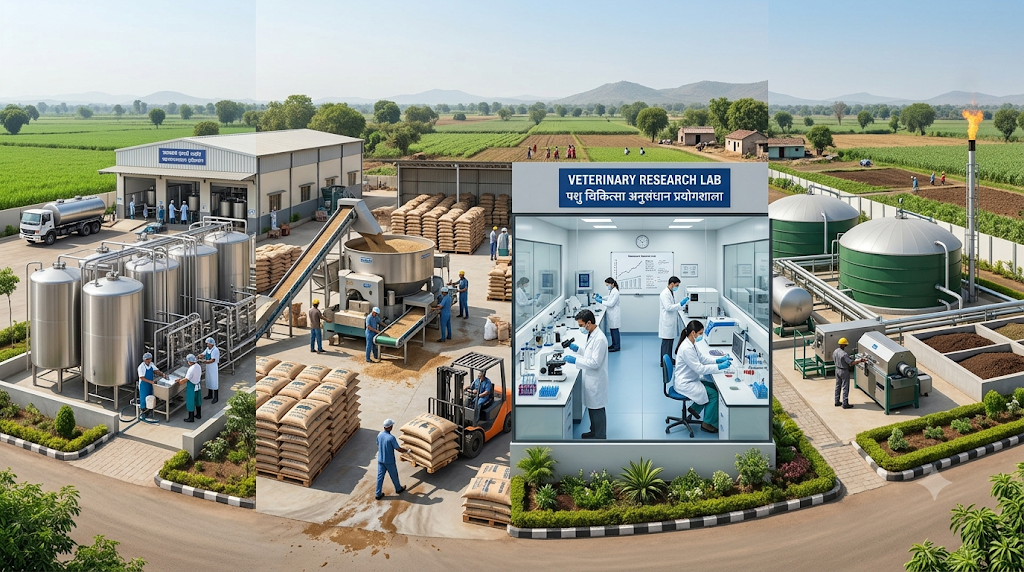
Projects the AHIDF Scheme Funds
DAHD lists seven project types. The Cabinet release of February 2024 lists six; the DAHD page adds primary wool processing.
- Dairy processing and value addition infrastructure. A dairy FPO that wants to move beyond selling raw milk falls here.
- Meat processing and value addition infrastructure.
- Animal feed plant. For a farm-level way to cut feed cost, see our guide on hydroponic fodder production. That is a farm choice, not an AHIDF project.
- Breed improvement technology and breed multiplication farm.
- Veterinary vaccine and drug manufacturing facilities.
- Animal waste to wealth management, also called agri-waste management.
- Primary wool processing infrastructure.
If your idea does not fit one of these seven boxes, the AHIDF scheme will not accept it, however good the idea is.
AHIDF Scheme Loan Terms at a Glance
| Feature | Detail |
|---|---|
| Scheme type | Central sector scheme |
| Implementing department | Department of Animal Husbandry and Dairying (DAHD) |
| Revised outlay | ₹29,610.25 crore (Cabinet, 1 February 2024) |
| Loan size | Up to 90% of project cost |
| Lenders | Scheduled banks, NCDC, NABARD and NDDB |
| Interest subvention | 3% per year for 8 years, including a 2-year moratorium |
| Credit guarantee fund | ₹750 crore, managed by NABARD |
| Published implementation period | Up to 31 March 2026 |
The loan covers up to 90% of the project cost, so you bring the rest. Margin money differs by category of entity, and for some categories your own share can go up to 25%. Confirm the figure for your category with your bank.
The repayment period is eight years from the first disbursement, according to HDFC Bank’s scheme page. That matches the 8 years of subvention.
The subvention is not cash in your pocket. It reduces what you pay on the loan. Example only: if a bank charged 10% on your loan (an assumed rate, not a quoted one), a 3% subvention would bring your effective cost close to 7%. Your sanction terms show how it is applied in your case.
Credit Guarantee Under the AHIDF Scheme
The Cabinet release provides a credit guarantee of up to 25% of the credit borrowed for MSMEs and dairy cooperatives. It comes from a credit guarantee fund of ₹750 crore, which NABARD manages.
Why does this matter to you? Banks lend more easily when part of the risk is covered. A guarantee does not remove the bank’s appraisal, but it can make a first-time processing borrower less of a worry for the lender.
The release names MSMEs and dairy cooperatives for this cover. If you are another type of entity, ask your bank whether the guarantee applies to you before you build it into your plan.
7 Steps to Apply for the AHIDF Scheme
- Check the status and your category. Confirm in writing that the AHIDF scheme is accepting applications, and confirm which entity type and project type you fall under.
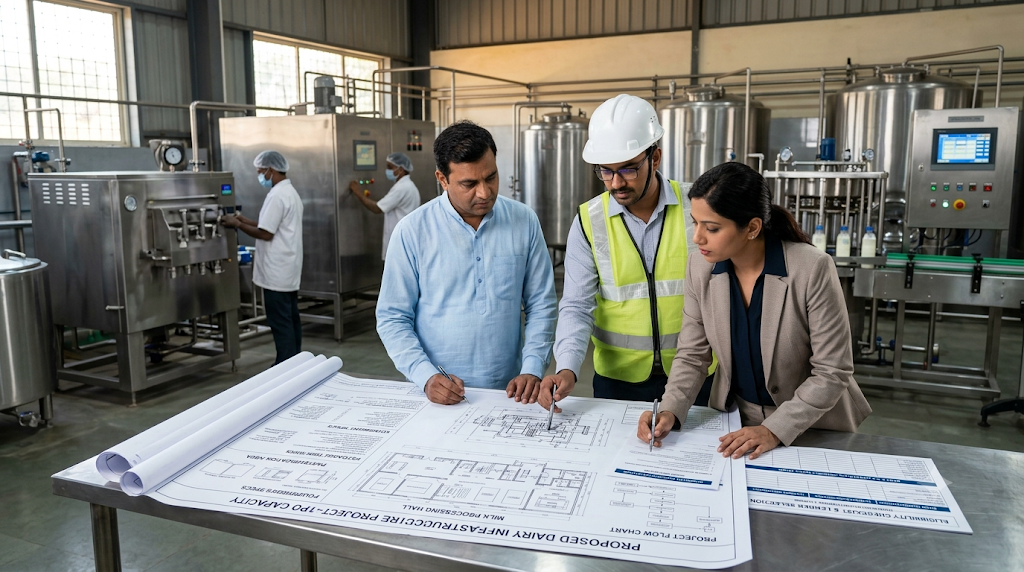
- Prepare a detailed project report. The bank sanctions the loan on the basis of a project report, so cost, capacity, market and repayment need to be on paper.
- Choose a lender. Eligible lenders are scheduled banks, NCDC, NABARD and NDDB. SBI, HDFC Bank, Federal Bank and Indian Bank all publish AHIDF pages, so start with a bank where you already have an account.
- Apply for the term loan. The bank appraises your project and your repayment capacity, as it would for any large loan.
- Bank forwards your case to DAHD. After its appraisal, the bank sends your application to the Department online for approval of the interest subvention.
- DAHD scrutinises and approves. The Department evaluates the bank-sanctioned proposal before it approves the subvention.
- Disburse and build. Use the funds only for the approved project plan. Keep bills and photographs of each stage, because the bank and the Department can ask for them.
The order matters. Steps 1 and 2 are where most people lose time and money, so do them properly.
Documents to Keep Ready
Your bank’s checklist is final, and it can differ between banks. These are the items lenders commonly ask for on a project of this size:
- Detailed project report with costs and repayment plan
- Registration papers of your FPO, company, cooperative or MSME (for example, Udyam registration)
- Identity and address proof of directors, members or the proprietor
- Land ownership or lease papers for the project site
- Quotations for machinery and civil work
- Licences and clearances needed for your type of unit
- Bank statements and past financial records
Ask the loan officer for the checklist on day one. It saves a second visit.
AHIDF Scheme vs Other Livestock Schemes
People mix these schemes up all the time. Here is the difference:
| Scheme | Who it suits | What it gives |
|---|---|---|
| AHIDF scheme | FPOs, MSMEs, companies, entrepreneurs and dairy cooperatives building processing, feed, breed, vaccine or waste units | Bank loan up to 90% with 3% interest subvention |
| Pashu Kisan Credit Card | Farmers who rear animals or birds | Short-term loan card |
| National Livestock Mission | Livestock entrepreneurs with a project | 50% of project cost as capital subsidy |
| Agriculture Infrastructure Fund | Farmers, FPOs, cooperatives and SHGs with post-harvest or storage projects | ₹1 lakh crore government financing facility |
If your project is storage, grading or marketing rather than animal processing, our guide to the Agriculture Infrastructure Fund explains a financing facility built for that.
You can look at all our animal schemes and farming guides in the Livestock category. If you are still working out which animals to raise, start with livestock categories.
Common Mistakes With the AHIDF Scheme
- Applying as a smallholder for animals or a shed. The AHIDF scheme funds infrastructure, not livestock purchase.
- Ordering a project report before checking status. The published implementation period ended on 31 March 2026.
- Treating the 3% as a grant. It is interest subvention. You still owe the loan.
- Ignoring your own contribution. The loan is up to 90%, so you need the remaining money ready.
- Using old PDFs. Outlay figures differ between pages: ₹15,000 crore, ₹29,110.25 crore and ₹29,610.25 crore all appear. Use the Cabinet release and the DAHD page.
- Paying an agent for a promised approval. Sanction comes from the lender, and subvention approval comes from DAHD. No agent controls either one.
What to Expect in 2027
I cannot tell you what the government will do. A fresh Cabinet decision could extend the AHIDF scheme, replace it with a new scheme, or let it lapse. I found no official word on any of the three.
What I can say is that people are already searching for terms such as AHIDF scheme last date and AHIDF scheme extension, which shows readers want a clear answer on validity.
So watch three places: the DAHD scheme page, the Union Cabinet decisions, and your own bank. If a new notice appears, check it against the points in this guide before you act.
If you plan a project for 2027, prepare the project report and your margin money now, so you can apply the day the window is confirmed. Do not spend on construction before the sanction arrives.
FAQs on the AHIDF Scheme
1. What is the AHIDF scheme?
The AHIDF scheme is a central sector scheme that gives a 3% interest subvention on bank loans of up to 90% of project cost for dairy, meat, feed, breed, vaccine, waste and wool processing infrastructure.
2. What is the full form of AHIDF?
AHIDF stands for Animal Husbandry Infrastructure Development Fund.
3. How much interest subvention does the AHIDF scheme give?
The subvention is 3% per year for 8 years, including a 2-year moratorium, according to the Cabinet release of 1 February 2024.
4. Who is eligible under the AHIDF scheme?
Individual entrepreneurs, private companies, MSMEs, FPOs, Section 8 companies and dairy cooperatives can apply. Government bodies are not on the list.
5. Can an individual farmer use the AHIDF scheme for a dairy farm?
Only if the farmer sets up an eligible processing, feed, breed, vaccine or waste project. Buying animals or building a shed is not covered. A Pashu Kisan Credit Card or the National Livestock Mission is a better fit.
6. What is the maximum loan under the AHIDF scheme?
The loan can be up to 90% of the project cost. Your own contribution makes up the rest, and it differs by category of entity.
7. Is there a credit guarantee?
Yes. A ₹750 crore credit guarantee fund, managed by NABARD, covers up to 25% of the credit for MSMEs and dairy cooperatives.
8. Is the AHIDF scheme still open?
The published implementation period ran up to 31 March 2026. As of 14 November 2026, I found no official extension notice and no closure notice. Ask your bank and check the DAHD page.
9. Where do I apply for the AHIDF scheme?
Apply for the term loan with a scheduled bank, NCDC, NABARD or NDDB. The bank forwards your application to DAHD online for approval of the subvention.
10. Is it a subsidy or a loan?
It is a bank loan with an interest subvention. The government pays part of your interest, but you repay the loan.
Conclusion
The AHIDF scheme can help entrepreneurs, FPOs and dairy cooperatives build better livestock infrastructure with a 3% interest subsidy. But remember, it is a loan-based scheme, not free money to buy animals or build cattle sheds. Before applying, check whether the scheme is currently accepting applications, understand the eligibility rules and prepare your project report carefully. A little planning and the right information can help you take a smarter step towards growing your livestock business.