
Isabgol farming means growing Plantago ovata, a rabi medicinal crop, on well-drained sandy loam soil in Rajasthan, Gujarat and Madhya Pradesh. The sowing window runs from 1 October to 30 November, so farmers planning isabgol farming this season have less than three weeks left.
Isabgol farming: mature Plantago ovata crop ready for harvest
Isabgol, also called psyllium or blond psyllium, is not a crop you can learn by copying wheat practice. It wants dry weather at maturity, light soil and very little nitrogen. This guide covers the full cycle of isabgol farming: season, soil, varieties, nutrients, pests, harvest and yield.
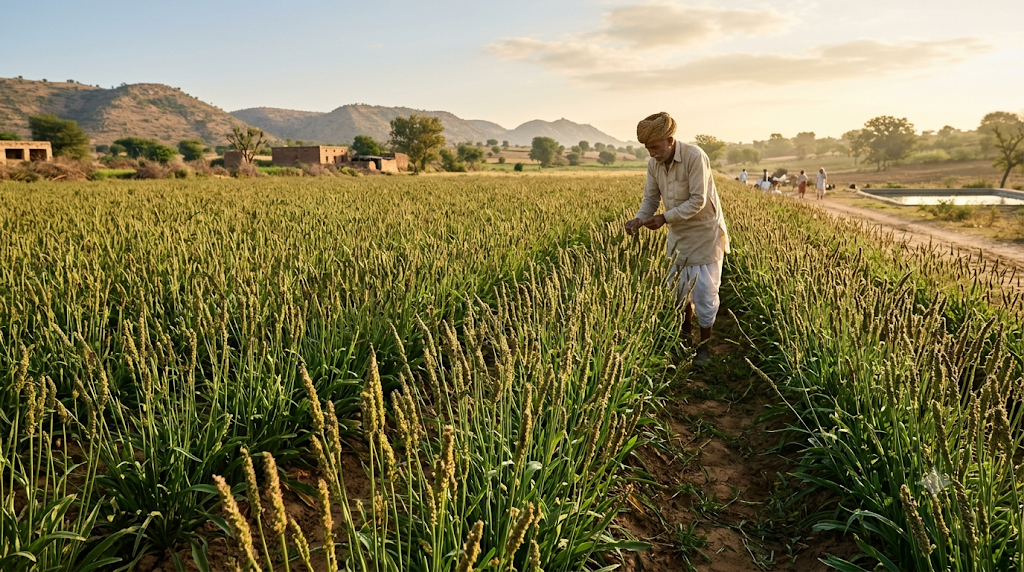
Table of Contents
What Is Isabgol Farming?
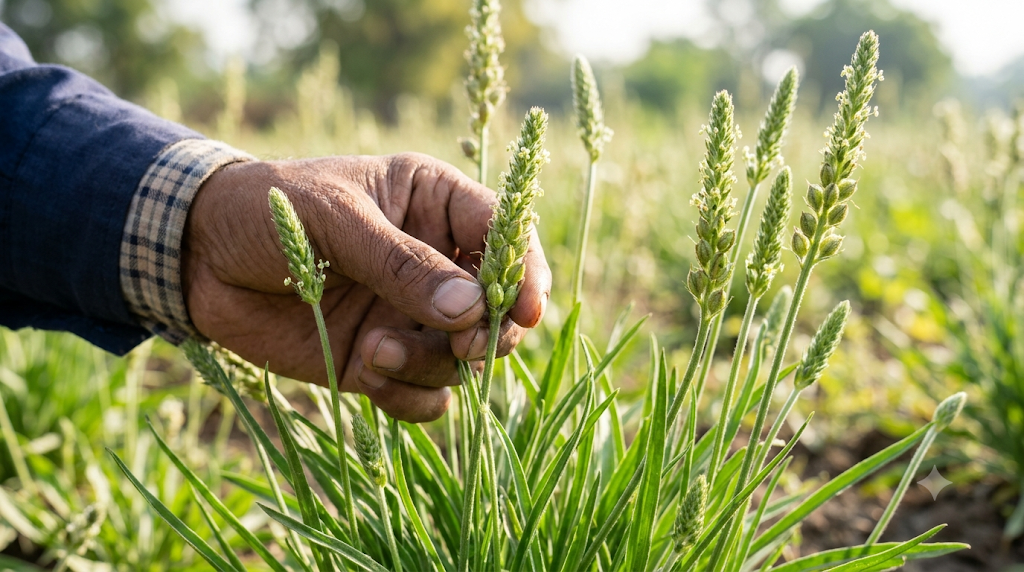
Isabgol farming is the cultivation of Plantago ovata, a short-stemmed annual herb of the family Plantaginaceae. Farmers grow it for the seed, and the husk (the outer seed coat) is the part that sells at the highest value.
The husk forms a mucilage, which is why it is used in digestive medicines. According to Vikaspedia, India is the largest producer and exporter of this crop in the world. The husk also goes into ice cream stabilisers, chocolates and some cosmetic bases, as per agricultural university course material.
For a smallholder, the attraction of isabgol farming is simple. It is a low-input rabi crop that suits dry, sandy fields where wheat gives a poor return. The risk is also simple: one unseasonal rain near maturity can damage the crop.
Isabgol seeds and husk used in psyllium products
Isabgol Farming Season and Sowing Time
Isabgol is a rabi crop. The crop calendar at Krishi Jagran lists the sowing window as 1 October to 30 November.
Timing matters more here than in most crops. A technical note on isabgol states that early sowing pushes more vegetative growth, which leads to lodging and higher downy mildew risk. Late sowing shortens the total growth period and cuts yield.
So in isabgol farming, do not sow on the first day you get free time. Sow when the field is ready and the weather has cooled. If you are reading this in mid-November, you are still inside the window, but you should not delay beyond 30 November.
Climate Needed for Isabgol Farming
Isabgol grows well in cool, dry and sunny weather. Krishi Jagran’s agripedia guide gives these figures:
- Germination: 20°C to 25°C
- Maturity: 30°C to 35°C
- Ideal annual rainfall: 50 to 125 cm
The same source and others make one point repeatedly. Regions with winter rain are not suitable for isabgol farming. The crop needs dry heat while the seed matures. Rain at that stage damages the spike and the seed quality.
Before you commit land, ask yourself one honest question. Does your area usually get winter showers? If yes, think again, or sow a crop that tolerates damp. Our guide to wheat farming and fertilizer dose per acre covers a safer rabi option for wetter fields.
Best Soil for Isabgol Farming
The best soil for isabgol farming is light, well-drained sandy loam. Course material from agricultural education sources gives a pH range of 7.0 to 8.0 and says the soil should have good organic matter.
Avoid heavy soils that hold water. Waterlogged roots invite disease, and the crop does not recover well. A source from Krishi Jagran also advises keeping the field away from chemically contaminated land and near a clean, reliable water source.
For a large plot, do a soil test first. It costs little compared with a failed crop. Your nearest Krishi Vigyan Kendra (KVK) or the soil testing lab under your state agriculture department can do it.
Sandy loam soil suitable for isabgol farming
Isabgol Varieties: Which One to Pick
Variety choice decides yield potential, maturity time and how well the crop suits your region. These are the varieties named in the sources:
| Variety | What the sources say |
|---|---|
| Gujarat Isabgol-1 (GI-1) | Released in 1976. Yield potential 800 to 900 kg per hectare. |
| Gujarat Isabgol-2 (GI-2) | Yield potential about 1,000 kg per hectare. |
| Vallabh Isabgol-1, 2, 3 | Released 2015 to 2016. Early maturing, suited to a wider range of regions including Delhi and Uttar Pradesh. |
| Vallabh Isabgol-3 | Highest yield among the listed varieties: 897 to 1,440 kg per hectare. |
| Jawahar Isabgol-4 | Suited to farmers with a longer growing season. |
| Haryana Isabgol-5 | Suited to farmers with a longer growing season. |
| Niharika | Listed as a recommended variety. |
If you are in Uttar Pradesh, Delhi or the northern belt, the Vallabh series looks like the safer starting point because of its wider adaptability. If you are in North Gujarat, the older Gujarat varieties are well tested locally.
One caution. Variety performance changes with soil and weather. Ask your KVK what has worked within 20 to 30 km of your village before you buy seed. Buy only from a licensed seed dealer and keep the bill.
Field Preparation and Sowing in Isabgol Farming
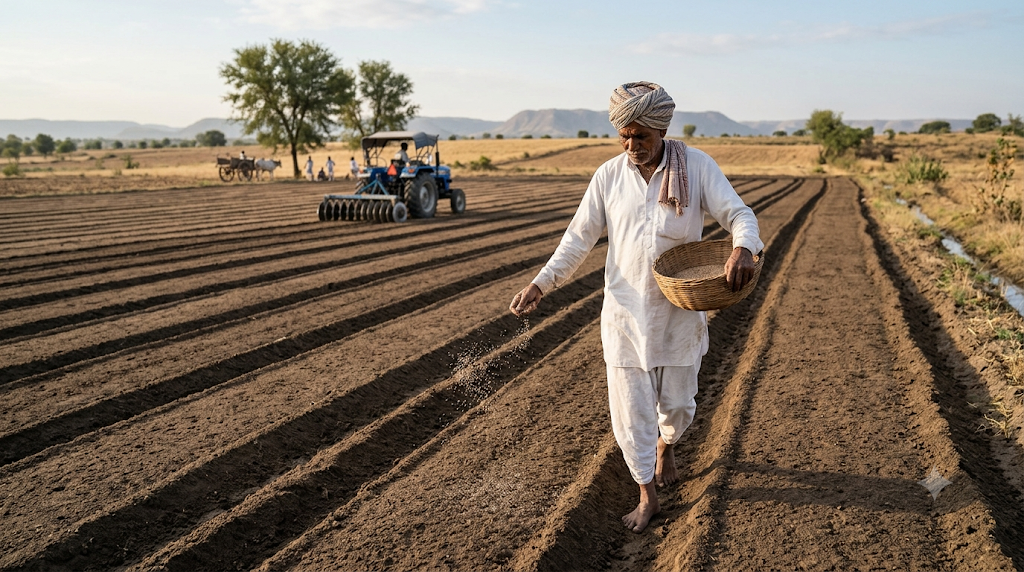
Isabgol seed is very small, so the seedbed must be fine and level. A rough, cloddy field gives poor and patchy germination.
A practical sequence for isabgol farming:
- Plough the field and break clods until the soil is fine.
- Mix in well-rotted farmyard manure or vermicompost during the last ploughing.
- Level the field so that water does not collect anywhere.
- Sow within the 1 October to 30 November window.
Seed rate: the sources I checked do not agree on a single figure, so I am not printing one. Use the seed rate recommended by your state agricultural university or KVK for your variety.
Method of sowing: an Indian Journal of Agronomy study compared seed rate and sowing method (row versus broadcast) and measured seed yield, swelling factor and mucilage percentage. The takeaway is that sowing method affects both yield and quality. Row sowing makes weeding and inspection easier, so smallholders should consider it.
Sowing should also be planned so that the monsoon does not coincide with seed maturity, as Vikaspedia notes. For this rabi crop, that is rarely a problem, but a late or irregular season can shift things.
Nutrient Management for Isabgol Farming
The crop needs low nitrogen and high phosphorus for good yield. This is the opposite of what many farmers do. Pouring urea on isabgol makes the plant leafy and soft, which invites lodging and mildew.
Technical guidance says organic sources are preferred over inorganic ones. Farmyard manure, vermicompost and green manure all work. You can also cut nitrogen needs by following a legume in rotation, such as groundnut, black gram or green gram.
I am not giving a fixed kilogram-per-acre dose, because the sources do not give one that holds across soils. Get a soil test and ask your KVK for a dose matched to your result. For a wider look at organic nutrient practice, read our organic farming in India beginner’s guide.
Organic manure application in isabgol farming
Pests and Diseases in Isabgol Farming
The two problems named in the sources are aphids and downy mildew. Technical guidance also mentions white grub as a pest that attacks the crop, and early sowing is linked to higher mildew risk.
What works, in order:
- Choose the right area. Fields with low pest and disease pressure are preferred for isabgol farming.
- Sow on time. Early sowing raises mildew risk, as covered above.
- Use cultural, biological and mechanical methods first. Rotation, clean fields, hand weeding and removing infected plants come before any spray.
- Spray only when needed. If aphids cross a damaging level, take advice from your KVK on an approved product. Do not buy whatever the shop owner recommends.
One older source recommends applying a soil insecticide against white grub at land preparation. Pesticide recommendations change and some older chemicals are now restricted in India. Check the current Central Insecticides Board list or your KVK before using any chemical. Do not follow an old recommendation blindly.
Harvest and Post-Harvest Handling
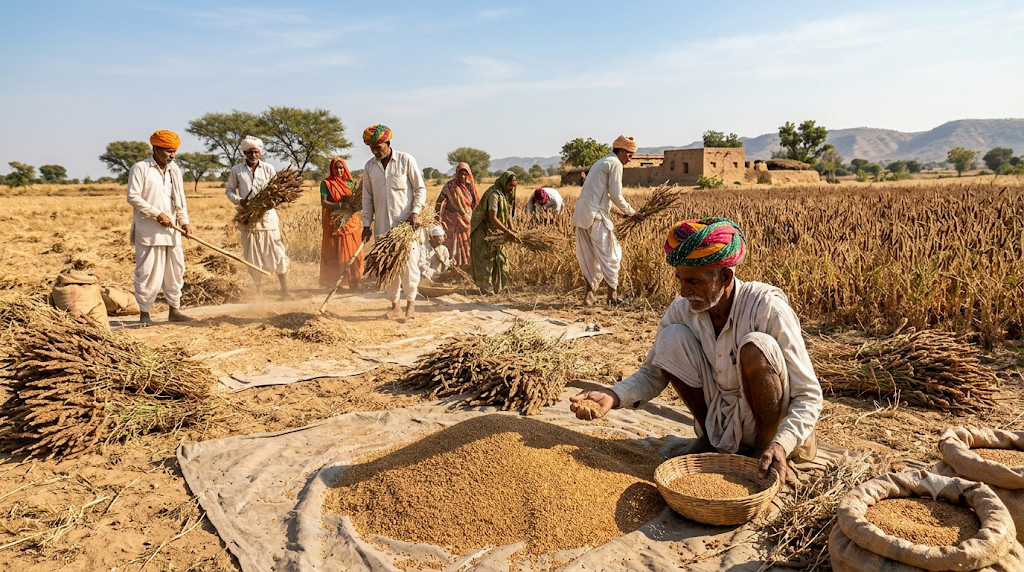
Harvest when the spikes turn brownish and the crop has matured, and do it in dry weather. Wet harvest spoils seed quality and reduces the husk’s swelling ability.
After harvest, dry the crop properly, thresh it and clean the seed. The seed is what most farmers sell. The husk (the epicarp) is separated by processors through milling, which is why value addition mostly happens outside the farm.
Straw is a by-product. Krishi Jagran reports the straw yield is about twice the seed yield, though I have not seen a reliable market rate for it, so do not count it as income until a buyer confirms.
Yield and Income from Isabgol Farming
Here is what the sources say about yield:
- Krishi Jagran: 800 to 1,000 kg seed per hectare under optimal conditions, and some varieties reach up to 1,500 kg per hectare.
- Vikaspedia: a good crop yields about 800 to 1,000 kg per hectare.
- Course material: average yield about 500 to 1,000 kg per hectare.
Converting to acres (1 hectare is about 2.47 acres), 800 to 1,000 kg per hectare is roughly 324 to 405 kg per acre. That is my own arithmetic, so treat it as an estimate.
I am not printing a profit figure. The only cost and return numbers I found were in an old, undated document, and prices of inputs and seed have changed. Instead, work out your own numbers with this table before sowing:
| Item | Your cost (₹ per acre) |
|---|---|
| Land preparation | |
| Seed | |
| Manure / fertilizer | |
| Irrigation | |
| Labour (sowing, weeding, harvest) | |
| Plant protection | |
| Threshing and transport | |
| Total cost | |
| Expected yield × local price |
Fill the last row with the lower yield figure, not the higher one. If isabgol farming still looks better than your alternative crop at the low end, it is a safe bet. If it only works at the high end, it is a gamble.
Crop Rotation with Isabgol
Technical guidance lists these rotations in use across India:
- Soybean – Isabgol
- Maize – Isabgol
- Sorghum – Isabgol
- Groundnut – Isabgol
- Maize – Isabgol – Green gram
These make sense. A kharif legume leaves some nitrogen in the soil, and isabgol needs little of it. Rotation also breaks pest and disease cycles. Do not grow isabgol on the same field year after year.
If you farm a mixed system, our post on traditional farming methods explains rotation and mixed cropping basics, and the primitive subsistence farming article covers low-input systems that smallholders often start from.
Where to Sell Isabgol
Isabgol is a commercial crop, and the buyer base is concentrated. Most processing and trade is linked to Rajasthan and Gujarat, and psyllium husk processors export it.
Before you sow, do three things:
- Visit or call two or three mandis and processors and ask the current rate.
- Ask whether they buy directly from farmers and what quality norms they use.
- Check whether your nearest mandi trades isabgol on eNAM, so you can compare prices beyond your local market.
Never sow a commercial crop without knowing who will buy it. This is the most common blind spot in isabgol farming.
For more on protected, high-value alternatives, see our polyhouse farming guide.
Common Mistakes in Isabgol Farming
- Sowing too early or too late. Both cut returns, for different reasons.
- Over-using nitrogen. The crop does not need it, and it increases lodging risk.
- Choosing heavy or waterlogged soil. Isabgol wants well-drained sandy loam.
- Ignoring weather at maturity. Rain at that stage spoils seed.
- Using an unverified variety. Buy named, labelled seed.
- Growing without a buyer. Check the market first.
- Following old pesticide advice. Use current, approved recommendations only.
Isabgol Farming Checklist
- Confirm your area has dry winters.
- Test the soil and check pH (7.0 to 8.0 is the stated range).
- Pick a variety suited to your region from the table above.
- Prepare a fine, level seedbed with organic manure.
- Sow between 1 October and 30 November, preferably in rows.
- Keep nitrogen low, watch for aphids and downy mildew.
- Harvest in dry weather and confirm your buyer before threshing.
Isabgol farming checklist for rabi season
FAQs on Isabgol Farming
1. What is isabgol farming?
Isabgol farming is the cultivation of Plantago ovata (psyllium) for its seed and husk. It is a rabi medicinal crop grown mainly in Rajasthan, Gujarat and Madhya Pradesh.
2. When should I sow isabgol in India?
The sowing window is 1 October to 30 November. Sowing too early raises lodging and downy mildew risk, and sowing too late shortens the growth period.
3. Which soil is best for isabgol farming?
Light, well-drained sandy loam with a pH of 7.0 to 8.0 and good organic matter is best. Avoid soils that hold water.
4. How much yield can I expect from isabgol farming?
Sources give 800 to 1,000 kg of seed per hectare under good conditions, with some varieties reaching up to 1,500 kg per hectare. That is roughly 324 to 405 kg per acre at the 800 to 1,000 range.
5. Which isabgol variety is best?
Vallabh Isabgol-3 shows the highest yield in the sources (897 to 1,440 kg per hectare). Gujarat Isabgol-1 and 2 are older, locally tested options. Check with your KVK for your area.
6. Can isabgol be grown in Uttar Pradesh or Bihar?
The Vallabh varieties are described as adaptable to regions including Delhi and Uttar Pradesh. Winter rainfall is the main risk in eastern states, so check your local weather pattern first.
7. Does isabgol need a lot of fertilizer?
No. It needs low nitrogen and high phosphorus. Organic manures such as farmyard manure and vermicompost are preferred.
8. What are the main pests and diseases?
Aphids and downy mildew are named in the sources, and white grub is mentioned as a soil pest. Early sowing increases mildew risk.
9. Which crops can I rotate with isabgol?
Soybean, maize, sorghum, groundnut and green gram are used in rotation with isabgol in different parts of India.
10. Is isabgol farming profitable for small farmers?
It can be, but only if you have the right soil, dry weather at maturity and a confirmed buyer. Work out your own cost and yield table before sowing, using the lower yield figure.
Conclusion
Isabgol farming can be a good option for farmers who want to try a different rabi crop and earn from the medicinal crop market. But getting a good harvest depends on a few important things, such as choosing the right variety, sowing at the right time, using suitable soil and managing irrigation properly.
Before starting, check your local weather, arrange good-quality seeds and find out where you can sell your produce. Don’t use too much fertilizer or ignore the risk of rain during harvesting.
A successful crop is not just about growing well; it’s also about knowing when to harvest and where to sell.
For more practical farming tips, crop cultivation guides and agriculture updates, keep reading FarmSutras – Practical Agriculture Knowledge for a Changing World.