
The Rashtriya Gokul Mission (RGM) is a central government scheme, running since December 2014, to conserve and develop indigenous cow and buffalo breeds. After the March 2025 revision, its outlay for 2021-22 to 2025-26 is ₹3,400 crore, spent on breeding, semen stations, IVF heifers and breed multiplication farms.
If you keep two buffaloes or run a 50-cow dairy, this scheme can reach you. It reaches you through breeding services, a subsidised loan or a capital grant, depending on your size. This guide covers who gets what, what has changed, and where farmers lose out.
Rashtriya Gokul Mission supporting indigenous cow breeding in an Indian village
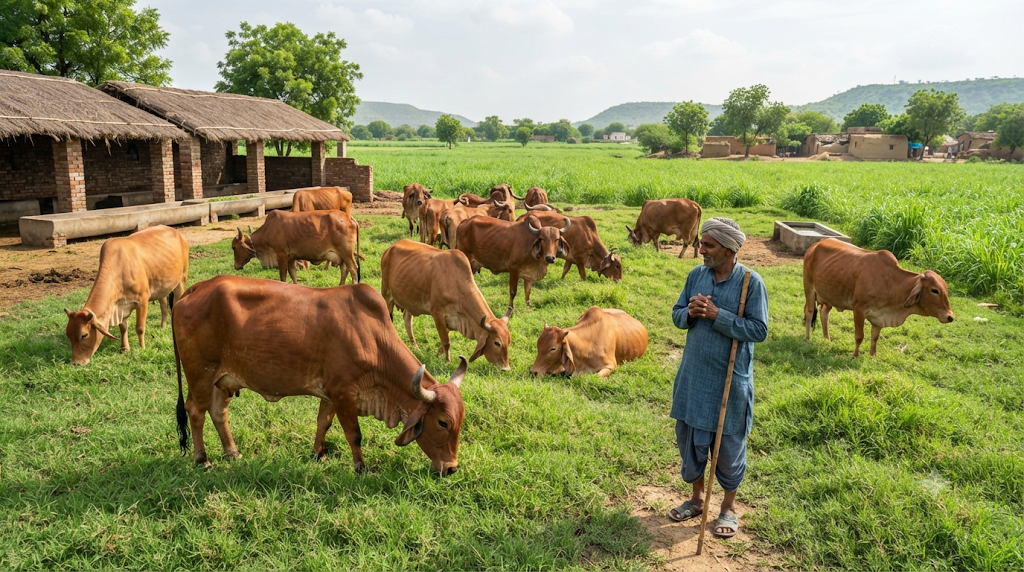
Table of Contents
What Is the Rashtriya Gokul Mission?
The Rashtriya Gokul Mission is a Central Sector scheme of the Department of Animal Husbandry and Dairying (DAHD). It was launched in 2014 to develop and conserve indigenous bovine breeds. Bovine means cattle and buffaloes.
The idea is simple. Better bulls, better semen and better-bred heifers give a farmer more milk from the same animal. The Rashtriya Gokul Mission does not give cash to every dairy farmer. It funds the breeding system behind your animal: semen stations, breeding farms, genetic improvement programmes and selected farmer loans.
Since 2021, the scheme runs under the umbrella of the Development Programmes scheme. That umbrella also covers the National Programme for Dairy Development and the National Livestock Mission.
New to the sector? Start with our livestock categories guide to see how cattle, small ruminants, pigs and poultry are classified.
Why the Rashtriya Gokul Mission Matters in 2027
Milk is the steadiest cash income for a smallholder, and animal quality decides how much milk you get. A scheme that improves breeds works on the root cause rather than on one year’s feed cost.
Three reasons the Rashtriya Gokul Mission matters for 2027:
- Breed quality is the bottleneck. Many farmers keep low-yielding, non-descript animals.
- Credit is expensive. An interest subvention on heifer loans cuts the real cost of buying a better animal.
- Policy is renewing. The 2021-26 cycle has ended, so the next allocation will decide what farmers can claim.
One target is worth knowing. A policy note citing PIB says the Rashtriya Gokul Mission aims to raise bovine productivity to 3,000 kg of milk per animal per year by 2030. Treat it as a government goal, not a promise to your cowshed.
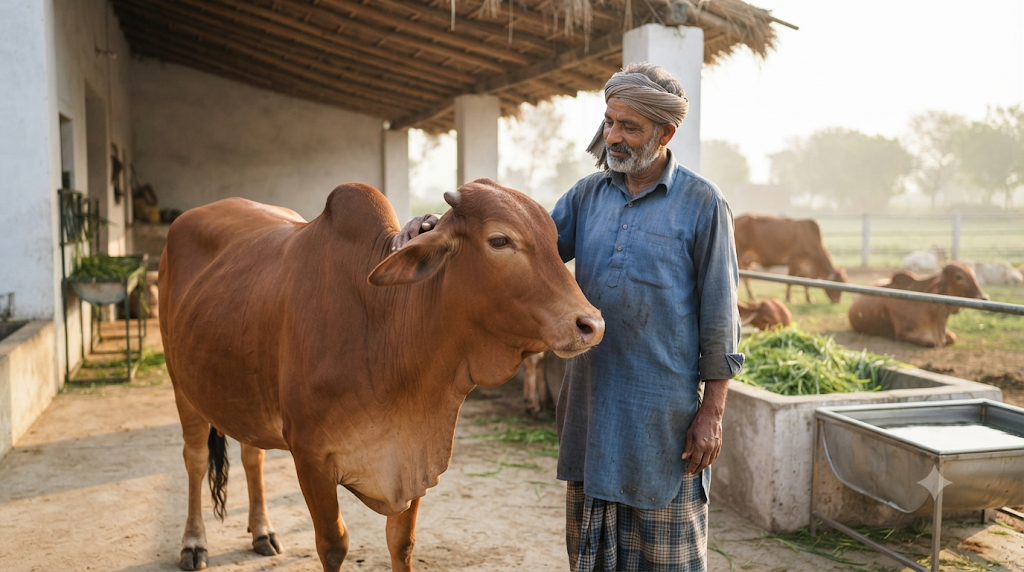
Dairy farmer with indigenous cow, Rashtriya Gokul Mission beneficiary example
Rashtriya Gokul Mission Budget: ₹2,400 Crore to ₹3,400 Crore
For 2021-22 to 2025-26, the Rashtriya Gokul Mission started with a budget outlay of ₹2,400 crore, as stated in PIB’s backgrounder. In March 2025, the Union Cabinet approved a revised Rashtriya Gokul Mission with an additional ₹1,000 crore. That took the total to ₹3,400 crore for the 15th Finance Commission cycle.
| Item | Figure |
|---|---|
| Launch | December 2014 |
| Original outlay, 2021-22 to 2025-26 | ₹2,400 crore |
| Additional outlay (March 2025 revision) | ₹1,000 crore |
| Revised total outlay | ₹3,400 crore |
DAHD also issued an administrative approval for implementing the revised Rashtriya Gokul Mission during 2026-27. The copy I could read says it runs up to 30 September 2026 or until a further decision. That date has passed, so check the DAHD website for the current status before you plan around it.
Main Components of the Rashtriya Gokul Mission
The revised Rashtriya Gokul Mission is organised into six broad components, labelled A to F. Several components matter directly to farmers.
Genetic Improvement and Semen Stations
The scheme supports sex-sorted semen and accelerated breed improvement programmes. Sex-sorted semen raises the chance of a female calf, which is what a dairy farmer wants. Semen station certificates are tracked by DAHD, and one notice extended validity of certain station certificates up to 31 December 2026.
Centres of Excellence and Central Cattle Breeding Farms
The revised mission supports Centres of Excellence while reinforcing Central Cattle Breeding Farms. These sit far from your village, but they produce the high-quality bulls and genetics your local artificial insemination (AI) technician uses.
Support for High Genetic Merit Heifers
This component is the one most farmers can use directly. It gives a 3% interest subvention on loans taken to buy High Genetic Merit (HGM) IVF heifers. The next section explains it.
Entrepreneurship Model for Breed Multiplication
Larger farmers can set up breed multiplication farms with a capital subsidy. This is covered below.
Digital Livestock Management
Recent summaries of the Rashtriya Gokul Mission mention digital livestock management and advanced breeding technology. Animal identification and records are central to this. See our guide on Pashu Aadhaar for how animal tagging works.
Interest Subvention on IVF Heifers
Under the revised Rashtriya Gokul Mission, farmers get a 3% interest subvention on loans taken to buy HGM IVF heifers from milk unions or financial institutions.
In plain terms, you borrow to buy a high-quality heifer, and the government pays 3 percentage points of the interest. Your bank or milk union will give the exact eligibility and the maximum loan covered.
Before you apply, work out three things:
- Total cost: the price of the heifer plus transport and insurance.
- Repayment: whether your monthly milk income covers the instalment in a lean season.
- Milk market: whether a union or private dairy will actually collect your milk.
A good heifer on a loan you cannot repay is a bad deal. Pair the loan with a Pashu Kisan Credit Card for feed and medicine costs, so working capital does not run out in month three.
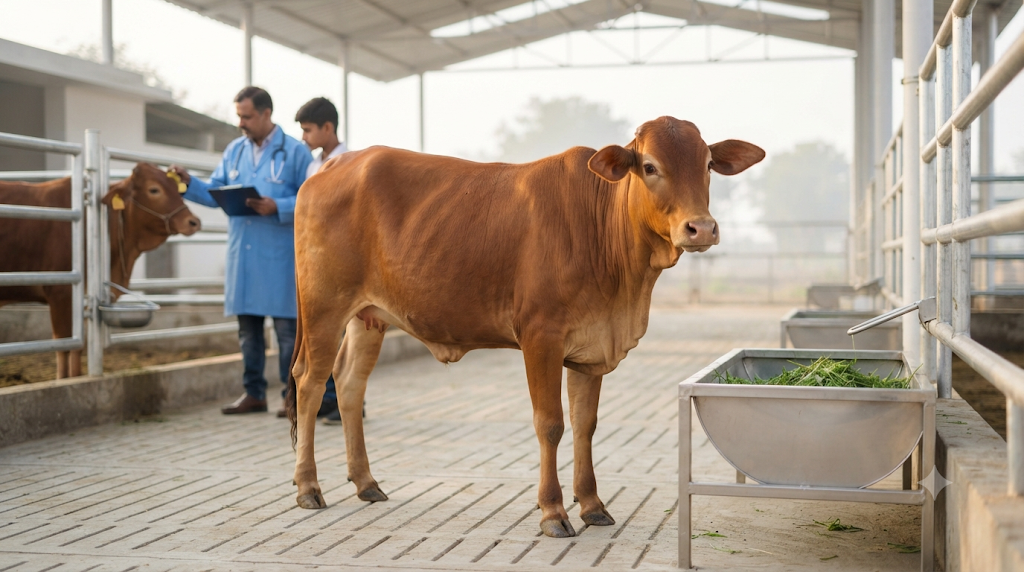
IVF heifer calf on a smallholder dairy farm
Breed Multiplication Farm Subsidy
For entrepreneurs, the Rashtriya Gokul Mission offers a one-time capital subsidy of up to 50% of project cost, with a maximum of ₹2 crore. The project cost is around ₹4 crore, and the remaining 50% comes as a bank loan.
This is not for a two-cow farmer. It suits a group, a cooperative or a serious dairy entrepreneur with land, capital and bank credibility.
If you are in that group, also read our post on the AHIDF scheme, which supports dairy infrastructure investment. Do not assume you can stack both subsidies on one project. Ask your bank which scheme fits your project and whether the rules allow combining them.
What Happened to Gokul Grams
Older articles describe Gokul Grams as integrated indigenous cattle development centres. Under the revised guidelines, that component and some related ones are discontinued. Gokul Grams sanctioned earlier, such as the ones in Dharampur and Porbandar in Gujarat, continued.
This is a common error in old blog posts and YouTube videos. If a source promises you a new Gokul Gram, check the DAHD page first.
Who Can Benefit from the Rashtriya Gokul Mission
The scheme has different entry points for different people.
- Smallholder with 1 to 5 animals: AI services, better semen and, where available, an IVF heifer loan with interest subvention.
- Dairy farmer scaling up: the heifer loan route plus support from your milk union.
- Entrepreneur or cooperative: the breed multiplication farm subsidy.
- State animal husbandry departments and breed societies: the institutional components, including breeding farms and awards.
- Agriculture students: a clear case study of how government funds breed improvement.
If you are a registered PM-KISAN farmer, you may find state-level breed improvement sub-schemes linked to the Rashtriya Gokul Mission. Rules differ by state, so confirm locally.
Rashtriya Gokul Mission: 7 Steps to Get Benefits
DAHD implements the Rashtriya Gokul Mission through State Implementing Agencies, so the process runs through your state. Follow this sequence.
Step 1: Identify Which Component Fits You
Decide whether you want breeding services, a heifer loan or a breed farm. Do not apply for everything. Pick one.
Step 2: Visit Your Veterinary Hospital or District Office
Meet the veterinary officer or the District Animal Husbandry Officer. Ask which Rashtriya Gokul Mission components are active in your state this year.
Step 3: Get Your Animals Tagged and Recorded
Make sure your cattle and buffaloes are identified and recorded as your state requires. Missing records stop more applications than any eligibility rule.
Step 4: Keep Your Documents Ready
Your state will give the exact list. Keep your identity proof, bank passbook and proof of animal ownership ready, plus land or shed details if you want a farm subsidy.
Step 5: Approach Your Bank or Milk Union
For the IVF heifer route, ask whether your bank or milk union has a tie-up. Ask in writing how the 3% interest subvention will be credited.
Step 6: Make a Simple Repayment Plan
Write down monthly milk income and monthly instalments for the dry period too. If the numbers do not work, reduce the loan size.
Step 7: Keep Receipts and Follow Up
Keep sanction letters, bills and tag numbers. Follow up with the department every month. Subsidy delays are common, and a farmer with paperwork gets answers faster.
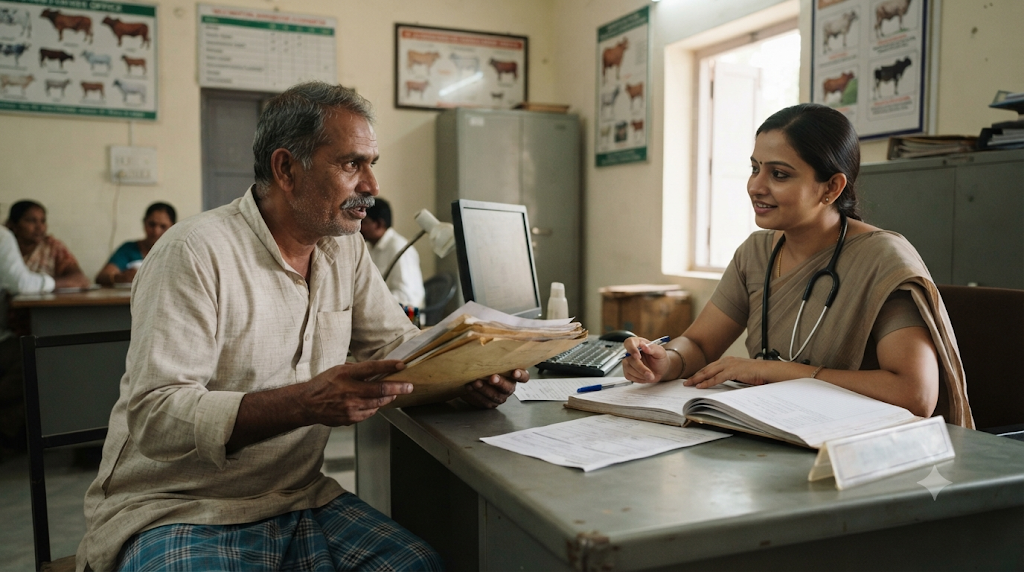
Farmer submitting animal husbandry scheme documents at a district office
Common Mistakes Farmers Make
Honest advice, since nobody else will give it:
- Trusting agents who promise “guaranteed subsidy.” Only the department sanctions benefits.
- Reading outdated articles. Scheme components change. Check the DAHD page for the current version.
- Borrowing before checking the market. An expensive heifer with no milk buyer is a loss.
- Ignoring insurance. An uninsured high-value animal is a large risk. Read our guide on livestock insurance.
- Ignoring animal health. A high-genetic-merit heifer still loses yield to disease. Our posts on lumpy skin disease and foot and mouth disease explain what to vaccinate against.
Rashtriya Gokul Mission vs Other Livestock Schemes
Farmers often mix up the schemes. This table separates them.
| Scheme | Main focus | Best for |
|---|---|---|
| Rashtriya Gokul Mission | Breed development of cattle and buffalo | Dairy farmers, breeders |
| National Livestock Mission | Goats, sheep, pigs, poultry and fodder | Small ruminant and poultry farmers |
| Kisan Credit Card (animal husbandry) | Working capital for feed and medicine | All livestock keepers |
| AHIDF | Dairy and meat processing infrastructure | Entrepreneurs, cooperatives |
| Livestock insurance | Risk cover for animals | Anyone with valuable stock |
The National Livestock Mission covers livestock other than cattle and buffalo, so it complements the Rashtriya Gokul Mission. Read our National Livestock Mission guide if you keep goats or sheep.
For breed selection, see our cow breeds in India post, and for the business side, dairy farming in India.
Rashtriya Gokul Mission in 2027: What to Watch
I will not predict numbers. What farmers can track is the following.
- New cycle approval. The 2021-26 cycle has ended, so watch for the next outlay and guideline notice from DAHD.
- Component changes. The revision already discontinued some components. More changes are possible.
- Digital records. The mission’s focus on digital livestock management means animal tagging will matter more.
- State rollout. Benefits reach you through your state, so rollout speed differs between states.
Check the DAHD scheme page and your state animal husbandry department every quarter.
FAQs
1. What is the Rashtriya Gokul Mission in simple words?
The Rashtriya Gokul Mission is a central scheme to improve and conserve indigenous cow and buffalo breeds through better breeding, semen, heifers and farms.
2. When was the Rashtriya Gokul Mission launched?
The Rashtriya Gokul Mission was launched in December 2014.
3. Which ministry runs the Rashtriya Gokul Mission?
The Department of Animal Husbandry and Dairying under the Ministry of Fisheries, Animal Husbandry and Dairying runs it.
4. What is the total budget of the Rashtriya Gokul Mission?
The total outlay for 2021-22 to 2025-26 is ₹3,400 crore after the March 2025 revision. It was originally ₹2,400 crore, plus an additional ₹1,000 crore.
5. How much interest subsidy do farmers get on IVF heifers?
The revised scheme provides a 3% interest subvention on loans for HGM IVF heifers bought from milk unions or financial institutions.
6. What is the breed multiplication farm subsidy?
It is a one-time capital subsidy of up to 50% of project cost, with a maximum of ₹2 crore. The rest comes as a bank loan.
7. Are Gokul Grams still being set up?
Under the revised guidelines, that component is discontinued. Earlier-sanctioned Gokul Grams continued.
8. Can a farmer with two cows benefit from the Rashtriya Gokul Mission?
Yes, mostly through breeding services and, where available, the heifer loan route. The farm subsidy suits larger projects.
9. Where do I apply for the Rashtriya Gokul Mission?
Start with your state animal husbandry department, district veterinary office, or milk union. The scheme runs through State Implementing Agencies.
10. Is the Rashtriya Gokul Mission valid in 2027?
The 2021-26 cycle has ended. DAHD issued an approval for 2026-27, but its stated validity needs checking. Confirm the current status on the DAHD website.
11. Can farmers apply for the Rashtriya Gokul Mission online?
There is no single online application portal. Farmers should contact their local veterinary hospital, District Animal Husbandry Office or milk union to check the application process.
12. Which animals are covered under the Rashtriya Gokul Mission?
The Rashtriya Gokul Mission focuses on indigenous cattle and buffalo breeds to improve their genetic quality and milk productivity.
13. Is the Rashtriya Gokul Mission available to small dairy farmers?
Yes, small dairy farmers can benefit through breeding services and, where available, interest-subsidised loans for eligible IVF heifers.
Conclusion
The Rashtriya Gokul Mission will not fix a dairy farm on its own. It improves the breeding base, and it can cut the cost of buying a better animal. A farmer who tags animals, keeps records and checks the current rules gets more from it than one who relies on an agent.
Verify every component with your state department before you borrow or invest, and read our livestock categories guide for the wider picture.