
Ashwagandha farming is the cultivation of Withania somnifera, a medicinal crop grown for its roots. Sow seed with the monsoon on well-drained sandy loam soil, harvest roots after about five to six months, and dry and grade them before sale.
That is the whole crop in two lines. This guide explains each step in plain language, so a smallholder can decide whether ashwagandha farming suits their land, water and market.
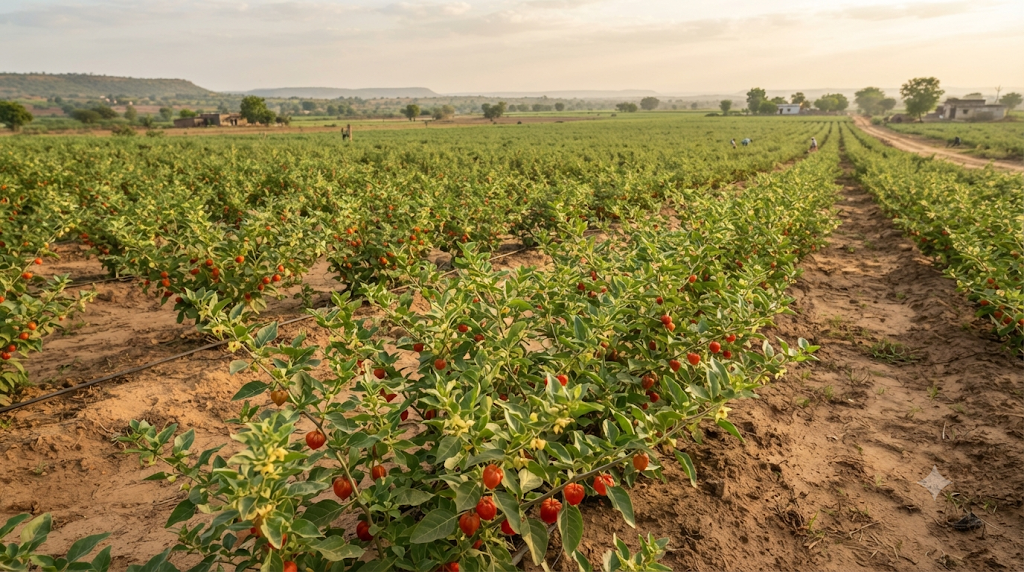
Table of Contents
What Is Ashwagandha Farming?
Ashwagandha farming is the commercial growing of Withania somnifera, also called asgandh, Indian ginseng or winter cherry. It is a short shrub, usually knee to waist high. The economic part is the root. Farmers also collect seed and, in some cases, dried leaves, but the root decides your income.
The crop is hardy. It tolerates dry spells and does not like standing water. That is why ashwagandha farming suits dryland and semi-arid belts where many food crops struggle.
One point matters before you start: ashwagandha is not a food crop. Nobody eats it from your field. You sell to traders, extraction units and herbal companies, so your income depends on quality and on finding a buyer before you sow.
Why Ashwagandha Farming Is Getting Attention for 2027
Three reasons are behind the interest.
Herbal demand. Ashwagandha root is used in Ayurvedic products and in capsules, powders and extracts sold in India and abroad. Buyers want steady supply with clean roots.
Dryland fit. Farmers in water-short areas look for crops that need few irrigations. Ashwagandha farming fits that need.
Policy support. The National Medicinal Plants Board (NMPB) under the Ministry of Ayush supports cultivation of medicinal plants. Rules and rates change, so verify the current scheme on the official site.
None of this guarantees profit. Prices move with demand, and a farmer without a buyer can end up holding unsold roots.
Where Ashwagandha Farming Works in India
Ashwagandha farming is most established in Madhya Pradesh, especially around Mandsaur and Neemuch, and in parts of Rajasthan such as Nagaur. Gujarat, Maharashtra, Punjab, Haryana and Uttar Pradesh also have growers.
The crop suits places with:
- Light, well-drained soil
- Low to moderate rainfall
- Dry weather in the later part of the crop
- A nearby mandi or processor that buys roots
If your village has heavy clay soil and waterlogging, ashwagandha farming will give weak roots and disease. Test a small plot first.
Soil and Climate for Ashwagandha Farming
Ashwagandha prefers sandy loam or light red soil with good drainage and a slightly alkaline to neutral pH. Waterlogging causes root rot, so avoid low pockets.
The crop is raised in the kharif season, sown with the monsoon. It needs some rain at sowing and early growth, then dry weather as roots mature. Heavy late rain hurts root quality.
Practical checks before ashwagandha farming on a plot:
- Does water drain within a day or two after heavy rain?
- Is the soil loose enough for roots to go deep?
- Has the plot grown ashwagandha or a related crop (tomato, brinjal, potato) in the last season? Related crops can carry the same pests.
Get a soil test from your nearest Krishi Vigyan Kendra (KVK). It costs little and saves a failed season.
Varieties for Ashwagandha Farming
Improved varieties give more uniform roots than random local seed. Ones you will hear about include Jawahar Asgandh-20 and Jawahar Asgandh-134 from JNKVV, Jabalpur, and Poshita from CSIR-CIMAP, Lucknow.
How to choose seed for ashwagandha farming:
- Ask your KVK or a university which variety suits your district.
- Buy from a research institute, an agricultural university or a trusted seed seller who gives a bill and the lot number.
- Use fresh seed. Old seed sprouts poorly.
- Ask your buyer which type of root they prefer.
Avoid seed from an unknown trader who cannot tell you its source.
The 7 Steps of Ashwagandha Farming
Step 1: Choose the plot. Pick well-drained sandy loam. Skip waterlogged corners.
Step 2: Prepare the land. Plough two or three times to a fine tilth and remove stubble and weeds. Mix in well-rotted farmyard manure at land preparation. See our guide on biochar for soil health if your soil is poor in organic matter.
Step 3: Treat the seed. Treat seed as advised by your KVK to reduce seed-borne disease before sowing. Do not guess the chemical or dose.
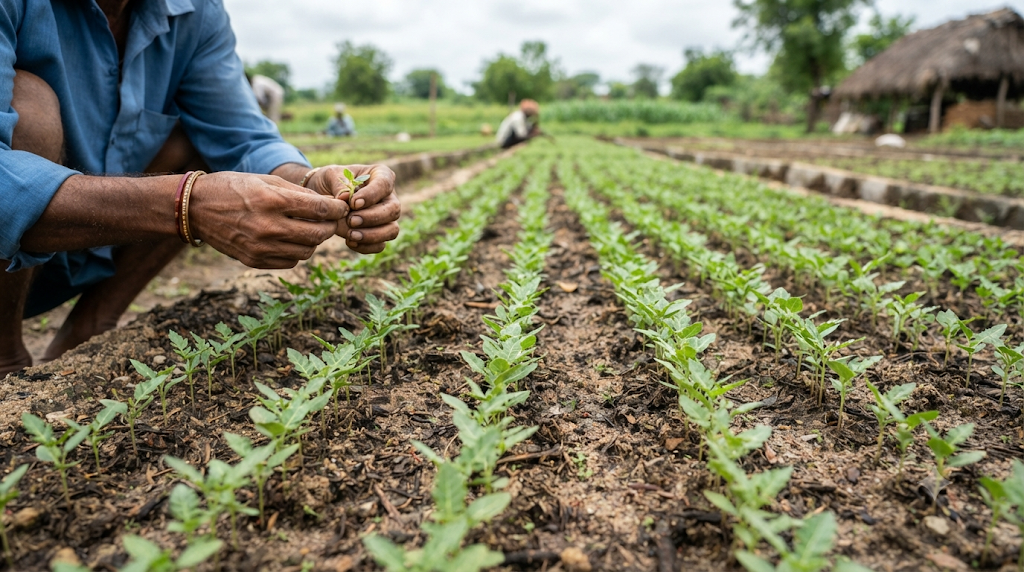
Step 4: Sow. Farmers sow in two ways: direct sowing, where seed is broadcast or drilled in lines, and nursery raising with transplanting. Direct sowing in lines makes weeding easier. Plant spacing and seed rate vary by method and variety, so confirm figures with CIMAP or your KVK.
Step 5: Thin and weed. Thin crowded plants so roots get space. Remove weeds early, because ashwagandha grows slowly in the first weeks.
Step 6: Irrigate lightly. Give light irrigation only if rain fails. Over-watering is the quickest way to lose the crop.
Step 7: Harvest, dry and grade. Dig roots when leaves yellow and berries turn red. Dry, grade and sell.
Treat these steps as a framework. Local advice beats any blog, including this one.
Crop Calendar for Ashwagandha Farming
| Stage | Usual time | What you do |
|---|---|---|
| Land preparation | June to July | Plough, add manure |
| Sowing | July to September | Sow with monsoon rain |
| Thinning and weeding | 3 to 6 weeks after sowing | Remove extra plants and weeds |
| Growth | Monsoon to post-monsoon | Watch moisture, pests |
| Flowering and berries | After monsoon | Keep field dry and clean |
| Harvest | Roughly December to March | Dig roots |
| Drying and grading | Right after harvest | Clean, cut and sun-dry |
Dates shift with region and rain. Adjust them using local advice.
Nutrient and Water Management
Ashwagandha farming does not need heavy feeding. Excess nitrogen gives leafy plants and weaker roots.
- Organic matter: Well-rotted farmyard manure at land preparation is the usual base.
- Chemical fertiliser: Apply only what a soil test and your KVK recommend. Over-feeding raises cost without raising root quality.
- Nano and liquid inputs: If you plan to use them, read our guide on nano fertilizer and check the label for crop approval.
- Water: Rain does most of the work. Give a light irrigation only during a long dry spell. Stop irrigation as roots mature.
Roots from a field that stood in water often rot or turn dark. Buyers reject them.
Pests, Diseases and Weeds
Common troubles in ashwagandha farming:
- Seedling rot and damping off: Caused by wet soil and poor drainage. Prevent with drainage and treated seed.
- Leaf spot and blight: Show in humid weather.
- Sucking insects and caterpillars: Feed on leaves and can reduce growth.
- Root rot: Appears when water stands near roots.
- Weeds: Compete strongly in the first weeks.
Be careful with sprays. Ashwagandha goes into herbal products, and buyers test for pesticide residue. Use only products an agriculture officer or university names for this crop, with the correct dose and waiting period. Keep a written record of every input.
Harvesting and Drying
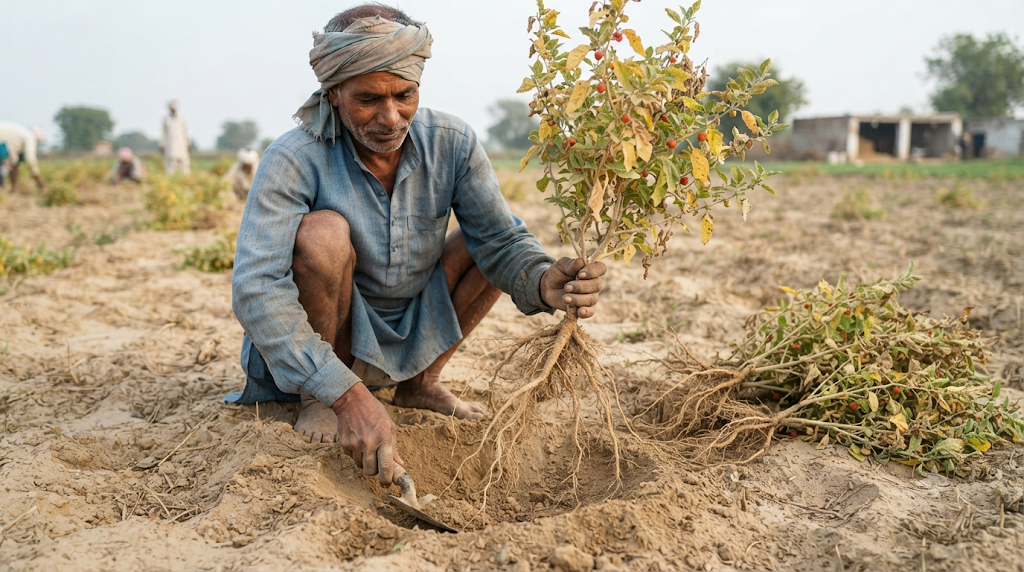
Harvest happens when leaves turn yellow and dry and berries turn red. In many areas this falls between December and March.
Steps farmers follow:
- Dig the whole plant. Loosen the soil and pull the plant out by hand or with a light implement so roots do not snap.
- Cut roots from the stem. Separate the root from the shoot just above the root top.
- Wash lightly. Remove soil but do not soak the roots.
- Cut into pieces. Roots are often cut into short lengths for faster drying.
- Sun-dry. Spread roots on a clean sheet or floor in sun until they snap cleanly.
- Collect seed. Berries from the plants can be dried and the seed separated for next season’s sowing.
Moisture ruins ashwagandha. Roots packed damp develop mould and lose value. Dry them fully before you bag them.
Grading and Storage
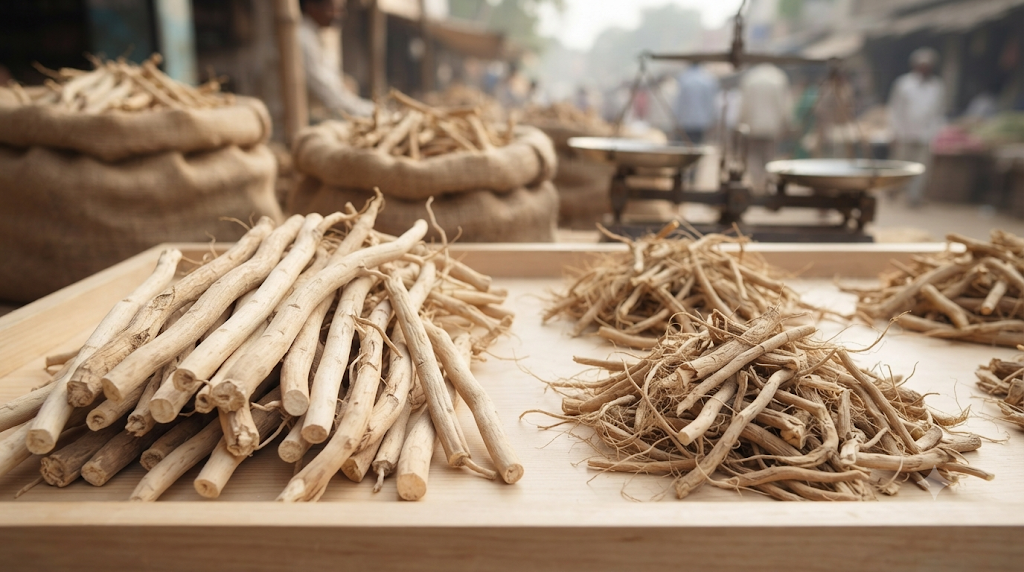
Buyers usually grade ashwagandha root by length, thickness and colour. Longer, thicker, whiter roots fetch better rates. Small broken pieces and thin lateral roots are sold at lower rates.
Storage rules:
- Store in clean, dry jute or HDPE bags
- Keep bags on pallets, away from walls and floor
- Keep away from fertiliser, pesticides and fuel
- Check for moisture and insects each week
Ask your buyer how they grade before harvest, so you can sort roots the same way.
Cost Heads and Income Planning
I am not quoting rupee figures. Costs and prices differ by district, variety and year, and a number I cannot source is a number you should not plan on. Build your own sheet.
Cost heads in ashwagandha farming:
- Land preparation and ploughing
- Seed
- Manure and any fertiliser
- Seed treatment
- Sowing labour
- Weeding and thinning labour
- Plant protection, if needed
- Harvest and digging labour
- Drying, cutting and grading
- Bags and transport
- Mandi fee or broker commission
How to estimate income:
- Ask three growers nearby what dry root they got per acre and what they sold it for.
- Ask two traders for today’s price by root grade.
- Subtract all cost heads from the sale value.
- Run a bad-year case with lower yield and lower price.
If the bad-year case wipes out your profit, start with a small plot. Ashwagandha farming over a whole holding in the first year is a gamble.
Where to Sell
Ashwagandha farming has fewer buyers than wheat or rice, so decide your market first.
- Local mandi: Mandsaur and Neemuch in Madhya Pradesh are well-known markets for the crop.
- Traders and brokers: Quick but you take the going rate.
- Herbal and extraction companies: Pay for quality and consistency. Many prefer contract farming with a written agreement.
- Farmer Producer Organisation (FPO): A group can pool roots, grade them and negotiate better.
- e-NAM: Check whether a nearby mandi lists medicinal crops. Our guide to the e-NAM platform explains registration.
If you sign a contract, read the price clause, quality clause, rejection clause and payment date before you sign. Ask a trusted person to read it too.
Government Support for Ashwagandha Farming
Verify each item on the official site before applying.
- National Medicinal Plants Board (NMPB): Supports cultivation, post-harvest work and marketing of medicinal plants. See nmpb.nic.in.
- Ministry of Ayush: Policy and schemes for medicinal plants. See ayush.gov.in.
- CSIR-CIMAP, Lucknow: Research, improved varieties and training. See cimap.res.in.
- Kisan Credit Card: Working capital for crop costs. Read our Kisan Credit Card scheme guide.
- Crop insurance: Check whether your crop and district are covered. See our guide on crop insurance for farmers and the PMFBY portal.
- State horticulture or medicinal plant boards: Many states run their own schemes. Visit your district office.
Carry land papers, bank passbook, Aadhaar and your Farmer ID when you apply. Missing papers cause most delays.
Mistakes to Avoid in Ashwagandha Farming
- Sowing without a buyer. This is the most common and most costly mistake.
- Planting in waterlogged soil. Root rot follows.
- Using old or unknown seed. Poor sprouting wastes the season.
- Over-irrigating. Rain and light irrigation are enough.
- Spraying without advice. Residue failures can lead to rejection by herbal buyers.
- Packing damp roots. Mould reduces grade.
- Following social media income claims. Ask for the full cost sheet and the buyer’s name.
Ashwagandha Farming vs Other Rabi and Medicinal Options
| Point | Ashwagandha farming | Isabgol | Linseed |
|---|---|---|---|
| Season | Kharif sowing, winter harvest | Rabi | Rabi |
| Water need | Low | Low | Low to moderate |
| Part sold | Root | Husk from seed | Seed and fibre |
| Market | Herbal buyers, mandi | Processors and traders | Oil mills, traders |
| Main risk | Few buyers, price swings | Weather at maturity | Price and disease |
If you already grow isabgol, read our isabgol farming guide to see how the two medicinal crops compare in practice. For another dryland option, see linseed farming and safflower farming.
Honest Risks Before You Start
- Market risk. There are fewer buyers than for staple crops.
- Price swings. Medicinal crop prices move sharply with demand.
- Weather. Late heavy rain damages roots.
- Quality rules. Residue and moisture limits can lead to rejection.
- Weak information. Many online videos skip failures and costs.
If you are a student, treat ashwagandha farming as a case study in medicinal crops, contract farming and quality control. If you are a farmer, start with a small plot, finish one full cycle, and decide after you see your own numbers. Also read our guide on climate-resilient crops if rainfall in your area is becoming unreliable.
FAQs
1. What is ashwagandha farming?
Ashwagandha farming is the cultivation of Withania somnifera for its roots. Farmers sow with the monsoon, harvest after about five to six months, then dry, grade and sell the roots.
2. Which soil is best for ashwagandha farming?
Well-drained sandy loam or light red soil. Waterlogged or heavy clay soil causes root rot.
3. When should I sow ashwagandha?
Usually between July and September with the monsoon. Confirm dates with your local KVK.
4. How long does the crop take?
Roots are usually ready after about five to six months, often between December and March.
5. Does ashwagandha farming need a lot of water?
No. Rain does most of the work. Give light irrigation only in a long dry spell and avoid standing water.
6. Is ashwagandha farming profitable?
It can be, but it depends on yield, root grade, price and having a buyer. Make your own cost sheet from local quotes.
7. Which varieties are used?
Jawahar Asgandh-20, Jawahar Asgandh-134 and Poshita are well known. Ask your KVK what suits your district.
8. Where can I sell ashwagandha roots?
Local mandis such as Mandsaur and Neemuch, traders, herbal companies, FPOs and contract farming arrangements.
9. Is there government support for ashwagandha farming?
Support comes through the National Medicinal Plants Board, Ministry of Ayush schemes, state boards and research institutes. Verify current rules on official sites.
10. How do I avoid rejection by buyers?
Dry roots fully, grade them, avoid unrecommended sprays, keep input records and store in clean, dry bags.
Conclusion
Ashwagandha farming can be a good option for farmers looking to try medicinal crops. It needs less water, but proper soil, good-quality seeds and timely harvesting are important for getting healthy roots.
Before starting, farmers should check market demand and find a reliable buyer. Don’t invest in large areas just because you hear about high prices or profits. Start small, understand the crop and calculate your costs.
Good planning, proper crop management and the right market connection can make ashwagandha farming a worthwhile addition to your farming activities.