
ONDC for farmers is a government-backed open network where you list your produce on a seller app and get orders from buyer apps across India, without depending on one e-commerce company. You register on a seller app, upload product details, and orders reach you from any buyer app on the network.
ONDC stands for Open Network for Digital Commerce. It is backed by the Department for Promotion of Industry and Internal Trade (DPIIT). It is not an app you download.
This guide explains ONDC for farmers in plain steps: what it is, which documents you need, what to check before signing up, and where it does not work. We have not added income or sales promises because none can be made. The few figures used are from published reports and are linked in the Sources section.
ONDC for farmers: a farmer packing produce to sell on a seller app
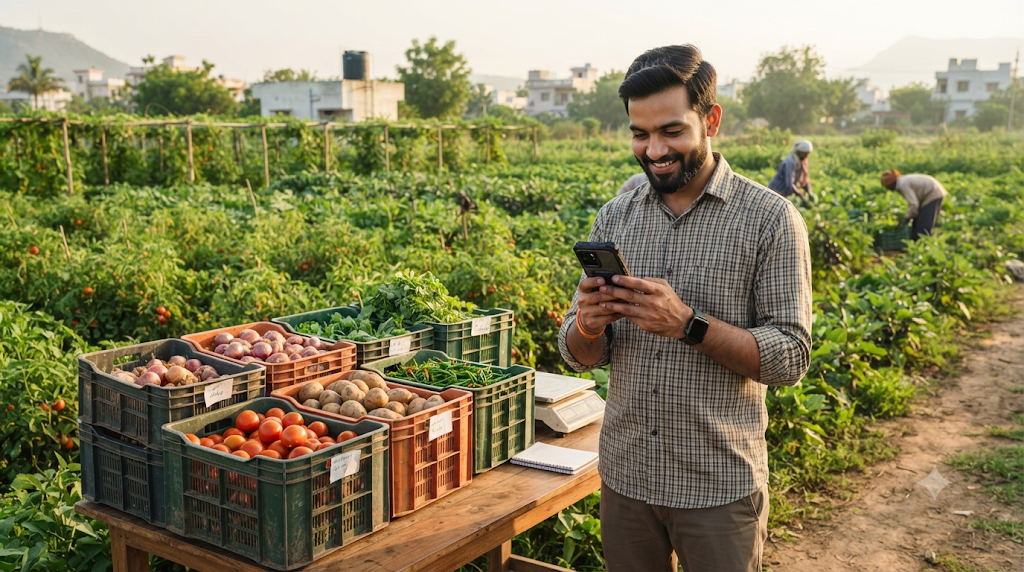
Table of Contents
What Is ONDC for Farmers?
ONDC for farmers means a farmer, farmer group or FPO can sell through the same open network that big sellers use. You are not tied to one company’s app, fees or customer list.
ONDC is a set of common rules. These rules let different buyer apps and seller apps talk to each other.
The closest comparison is UPI. You can pay from any app and still reach any bank account. ONDC tries to do the same for shopping. A buyer on one app can order from a seller who registered on a different app.
In April 2023, FPOs were brought onto the network through a tie-up with the Small Farmers Agribusiness Consortium (SFAC), an agriculture ministry body. Reports say these FPOs listed about 3,100 varieties of value-added agricultural products. Reports differ on how many FPOs are active, between 3,200 and 4,000, so treat that count as approximate.
How ONDC for Farmers Works
Four parties are involved in every order. Knowing them helps you pick the right seller app.
- Buyer app: where the customer searches and orders. Paytm and Pincode are examples named in news reports.
- Seller app: where you register, list products and manage orders. This is your real “shop”.
- Logistics partner: picks up from you and delivers to the buyer.
- Payment flow: the buyer pays through the buyer app, and the amount reaches you after deductions, as per your seller app’s terms.
When a customer searches for “jaggery”, the buyer app asks the network for sellers. Your listing appears if it matches and delivers to that pincode.
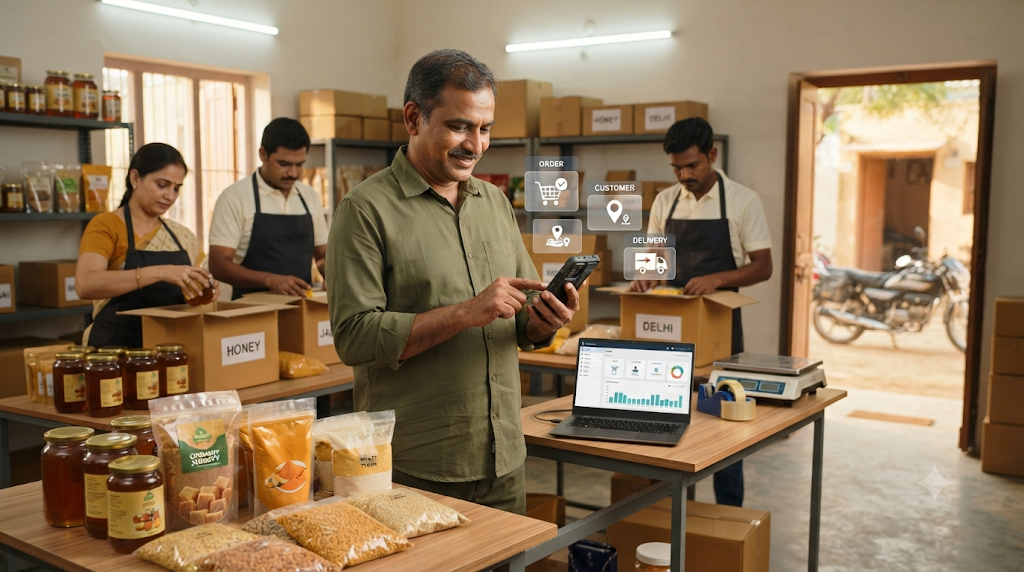
Your daily work stays on the seller app. You accept the order, pack it, and hand it to the delivery partner.
The key point: ONDC does not find customers for you. It puts you in the same search results as other sellers. Your price, photos and packing decide whether you get the order.
Who Can Use ONDC for Farmers
ONDC for farmers suits people who can pack and ship a product with a clear weight and price. That includes:
- Farmers who process their own produce, such as jaggery, turmeric powder, honey or pickles
- FPOs with packing and storage space
- Self-help groups making food products
- Farmers selling dry produce like pulses, millets or spices in small packs
It does not suit loose, bulk produce such as paddy or wheat sold by the trolley. For that, the mandi or eNAM is the right channel.
If you have no smartphone and no one to help with listing, start with your local FPO instead. Going alone will cost you time.
ONDC vs eNAM: Which One Do You Need
These are different tools for different sales.
| Point | ONDC | eNAM |
|---|---|---|
| Sale type | Retail packs and small B2B orders | Bulk mandi trade |
| Buyer | Consumers, shops, businesses | Registered traders |
| Product form | Packed, graded, branded | Raw produce in lots |
| Price setting | You set the price | Auction-based |
Many farmers will use both. Sell bulk raw produce through eNAM, and sell packed, processed items through ONDC. Our guide on eNAM registration covers the mandi side.
Documents Needed for ONDC for Farmers
Requirements differ by seller app, so check the app’s onboarding page. These are the common ones:
- Aadhaar and PAN
- Bank account in your name, with IFSC
- Mobile number linked to Aadhaar
- GSTIN or a declaration, depending on the product and the app
- FSSAI registration or licence if you sell packed food (the type depends on your size)
- Address proof for the pickup location
- Product photos and a short description
Do not skip FSSAI for packed food. Buyers can raise complaints, and an unregistered food seller is a risk. Apply through the FSSAI portal.
If you hold a Farmer ID, keep it handy for scheme-linked work. See our post on Farmer ID.
7 Easy Steps to Join ONDC for Farmers
Steps to join ONDC for farmers on a seller app
- Decide what to sell. Pick one or two products you can pack consistently. Do not list ten items on day one.
- Complete the paperwork. Gather the documents above, and apply for FSSAI first if you sell food.
- Choose a seller app. Compare commission, payout time, support language and logistics options. Ask two other sellers which app they use.
- Register and verify. Fill in your details, upload documents and complete bank verification.
- Create listings. Add clear photos, net weight, price, shelf life and delivery area. Write the description in simple words.
- Set up pickup. Confirm which delivery partner collects from your village or town, and what packing they need.
- Test with a few orders. Ask a relative in another city to order. Check packing, delivery time and payment before you promote.
Start small. A failed first order costs you money and your rating.
The official ONDC website lists the current network participants. Always check there, because seller apps change.
Best Products to Sell Through ONDC
Choose products that survive transport and have a clear grade.
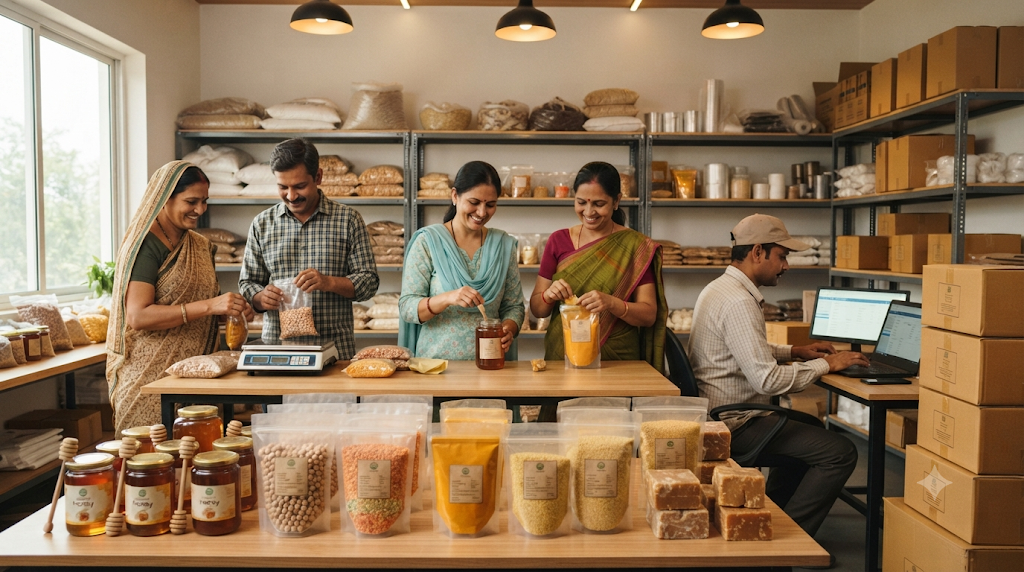
- Good fit: honey, jaggery, spices, millet flour, dry pulses, cold-pressed oils, pickles, papad, dried fruit
- Possible, with care: fresh fruit and vegetables in cities your logistics partner covers quickly
- Poor fit: very perishable items, heavy low-value produce, anything with no standard weight
Value-added products usually carry more margin than raw produce. A packed, labelled product also builds repeat buyers.
Practical Example: How an FPO Can Sell Products Online Through ONDC
Imagine an FPO selling locally made jaggery through an ONDC seller app. In the beginning, it receives limited customer interest because the product has basic packaging and unclear product details. After reviewing customer feedback during the first month, the FPO improves its packaging, adds proper labels, uploads better product photos and starts offering smaller packs.
These small improvements can make the product more appealing to online buyers. The FPO can also monitor customer feedback, delivery issues and order costs to understand what needs improvement.
This shows that selling through ONDC is not just about listing agricultural products online. Good packaging, product quality and customer satisfaction are equally important for building a successful online business.
Costs, Commission and Payments
Ask these questions before registering. The answers differ by seller app and category.
- What commission does the app take on each order?
- Are there listing, onboarding or monthly fees?
- How many days after delivery does payment reach my bank?
- Who pays for returns and damaged goods?
- Who pays when the buyer cancels after I have packed?
Write down the total cost for one order: packing, delivery share, commission and your own labour. Only then set your price.
Many farmers fail here. They compare their ONDC price with the mandi rate and forget packing and delivery costs. A packed product is a different product, so price it accordingly.
How FPOs Use ONDC for Farmers
An FPO is often a better seller than one farmer. It can pool stock, keep a packing area and handle paperwork once for many members.
The ONDC blog on farmer groups expanding business outreach describes how FPOs have used the network. SFAC supports FPOs with onboarding, so ask your FPO’s CEO whether they are registered.
If your FPO is not on ONDC, raise it in the next board meeting. Bring three questions: which products, which seller app, and who will manage orders.
For funding packing units and cold rooms, read our guide on the Agriculture Infrastructure Fund. Digital tools tie into the wider push covered in our post on the Digital Agriculture Mission.
Packaging, Pricing and Delivery
Packing is where most small sellers lose orders.
- Use sealed, food-safe packs with a label showing name, weight, date and your FSSAI number
- Use sturdy outer cartons. A broken jar means a refund and a bad review
- Weigh every pack on a digital scale. Short weight is a complaint
- Take photos in daylight against a plain background
- Keep stock for at least a week of expected orders
For pricing, add your cost of production, packing, delivery share and commission, then add your profit. Check two or three similar listings on a buyer app. If you are far above them, explain why in the description, for example “single-origin”, “stone-ground” or “no added sugar”. Only say what is true.
Delivery time matters. If your logistics partner takes long to reach your area, avoid products with short shelf life.
Mistakes Farmers Make on ONDC
- Listing too many items too early. You cannot keep quality across ten products.
- Ignoring FSSAI. It is a legal need for packed food.
- Wrong weight or price. Customers compare listings in seconds.
- Poor photos. Dark, blurry images lose orders.
- Slow order acceptance. Late acceptance hurts your rating.
- No cost sheet. Without one, you will not know if you are making money.
- Trusting claims of guaranteed income. Nobody can promise it. Walk away from anyone who does.
Honest Limits of ONDC for Farmers
ONDC for farmers will not fix every marketing problem, and you should hear that before you spend money.
- Orders are not guaranteed. A listing with no demand earns nothing.
- Logistics in remote villages can be weak or costly.
- Perishables carry high return risk.
- You compete with large sellers who have better packing and budgets.
- Seller app quality varies. Support in your language may be limited.
- Small farmers may find the paperwork the biggest hurdle.
The honest advice: test with one product, learn the numbers, then grow. If costs eat your profit after three to four weeks, change the product or stop. Do not take a loan to start.
Why Learn ONDC Before 2027
Direct selling is becoming a regular part of how farm products reach cities. Skills like packing, listing and costing carry over to any platform, ONDC or not.
Farmers who learn this now will adjust faster as seller apps improve. We cannot predict how large ONDC will be in 2027, but learning the process costs little.
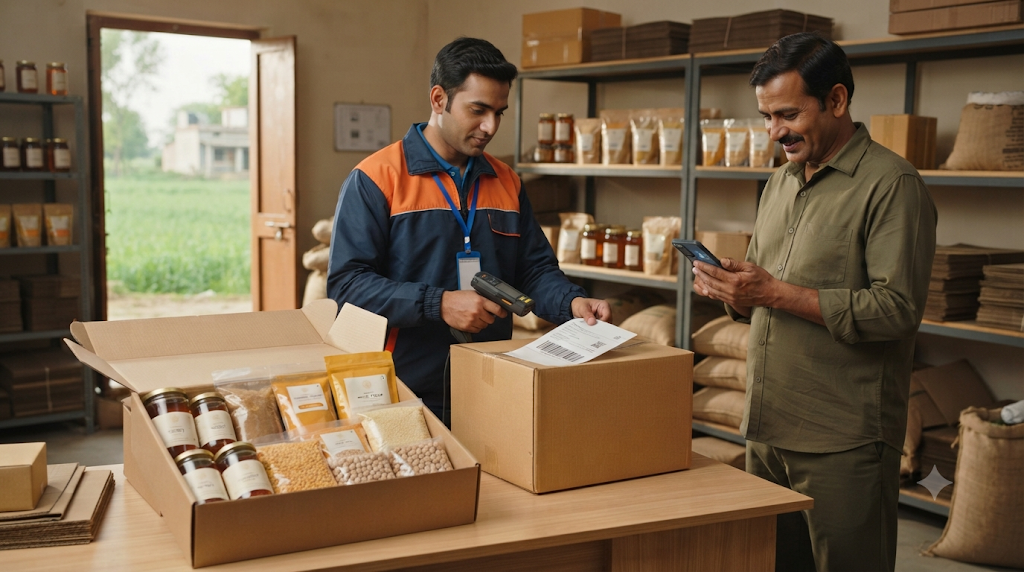
Packed farm products ready for dispatch under ONDC for farmers
FAQs
1. What is ONDC for farmers in simple words?
It is an open network that lets farmers and FPOs sell produce to buyers on many apps through one seller app.
2. Is ONDC an app I can download?
No. It is a network. You use a seller app to join it.
3. Is registration free?
It depends on the seller app. Ask about onboarding, listing and commission charges before you sign up.
4. Which documents do I need?
Aadhaar, PAN, a bank account and address proof are common. Packed food sellers also need FSSAI. Check your seller app for the full list.
5. Can I sell fresh vegetables?
You can, where logistics can deliver fast. Returns and spoilage are the main risks.
6. Is ONDC the same as eNAM?
No. eNAM is for bulk mandi trade. ONDC is mainly for packed products and retail or small business orders.
7. Can an FPO join on behalf of its members?
Yes. FPOs have been onboarded through the SFAC tie-up. Ask your FPO about its status.
8. Who sets my price?
You do. Include packing, delivery share and commission in your cost.
9. When do I get paid?
Timelines differ by seller app. Confirm the payout days before you register.
10. Can I lose money on ONDC?
Yes, if packing, delivery or return costs exceed your margin. Start small and track costs.
11. Can small farmers sell products on ONDC without owning a shop?
Yes. Farmers can sell through an ONDC-connected seller app without having a physical shop. However, they need suitable products, proper documentation and a pickup or delivery arrangement.
12. Can farmers sell organic products through ONDC?
Yes. Farmers can list organic products if they meet the applicable food safety, labelling and organic certification requirements. Any organic claim should be supported by valid certification where required.
13. Can customers from other states buy agricultural products through ONDC?
Yes. Customers from other states can place orders if the seller app and logistics partner support delivery to their location.
14. How can farmers attract more customers on ONDC?
Farmers can improve product photographs, use clear descriptions, offer competitive prices, maintain product quality and pack orders properly. Positive customer experiences can also help build trust.
15. Is ONDC useful for Farmer Producer Organisations (FPOs)?
Yes. ONDC can help FPOs showcase their agricultural and value-added products to customers through multiple buyer apps. It can also support collective selling and wider market access.
Writing
16. Do farmers need a GST registration to sell on ONDC?
GST requirements depend on the type of product, business structure and applicable tax rules. Farmers should check the latest GST requirements and confirm the seller app’s onboarding conditions before registering.
Conclusion
ONDC for farmers gives small sellers a route to city customers without relying on one platform. It rewards good packing, fair pricing and steady quality. It does not reward guesswork.
Start with one product, one seller app and a cost sheet. Join your FPO’s effort if one exists. Read the terms before you sign.
For related guides, see eNAM registration, Farmer ID and the Agriculture Infrastructure Fund.