
The Pashu Kisan Credit Card is a short-term loan card for farmers who rear animals or birds. It lets a dairy, goat, sheep, pig or poultry farmer borrow up to ₹2 lakh for feed, medicines and running costs, with part of the interest paid by the government.
Many livestock farmers still borrow from local lenders when cash runs short. The Pashu Kisan Credit Card is meant to replace that with bank credit at a lower cost. This guide covers who can get it, how much you can borrow, which documents banks ask for, and how to apply in seven steps.
Every number below is tied to a source listed at the end. Where sources disagree, I say so instead of picking one quietly.
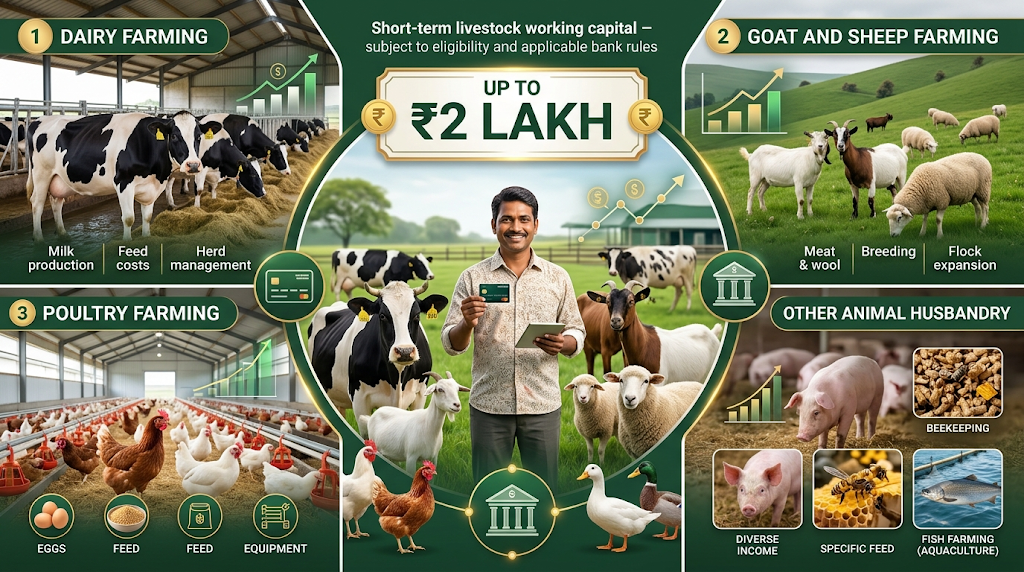
Table of Contents
What Is a Pashu Kisan Credit Card?
Officially, there is no separate scheme with this exact name. The Pashu Kisan Credit Card is the everyday name for the Kisan Credit Card (KCC) facility for animal husbandry and fisheries.
The facility was extended to animal husbandry and fisheries farmers to cover working capital needs. The Reserve Bank of India (RBI) circular dated 26 August 2019 told banks to give these farmers short-term loans up to ₹2 lakh through a separate card, apart from the crop-loan KCC. You can read the RBI master direction yourself.
Indian Bank describes the purpose simply: short-term credit for rearing animals, birds and fisheries. It is working capital, which means money for running costs. It is not meant for buying land or building a large shed.
The revised KCC scheme explained on Vikaspedia builds the card limit on a five-year view. So expect the bank to review your account every year.
How Many Farmers Use It?
A report on Budget 2025-26 said 44.40 lakh KCCs had been issued for animal husbandry and 1.24 lakh for fisheries.
India’s livestock population was 535.78 million animals in the 20th Livestock Census (2019), not counting poultry, as covered in our post on livestock population in India.
Cards are not farmers, and animals are not owners, so I will not calculate a coverage rate. Still, the card count looks small next to the animal count.
Who Can Get a Pashu Kisan Credit Card?
The KCC covers small, marginal and tenant farmers, along with self-help groups (SHGs) and joint liability groups (JLGs), according to a KCC explainer by C4S Courses. Banks decide each case on their own checks.
If you rear animals for milk, meat, eggs, wool or breeding, you fit the purpose of the card. Not sure which group your animals fall in? Read our guides on livestock categories and types of livestock.
I could not open Indian Bank’s full eligibility list. Ask your branch for its checklist instead of guessing, because proof requirements differ from bank to bank.
Two practical points. First, you need a bank account in your own name. Second, a loan already overdue at the same bank can block a new limit, so clear it first.
How Much Can You Borrow on a Pashu Kisan Credit Card?
The limits below come from RBI and press reports. This is the one area where sources disagree.
| What | Limit | Source |
|---|---|---|
| Short-term loan for animal husbandry or fisheries only | Up to ₹2 lakh | RBI, 2019 |
| Interest benefit when you also hold a crop KCC | ₹3 lakh a year overall, with a ₹2 lakh sub-limit for allied-only farmers | RBI circular index |
| Collateral-free limit | ₹2 lakh per borrower from 1 January 2025 (earlier ₹1.6 lakh) | C4S Courses |
| Crop-loan limit under the interest scheme | ₹5 lakh after Budget 2025-26 (earlier ₹3 lakh) | Upstox |
The sources agree on one thing: ₹2 lakh is the key figure for farmers who do only animal husbandry or fisheries. When you hold both a crop card and an animal card, the crop loan gets priority for the interest benefit and the leftover amount goes to allied activities.
They disagree on the Budget 2025-26 change. A Deccan Herald report on the 2025-26 extension says animal husbandry and fisheries-only loans still get the interest benefit up to ₹2 lakh. Another summary says the allied-activity credit limit moved from ₹2 lakh to ₹5 lakh.
I cannot settle this from here. Ask the bank which limit applies to your Pashu Kisan Credit Card and get it in writing.
Interest Rate and Subsidy on a Pashu Kisan Credit Card
The RBI’s 2019 circular gave animal husbandry and fisheries farmers a 2% interest subvention and a 3% prompt repayment incentive (PRI) on short-term loans up to ₹2 lakh. In the claim format banks filed, these loans were disbursed at 7% a year.
Under the Modified Interest Subvention Scheme (MISS), a report says the government gives banks a 1.5% interest subvention and farmers a 3% PRI on loans up to ₹2 lakh for animal husbandry, dairying and fisheries. The cabinet approved continuing MISS for 2025-26, and RBI issued a circular on MISS dated 13 January 2026.
I could not find a confirmed rate for 2026-27. Check the current rate before you sign, because the subsidy decides the real cost of a Pashu Kisan Credit Card.
A Simple ₹2 Lakh Example
This is arithmetic on the 2019 figures, not a promise of today’s rate.
- Borrow ₹2,00,000 at 7% for a year: interest is ₹14,000.
- A 3% PRI on ₹2,00,000 is ₹6,000, returned if you repay on time.
- Net interest is ₹8,000, which works out to 4%.
Put that next to whatever your local lender charges. The gap is the reason to apply.
What You Can Spend a Pashu Kisan Credit Card On
The card is for working capital. Typical uses are:
- Feed, fodder and mineral mixture
- Medicines, vaccination and vet fees
- Labour, water and electricity for the shed
- Day-to-day supplies for milk, egg or meat production
Large costs need other support. A new shed, a new herd or a milking machine usually needs a term loan or a project scheme. The National Livestock Mission pays 50% of project cost as a capital subsidy, as we explained in our earlier post.
If you are still planning a unit, read our guides on dairy farming in India, goat farming in India and pig farming in India.
Documents Needed for a Pashu Kisan Credit Card
This is a common list, not an official one. Ask your branch for its own.
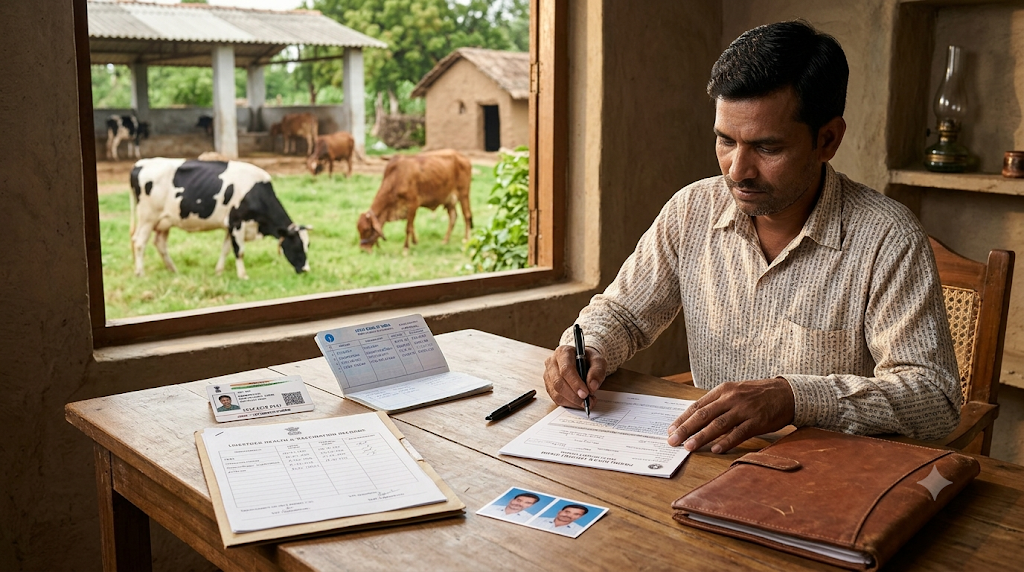
- Identity and address proof (Aadhaar is the usual one)
- Bank passbook or account details
- Passport-size photographs
- Filled KCC application form
- Proof of animals, such as a vet certificate, tag records or a self-declaration, depending on the bank
- Land or lease papers, where the bank asks for them
- SHG or JLG papers, if you apply as a group
Keep photocopies and one set of originals. Names must match across every document.
7 Steps to Apply for a Pashu Kisan Credit Card
Step 1: Check Your Account and Old Loans
Confirm your bank account is active and in your name. Ask whether you already hold a crop KCC, since that changes your overall limit.
Step 2: Record Your Animals
Write down species, number, age and breed. Add milk or egg records if you keep them. A clear record helps the bank judge how much working capital you need.
Step 3: Get a Vet Health Record
Visit the local veterinary officer for a health note or vaccination record. Our guide to livestock insurance in India explains why insured and tagged animals are easier to document.
Step 4: Collect Your Documents
Use the list above and add whatever your branch asks for. Missing papers cause most of the delay.
Step 5: Apply at the Branch
Go to the branch where you hold your account, whether cooperative, regional rural or commercial. Ask for the animal husbandry and fisheries KCC form, and say clearly that you want a Pashu Kisan Credit Card. Some banks also publish the form online.
Step 6: Cooperate With Verification
The bank may visit to count animals and check the shed. Be present, keep records ready and answer plainly.
Step 7: Use the Limit and Repay on Time
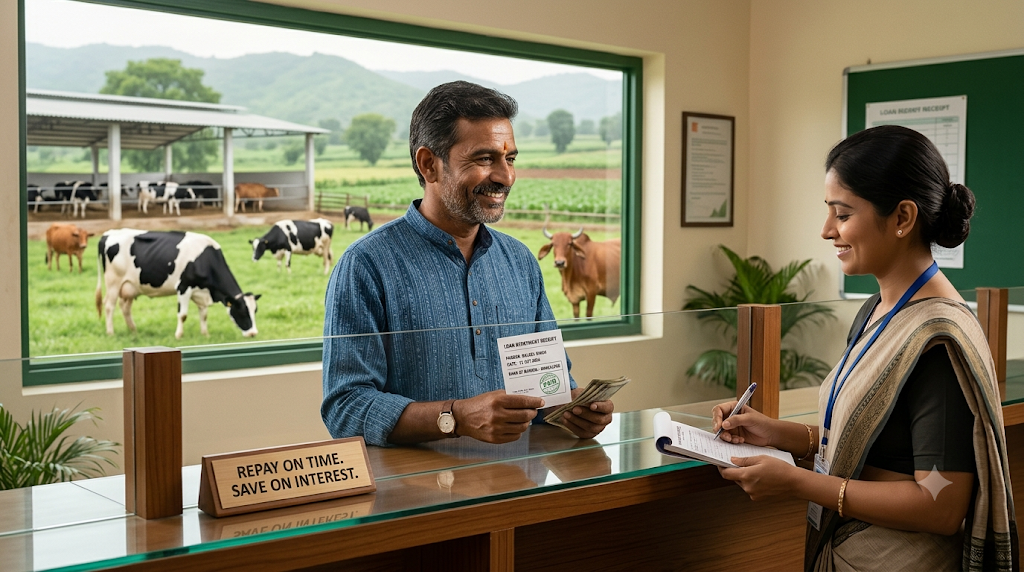
Once sanctioned, draw money only when you need it. Repay by the due date in your sanction letter to qualify for the 3% incentive.
Pashu Kisan Credit Card vs Livestock Insurance vs National Livestock Mission
These three are not alternatives. They cover different risks.
| Tool | What it does | Best for |
|---|---|---|
| Pashu Kisan Credit Card | Short-term credit at subsidised interest | Feed, medicine and running costs |
| Livestock insurance | Pays compensation when an insured animal dies from a covered cause | Protecting the animal’s value |
| National Livestock Mission | Capital subsidy of 50% of project cost | Starting or expanding a unit |
A smart small farmer uses the card for monthly costs, insurance for the animals and a project scheme only when building something new.
Why a Pashu Kisan Credit Card Application Gets Stuck
These are checks, not statistics. I have no data on rejection rates.
- Names on Aadhaar, passbook and application do not match.
- No proof that you actually own the animals.
- An older loan at the same bank is overdue.
- The purpose on the form is vague. Write feed, medicine and running costs.
- You never asked which sub-limit applies, so the sanctioned amount surprises you.
Fix these before you submit, not after the bank returns the file.

Repayment Rules and the 3% Incentive
The 3% PRI is a reward for repaying on time. If you miss the due date in your sanction letter, expect to lose it. Ask the bank how it calculates the due date and whether it can be renewed after annual review.
An Angel One note on the scheme describes collateral-free loans for one year under the earlier limit, so plan for a yearly cycle. Keep every receipt. A written repayment record also makes the next review easier.
Pashu Kisan Credit Card FAQs: 10 Common Questions
What is the Pashu Kisan Credit Card?
It is the popular name for the Kisan Credit Card facility for animal husbandry and fisheries. It gives short-term working-capital loans to farmers who rear animals or birds.
Is it a separate scheme from the Kisan Credit Card?
No. It is the KCC facility extended to animal husbandry and fisheries, as set out in the RBI’s 2019 circular.
How much loan can I get?
Up to ₹2 lakh for farmers involved only in animal husbandry or fisheries. Sources differ on whether a higher allied limit now applies, so confirm with your bank.
Is collateral required?
The collateral-free limit for agricultural loans is ₹2 lakh per borrower from 1 January 2025, subject to the bank’s lending conditions.
What is the interest rate?
The 2019 framework had loans at 7% with a 3% PRI for prompt repayment. The current scheme gives banks 1.5% subvention. I could not confirm the 2026-27 rate, so ask your bank.
Can poultry farmers apply?
Indian Bank describes the card as covering animals, birds and fisheries, so poultry rearing fits the purpose. Eligibility is still decided by the bank.
Can I hold this card along with a crop KCC?
Yes. Your animal husbandry limit then sits within the overall ₹3 lakh limit set in the RBI’s 2019 circular, and the crop loan gets priority for the interest benefit.
Can I use it to buy animals?
It is meant for working capital. Buying animals or building sheds usually needs a term loan or a scheme such as the National Livestock Mission. Ask the bank before using it that way.
How long does approval take?
I could not find an official timeline. It depends on the bank, your documents and verification, so ask the branch for a date in writing.
Where can I find official information?
Start with the RBI circulars linked below, the Department of Animal Husbandry and Dairying at dahd.nic.in and NABARD. Your bank branch has the final word on forms and limits.
Can tenant farmers and landless livestock farmers apply for a Pashu Kisan Credit Card?
Yes. Farmers involved in animal husbandry may be eligible even without owning agricultural land. Tenant farmers, dairy farmers and other livestock rearers can approach a bank, subject to its eligibility checks and required proof of their livestock activity.
Can I apply for a Pashu Kisan Credit Card through a Common Service Centre (CSC)?
You can visit a nearby Common Service Centre (CSC) to ask about application assistance and available banking services. However, application acceptance and loan approval depend on the participating bank.
Can sheep and goat farmers get a Pashu Kisan Credit Card?
Yes. Sheep and goat rearing are allied animal husbandry activities covered under the KCC facility. Eligible farmers can approach their bank for short-term working-capital credit, subject to applicable lending conditions.
Can I use the Pashu Kisan Credit Card to purchase animal feed and medicines?
Yes. The facility is designed to meet working-capital expenses associated with animal husbandry. Farmers can use the sanctioned credit for feed, fodder, medicines, veterinary expenses and other approved day-to-day livestock management costs.
What happens if I fail to repay my Pashu Kisan Credit Card loan on time?
Late repayment can result in additional interest or applicable charges and may affect your eligibility for the 3% prompt repayment incentive. It can also affect future loan renewals. Contact your bank immediately if you are unable to repay by the due date.
Final Word
The card is useful, but only if you ask the right questions: which limit applies, what rate you pay this year, and what the bank needs in writing. Get those three answers before you sign.
For more guides, browse our Livestock category, or see how technology can help with prices and records in agritech apps for farmers.