
Sheep farming in India means raising sheep for meat, wool, manure and breeding stock, mostly on grazing land and crop residue. It works best in dry and semi-arid regions where crops and dairy are risky, and a small flock can start with low capital.
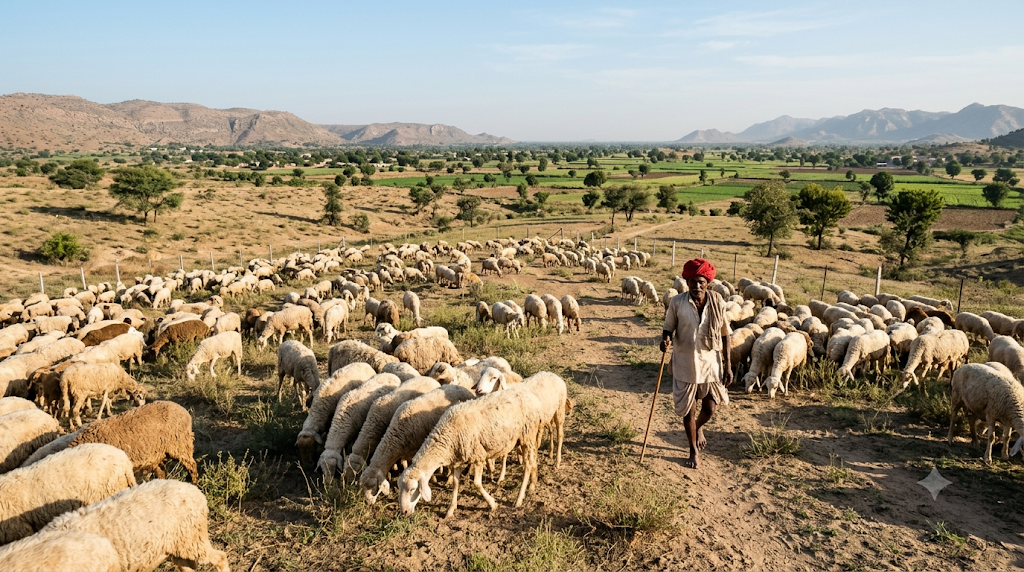
Table of Contents
What Is Sheep Farming in India?
Sheep farming in India is the rearing of sheep as a livestock enterprise. Farmers earn from live animals, mutton, wool, skins, and manure. Milk matters only in a few pockets.
Most flocks are not kept in sheds all day. They walk to grazing land, stubble fields and common pastures, then return to a night enclosure. This is cheaper than dairy, which needs daily fodder, water and milking labour.
Sheep farming in India sits inside the wider small ruminant sector, alongside goats. If you are comparing the two, read our guide on goat farming in India first. The two animals need different feed and handling.
For a broader view of every farm animal category, see our posts on livestock categories and types of livestock.
Why Sheep Farming in India Suits Small Farmers
Sheep farming in India suits small and landless farmers for four practical reasons.
- Low feed bill. Sheep graze on rough pasture, crop stubble and tree leaves that other animals ignore.
- Several income streams. One flock gives lambs for sale, wool where the breed grows it, manure for fields and skins.
- Dry-land fit. In arid and semi-arid areas, rainfall is uncertain and crops fail often. A flock gives income when the crop does not.
- Small units. You can start with a few animals and grow the flock from your own lambs.
The honest downside: sheep farming in India depends on access to grazing land. If you have no pasture, no common land and no crop-residue arrangement with neighbours, feed cost rises fast and the numbers stop working.
Also, sheep are less forgiving than goats on wet ground. Foot problems and worm load rise in damp, low-lying areas. Choose your site before you choose your breed.
Sheep Farming in India by the Numbers
The 20th Livestock Census (2019), published by the Department of Animal Husbandry and Dairying (DAHD), counted 74.26 million sheep in India. That is the latest full census count. You can read the national data on the DAHD website.
An ICAR review of the sector states that India ranks second in the world in sheep population. The review covers breeds, production systems and how the sector has changed over seventy-five years. It is listed in the sources below.
These two facts tell you that sheep farming in India is a large, established sector, not a new trend. They do not tell you that every farmer who starts will earn money. The census counts animals, not profit.
For the wider animal picture, including cattle, buffalo, goat and poultry, see our article on livestock population in India.
Step 1: Choose a Breed for Your Region
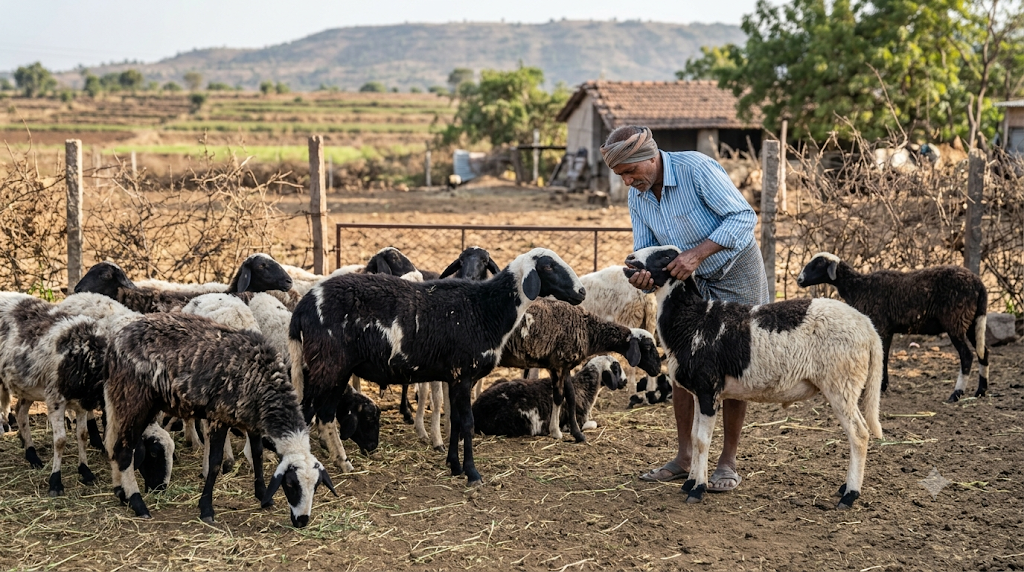
Breed choice is the first big decision in sheep farming in India. A breed that thrives in Rajasthan can struggle in coastal Tamil Nadu.
Indian sheep breeds are usually grouped by region. Tamil Nadu Agricultural University’s agritech portal lists these examples:
- North-western arid and semi-arid region: Chokla, Sonadi, Muzaffarnagri, Jalauni, Hissardale
- Southern peninsular region: Deccani, Pattanwadi, Vembur, Coimbatore, Nilgiri, Ramnad White, Madras Red, Tiruchy Black, Kenguri
- Eastern region: Chottanagpuri
- Northern temperate region: Changthangi
Match the breed to three things:
- Your local climate. Use breeds already common within your district. Local breeds are already adjusted to local heat, feed and disease.
- Your main product. Meat flocks and wool flocks are managed differently. Southern breeds are mostly kept for meat and manure. Northern and north-western breeds are better known for wool.
- Your market. Ask traders and mandi agents which animals sell fastest in your area before you buy.
Do not buy an exotic breed because a video made it look easy. Imported or crossbred animals often need better feed, shelter and vet care than a small farmer can give.
The best source for breed advice is ICAR-Central Sheep and Wool Research Institute and your nearest Krishi Vigyan Kendra. Call them before you buy.
Step 2: Plan Land and Shelter
Sheep farming in India does not need expensive buildings, but sheep do need dry, shaded, safe space.
Grazing land. Check how much grazing is really available through the year, not only in the monsoon. Many first-time farmers plan around green season pasture and run short in summer.
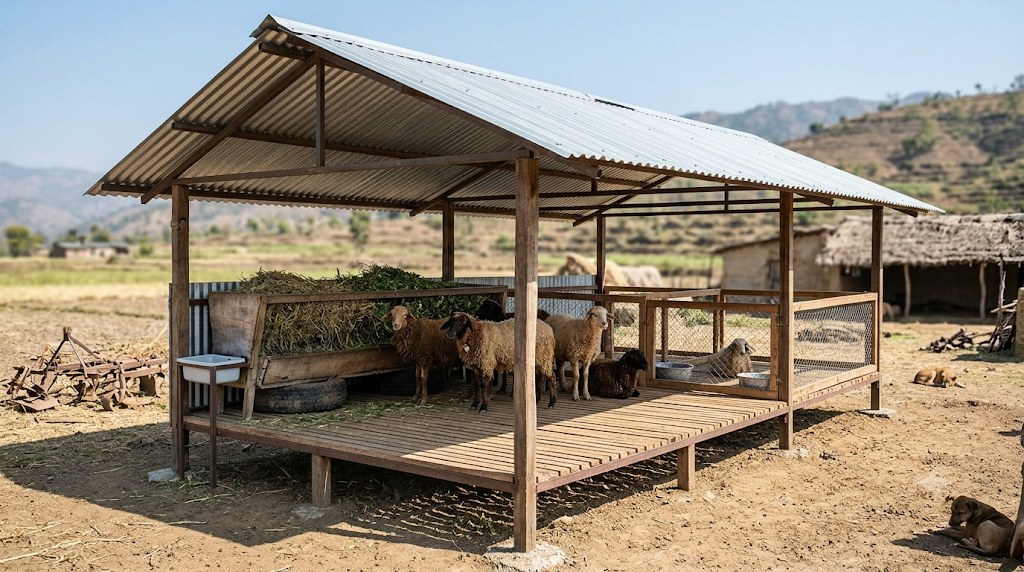
Night shelter. A simple raised, well-drained shed or fenced enclosure is enough in most regions. Keep these points in mind:
- The floor must stay dry. A damp floor causes foot rot and worm problems.
- Provide shade and airflow in summer, and wind protection in cold regions.
- Keep feed and water troughs raised so animals cannot dirty them.
- Build a separate small pen to isolate sick or newly bought animals.
Fencing. Fence against stray dogs and other predators. Predation is a real, regular loss in open-grazing flocks.
If you plan to keep animals under a government subsidy, check the scheme’s shelter norms before building anything. A shed that does not meet the norms can cost you the subsidy.
Step 3: Buy Healthy Foundation Stock
The foundation flock decides your next five years. Buy slowly and inspect carefully.
Look at each animal, not just the breed:
- Bright eyes, clean nose, no discharge
- Smooth walking, no limping
- Good body condition without being fat
- Clean wool or coat with no bald or scabby patches
- For ewes, a well-formed udder with no lumps
Buy from a known breeder, a government farm or a trusted local flock owner. Avoid buying all animals at a crowded weekly market. Crowded markets are where diseases like pox and PPR spread. Our posts on sheep pox and goat pox and foot and mouth disease explain why movement and mixing are the main risk.
Quarantine every new animal in a separate pen for at least two to three weeks, as vets commonly advise, and watch for coughing, diarrhoea, fever or skin lesions before mixing them with your flock.
Start with ewes and one or two good rams, or arrange to borrow a quality ram from a neighbouring flock. Keeping an unrelated ram avoids inbreeding, which lowers lamb survival and growth.
Step 4: Feed and Graze the Flock
Feed is the biggest running cost in sheep farming in India once you leave pure open grazing, so plan it early.
Grazing is the base. Sheep eat grass, herbs and shrubs. Rotate grazing areas so pasture can regrow and parasite load stays low.
Dry fodder and crop residue. Wheat straw, paddy straw, groundnut haulms and similar residues fill the gap in the lean months. Straw alone does not meet protein needs, so supplement it.
Green fodder and tree leaves. Subabul, Sesbania and local fodder trees give protein. Plan a small fodder plot if you can.
Concentrate feed. Pregnant ewes, late-stage ewes with lambs and fattening lambs need extra energy and protein. Use a locally available mix and ask your veterinary officer for a ration that suits your breed and region, instead of copying a mix from a video.
Minerals and water. Give a mineral mixture and clean water daily. Sheep that drink dirty water get sick more often.
Never change feed suddenly. A sudden shift to rich grain can cause digestive problems and sudden deaths. Introduce any new feed over several days.
If you are interested in cutting feed cost further, our guide on hydroponic fodder production explains one option, though it fits dairy better than a grazing flock.
Step 5: Manage Breeding and Lambing
Breeding is where sheep farming in India earns or loses money, because lamb numbers and lamb survival drive income.
Breeding age. Do not breed ewes too young. Wait until they have reached enough body size, usually about a year or more depending on breed and feeding. Your vet can confirm the right age for your breed.
Gestation. A ewe carries lambs for about five months. Mark the breeding date so you know when to expect lambing.
Flush feeding. Give ewes slightly better feed for a few weeks before and during mating. This helps conception and can improve the number of lambs.
Late pregnancy. The last weeks of pregnancy need more energy. Underfed ewes give weak lambs and little milk.
At lambing:
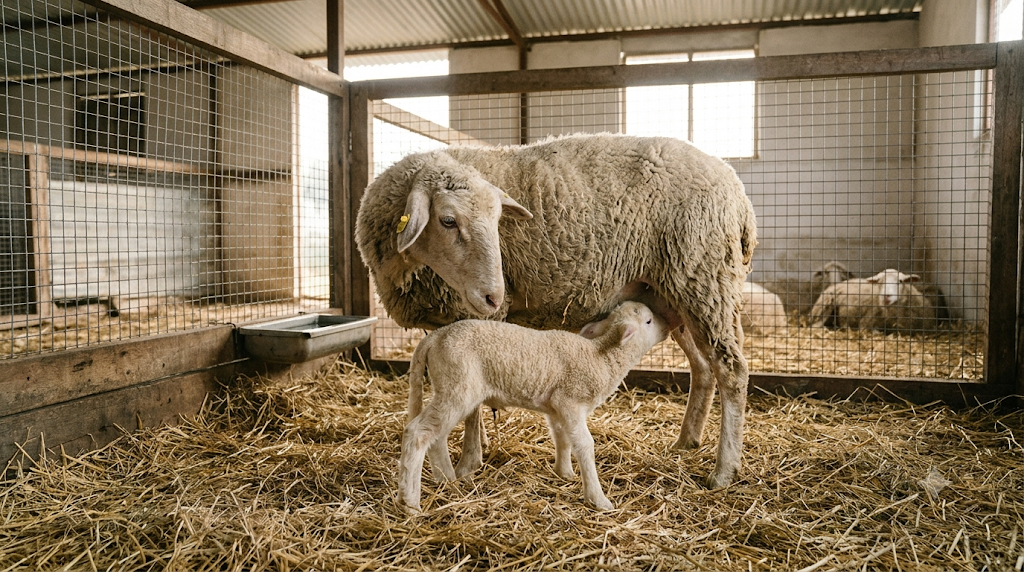
- Keep a clean, dry lambing area.
- Make sure each lamb nurses colostrum, the first milk, within the first hours. Colostrum carries the antibodies a newborn needs.
- Check that the navel cord is dry and clean, and follow your vet’s advice on disinfecting it.
- Watch for ewes rejecting lambs. Help or bottle-feed if needed.
Record keeping. Tag or mark every animal. Write down mating dates, lambing dates, lamb sex, weights and deaths. After a year, records show which ewes pay for themselves and which ones should be sold.
Step 6: Protect Flock Health
Disease losses can wipe out a small flock’s profit in one season. Prevention is cheaper than treatment, so build a health routine from day one in sheep farming in India.
Vaccination. Follow the vaccination calendar of your state animal husbandry department. Vaccines commonly used in sheep include those for PPR (peste des petits ruminants), sheep pox, enterotoxaemia and FMD. Schedules and availability differ by state, so ask at your nearest veterinary dispensary.
Deworming. Internal parasites are a major hidden cause of poor growth and death in lambs. Deworm on a schedule advised by your vet, and rotate pastures. Do not guess drug doses. Wrong dosing causes resistance or poisoning.
External parasites and foot care. Check for ticks, lice and mange. Trim overgrown hooves and keep floors dry to prevent foot rot.
Daily observation. Spend a few minutes each morning looking at the flock. Warning signs include:
- An animal staying away from the group
- Not eating or not chewing the cud
- Nasal discharge, coughing or laboured breathing
- Watery or bloody droppings
- Swelling, skin lumps or blisters
Isolate any sick animal immediately and call a vet. If many animals fall sick together or die suddenly, report it to the veterinary officer without delay. Some of these diseases are notifiable, and fast reporting protects your neighbours’ flocks too.
Our posts on foot and mouth disease and sheep pox and goat pox cover disease control in more detail.
Step 7: Sell Lambs, Wool and Manure
You earn only when you sell, so decide the market before you scale up sheep farming in India.
Live animals and meat. Most income for meat flocks comes from selling lambs at a good market weight. Ask local traders and butchers which weight and age they pay best for. Demand rises around festivals, so plan your breeding so lambs are ready for those weeks.
Wool. Wool breeds are sheared on a regular schedule. Wool income depends heavily on breed, wool quality and nearby buyers. Check whether a state sheep and wool board, a cooperative or a local trader buys wool in your area before you invest in a wool flock.
Manure. Sheep manure is a useful fertiliser. In many regions, farmers pay shepherds to pen the flock overnight on their fields. If you have crop-farming neighbours, ask whether they will pay for penning.
Skins and by-products. Skins fetch lower income than meat or wool, but add a little in places with active hide buyers.
A practical rule: line up at least one regular buyer before your first lambs arrive. Farmers who wait until the animals are ready often sell to the first trader who offers a price, and that is rarely the best price.
Costs and Income: What You Can and Cannot Know
Most websites give a neat table of profit per sheep. I will not do that. Costs and prices change by state, breed, season and even village, and I cannot source a reliable all-India figure.
What I can tell you is where the money goes and where it comes from.
Main costs:
- Purchase of foundation stock
- Shelter and fencing
- Feed, minerals and water
- Vaccines, deworming and vet visits
- Labour for herding, if you are not doing it yourself
- Transport to market
Main income:
- Sale of lambs and culled adults
- Wool, where the breed grows it
- Manure and penning fees
- Skins
To build your own number, get three local quotes for animals, ask two flock owners in your area what they spend on feed and medicine, and ask two traders what lambs sold for in the last season. Then build a cautious plan, assuming some animals will die and some will sell late. If the plan only works in the best case, it is a bad plan.
Government Support for Sheep Farming in India
Several schemes can reduce the cost of starting sheep farming in India. Check current rules before you apply, because guidelines change.
National Livestock Mission (NLM). NLM is a central scheme that gives a capital subsidy of 50% of project cost for eligible livestock units, including small ruminants such as sheep and goats. Our detailed article on the National Livestock Mission explains who can apply and how the process works. The DAHD website lists the current guidelines.
Livestock insurance. Insurance can protect you from the loss of an insured animal due to disease or accident. Read our step-by-step guide on livestock insurance in India before you buy your flock, because most policies require ear tags and a health check at purchase.
Bank finance. Ask your nearest bank or a NABARD-linked branch about loans for animal husbandry. Visit NABARD for scheme information.
State schemes. Many states run sheep distribution, breed improvement and wool support schemes. The best place to ask is your block veterinary office or district animal husbandry department.
Keep every receipt, tag number and bank record. Subsidy claims are rejected most often for missing paperwork, not for bad projects.
Common Mistakes New Sheep Farmers Make
These are the errors that most often sink new flocks in sheep farming in India.
- Buying before checking grazing. Land comes first, animals second.
- Starting too big. A large flock multiplies mistakes. Start small, learn for a year, then grow.
- Wrong breed for the area. Buying a breed you saw online instead of one that suits your district.
- Skipping quarantine. One sick animal from the market can infect the entire flock.
- No vaccination or deworming plan. Treating sick animals is far costlier than preventing disease.
- No buyer lined up. Waiting until animals are ready to find a market.
- No records. Not knowing which ewes perform and which do not.
- Trusting only video claims. Profit figures on social media rarely include losses, deaths or vet costs.
FAQs on Sheep Farming in India
1. Is sheep farming profitable in India?
It can be, mainly where cheap grazing is available and a buyer is nearby. Profit depends on breed, feed cost, lamb survival and market price. It is weaker without grazing land.
2. How much money do I need to start sheep farming in India?
It depends on flock size, breed, shelter and land. Get local quotes for animals, fencing and feed, and ask nearby flock owners for their real costs. Any single national figure online should be treated with caution.
3. Which sheep breed is best for sheep farming in India?
There is no single best breed. Choose a breed native to your region, such as Chokla or Sonadi in the north-west, or Deccani in the southern peninsula, and match it to your market.
4. How many sheep are there in India?
The 20th Livestock Census (2019) recorded 74.26 million sheep in India. A newer census may have updated this, so check the DAHD website for the latest figure.
5. Is sheep farming easier than goat farming?
Neither is easy. Sheep graze more than they browse and are more sensitive to damp ground and worms. Goats browse shrubs and trees more. See our goat farming in India guide to compare.
6. Can I do sheep farming in India without land?
It is difficult. You need grazing access, either your own land, common pasture or an arrangement with crop farmers. Without it, buying all feed usually makes the enterprise uneconomical.
7. What diseases should I worry about in sheep?
Common concerns include PPR, sheep pox, enterotoxaemia, FMD, internal worms and foot rot. Ask your veterinary officer for the vaccination and deworming schedule for your area.
8. Is there a subsidy for sheep farming in India?
Yes. The National Livestock Mission offers a 50% capital subsidy for eligible projects, and many states run their own schemes. Rules and limits change, so verify current guidelines with DAHD or your district office.
9. How long does a ewe carry her lambs?
About five months. Record the mating date so you can prepare the lambing area and extra feed in time.
10. Can sheep farming in India be combined with crop farming?
Yes, and it often works well. Flocks graze crop residue and fallow land, and farmers benefit from manure. Check that your grazing plan does not damage standing crops.
Conclusion
Sheep farming in India works when three things line up: access to grazing, a breed that suits your region and a buyer you trust. Miss any one of them and the plan weakens.
Start small, buy healthy local stock, quarantine every new animal, keep a vaccination and deworming routine and write down your numbers. Check subsidy rules with your district office before you spend.
If you are still deciding between animals, compare this guide with our posts on dairy farming in India and goat farming in India. More livestock guides are in our Livestock category. Read our editorial policy to see how we research and check our articles.