
Types of livestock are the farm animals raised for milk, meat, eggs, wool, draught power and manure, and they fall into a few clear categories that decide your feed, shelter, health risks and income.
Most new farmers choose an animal first and learn its category later. That order is expensive. A goat, a buffalo and a broiler chicken need very different land, water, money and vet support.
This guide sorts the types of livestock in ways you can act on: by species, digestion, purpose and production system. It draws on the 20th Livestock Census, Basic Animal Husbandry Statistics and FAO references, and it flags where the evidence runs out.
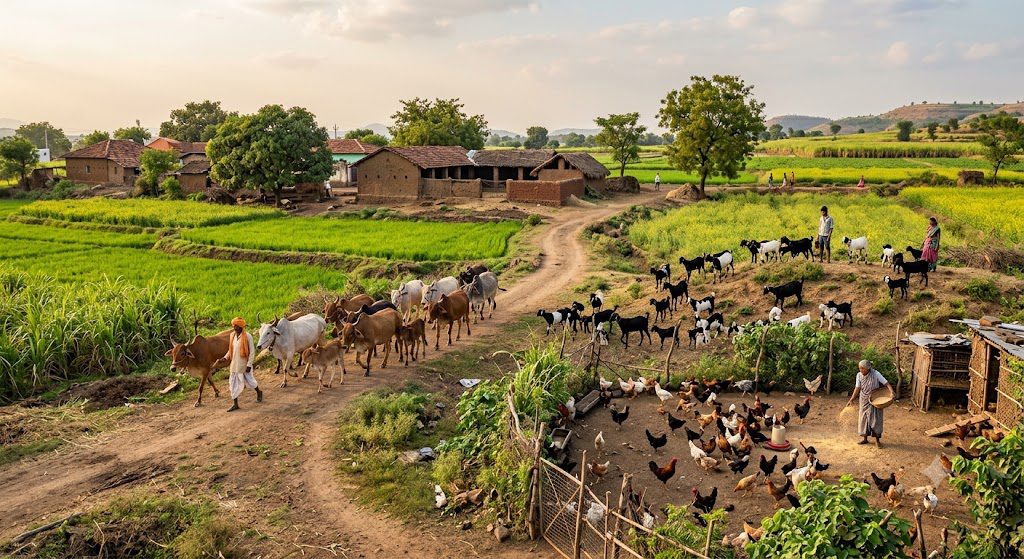
Table of Contents
What Are Types of Livestock?
Livestock are domesticated animals kept in a farm setting for products and services. The products include milk, meat, eggs, wool and hides. The services include field work, transport and manure for crops.
India counted about 536 million livestock in its 20th Livestock Census, according to a summary from the People’s Archive of Rural India. Poultry is counted separately and was far larger, at about 852 million birds.
The census lists cattle, buffalo, yaks, mithun, sheep, goats, pigs, horses, ponies, mules, donkeys, camels, dogs, rabbits and elephants. Not all of these are farm animals in the everyday sense.
In this guide, types of livestock means the animals a farm can realistically raise for income. Fish and honey bees are farmed too, but they follow different rules, so they get only a short mention.
Why Types of Livestock Matter for Indian Farmers
Livestock is not a side business in India. The Department of Animal Husbandry and Dairying data, summarised by Vikaspedia, ranks India first in milk, second in eggs and fourth in meat.
For 2024-25, the same summary reports 247.87 million tonnes of milk, 149.11 billion eggs and 10.50 million tonnes of meat.
Meat also shows how uneven the categories are. A BAHS 2024 summary puts poultry at about 49% of meat output in 2023-24. Buffalo meat followed at about 18%, goat at 15.5%, sheep at 11% and pig at under 4%.
Those totals hide a hard truth. The type of livestock you pick decides the risk you carry. Eggs and chicken turn over in weeks. A buffalo heifer needs years before she earns. Goats breed faster than cattle but pay for damp, crowded sheds.
Knowing the types of livestock before you spend money prevents the most common mistake: buying the wrong animal for your land, water and market.
Types of Livestock by Species: The 7 Main Categories
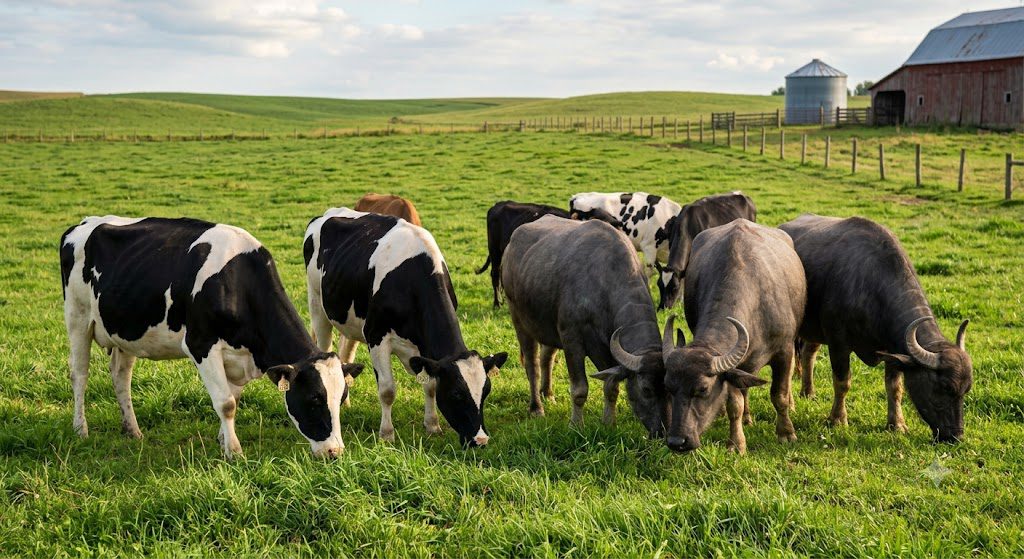
Species is the most common way to sort the types of livestock. These seven categories cover almost every working farm in India.
1. Cattle
Cattle are the all-rounders of Indian farming. They give milk, bullock power for field work, and dung that feeds both soil and biogas plants.
Two groups matter. Indigenous zebu breeds such as Gir, Sahiwal and Red Sindhi tolerate heat and ticks well. Exotic and crossbred animals, built on Holstein Friesian or Jersey blood, give more milk but demand better feed, shade and vet care.
The census recorded 145.91 million cows in 2019, an increase of 18.6% over the previous count.
Crossbreds pay for their higher yield with higher risk. Our guide on heat stress in dairy cattle shows how quickly milk falls in hot weather.
For breeding choices, read our breeding cows guide. For housing, see our cow shelter guide.
2. Buffalo
Buffalo carry a very large share of India’s milk. Murrah, Jaffarabadi, Mehsana and Surti are well-known dairy breeds, and buffalo milk is richer in fat than cow milk.
Buffaloes feel heat badly, so they need clean water for cooling and shade. They also mature slowly, which stretches the gap before a heifer earns anything.
Male calves have little dairy value, but buffalo meat is a major part of national meat output, as the numbers above show.
Feed is the largest running cost for both cattle and buffalo. Our guide on feeding cattle without spending more and our corn silage basics cover practical savings.
3. Goats
Goats are the classic smallholder animal. They need less capital than cattle, breed quickly and eat a wide mix of browse and fodder.
Popular breeds include Jamunapari, Beetal, Barbari, Sirohi, Black Bengal and Osmanabadi.
The 2019 census counted 148.88 million goats, up 10.1% from 2012. Meat is the main income, with some milk from dairy breeds.
Goats are hardy, but they struggle in damp, crowded sheds. PPR (peste des petits ruminants) can cause heavy losses, so keep sheds dry, raised and well ventilated, and vaccinate on your local schedule.
Our guide to sheep pox and goat pox covers another serious threat to small ruminants.
4. Sheep
Sheep give meat, wool and manure, and they suit dry and semi-arid areas where crops often fail. The census counted 74.26 million sheep in 2019, up 14.1%.
Marwari, Magra and Deccani are among the breeds found in different regions. India’s wool output was 33.69 million kg in 2023-24, according to a Drishti IAS summary of the BAHS 2024 report.
Most flocks graze over wide areas. Grazing access and movement routes therefore matter as much as shed design.
5. Pigs
Pigs are the fastest meat producers among the larger animals. Sows have big litters, and pigs turn feed into meat quickly.
The census counted 9.06 million pigs in 2019, about 1.7% of the livestock population. Large White Yorkshire and Landrace are common exotic breeds, and Ghungroo is an indigenous type.
Pig farming works only with strict biosecurity. African swine fever spreads through feed, people and equipment, so read our African swine fever prevention guide before you buy a single piglet.
Market access also decides success. Check that buyers exist within reach before building a shed.
6. Poultry
Poultry is the biggest category by head count. The census recorded 851.81 million birds in 2019, with 317.07 million in backyard flocks and 534.74 million in commercial units.
Broilers are raised for meat and reach market weight in a matter of weeks. Layers produce eggs for much of a year. Desi and backyard birds, ducks, quail and turkeys fill smaller niches.
Returns come fast, and so do losses. Disease and price swings can erase a season’s profit.
Start with our guides on chicken breeding and duck farming.
Bird flu is the main shared risk, so read bird flu prevention for poultry farms and our avian influenza biosecurity guide.
7. Other livestock: horses, camels, mithun, rabbits and bees
This last group is small but real. The census recorded 3.4 lakh horses and ponies, down 45.2%, and 2.5 lakh camels, down 37.1%. Mithun numbers rose 29.5% to about 3.9 lakh.
Markets for these animals are thin, so treat them as niche businesses and not as a default choice.
Our guides on horse breeds and horse breeding cover the equine side.
Bees and aquatic animals sit at the edge of this list. See our bee farming strategies, honey bee farm setup and mud crab farming guide.
| Category | Main income | Speed of returns | Main watch-out |
|---|---|---|---|
| Cattle | Milk, bullock power, dung | Slow to medium | Heat stress, FMD, lumpy skin disease |
| Buffalo | Milk, meat | Slow | Long gap to first calving, heat |
| Goats | Meat, some milk | Medium | PPR, pneumonia, parasites |
| Sheep | Meat, wool | Medium | Pox, parasites, grazing access |
| Pigs | Pork | Fast | African swine fever, market access |
| Poultry | Eggs, meat | Fastest | Bird flu, Ranikhet disease, price swings |
| Other | Draught, honey, niche sales | Varies | Thin markets |
Types of Livestock by Digestive System
Another useful way to group the types of livestock is by how the animal digests feed. This decides what you must buy and what you can grow.
Ruminants have a four-compartment stomach. Cattle, buffalo, goats, sheep, camels, yaks and mithun belong here. They turn fibrous feed such as grass, straw and silage into milk and meat.
Monogastrics have a single stomach. Pigs, poultry, rabbits and horses belong here. Pigs and poultry need concentrate feed that is rich in grain and protein.
FAO notes that landless monogastric systems depend on feed brought in from outside the farm. That separates feed decisions from farm production, according to the FAO classification of livestock production systems.
| Feature | Ruminants | Monogastrics |
|---|---|---|
| Examples | Cattle, buffalo, goats, sheep | Pigs, poultry, rabbits |
| Main feed | Green fodder, straw, silage | Grain-based concentrate |
| Can use farm-grown roughage | Yes | Limited |
| Cash pressure | Fodder land and labour | Feed bills |
The practical lesson is simple. If you own fodder land, ruminants use it well. If you do not, a monogastric business can turn into a feed-purchasing business, which sits at the mercy of grain prices.
Newer feed options are emerging too. Read our guide on insect protein for livestock feed for what the evidence says so far.
Types of Livestock by Purpose
Farmers also group the types of livestock by what they produce. One animal can serve several purposes, so these groups overlap.
- Dairy: cattle, buffalo and dairy goats
- Meat: broilers, goats, sheep, pigs, buffalo
- Eggs: layers, ducks and quail
- Fibre: sheep for wool
- Draught: bullocks, camels, donkeys, horses
- Manure and biogas: every species, especially cattle
Dual-purpose thinking improves income. A goat gives meat, a little milk and manure. A dairy cow gives milk and a calf.
Some farms now push this idea further. In the United States, dairy farmers cross cows with beef bulls so that male calves earn more. Our guide on beef-on-dairy crossbreeding explains how it works and where the limits lie.
For a broader view of how these groups fit into one subject, see our overview of animal husbandry and its types.
Types of Livestock by Production System
FAO also sorts livestock by how the farm is run. The FAO production systems review names three main groups: grazing, mixed farming and industrial systems.
Grazing systems depend on pasture and rangeland. FAO reports that they supply only about 9% of global meat, so they matter more for livelihoods than for volume.
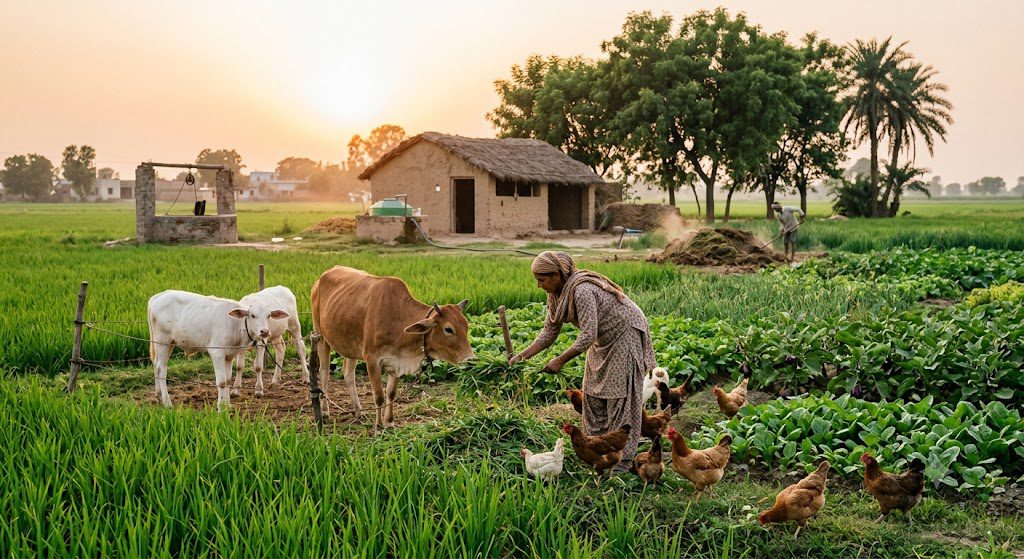
Mixed farming systems integrate crops and livestock on the same farm. Animals eat crop residues, and manure goes back to the soil. This is the default model for most Indian smallholders.
Industrial systems cover large, confined units. Both pig and poultry production and some ruminant production use this model, and it relies heavily on purchased feed.
Technology is now entering the industrial end. Our guides on precision livestock farming and robotic milking systems show what that looks like and what it costs.
How to Choose the Right Types of Livestock for Your Farm
There is no single best animal. There is only the best fit for your land, water, money, skills and market. Work through these seven checks in order.
- Fodder: Do you own or reliably buy green fodder and dry roughage?
- Water: Is clean water available all year, including summer?
- Capital: How long can you pay costs before income starts?
- Market: Who will buy your product, and how far away are they?
- Vet access: Is a veterinarian or vaccination team within reach?
- Labour and skill: Who will check animals every day?
- Climate: Can the animal handle your heat, cold and humidity?
Here is a simple starting guide. Treat it as a prompt for discussion with your vet, not a prescription.
| Your situation | Types of livestock worth considering |
|---|---|
| Small land, small capital | Goats, backyard poultry |
| Irrigated land with fodder | Dairy cattle or buffalo |
| Dry rangeland | Sheep, goats, camels |
| Close to a city with steady buyers | Layers, broilers (with strict biosecurity) |
| Grain surplus and a pork market | Pigs (with strict biosecurity) |
Start small and learn. A few animals teach you more than a big loan does.
Government Support for Types of Livestock Farming
The National Livestock Mission supports entrepreneurship in some of the types of livestock. According to a DAHD document, its scope includes sheep, goats, pigs, poultry and fodder development, and livestock insurance sits within it.
A DAHD schemes booklet describes capital subsidy of 50% up to set limits for sheep and goat breeding units, with money routed through SIDBI.
Two cautions apply. First, unit sizes and subsidy ceilings have been revised more than once, so read the latest guidelines before you plan a project. Second, the guidelines I found covered 2021-22 to 2025-26, so confirm the current status with DAHD or your state animal husbandry department.
Cattle and buffalo breeding support falls under separate DAHD programmes. Ask your district veterinary office which one applies to you.
Health and Biosecurity Across Types of Livestock
Each category has its own disease priorities. Learn the top one or two for your animals before you buy.
| Category | Disease priority | Our guide |
|---|---|---|
| Cattle and buffalo | Foot-and-mouth disease, lumpy skin disease | FMD in cattle, lumpy skin disease |
| Sheep and goats | Pox, PPR | Sheep pox and goat pox |
| Pigs | African swine fever | ASF prevention |
| Poultry | Avian influenza | Bird flu prevention |
Species do not always stay in their lanes. FMD affects cattle, buffalo, sheep, goats and pigs, so a mixed farm needs mixed protection.
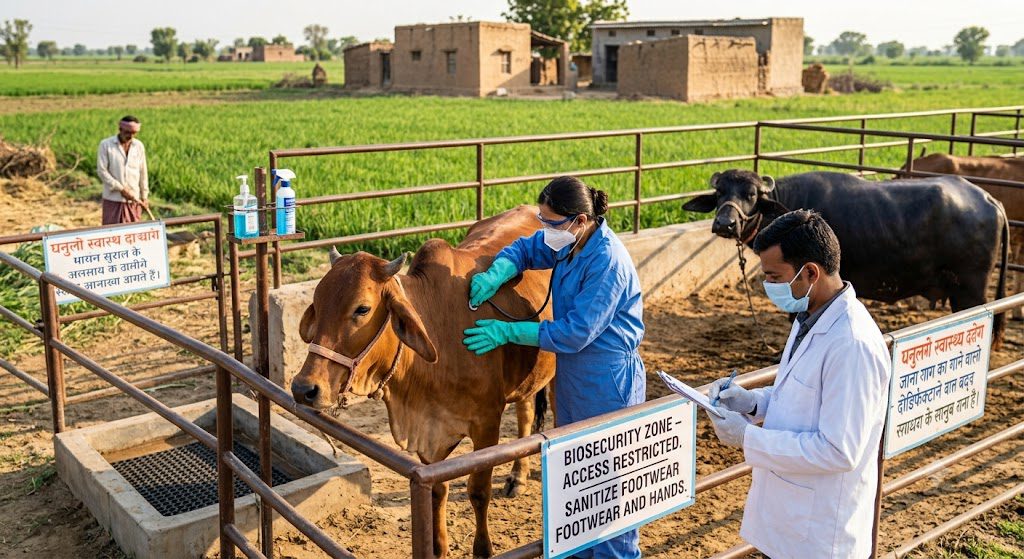
Five habits protect almost every category:
- Isolate new animals for at least two weeks.
- Limit visitors, vehicles and shared equipment.
- Clean first, then disinfect with the right product.
- Report blistering, sudden deaths or unusual illness at once.
- Follow your local vaccination schedule and keep records.
5 Common Mistakes When Choosing Types of Livestock
- Buying before planning feed. An animal without fodder is a cost, not an asset.
- Copying a neighbour’s choice. Their land, water and buyers may differ from yours.
- Mixing species without biosecurity. Disease moves between groups.
- Ignoring the cash gap. Slow-return animals can drain savings before income arrives.
- Skipping vet contact. Find your vet before the first animal arrives, not after the first illness.
What We Still Do Not Know
The 20th Livestock Census is still the last full species-wise count I could verify. The 21st census was launched on 25 October 2024, according to a PIB document. I could not confirm published national results at the time of writing, so numbers here may shift.
There is also no single official list of livestock categories. Census species, FAO production systems and trade classifications all differ.
Profitability varies too much by state, season and market to quote one honest income figure. This guide deliberately avoids per-animal profit claims.
Questions to Ask Your Vet Before You Buy
- Which diseases are most common in my block for this species?
- Which vaccines are due, and when is the next campaign?
- What housing and water setup do I need?
- Which breeds suit my climate and feed?
- What does a realistic first-year cash plan look like?
Write the answers down and keep them with your farm records.
Frequently Asked Questions
1. What are the main types of livestock?
The main types of livestock are cattle, buffalo, goats, sheep, pigs and poultry. Horses, donkeys, camels, mithun, rabbits and yaks form a smaller group.
2. What are the types of livestock found in India?
India’s census covers cattle, buffalo, yaks, mithun, sheep, goats, pigs, horses, ponies, mules, donkeys, camels, dogs, rabbits and elephants, with poultry counted separately. Cattle, buffalo, goats, sheep, pigs and poultry matter most for farm income.
3. What is the difference between livestock and poultry?
Poultry means domesticated birds such as chickens and ducks. The census counts them separately from other livestock, but in everyday farming poultry is usually treated as one of the types of livestock.
4. Which livestock is most profitable?
No category wins everywhere. Returns depend on your feed cost, market, disease control and skill. Compare at least two options using local prices and talk to your vet before you decide.
5. Which types of livestock are ruminants?
Cattle, buffalo, goats, sheep, camels, yaks and mithun are ruminants. They have a four-compartment stomach and digest fibrous feed such as grass and straw.
6. What are monogastric livestock?
Monogastric livestock have a single stomach. Pigs, poultry, rabbits and horses are examples. They need concentrate feed that is high in grain and protein.
7. Which livestock needs the least investment?
Goats and backyard poultry are commonly chosen for low starting costs. Even so, shelter, vaccination and feed still need a budget, so plan before you buy.
8. Are bees and fish counted among the types of livestock?
They are farmed animals, but the livestock census does not list them with the main species. Their housing, feed and rules differ, so treat them as separate enterprises.
9. Can I raise different types of livestock on one farm?
Yes, and mixed farming is common. Keep species in separate housing, control movement between groups and watch for diseases that cross species, such as FMD.
10. Does the government help with starting livestock farming?
The National Livestock Mission supports entrepreneurship in sheep, goats, pigs, poultry and fodder, with livestock insurance included. Check current guidelines and eligibility with DAHD or your state animal husbandry department.
Key Takeaways
- Types of livestock can be grouped by species, digestion, purpose and production system.
- Cattle, buffalo, goats, sheep, pigs and poultry are the six core species.
- Ruminants use farm-grown roughage, while pigs and poultry depend on bought feed.
- Pick the animal that fits your fodder, water, cash and market, not the one your neighbour chose.
- Learn each category’s top disease risk before you buy.
- Confirm current scheme rules with DAHD before planning around a subsidy.