
Livestock categories in India fall into seven groups: cattle, buffalo, goat, sheep, pig, poultry and other animals such as camel, horse and yak. Farmers choose between them by what the animal earns: milk, meat, eggs or draught power.
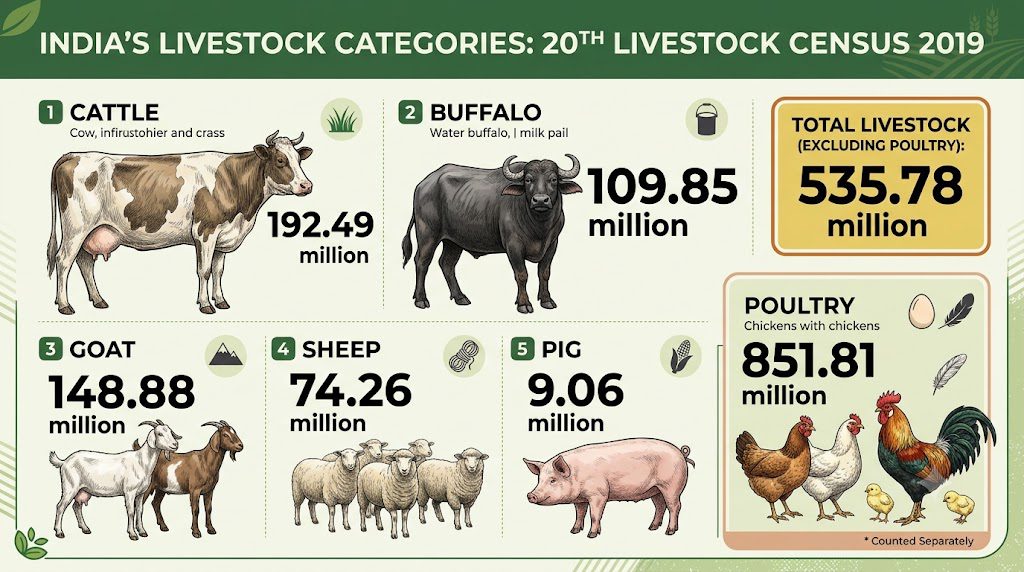
Cattle lead with 192.49 million animals in the 20th Livestock Census (2019). Goats follow at 148.88 million, then buffalo at 109.85 million.
This guide sorts the livestock categories by species and by purpose, then shows how a smallholder can pick one. Every number comes from the 2019 census or DAHD data already used in our livestock population in India article.
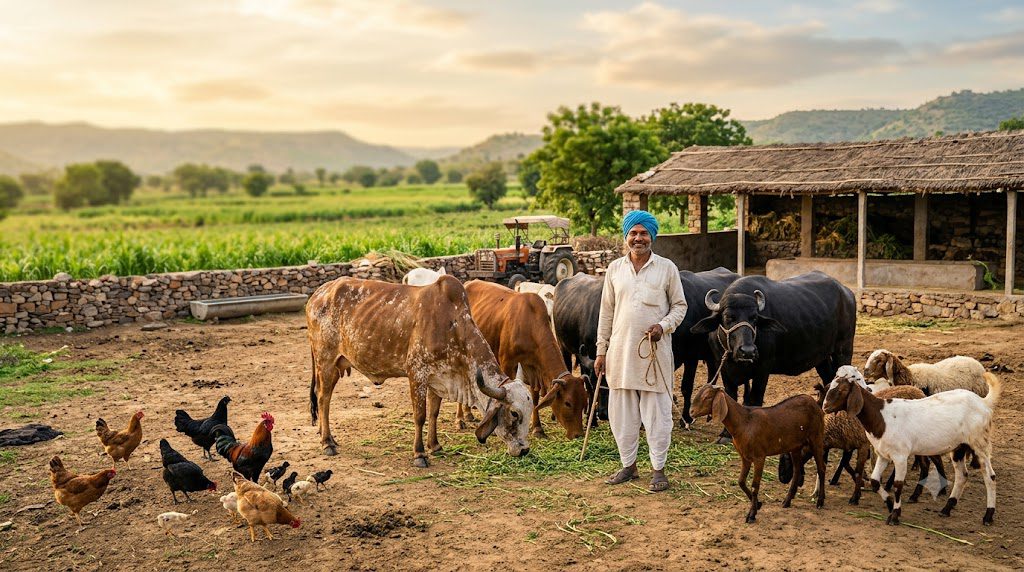
Table of Contents
What Livestock Categories Mean in Indian Farming
Livestock categories are the groups used to sort farm animals, first by species and then by purpose.
The government counts animals by species. Farmers sort them by what the animal earns. A buffalo is a species to the census and a milk business to the farmer. Both views matter, so this guide uses both.
This post is a companion to our types of livestock guide. That post explains the species. This one helps you decide which group fits your land, money and market.
We follow our editorial policy. We use verified numbers only, and we say so when data is missing.
Livestock Categories at a Glance: The Census Table
The table below shows the main groups from the 20th Livestock Census (2019).
| Category | Head count (million) | Change vs 2012 | Main use |
|---|---|---|---|
| Cattle | 192.49 | -0.8% | Milk, draught, manure |
| Buffalo | 109.85 | +1.0% | Milk |
| Goat | 148.88 | +10.1% | Meat, milk |
| Sheep | 74.26 | +14.1% | Meat, wool |
| Pig | 9.06 | -12.03% | Meat |
| Total livestock | 535.78 | +4.6% | Excludes poultry |
| Poultry | 851.81 | +16.8% | Eggs, meat |
DAHD puts the bovine group (cattle, buffalo, mithun and yak) at 302.79 million. Goats and sheep together cross 223 million.
Notice the direction of change. The small animals grew and the large ones stayed flat or fell. The census counts heads. It does not say why numbers moved, so treat any reason as a reading, not a finding.
Cattle: The Largest Group of Farm Animals
Cattle are the biggest group at 192.49 million, and the count fell 0.8% from 2012. Fewer bullocks are needed as tractors spread.
A cattle herd serves three jobs:
- Milch animals: indigenous and crossbred cows kept for milk.
- Draught animals: bullocks for ploughing and carting.
- Young stock: calves and heifers, which cost money to feed before they earn.
Cattle suit farmers who already have fodder, a nearby milk buyer and a vet within reach. They do not suit a farmer who needs cash in a few weeks.
Young stock is where beginners lose money. You feed the calf for a long time before it gives anything back, so budget for that gap before you buy.
Read about foot and mouth disease and brucellosis in cattle before adding animals to any herd.
Buffalo: The Milk-Value Group
Buffalo stand at 109.85 million. The count rose 1.0%, the only large bovine group to grow.
Buffalo milk is richer in fat than cow milk, so dairies often pay more per litre for it. That price gap is why many North Indian dairy farmers choose buffalo.
The trade-off is cost. Buffalo need more water, a cooling arrangement in summer, and often a longer gap between calvings.
Do not pick buffalo only because the milk price looks good. Check your water supply first. A buffalo without water access in peak summer loses condition fast.
For a full milk-business plan, start with our dairy farming in India guide.
Goat and Sheep: The Small Ruminants
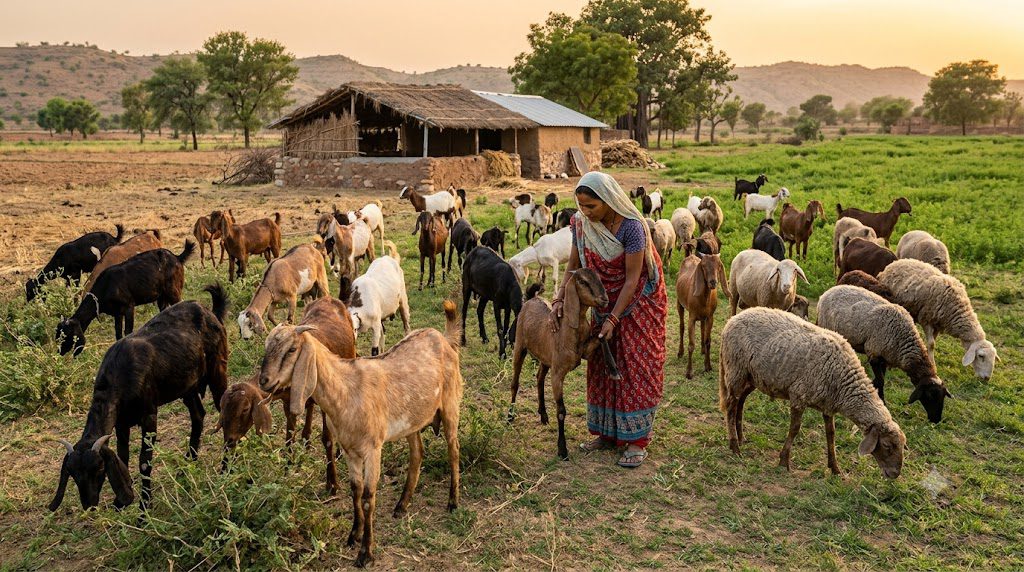
Goats number 148.88 million, up 10.1%. Sheep number 74.26 million, up 14.1%. Both grew faster than total livestock.
Small ruminants keep growing because the entry cost is low, they breed quickly, and meat demand stays steady. A goat costs a fraction of a crossbred cow, so it is the first animal many landless households buy.
Goat: works for meat, and also for milk in some systems. It suits small plots and low capital.
Sheep: works best where grazing land exists, usually in drier regions. Sheep also give wool.
Disease is the main loss in this group. Sheep pox and goat pox remain a live concern; see our post on sheep pox and goat pox. For setup steps, read goat farming in India.
Pig and Poultry: Fast-Turnover Animals
Pigs are only 9.06 million, and the count fell 12.03% from 2012. Pig keeping is concentrated in a few regions and communities, so national numbers stay small.
Poultry is the largest group by head count: 851.81 million birds, up 16.8%. It is not added to the 535.78 million livestock total.
Birds turn over fast. A broiler batch is measured in weeks, while a cow’s payback is measured in years.
That speed is also the risk. One disease outbreak or one bad feed price swing can wipe out a batch margin.
Pig and poultry both need strict hygiene, tight feed cost control and a buyer lined up before you start. Without a buyer, a fast animal only means a fast loss.
Other Livestock Categories: Horse, Camel, Yak and More
The census also counts horse, pony, mule, donkey, camel, yak and mithun. These animals are few in number but matter in specific regions.
- Horse, pony, mule, donkey: transport and carrying loads, mostly in hills and rural areas.
- Camel: dry-region transport and, in some places, milk.
- Yak and mithun: high-altitude and hill-state animals. DAHD counts them in the bovine group.
You will rarely pick one of these livestock categories as a business unless you live where the market for them already exists.
The 21st Livestock Census, launched on 25 October 2024, covers 16 species. It is the first to count pastoral livestock and pastoral communities. We could not verify a final national table, so the 2019 numbers remain our reference. Check the DAHD website for the release.
Livestock Categories by Purpose: Milk, Meat, Eggs and Draught
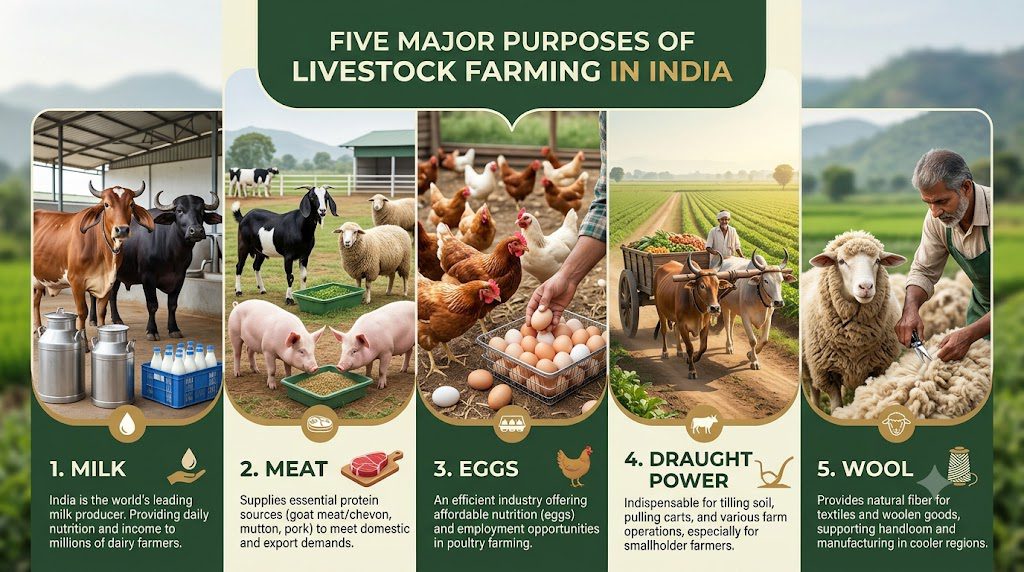
Species is one way to sort animals. Purpose is the other, and it is closer to how farmers decide.
| Purpose | Animals that serve it | What to check first |
|---|---|---|
| Milk | Cattle, buffalo, goat | Nearby collection point, fodder |
| Meat | Goat, sheep, pig, poultry | Local demand, disease control |
| Eggs | Poultry | Feed cost, biosecurity |
| Draught | Bullock, buffalo, donkey, mule, camel | Whether machines already replaced the work |
| Wool | Sheep | Grazing access, buyer |
DAHD’s 2025 review slides give these all-India output estimates:
| Product | Latest estimate | Growth over previous year |
|---|---|---|
| Milk | 239.30 million tonnes | 3.78% |
| Eggs | 142.77 billion | 3.18% |
| Meat | 10.25 million tonnes | 4.95% |
Output is growing even where cattle numbers are flat. That points to more yield per animal, not only more animals.
A smaller herd of better animals can out-earn a large herd of weak ones.
How to Choose Between Livestock Categories on Your Farm
Head counts tell you what is common. They do not tell you what suits your land. Use this table as a starting filter.
| Your situation | Group to look at first | Main risk |
|---|---|---|
| Some land, steady water, near a milk collection point | Buffalo or crossbred cow | High feed and vet cost |
| Little or no land, low capital | Goat | Disease and kid mortality |
| Dry region, grazing access | Sheep | Pox, parasites, market access |
| Small yard, want quick cash | Backyard poultry | Disease outbreaks |
| Cultural and market access for pork | Pig | Disease control, local demand |
Before you buy any animal, answer three questions:
- Where will I sell?
- How far is the nearest vet?
- What will feed cost me per day?
If you cannot answer all three, you are not ready to buy. That is not a harsh view. It is the most common reason small units close.
Feed is the cost beginners underestimate most. Our guide on hydroponic fodder production covers one way to lower it.
Disease Risks Across Animal Groups
Every group has its own disease risks, and a head count does not protect any of them. Vaccination and early vet contact do.
- Cattle and buffalo: foot and mouth disease and brucellosis.
- Goat and sheep: pox and parasites.
- Pig and poultry: fast-spreading outbreaks where hygiene slips.
Keep new animals apart from your herd for some days before mixing them. Ask your vet for the local vaccination schedule rather than copying one from another state.
Government Support by Category
Central support is routed through DAHD. The National Livestock Mission offers a capital subsidy of 50% of project cost for eligible units, which we explain in full in that article.
Dairy farmers can use the National Dairy Development Board for cooperative and milk-marketing information. For breed and research material, the Indian Council of Agricultural Research publishes guidance on indigenous breeds.
Scheme rules and subsidy rates change. Confirm current terms with your district animal husbandry office before you invest.
Mistakes Farmers Make When Choosing Animals
- Treating poultry as part of the 535.78 million. It is counted separately.
- Using old numbers as current. The 2019 census is the last complete national count we can confirm.
- Assuming growth means profit. More goats in India does not mean your goat unit will earn well.
- Ignoring the local market. A group that sells well in one district can be unsellable in the next.
- Skipping vaccination. Animals do not stay healthy because the census counted them.
You can browse every article in our Livestock category.
FAQs: Livestock Categories
1. What are the main livestock categories in India?
The main livestock categories in India are cattle, buffalo, goat, sheep, pig, poultry and a small group of other animals such as horse, camel and yak. The 20th Livestock Census (2019) counts all of them. Poultry is reported separately from the 535.78 million livestock total.
2. Which of the livestock categories is largest in India?
Cattle are the largest counted group at 192.49 million in the 2019 census. Goats are second at 148.88 million, and buffalo third at 109.85 million. Poultry has the highest head count overall at 851.81 million birds, but it is reported separately.
3. Is poultry counted with other livestock?
No. The census reports poultry as a separate figure. India had 851.81 million birds in 2019, while the livestock total was 535.78 million animals. Keep the two numbers apart when you read or quote data.
4. Which animal group grew fastest between 2012 and 2019?
Poultry grew fastest at 16.8%. Sheep rose 14.1% and goats rose 10.1%. Buffalo rose 1.0%. The census records the growth but does not explain the cause, so do not assume growth means higher profit.
5. Which groups declined between 2012 and 2019?
Cattle fell 0.8% and pigs fell 12.03%. Total livestock still rose 4.6% over the same period, because small ruminants and buffalo grew.
6. Which category is best for a small farmer with little land?
Goats are the usual first choice when land and capital are limited, since the entry cost is low. Backyard poultry suits a small yard and quick cash. Both carry disease risk, so confirm vet access and a buyer before you start.
7. What is the difference between large and small ruminants?
Cattle and buffalo are large ruminants. Goats and sheep are small ruminants. Small ruminants cost less to buy and breed quickly, while large ruminants need more feed, water and capital but serve the milk market.
8. Why is buffalo preferred for milk business in some regions?
Buffalo milk is richer in fat than cow milk, so dairies often pay more per litre. The trade-off is higher water needs, summer cooling and often longer gaps between calvings. Check your water supply first.
9. Does government support differ across livestock categories?
Support runs through DAHD, and the National Livestock Mission offers a 50% capital subsidy of project cost for eligible units. Terms and eligibility change, so confirm current rules with your district animal husbandry office.
10. Where can I find the latest livestock numbers?
Check the Department of Animal Husbandry and Dairying at dahd.gov.in. It publishes census updates and production data. Before using any figure in a loan or project plan, check the reporting year so old data is not presented as current.
11. What factors should farmers consider before starting a livestock business?
Farmers should consider available land, water supply, fodder availability, initial investment, veterinary services and local market demand. They should also calculate daily feeding costs and identify potential buyers before purchasing animals.
12. Which livestock animals are mainly raised for meat production in India?
Goats, sheep, pigs and poultry are commonly raised for meat production. The choice depends on regional food preferences, animal availability, rearing conditions and access to local markets.
13. What is the importance of livestock farming for rural households?
Livestock farming provides milk, meat, eggs, manure and other useful products. It also creates additional livelihood opportunities and helps rural households diversify their agricultural activities.
14. Why is fodder availability important when selecting a livestock category?
Fodder availability directly affects animal health, productivity and feeding expenses. Cattle and buffalo require regular supplies of green fodder and dry feed, while goats and sheep can use different grazing resources. Farmers should assess local feed availability before selecting an animal group.
15. How can farmers reduce disease risks in different livestock categories?
Farmers can reduce disease risks through timely vaccination, regular veterinary check-ups, clean housing, proper nutrition and quarantine of newly purchased animals. Maintaining hygiene and following the vaccination schedule recommended by a local veterinarian can help protect the herd or flock from common infectious diseases and prevent major financial losses.
Conclusion: Livestock Categories
Livestock categories are a starting point, not a business plan. Cattle and buffalo serve milk, goat and sheep serve low-cost meat, pig and poultry turn over fast, and the other animals serve specific regions.
Pick the group that matches your land, water, cash, and market. Then check feed cost, vet access, and your buyer before buying a single animal.