
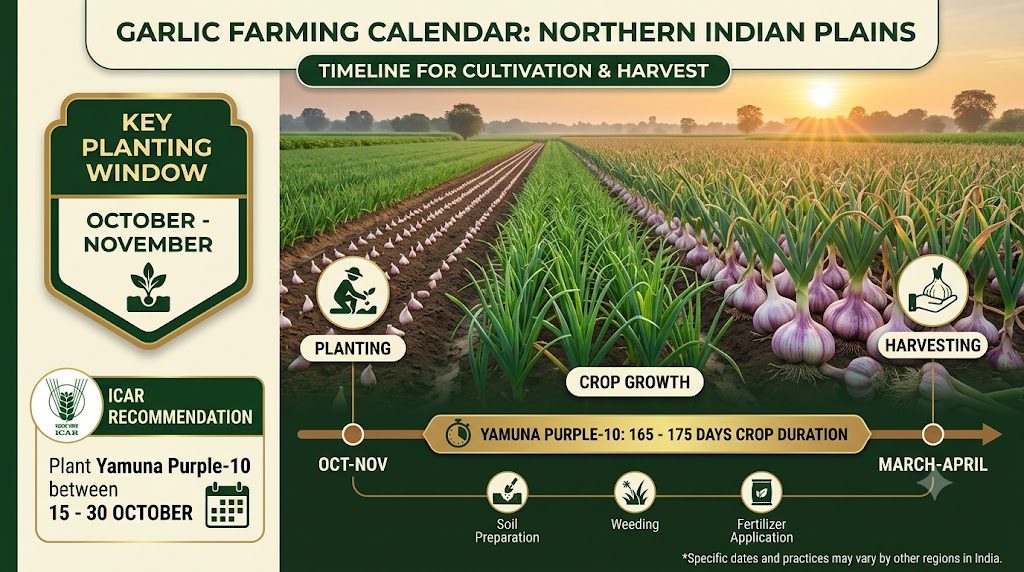
Garlic farming in the north Indian plains starts with planting cloves in October–November on well-drained loam, at about 15 × 10 cm spacing. ICAR’s Yamuna Purple-10 is recommended for planting between 15 and 30 October and is ready in 165–175 days.
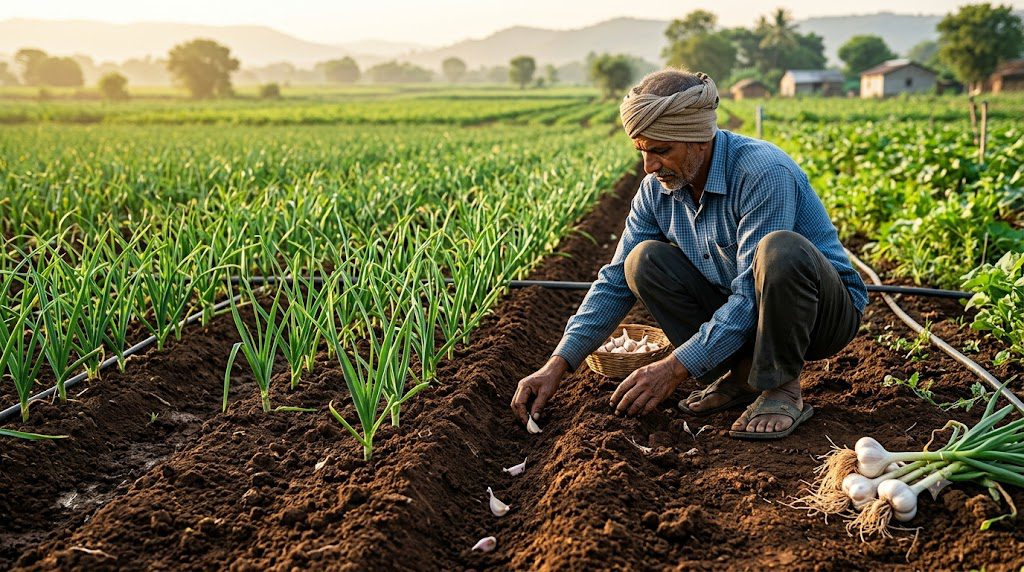
Table of Contents
What Is Garlic Farming and Is It Right for Your Land?
Garlic farming is the cultivation of lehsun (Allium sativum) from cloves, as a cool-season rabi crop. You plant a clove, not a seed, and you dig a bulb about five to six months later.
It competes for land and water with other rabi crops. If you are still choosing, read our guides on mustard farming, chana farming and lentil farming first. The full list is in our post on the names of rabi crops.
According to Krishi Jagran, more than half of India’s garlic comes from Gujarat and Madhya Pradesh. That shows where the crop is strongest. It does not mean it fails elsewhere, but talk to local growers before you plant.
Ask yourself three things before you start:
- Do I have water for light, regular irrigation until the bulbs form?
- Does my field drain well after rain or irrigation?
- Can I buy clean seed cloves from a source I trust?
If any answer is no, fix that first. Garlic farming is not forgiving. The same Krishi Jagran guide says thrips alone can cause up to 50 percent yield loss when not controlled.
Best Time for Garlic Farming in India
In the northern plains, sow garlic in October–November. The exact date depends on your region, soil and local climate.
For Yamuna Purple-10, ICAR recommends planting on 15–30 October. A trial in the Malwa region of Madhya Pradesh found that sowing on 30 September gave significantly better growth and bulb yield than later dates. A separate planting-date and spacing study found yield fell significantly with delayed planting, especially at close spacing.
What this means for you: do not drift into December because wheat sowing ran late. Late garlic farming costs yield. Ask your Krishi Vigyan Kendra (KVK) for the sowing window for your district and variety. A date that suits Malwa may be wrong for the hills.
Soil and Land Preparation for Garlic Farming
Garlic roots are shallow, only 5–8 cm deep according to ICAR’s Indian Horticulture. So the top layer must be loose, fertile and well drained.
- Soil type: Loam with good drainage. Krishi Jagran gives a soil pH of 6.0–7.5 and says bulbs do not develop well in sandy, loose soil.
- Organic matter: ICAR advises well-rotten FYM at 20 tonnes per hectare, or vermicompost at 5 tonnes per hectare, mixed in at field preparation. Per acre, that works out to roughly 8 tonnes of FYM or 2 tonnes of vermicompost.
- Raised beds: ICAR notes that drip and sprinkler irrigation on raised beds works well for garlic. Beds also help water drain away.
- Crop history: A Kenyan extension article in Standard Media advises against planting garlic where onion-family crops grew recently. Rotation reduces disease carry-over.
Get a soil health card before you buy fertiliser. Our guide shows how to read it. If you want lower-input options, see our zero budget natural farming guide.
Garlic Varieties for Indian Farmers
Variety sets your yield ceiling and your storage life. These are the names you will meet most often:
- Yamuna Safed (G-1) and Yamuna Safed 1–4: In a spacing trial, G-1 gave the highest yield, 98.23 quintals per hectare, at 10 × 10 cm.
- Yamuna Purple-10: ICAR reports harvest in 165–175 days, average bulb yield of about 18–20 tonnes per hectare, good keeping quality and high tolerance to purple blotch and Stemphylium blight. Twenty bulbs weigh 650–750 g.
- G-41 and G-50: BigHaat lists them among improved varieties. I could not verify their yield figures, so ask your KVK.
The yield numbers above do not agree, and that matters. A 2020 Yamuna Safed trial recorded 50–70 q/ha at close spacing and 40–50 q/ha at wider spacing. Krishi Jagran quotes 100–200 q/ha for long-day varieties. ICAR’s 18–20 t/ha equals 180–200 q/ha. Variety, soil, season and management explain the gap. When you budget, use the lowest figure, not the highest.
How to Choose Seed Cloves for Garlic Farming
Pick large, healthy, disease-free cloves. Separate them from the bulb just before sowing, not days earlier. Buy from a KVK, a State Agricultural University outlet or a seed seller you can return to. Do not plant kitchen-grade garlic from the mandi if you do not know the variety.
I could not verify a standard seed rate per acre across sources. It changes with variety and clove size, so ask your KVK and weigh a sample of cloves before ordering.
How to Plant: Spacing and Method in Garlic Farming
Good garlic farming depends on correct spacing and clove orientation. The method is simple.
- Prepare the bed and level it so water does not stand.
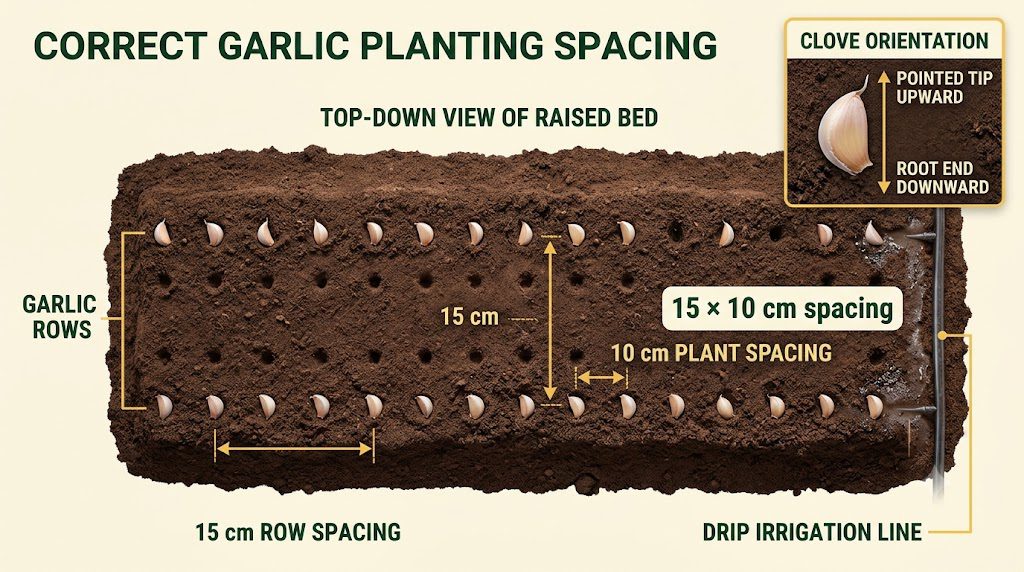
- Plant each clove root end down and tip up.
- Follow the spacing for your variety. ICAR recommends 15 × 10 cm for good-quality bulbs of Yamuna Purple-10.
- Cover lightly with soil.
- Irrigate straight after sowing.
- Mulch if you can. Standard Media notes mulch stops roots heaving out, suppresses weeds and holds moisture.
Spacing is a trade-off. The 2020 trial found the closest spacing (10 × 10 cm) gave the highest yield per hectare, while wider spacing gave stronger individual plants. ICAR’s 15 × 10 cm is a sensible middle for most smallholders who want saleable bulb size.
Fertiliser Plan for Garlic Farming
Garlic is a heavy feeder. ICAR’s recommendation for Yamuna Purple-10, per hectare, is:
- 120 kg nitrogen
- 50–80 kg phosphorus (P2O5)
- 50–60 kg potash (K2O)
- 30 kg sulphur
Per acre, divide by about 2.47: roughly 49 kg N, 20–32 kg P2O5, 20–24 kg K2O and 12 kg sulphur. These are trial recommendations for one variety, so match them to your soil test.
ICAR also reports that foliar sprays of 1% 19:19:19 at 30, 45 and 60 days after planting, and 13:46 at 75, 90 and 105 days, improve yield and quality. Zinc, boron and sulphur also help. A spacing and nitrogen study applied nitrogen as urea at 30 and 45 days after sowing, which supports splitting the dose rather than applying it all at once.
In garlic farming, over-feeding nitrogen late can push leaf growth at the expense of bulbs. I could not verify an exact cut-off day, so ask your KVK. For newer input options, read our post on nano fertilizer.
Irrigation in Garlic Farming
Because roots stay shallow, garlic needs light, regular watering rather than a few heavy ones.
- Give the first irrigation immediately after sowing.
- Irrigate properly when the cloves (bulbs) are forming, Krishi Jagran stresses.
- Prefer drip or sprinkler on raised beds, as ICAR notes.
I could not verify one standard irrigation gap in days, because it depends on soil, weather and bed type. Ask your KVK. A practical rule from growers: check the top 5 cm of soil by hand. If it is dry, irrigate. If it is wet, wait. Waterlogging invites rot, which is the bigger risk in garlic farming than a one-day delay.
Weeds, Thrips and Diseases in Garlic Farming
Garlic competes badly with weeds because its roots and leaves are small. Mulch and timely hand weeding protect the crop.
Thrips. This is the pest to watch. Krishi Jagran says uncontrolled thrips can cause up to 50 percent yield loss. Walk the field weekly, check leaf bases and inner folds, and act early.
Diseases. The ones named in the sources are purple blotch, Stemphylium blight and white rot. ICAR reports Yamuna Purple-10 is highly tolerant to purple blotch and Stemphylium blight. Standard Media says white rot is a fungus that may attack garlic in cool weather.
I am not giving spray doses here. Product choice and dose depend on your district and label. Use only products registered in India, follow the label, and confirm with your KVK or plant protection officer. Rotation, clean seed and good drainage reduce disease pressure before you spend on chemicals.
Harvest, Curing and Storage
Garlic farming does not end when you dig. Poor curing ruins good bulbs.
- When to harvest: ICAR reports Yamuna Purple-10 is ready in 165–175 days. Across sources, the sign is the same: most leaves turn brown.
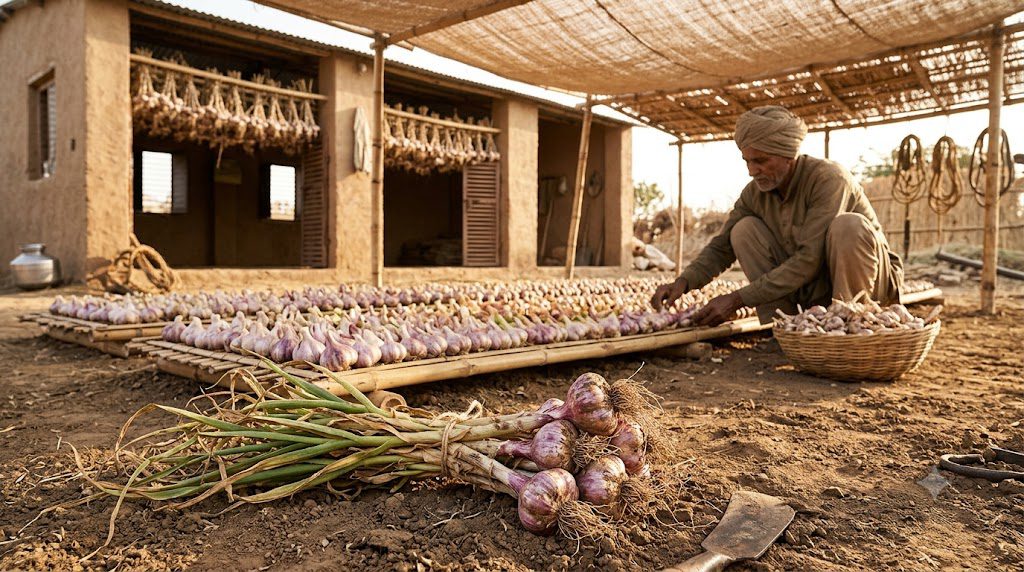
- How to harvest: Loosen the soil and lift the bulbs. Do not pull them by the tops.
- Curing: Dry bulbs in a shaded, airy place. A Kenyan guide suggests about a month of curing and up to six months of shelf life for well-cured bulbs. Indian conditions differ, so treat that as a reference, not a rule.
- Storage: ICAR describes Yamuna Purple-10 as having good keeping quality. Store only dry, undamaged bulbs.
Cost, Yield and Income from Garlic Farming
I could not find a verified per-acre cost of cultivation for India from an official source, so I will not invent one. Here is how to work it out yourself.
Step 1: Yield. ICAR’s 18–20 t/ha is about 7.3–8.1 tonnes per acre. The 2020 trial’s 50–70 q/ha is about 2.0–2.8 tonnes per acre. Plan on the lower end.
Step 2: Costs. Add seed cloves, FYM, fertiliser, irrigation, labour for planting, weeding and harvest, plant protection, and transport.
Step 3: Price. Check the current price on e-NAM or your local mandi. Garlic prices move a lot between seasons, so use a conservative figure.
Step 4: Net. Yield × price − all costs. If the net is thin at the low yield, start with a smaller plot.
That last test is the honest one. Many first-time garlic farming plans look good only at the best yield and the best price.
Government Support Garlic Farmers Should Check
If you borrow for garlic farming, a Kisan Credit Card is the usual route for crop loans. Read our guide on crop insurance for farmers and ask your bank or agriculture office whether garlic is notified in your district for the season. I could not verify this, and it varies by state.
Many schemes now ask for a digital identity, so complete your Farmer ID registration before you need it.
Common Mistakes in Garlic Farming
- Planting late and losing yield.
- Using unknown cloves with no variety name.
- Planting in a field that stays wet.
- Skipping the soil test and guessing fertiliser.
- Ignoring thrips until the damage is visible.
- Budgeting on the highest yield figure.
- Storing bulbs before they are fully cured.
Frequently Asked Questions about Garlic Farming
1. What is the best time for garlic farming in India?
In the northern plains, October–November. ICAR recommends 15–30 October for Yamuna Purple-10. Confirm your local window with your KVK.
2. How many days does garlic take to grow?
ICAR reports 165–175 days for Yamuna Purple-10. Other varieties differ.
3. Which garlic variety is best for small farmers?
Yamuna Safed and Yamuna Purple-10 are documented in ICAR and trial sources. The best variety is the one your KVK confirms suits your district.
4. What spacing should I use?
ICAR recommends 15 × 10 cm. A trial found 10 × 10 cm gave the highest yield per hectare.
5. How much fertiliser does garlic need per acre?
ICAR’s per-hectare figures convert to roughly 49 kg N, 20–32 kg P2O5, 20–24 kg K2O and 12 kg sulphur per acre. Adjust using a soil test.
6. How much water does garlic need?
It needs light, regular irrigation because roots are only 5–8 cm deep. Irrigate right after sowing and during bulb formation. Ask your KVK for the interval.
7. How much yield can I expect per acre?
Sources range from about 2.0–2.8 tonnes per acre (2020 trial) to 7.3–8.1 tonnes per acre (ICAR). Budget on the low end.
8. Is garlic farming profitable for small farmers?
It can be, but profit depends on yield, price and cost, and I found no verified Indian cost figure. Do the four-step calculation above with your own numbers.
9. Which pest damages garlic the most?
Thrips. Krishi Jagran says they can cause up to 50 percent yield loss if uncontrolled.
10. How long can garlic be stored?
A Kenyan guide says well-cured garlic can last up to six months. ICAR describes Yamuna Purple-10 as having good keeping quality. Your result depends on curing and storage conditions.
11. How much seed garlic is required per acre?
The seed requirement depends on the garlic variety, clove size and planting spacing. Choose healthy, disease-free cloves and confirm the recommended seed rate with your local Krishi Vigyan Kendra (KVK).
12. Which soil is best for garlic farming?
Well-drained loamy soil with good fertility is suitable for garlic farming. A soil pH of around 6.0–7.5 is generally preferred. Avoid fields with poor drainage, as excess moisture can increase the risk of bulb rot.
13. How can farmers control thrips in garlic crops?
Inspect garlic leaves regularly, especially near the leaf bases and inner folds. Maintain proper crop hygiene, manage weeds and seek local agricultural advice if an infestation develops. Use only approved plant protection products according to their labels.
14. When should garlic be harvested?
Garlic is generally ready for harvesting when most leaves begin turning yellow or brown and the bulbs have matured. Yamuna Purple-10 takes approximately 165–175 days, according to ICAR. Harvest timing varies by variety and growing conditions.
15. How can farmers improve the storage life of garlic bulbs?
Harvest mature bulbs carefully, remove excess soil without damaging them and cure them in a shaded, well-ventilated area. Store only dry, healthy bulbs in a cool, dry and well-ventilated place. Proper curing and storage help reduce spoilage and extend shelf life.
Conclusion: Start Garlic Farming Small
Garlic farming pays when timing, drainage, clean seed and thrips control are right, and it punishes shortcuts. Plant in the October–November window, use ICAR’s 15 × 10 cm spacing as your starting point, test your soil, and budget on the low yield figure. Try a small plot first, record every cost, and scale next season. For more rabi options, browse the Farming category.