
The National Livestock Mission (NLM) is a central government scheme that pays 50% of the project cost, as a capital subsidy, to individuals, FPOs, SHGs and companies that set up poultry, sheep, goat, pig or fodder units. You apply on the NLM Udyami Mitra portal, and the subsidy goes to your bank, not to you.
Most farmers hear “50% subsidy” and stop reading. That is where the problems start. This subsidy is tied to a bank loan, it is released in two parts, and it is paid after you have already spent money. This guide covers the numbers, the conditions and the traps.
Table of Contents
What Is the National Livestock Mission?
The National Livestock Mission started in 2014-15 under the Department of Animal Husbandry and Dairying (DAHD), part of the Ministry of Fisheries, Animal Husbandry and Dairying. The Cabinet approved a realigned version in 2021-22. The current design focuses on entrepreneurship and genetic upgradation for sheep, goats, pigs, poultry and fodder.
The stated aims are more jobs, more entrepreneurs and higher productivity per animal. The target outputs are meat, goat milk, eggs and wool.
One timing point matters. State government notices describe the scheme period as 2021-22 to 2025-26. That window has technically passed. An August 2026 news report still describes the 50% capital subsidy as active, but you should confirm on the portal whether the National Livestock Mission is accepting fresh applications in your state before you start any paperwork.
A related scheme, the Animal Husbandry Infrastructure Development Fund (AHIDF), also exists to bring private investment into the sector. It is separate from NLM.
National Livestock Mission Sub-Missions Explained
The scheme has three sub-missions:
- Breed Development of Livestock and Poultry. This is where the subsidy for breed multiplication farms sits. It covers poultry, sheep, goat and piggery. States also receive support for breed-improvement infrastructure.
- Feed and Fodder Development. This supports fodder seed, silage and fodder from degraded land. It also includes entrepreneurship in fodder seed processing.
- Innovation and Extension. This includes research, extension work and livestock insurance.
If you are new to the animal categories behind these headings, our guide on types of livestock explains which animals are raised for which output. Fodder is the most overlooked sub-mission. Feed is the biggest running cost on almost every livestock unit, so a silage or fodder seed project can be a smarter entry point than another goat shed.
Who Can Apply for the National Livestock Mission
Official state notices list these applicant types:
- Individuals
- Farmer Producer Organisations (FPOs)
- Joint Liability Groups (JLGs)
- Self-Help Groups (SHGs)
- Farmer Cooperative Organisations (FCOs)
- Section 8 companies
A Nagaland government notice adds a useful detail: more than one adult member of the same family can apply, provided each meets the eligibility criteria.
You will also be asked for an experience or training certificate showing earlier livestock work. MyScheme lists this for the piggery component. If you have never kept animals, get training first. A Krishi Vigyan Kendra is the usual place. Our guide on Kisan Sarathi explains how to reach KVK scientists for advice.
Check the activity list. Official notices describe the entrepreneurship component as covering rural poultry, sheep and goat, piggery, and feed and fodder. Plain dairy cattle is not on that list. If your plan is a dairy unit, the National Livestock Mission is probably the wrong door. Start with our dairy farming in India guide and look at dairy-specific schemes instead.
National Livestock Mission Subsidy Limits by Activity
The headline rate is 50% of the project cost. The ceiling changes by activity.
| Activity | Subsidy rate | Maximum subsidy | Source |
|---|---|---|---|
| Piggery entrepreneurship | 50% | ₹30 lakh | MyScheme |
| Rural poultry breed development | 50% | ₹25 lakh per unit | MyScheme |
| Horse, donkey, mule, camel | 50% | ₹50 lakh | PIB-linked Cabinet approval |
| Fodder seed processing infrastructure | 50% | ₹50 lakh | PIB-linked Cabinet approval |
| Sheep and goat breeding farm | 50% | Check the project component in the guideline | State EOI notices |
I am not stating a sheep and goat ceiling because I could not confirm it from an official page during research. Read the project-component document on the portal before you draw up your cost sheet.
For rural poultry, the central government gives the 50% subsidy for a parent farm, rural hatchery and mother unit with a minimum of 1,000 parent layers.
A worked example (arithmetic only, not a real project). Say an approved piggery project costs ₹40 lakh. Fifty percent is ₹20 lakh, which is under the ₹30 lakh cap. If the project cost ₹80 lakh, half would be ₹40 lakh, but the subsidy stops at ₹30 lakh. The extra cost is yours.
How the Subsidy Is Paid
This section decides whether the scheme works for you.
The subsidy is a one-time capital subsidy. It is paid in two equal instalments, and SIDBI routes the money to your lender, not to you.
- First 50% of the subsidy. It is released after the bank releases the first loan instalment and confirms this to the State Implementing Agency.
- Second 50% of the subsidy. It is released after the project is complete and verified by the State Implementing Agency.
For piggery, MyScheme also states that the entrepreneur must provide a bank guarantee valid for three years for the project cost beyond the subsidy amount.
What this means in plain words: you need a bank that believes in your project, and you need enough working money to get through the build. The subsidy reduces the loan burden after the fact. It does not fund the start.
What the Subsidy Does Not Cover
MyScheme states clearly that no subsidy is given for:
- Land purchase
- Rent or lease of land
- Working capital
- Personal vehicles
Working capital is the one that hurts. Feed, medicine and wages for the first months come from your pocket or a separate loan. Add that cost to your plan before you apply, not after.
Eligible costs, per the piggery page, include infrastructure, breeding animals, transportation, insurance and equipment.
How to Apply for the National Livestock Mission Online
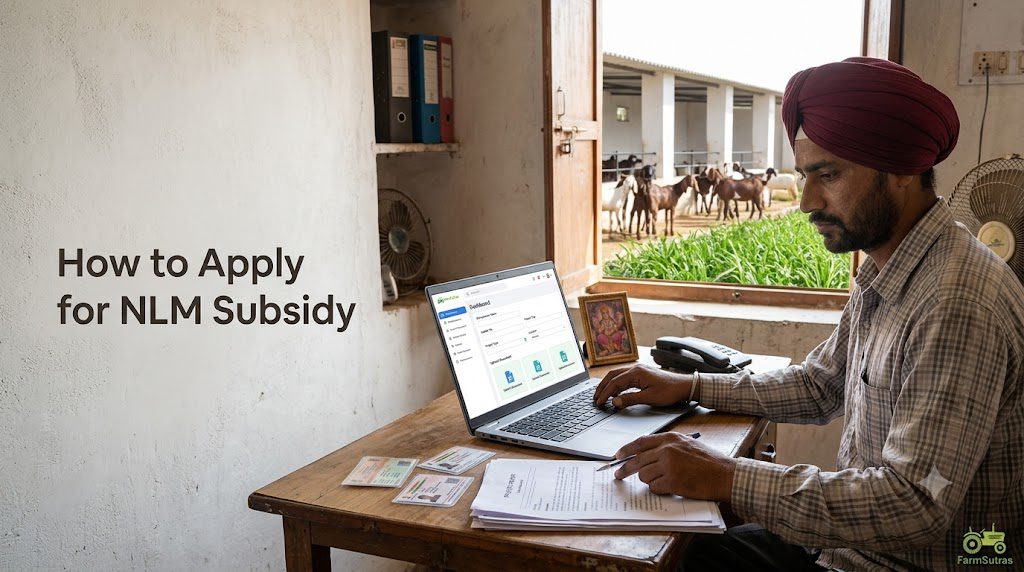
Applications go through one portal: nlm.udyamimitra.in. Several state notices confirm this. Follow these steps.
- Check your state notice. Your State Implementing Agency (usually the animal husbandry directorate) issues the Expression of Interest. It lists the projects open to you and the documents needed.
- Register on the portal and log in as an applicant.
- Choose your project type, such as rural poultry, sheep and goat, piggery or fodder.
- Prepare a project report. Kerala’s animal husbandry department publishes sample project reports for goat and sheep, pig, rural poultry and feed and fodder. Use them to see the expected level of detail.
- Upload your documents. These include identity proof, project details and an experience or training certificate.
- Wait for scrutiny. A selection committee evaluates applications. Incomplete ones can be marked not interested or sent back.
- Bank sanction. Eligible applications are forwarded to lenders. The bank decides on the loan.
- Subsidy release follows the two-instalment process above.
Do not pay anyone to “guarantee” selection. The official route is the portal and your State Implementing Agency. If someone on social media asks for money to get you approved, treat it as a red flag.
Livestock Insurance and Kisan Credit Card
Livestock insurance sits inside the Innovation and Extension sub-mission. A summary of the Cabinet approval reports that the farmer’s premium share was cut to 15% as part of simplifying the insurance programme. Confirm the current share with your State Implementing Agency, because the share can differ by category and state.
An August 2026 report on the livestock sector says Kisan Credit Card coverage for livestock keepers has jumped threefold. If you keep animals but have no KCC, ask your bank about a livestock KCC. It can fund working capital, which is exactly what the capital subsidy does not cover.
Which Project Fits Your Farm
Pick the project based on what you can manage, not on the largest subsidy ceiling.
- Goats. Goat units suit small land and low entry cost. Read our goat farming in India guide for breeds and shed basics.
- Sheep. For dryland and shepherding communities, see sheep farm growth.
- Poultry. The rural poultry component needs a parent farm of 1,000 layers or birds, so it is a bigger commitment than a backyard flock. Our poultry farming guide covers the basics.
- Pigs. Disease risk is the main issue. Read African swine fever prevention in pigs before you borrow a rupee.
- Fodder. Feed costs decide profit. See hydroponic fodder production and our guide on animal nutrition and cattle feed.
Whatever you pick, plan for disease. A single outbreak can erase a year of margin. Read about FMD in cattle and brucellosis in cattle to understand how losses build up, even if your project is not cattle.
Five Mistakes to Avoid
- Treating the subsidy as startup money. It is paid in two parts, after the lender and the State Implementing Agency act. Plan your cash flow without it.
- Forgetting what is excluded. Land, rent, lease, working capital and personal vehicles are not covered.
- Applying for the wrong activity. Dairy cattle is not in the entrepreneurship project list.
- Skipping the disease plan. Banks and inspectors will ask about biosecurity. So will the animals, indirectly.
- Using agents and forwarded messages as your source. Use the portal, DAHD documents and your State Implementing Agency.
Honest Verdict
The National Livestock Mission is worth your time if you already have animal experience, a clear project report, a bank that will lend and enough cash to run the unit for the first months. It is a weak fit if you want a quick, low-effort handout.
It also makes more sense for groups. FPOs, SHGs and JLGs can pool the margin money and share the paperwork. A single first-time farmer with no training certificate and no savings will struggle.
Before anything else, confirm that your state is accepting applications this year.
FAQs
1. What is the National Livestock Mission?
The National Livestock Mission (NLM) is a central government scheme implemented by the Department of Animal Husbandry and Dairying (DAHD) under the Ministry of Fisheries, Animal Husbandry and Dairying. It aims to promote livestock entrepreneurship, improve animal breeds, support fodder development and strengthen livestock-related activities. Eligible applicants can receive a 50% capital subsidy for approved projects, subject to the applicable scheme guidelines, project limits and eligibility conditions.
2. How much subsidy does the National Livestock Mission give?
The National Livestock Mission provides a capital subsidy of 50% of the eligible project cost, with the maximum amount depending on the activity. For example, the piggery entrepreneurship component lists a maximum subsidy of ₹30 lakh, while rural poultry breed development lists a maximum of ₹25 lakh per unit. Certain horse, donkey, mule and camel entrepreneurship projects, along with fodder seed processing infrastructure, have subsidy ceilings of up to ₹50 lakh. Applicants should verify the current limits for their specific project before preparing a budget.
3. Who can apply?
The National Livestock Mission is open to eligible individuals, Farmer Producer Organisations (FPOs), Joint Liability Groups (JLGs), Self-Help Groups (SHGs), Farmer Cooperative Organisations (FCOs) and Section 8 companies. However, being part of an eligible category does not automatically guarantee approval. Applicants must meet the conditions for their chosen activity and submit the required documents, project report and relevant experience or training certificates where applicable. It is advisable to check the latest official guidelines and state-level application requirements before applying.
4. Where do I apply?
You can apply online through the official NLM Udyami Mitra portal. Before registering, check the latest notice or Expression of Interest issued by your State Implementing Agency, usually the state animal husbandry department. The notice helps you understand which project categories are accepting applications and which documents are required. After registration, select the relevant project, prepare your detailed project report, upload the required documents and submit your application for scrutiny and further processing.
5. Do I get the subsidy in my bank account?
No, the National Livestock Mission subsidy is generally routed through SIDBI to the lending bank or financial institution rather than being paid directly to the applicant as unrestricted cash. The amount is adjusted against the eligible project loan according to the scheme’s payment conditions. The subsidy is released in two instalments: the first after the lender releases the initial loan instalment and completes the required confirmation, and the second after project completion and verification by the State Implementing Agency. Applicants should plan their finances accordingly.
6. Can I get the subsidy without a bank loan?
The National Livestock Mission entrepreneurship component is designed around bank-financed projects, and its capital subsidy is routed through the lending institution. Therefore, applicants should not assume that they can receive the subsidy without obtaining the required bank finance. The lender assesses the project’s financial viability and decides whether to sanction the loan. Before spending money on construction, equipment or livestock, contact your State Implementing Agency and participating bank to confirm the financing requirements, margin contribution, documentation and approval process for your selected activity.
7. Does the subsidy cover land or working capital?
No, the National Livestock Mission does not provide a subsidy for land purchase, land rent or lease, working capital, or personal vehicles. Working capital is particularly important because livestock businesses need regular funds for feed, medicines, labour, transportation and daily operations. These expenses may arise before the business starts generating sufficient income. Applicants should include these costs in their financial planning and arrange separate funds or suitable credit where necessary. A realistic budget can help prevent cash shortages after the project receives approval.
8. Is dairy cow farming covered?
Ordinary dairy cow farming is not listed among the main entrepreneurship project categories described in the National Livestock Mission guidelines referenced in this article. These categories include rural poultry, sheep and goat breeding, piggery, and eligible feed and fodder activities. Therefore, someone planning to establish a conventional dairy cattle unit should not assume that the NLM subsidy will cover the project. Instead, check the relevant dairy development programmes and other animal husbandry schemes. Always verify the current eligibility conditions with the appropriate government department before making an investment.
9. Is the scheme still open in 2026?
The scheme period mentioned in some state government notices runs from 2021–22 to 2025–26, while an August 2026 report describes the 50% capital subsidy as available. These references alone do not establish whether fresh applications are currently being accepted in every state or for every project category. Availability may depend on current government instructions, state-level notices and the application window. Before preparing a project report or paying for any related service, check the official NLM portal and contact your State Implementing Agency to confirm the latest status and applicable deadlines.
10. What is the livestock insurance premium share for farmers?
A summary of the Cabinet approval for the National Livestock Mission’s livestock insurance component reports that the farmer’s share of the premium was reduced to 15%. The programme aims to help livestock owners manage financial losses associated with insured animals, subject to the applicable insurance conditions. However, applicants should not assume that the same contribution or terms apply universally in every situation. The actual premium, eligible animals, coverage limits, documentation and implementation conditions should be confirmed with the state animal husbandry department or the authorised insurance provider before purchasing a policy.
Conclusion
For farmers looking to start or expand a livestock business, the National Livestock Mission can be a helpful opportunity. But before applying, understand the costs of animal care, feed, medicines and daily operations. Check the latest scheme guidelines and confirm whether applications are open in your state. A good livestock business is built on proper planning, hard work and the right decisions—not just the hope of getting a subsidy.