
Table of Contents
Introduction
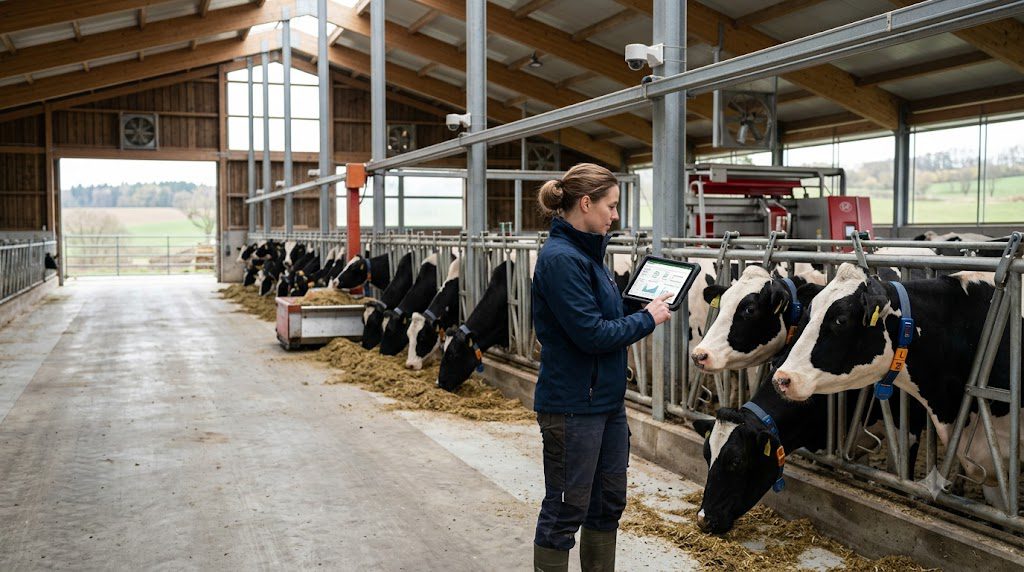
If you’ve spent any time around cattle, dairy cows, goats, or poultry, you already know the hardest part of livestock farming isn’t feeding animals it’s knowing what’s happening with them before a problem becomes expensive. A cow that’s coming down with mastitis, a flock that’s under heat stress, a herd that’s quietly losing weight because of a parasite you haven’t spotted yet by the time you notice these things with your own eyes, you’ve often already lost money.
This is exactly the gap precision livestock farming is built to close.
Precision livestock farming, often shortened to PLF, is no longer a “someday” technology reserved for massive commercial operations. In 2026, with U.S. cattle inventories continuing to shrink, labor getting harder to find, and disease costing the livestock industry billions of dollars a year, more small and mid-size farmers are asking the same question: can sensors, software, and AI actually help me run a better, more profitable operation?
Short answer: yes, but it depends on how you use it. Let’s break down what precision livestock farming actually is, why it’s suddenly everywhere in agricultural conversations, and how you can realistically start using it even if you’re not running a thousand-head feedlot. If you’re also exploring the broader technology side of farming, our guide to farming tech and modern innovation is a good companion read alongside this one.
What Is Precision Livestock Farming?
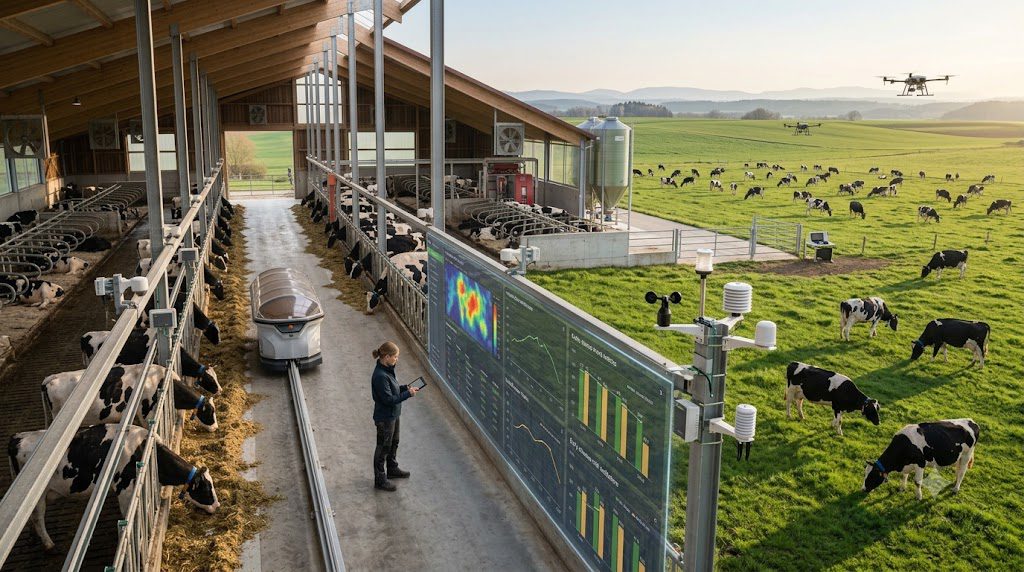
Precision livestock farming is the use of technology sensors, cameras, wearable devices, and data software to monitor livestock continuously and in real time. Instead of relying only on daily visual checks, farmers use PLF tools to track things like body temperature, rumination activity, movement patterns, feed intake, and milk output automatically, around the clock.
According to Wikipedia’s overview of precision livestock farming, PLF is best understood as a set of electronic tools and methods used to automate the monitoring of animals in order to improve their production, reproduction, health, welfare, and environmental impact. Large animals like cattle are typically tracked individually, while smaller animals such as poultry are often monitored “per flock,” with the whole group treated as a single unit.
The idea isn’t to replace the farmer’s judgment. It’s to give that judgment better information to work with. A good stockperson can tell when something feels “off” with an animal, but sensors can flag a problem days before it becomes visible to the human eye which is often the difference between a quick treatment and a serious loss.
At its core, precision livestock farming answers one simple question for every animal in your herd or flock: is this animal healthy, comfortable, and productive right now? And it answers that question without you having to physically inspect every single animal, every single day.
Why Precision Livestock Farming Is Trending Right Now
This isn’t a random buzzword moment. A few real pressures are pushing precision livestock farming from “interesting idea” to “practical necessity” in 2026.
Herds are shrinking, and margins are tighter. Cattle inventories in several major producing countries have been in a multi-year contraction, and industry analysts don’t expect meaningful herd expansion before 2028. Fewer animals means every single animal matters more a lost calf or a missed illness has a bigger impact on the bottom line than it did when herds were larger.
Labor is harder and more expensive to find. Fewer people want to do the physically demanding, early-morning, seven-day-a-week work of checking on livestock manually. Technology that can flag problems automatically reduces how many labor-hours you need to spend just watching for trouble.
Disease costs are enormous. Livestock disease costs the industry billions of dollars annually through lost production, treatment costs, and animal deaths. Early detection through continuous monitoring is one of the few tools that meaningfully reduces that cost.
Consumers and buyers want proof, not promises. Ethical sourcing, animal welfare certification, and traceability are becoming standard expectations, not extras. Precision livestock farming tools generate the kind of data records that support welfare certification and supply chain transparency.
Climate stress is a growing, direct threat. Heat stress alone reduces milk yield, slows weight gain, and increases mortality risk in cattle, poultry, and goats. Environmental sensors that track temperature and humidity in real time let farmers intervene through shade, ventilation, or water access before animals are visibly suffering.
The topic has also moved firmly into industry mainstream conversation. EuroTier 2026, one of the world’s largest livestock trade fairs, built its entire theme this year around “Intelligence in Animal Farming,” showcasing how AI-driven sensors, cameras, and herd management platforms are moving from experimental projects into everyday use on real farms.
Put those five pressures together, and it’s easy to see why precision livestock farming has moved from a research topic to a mainstream conversation at major agricultural events this year. This mirrors a wider shift across agriculture one we’ve also covered in our piece on smart farming and the future of agriculture.
The Core Technologies Behind Precision Livestock Farming
“Precision livestock farming” isn’t one single product you buy. It’s a category made up of several distinct technologies that often work together. Here’s what’s actually inside a modern PLF setup.
Wearable Sensors and Activity Collars
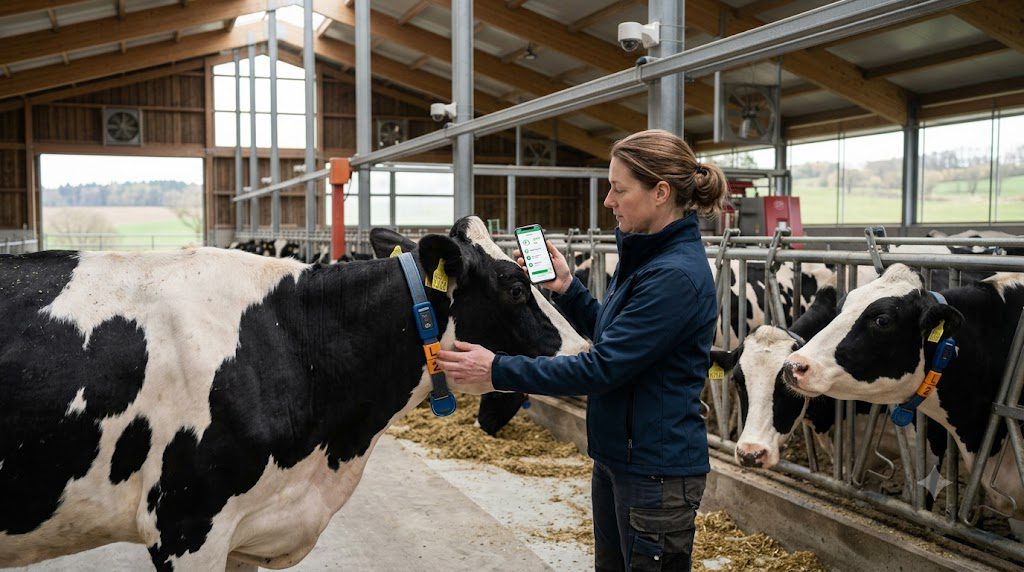
These are the most common entry point for farmers moving into precision livestock farming. Collars, ear tags, and leg bands track movement, rumination time, and activity levels in cattle, goats, and sheep.
A sudden drop in rumination, for example, is one of the earliest and most reliable signs of illness or digestive upset in cattle often visible in the data hours or even days before a farmer would notice anything unusual by eye. Many collar systems also detect estrus (heat cycles) automatically, which improves breeding timing and conception rates without you having to watch for physical signs manually.
AI-Powered Health and Behavior Monitoring
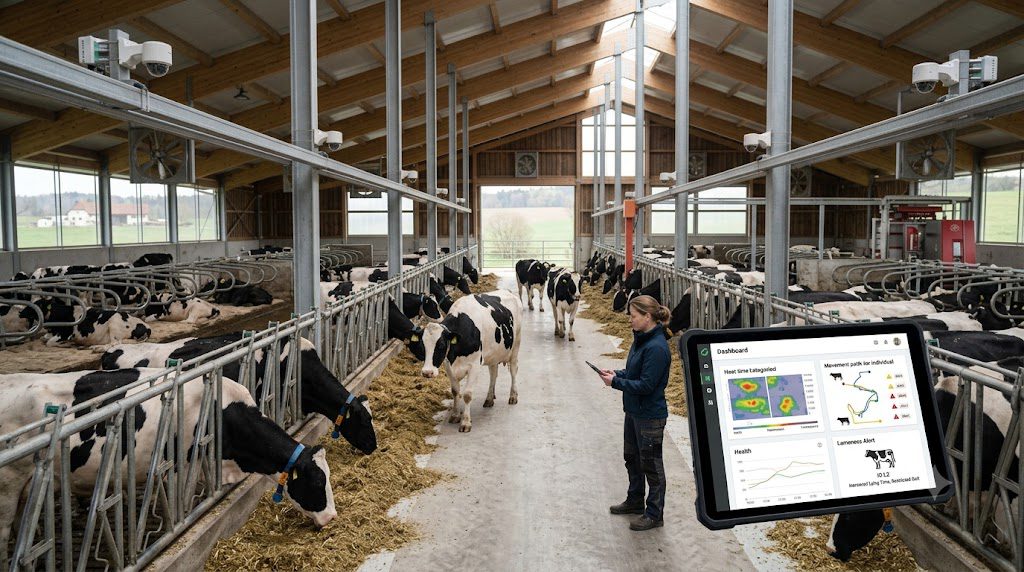
Camera-based systems are one of the fastest-growing areas of precision livestock farming. Cameras paired with AI software can assess body condition, detect lameness by analyzing gait, and flag unusual behavior patterns like an animal isolating itself from the herd, which is often an early sign of sickness or distress.
Some newer systems even use sound analysis, essentially “listening” to a barn or coop for coughing patterns in cattle or distress calls in poultry that indicate respiratory illness before visible symptoms appear. Researchers publishing in Frontiers in Animal Science note that PLF technologies are increasingly designed to monitor animal health, welfare, and behavior automatically and in real time, rather than relying on periodic manual checks.
Smart Feeding and Automated Feeders
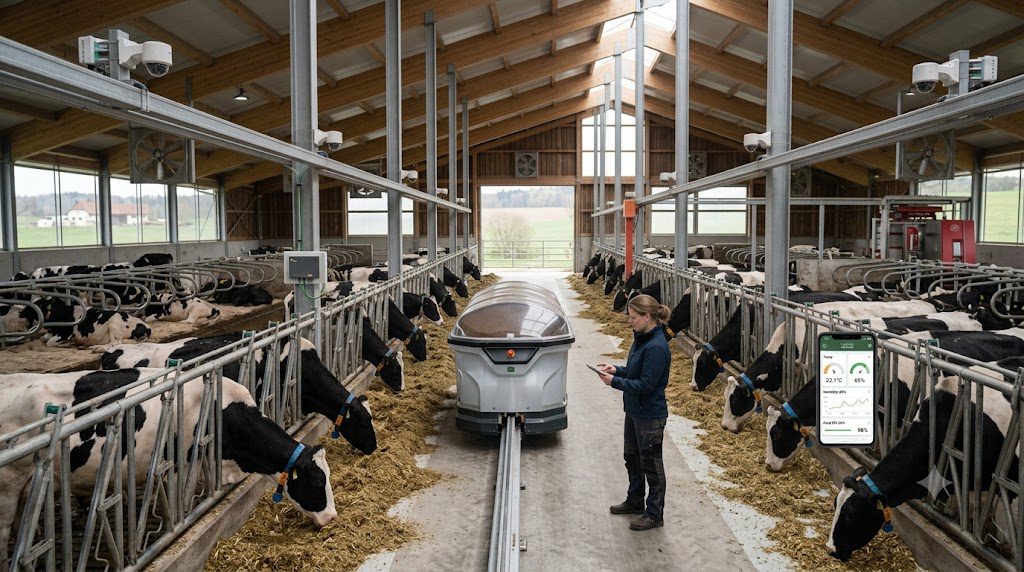
Feed is typically the single largest cost in any livestock operation. Automated feeding systems mix and deliver precise rations on a schedule, reducing both feed waste and labor. Some systems adjust rations automatically based on an individual animal’s stage of lactation, weight, or health status, rather than feeding the whole group identically. If you’re looking to cut feed costs more broadly, it’s worth pairing this with practical, low-tech approaches too our guide on feeding cattle without spending more covers several of them.
Environmental and Climate Sensors
These monitor barn or pasture conditions temperature, humidity, air quality, and ammonia levels and can trigger automatic responses like activating fans, misters, or ventilation systems when heat stress risk rises. For poultry operations especially, air quality monitoring has a direct, measurable impact on flock health and mortality rates.
Livestock Management Software and Data Platforms
This is the layer that ties everything together. Management software pulls data from collars, cameras, and sensors into a single dashboard, so a farmer can check herd health, breeding status, and feed efficiency from a phone instead of physically walking every pen. Good software also keeps digital records that support certification requirements organic, GAP, or export standards without the paperwork headache. This overlaps closely with the broader shift toward agri-tech transforming productivity across all areas of farming, not just livestock.
The Real Benefits of Precision Livestock Farming for Farmers
It’s worth being direct here: precision livestock farming isn’t magic, and it isn’t free. But when implemented thoughtfully, the return on investment shows up in a few concrete ways.
- Earlier disease detection. Catching illness in its first day instead of its fourth or fifth day dramatically reduces treatment costs and animal loss.
- Better breeding outcomes. Automated estrus detection improves conception rates and shortens calving intervals, which directly affects herd productivity.
- Lower labor demand. Continuous monitoring reduces the number of hours spent on manual visual checks, freeing up labor for other farm tasks.
- Improved feed efficiency. Precision feeding reduces waste and matches nutrition to actual animal needs instead of averages.
- Stronger compliance and certification readiness. Digital records make it far easier to meet welfare, organic, or export documentation requirements.
- Better financial visibility. Tracking cost and performance per animal or per group, rather than guessing at the herd level, makes it much easier to see which parts of the operation are actually profitable.
None of these benefits require a farmer to fully automate their entire operation overnight. Most farms that succeed with precision livestock farming start with one problem area usually disease detection or breeding and expand from there once they see results.
Precision Livestock Farming Across Different Types of Livestock
Not every technology fits every farm. Here’s how precision livestock farming typically looks depending on what you raise.
Dairy Cattle
Dairy has been the earliest and most enthusiastic adopter of precision livestock farming, largely because milk yield is measurable in real time and small health issues show up quickly in output. Inline milk sensors detect changes in milk composition that can signal mastitis before it’s visible. Rumination collars flag digestive problems early, and activity-based estrus detection has become close to standard on many mid-size and large dairy operations.
Beef Cattle
For beef operations, especially extensive grazing systems, GPS-enabled ear tags and collars help track herd location and movement across large pastures, reducing the time spent physically searching for animals. Combined with weight-tracking systems at watering points, farmers can monitor growth rates without running cattle through a chute constantly. This kind of tracking is especially valuable given how tight and volatile current cattle markets have become knowing exactly where your herd stands lets you make faster, better-informed selling and breeding decisions.
Poultry
In poultry, precision livestock farming shifts from tracking individual birds to monitoring the flock as a single unit since flocks are managed collectively rather than bird-by-bird. Environmental sensors tracking temperature, humidity, and ammonia levels are especially valuable here, since poultry are highly sensitive to air quality and heat stress, and small environmental shifts can cause significant mortality if not caught quickly.
Goat and Sheep Farming
Adoption here has been slower simply because smaller-bodied animals require different sensor designs, and margins per animal are lower, making the cost-to-benefit case harder to justify on paper. That said, activity collars and basic health-tracking apps are increasingly available at price points that make sense for smaller goat and sheep operations, particularly for tracking parasite load and lambing or kidding timing.
Challenges and Limitations Farmers Should Actually Know About
It would be dishonest to present precision livestock farming as a guaranteed win for every operation. There are real limitations worth weighing before you invest.
Upfront cost is real. Sensors, collars, cameras, and software subscriptions add up, and the return on investment isn’t instant. Smaller operations need to calculate payback period carefully rather than buying technology because it’s trending.
Rural connectivity can be a genuine barrier. Many precision livestock farming tools depend on reliable internet or cellular connectivity to transmit data. In areas with poor rural broadband, this alone can limit which systems are practical to use.
Data without action is worthless. A dashboard full of alerts doesn’t help anyone if nobody has time to check it or knows how to respond to what it’s showing. Successful adoption requires a farmer or farm manager who will actually use the data, not just collect it.
Integration between systems isn’t always smooth. Not every sensor brand talks to every software platform. Farmers sometimes end up with multiple disconnected apps instead of one unified dashboard, which defeats much of the purpose.
Technology supports good stockmanship – it doesn’t replace it. The farmers who get the most value from precision livestock farming are the ones who already understand animal behavior and health well. A global scientometric review of PLF research makes a similar point: the technology’s purpose is to support real-time monitoring and decision-making, not to substitute for the farmer’s own expertise. The tools amplify good judgment; they don’t replace it.
How Small and Mid-Size Farmers Can Realistically Start
You don’t need to digitize your entire operation in one season. A practical, low-risk path looks something like this:
- Identify your single biggest pain point. Is it late disease detection? Missed breeding windows? Feed waste? Start there instead of trying to solve everything at once.
- Start with one technology, not five. A single batch of activity collars on your highest-value animals, or one environmental sensor in your most heat-vulnerable barn, is enough to learn whether the investment pays off.
- Track the results for one full season. Compare treatment costs, conception rates, or feed costs before and after. Real numbers, not assumptions, should guide your next investment.
- Choose software that’s actually simple to use. A complicated dashboard nobody checks is worse than a simple one that gets used daily. Prioritize usability over feature lists.
- Expand gradually as the data proves its worth. Successful farms tend to scale precision livestock farming adoption over two or three years, not two or three months.
It also helps to think of precision livestock farming as one part of a larger shift rather than an isolated purchase. Many of the same sensor and data principles show up across modern agri-tech more broadly, so skills and lessons you pick up managing livestock data often transfer directly to other parts of the farm, from irrigation to storage monitoring.
The Future of Precision Livestock Farming
Looking ahead, a few developments are worth watching. AI-based sound analysis essentially teaching software to recognize the specific coughs, calls, or vocal patterns that indicate illness or distress is moving from research labs into commercial products. Satellite and drone-based pasture monitoring is starting to combine with ground-level livestock sensors, giving farmers a fuller picture of both animal health and land condition at the same time. And as rural connectivity slowly improves in more regions, the accessibility barrier for smaller farms should continue to shrink.
Market data reflects this momentum too: the global precision livestock farming market has been valued in the billions of dollars and is projected to keep growing at a steady annual rate through the end of the decade, driven largely by rising demand for animal welfare monitoring and production efficiency.
The direction is clear: precision livestock farming is moving from a tool for large commercial operations toward something increasingly practical for family farms and mid-size operations too. The technology is getting cheaper, the software is getting simpler, and the pressure to adopt it from labor shortages, disease costs, and buyer expectations isn’t going away.
Frequently Asked Questions About Precision Livestock Farming
Is precision livestock farming only for large commercial farms? No. While large operations adopted it first, sensor and software costs have come down significantly, and many tools are now priced for small and mid-size herds, especially for dairy and beef cattle.
What’s the easiest way to start with precision livestock farming? Most farmers start with activity or rumination collars for disease and estrus detection, since these tend to show measurable returns quickly and don’t require major infrastructure changes.
Does precision livestock farming replace the need for daily animal checks? No. It supports and sharpens manual observation rather than replacing it. The most effective operations combine experienced stockmanship with sensor-based alerts.
How much does precision livestock farming typically cost to start? Costs vary widely depending on herd size and the technology chosen, ranging from a few sensors on key animals to a full farm-wide monitoring system. Starting small and expanding based on results is the most financially sound approach.
Which livestock sector has adopted precision livestock farming the most? Dairy cattle farming has the highest adoption rate, largely because milk yield provides an immediate, measurable way to see the technology’s impact.
Can precision livestock farming help with animal welfare certification? Yes. The continuous digital records these systems generate on health interventions, space access, and monitored conditions are increasingly used to support welfare certification and buyer transparency requirements.
Final Thoughts
Precision livestock farming isn’t about replacing the farmer’s eye and experience with machines. It’s about giving that experience better, faster information catching a sick animal a day earlier, timing a breeding window more accurately, or spotting heat stress before it costs you production. In a year where herds are smaller, labor is harder to find, and every animal’s health directly affects your margin, that kind of early information isn’t a luxury anymore. It’s quickly becoming a basic part of running a modern, resilient livestock operation.
Pingback: Avian Influenza in Poultry Farms: 9 Critical Biosecurity Steps to Protect Your Flock -
Pingback: Bird Flu Prevention for Poultry Farms: 9 Essential Steps for 2026 -
Pingback: New World Screwworm Prevention in Cattle: 8 Critical Steps for 2026 -