
Masoor farming is the cultivation of lentil, a cool-season rabi pulse sown from mid-October to mid-November in north India. It is ready for harvest in roughly 110 to 120 days. Pick well-drained loam, sow certified seed treated with Rhizobium, irrigate lightly, and sell at or above the MSP of ₹7,390 per quintal set for the 2027-28 marketing season.
This guide covers masoor farming from field selection to storage, in the order a smallholder actually does the work. It also puts the new MSP next to the cost of production, so you can judge the crop before you sow.
Sowing time is now. If your field is still empty, read the sowing and seed-treatment steps first.
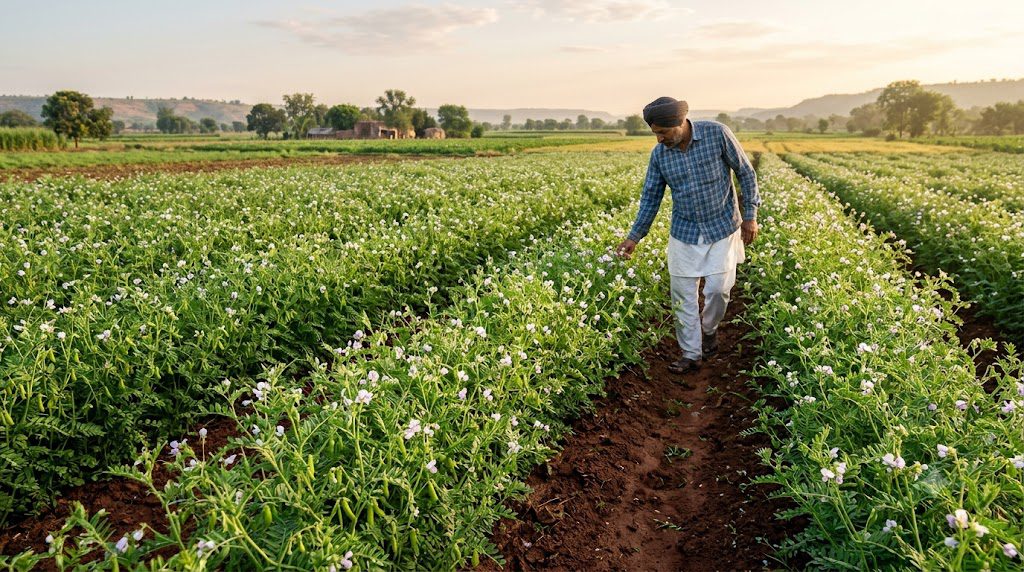
Table of Contents
What Is Masoor Farming and Why Do Farmers Grow It?
Masoor farming means growing lentil (Lens culinaris), the crop that becomes red dal in your kitchen. It is a legume. Its roots host Rhizobium bacteria that fix nitrogen from the air.
That is the main reason many farmers keep a pulse in the rabi rotation. The next crop gets a better start. Masoor farming also asks for less water than wheat.
Where Masoor Is Grown
Lentil is mainly a rabi crop of the Gangetic plains and central India. Uttar Pradesh, Madhya Pradesh, Bihar and West Bengal are usually named as the main producing states.
Dryland pockets with moisture-holding soil also grow it. Black cotton soils in parts of Karnataka are one example.
Why Masoor Farming Suits Smallholders
- Short duration. About 110 to 120 days, so it fits between a kharif harvest and a zaid crop.
- Low water need. It is generally drought-tolerant, though it hates waterlogging.
- Support price. MSP is announced for masoor every rabi season.
- Soil benefit. Nitrogen fixation helps the crop that follows.
Masoor Farming Income: MSP, Cost and Margin for 2027-28
The Union Cabinet fixed the masoor MSP at ₹7,390 per quintal for the 2027-28 rabi marketing season. That is ₹390 more than the ₹7,000 of 2026-27. The projected cost of production is ₹3,854 per quintal, which gives a margin of 92 per cent over cost.
Here is how masoor compares with other rabi crops on the Cabinet’s own numbers.
| Crop | Projected cost (₹/quintal) | MSP 2027-28 (₹/quintal) | Margin over cost |
|---|---|---|---|
| Wheat | 1,264 | 2,610 | 106% |
| Gram (chana) | 3,751 | 5,958 | 59% |
| Lentil (masoor) | 3,854 | 7,390 | 92% |
| Rapeseed/mustard | 3,367 | 6,613 | 96% |
The margin is calculated per quintal on projected cost. It says nothing about how many quintals your field will give.
How to Work Out Your Profit Per Acre
Before you commit to masoor farming, do this sum on paper:
Net income per acre = (yield in quintals × selling price) − your actual cost
I am not printing a “typical yield per acre” here. Yield swings with variety, sowing date, soil and rain, and any single number would mislead you. Use your own last two pulse crops as the baseline. Or ask your nearest KVK what farmers in your block actually harvested.
What MSP Does Not Promise
MSP is a support price. It does not mean every quintal sells at that rate on any day. Procurement depends on your state agency, your registration and the mandi.
The Centre has announced procurement support for masoor under its pulses mission. Ask your state agency whether it is running in your district. Register early. Our guide to Farmer ID registration lists the documents you need.
Step 1: Pick the Right Field for Masoor Farming
Field choice decides more of the result than any input you buy later. Waterlogged land ruins masoor farming faster than any pest.
Soil and pH for Masoor Farming
Masoor does best in well-drained loam or sandy loam with a pH between 6.0 and 7.5. Heavy clay holds water, and standing water causes root rot.
If your field has a history of waterlogging, cut drainage channels before sowing. Do not wait for the first heavy rain to find out where water collects.
Climate
Masoor wants cool weather while it grows and dry weather as pods mature. Frost at flowering can hurt pod set. Sowing on time keeps flowering away from the coldest nights in most plains districts.
Crop Rotation
Masoor farming works well after kharif paddy or a cereal. Do not sow lentil after lentil on the same plot. Wilt and root diseases build up in the soil. Rotate with cereals for at least a season.
Step 2: Choose Varieties for Masoor Farming
K-75 and DPL-62 are popular in central India. They mature in 110 to 115 days and carry decent disease resistance. Pant L-406 suits the cooler plains of north India.
Variety lists change by state. Ask the KVK or your state seed corporation which variety is currently recommended for your district. Do not buy on a neighbour’s word alone.
How to Read a Seed Tag
Buy certified seed in a sealed bag. Check four things on the tag:
- Variety name and lot number
- Germination percentage
- Physical purity
- Date of testing
Keep the bill and the tag. If germination fails, they are your proof.
Step 3: Prepare the Field
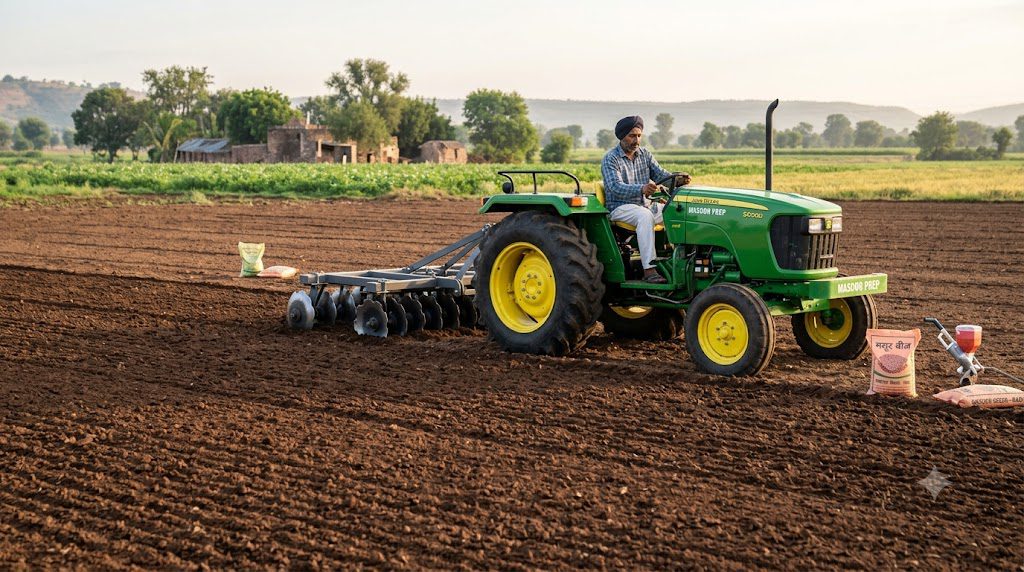
Good land preparation decides how well masoor farming starts. Lentil seed is small. It needs a fine, level seedbed, otherwise germination is patchy.
Plough once or twice, then harrow and plank to break clods. Level the field so water does not collect in low spots. If the previous crop left a lot of residue, clear it so seed-to-soil contact stays good.
Sow into moist soil. If the field is dry, give a light pre-sowing irrigation rather than sowing into dust.
Step 4: Sowing, Seed Rate and Seed Treatment in Masoor Farming
This is the step where most yield is won or lost. Do it on time and do it cleanly.
Best Sowing Time
In the north Indian plains, sow from mid-October to mid-November. Late sowing shortens the crop’s growing period and cuts yield, so do not wait for a “better” day. If you are past the window, ask the KVK about late-sown varieties and a revised seed rate.
Seed Rate and Row Spacing
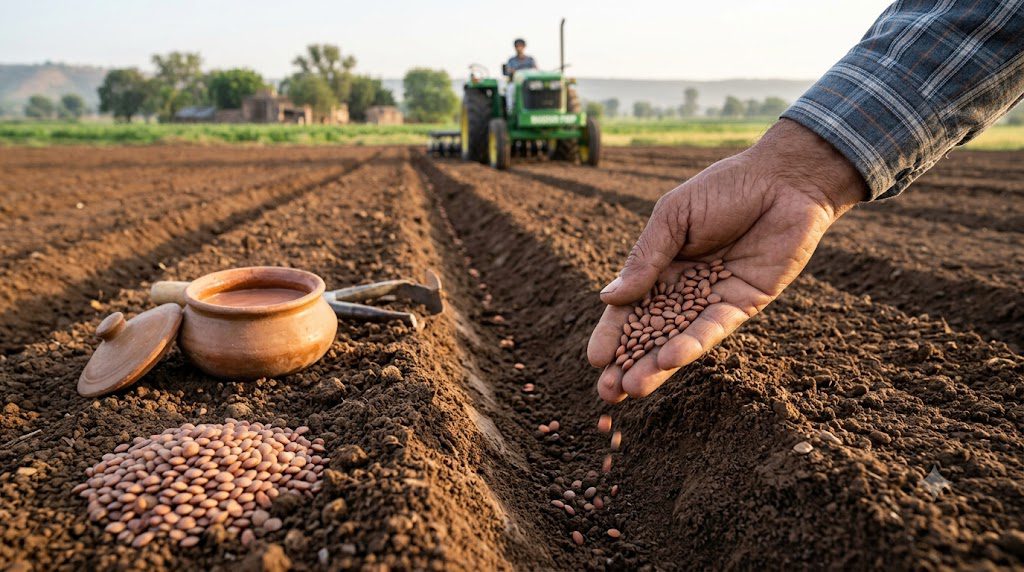
A normal guide for lentil is about 30 to 40 kg of seed per hectare, which is roughly 12 to 16 kg per acre. Keep rows about 25 cm apart. Line sowing helps weeding and gives each plant light and air.
Seed size varies by variety. Confirm the exact rate with your seed supplier or KVK.
Seed Treatment
Treat seed in this order:
- Treat with a recommended fungicide first, to protect against seed- and soil-borne disease.
- Then coat with Rhizobium culture. Add a phosphate-solubilising bacteria (PSB) culture if you can get it.
- Dry the seed in shade and sow the same day.
Do not mix chemical and culture in one go. The fungicide can kill the bacteria. Follow the packet instructions for each dose.
Many farmers use only Rhizobium. Adding PSB helps release locked phosphorus, which lentil needs at pod formation.
Step 5: Nutrient Management in Masoor Farming
Masoor fixes most of its own nitrogen once nodules form. Heavy nitrogen at sowing mostly grows leaves instead of pods. Phosphorus matters more.
A common starting point is around 20 kg nitrogen and 40 kg phosphorus (P₂O₅) per hectare at sowing. Add sulphur only if your soil is short of it. Treat these as a starting point. Your soil report overrides them.
Get your soil tested and use the Soil Health Card recommendation for your plot. Apply the full dose at sowing, in the furrow or just below the seed, not on the surface.
Do not top-dress urea in a healthy masoor crop. It adds cost and soft growth that aphids love.
Step 6: Irrigation
Irrigation in masoor farming is about restraint. The crop is generally drought-tolerant, and lentil is sensitive to excess moisture.
If the field was sown into good moisture, you may need only one or two light irrigations. The usual critical stages are branching and pod filling. Check the soil by hand first. If it is damp at root depth, skip the irrigation.
Never flood the field. Use a light, quick irrigation and drain any water that stands.
Step 7: Weed Control
Masoor grows slowly in its first weeks. Weeds take light, water and nutrients while the crop is still small. Weeds are the biggest early threat in masoor farming.
Keep the first month clean. Do one hoeing or hand weeding early, and a second if weeds return. Line sowing makes this much easier.
A pre-emergence herbicide is an option on larger plots. Use only a product and dose recommended by your KVK or state agriculture department, and read the label. Wrong dose on a small-seeded pulse can damage germination.
Step 8: Pest and Disease Management in Masoor Farming
Walk the field weekly. Early detection costs less than late treatment, and pest management in masoor farming starts with looking.
Aphids, Cutworms and Pod Borers
These are the main insect problems. Aphids cluster on tender shoots and pods. Cutworms cut seedlings at the base. Pod borers attack when pods form.
- Scout in the morning and note how many plants are affected.
- Use yellow sticky traps and neem-based sprays as a first step.
- Spray a recommended insecticide only when the problem crosses the threshold your KVK gives you.
Wilt, Root Rot and Rust
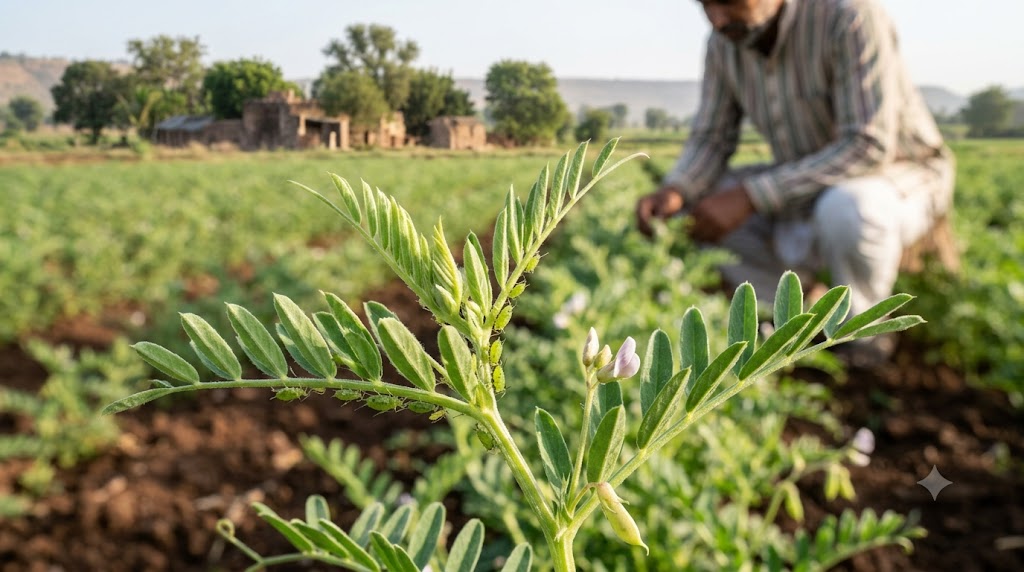
Wilt is the common serious disease. Seed treatment, rotation and good drainage reduce it more than any spray does. Rust shows up as rusty pustules on leaves and pods in humid spells.
Remove and destroy wilted plants early. Do not save seed from a diseased plot.
When to Call the KVK
If you cannot name the problem, send a photo and leaf sample to your KVK. Our post on Kisan Sarathi explains how to reach KVK scientists through the government platform. Find your nearest centre on the KVK portal.
Harvest, Threshing and Storage in Masoor Farming
Harvest when most pods turn brown and the plants begin to dry. Waiting too long causes pod shattering and seed loss. Harvest in the morning when plants are slightly moist to reduce shattering.
After cutting:
- Dry plants on a clean threshing floor before threshing.
- Clean and grade the seed to remove dust and broken grain.
- Dry grain to safe moisture before bagging. Damp grain spoils and attracts storage insects.
- Store in airtight containers or moisture-proof bags, off the floor.
Poor storage undoes good work in masoor farming. Check bags every few weeks.
Selling Your Masoor: MSP, Mandi and eNAM
Masoor farming only pays once the grain is sold. Do not decide the buyer after harvest, when you are in a hurry.
Compare three prices before you sell: the MSP, your local mandi rate and the rate on the national platform. If you have not yet signed up, our step-by-step guide to eNAM registration covers it. Check live prices on eNAM.
Keep your weighment slip and bill. If you plan to sell at an MSP centre, complete your registration before the procurement window opens.
Masoor Farming vs Chana vs Pea
You have limited land and one rabi season. Here is the honest comparison.
On the Cabinet’s 2027-28 numbers, gram carries a 59 per cent margin over projected cost, while lentil carries 92 per cent. That favours masoor on paper. The paper margin does not account for your yield, your soil or your market.
Chana is more forgiving on rainfed land and has deeper procurement in many states. Read our chana farming guide if your soil is lighter. Pea is usually a fresh-market crop with a different price risk. See our pea farming guide before choosing between them.
My advice: do not put the whole holding into one pulse because of one margin figure. Split the area if you can.
Common Mistakes in Masoor Farming
- Late sowing. Every week past the window costs yield.
- Skipping seed treatment. Wilt then arrives with no cure.
- Waterlogged plots. The most common cause of failure in masoor farming.
- Extra urea. It feeds aphids, not pods.
- Ignoring weeds in the first month. The crop never catches up.
- Late harvest. Shattering loses grain you already paid to grow.
- Selling in a hurry. Check three prices first.
FAQs
1. What is masoor farming?
Masoor farming is the cultivation of lentil, a rabi pulse sown in October–November and harvested after about 110 to 120 days.
2. What is the best month for masoor farming?
In north India, mid-October to mid-November. Late sowing reduces yield.
3. What is the masoor MSP for 2027-28?
₹7,390 per quintal, up ₹390 from ₹7,000 in 2026-27.
4. Which soil is best for masoor farming?
Well-drained loam or sandy loam with pH 6.0 to 7.5. Avoid heavy, waterlogged clay.
5. How much seed do I need per acre?
Roughly 12 to 16 kg per acre as a general guide. Confirm with your KVK, since it depends on seed size.
6. Which varieties are popular?
K-75 and DPL-62 in central India, and Pant L-406 for cooler north Indian plains. Check your district’s recommendation.
7. How many irrigations does masoor need?
Often one or two light ones, at branching and pod filling, depending on soil moisture. Never flood.
8. Is masoor farming profitable for small farmers?
It can be. The MSP margin over projected cost is 92 per cent, but your profit depends on your own yield and cost. Do the per-acre sum first.
9. What are the main diseases?
Wilt, root rot and rust. Seed treatment, rotation and drainage are the best protection.
10. Can I do masoor farming on one acre?
Yes. The crop does not need machinery, and a single acre is a sensible trial before you scale up.
Conclusion
Masoor farming can be a rewarding rabi crop when managed properly. Choose the right variety, sow on time, use quality seeds and manage water, weeds and diseases carefully. Before selling, compare mandi prices with the MSP of ₹7,390 per quintal for 2027–28. Remember, a good harvest starts with smart planning, timely care and proper cost management.