
FMD in cattle is a fast-spreading viral disease that blisters the mouth, teats and feet, and it can quietly drain a dairy farm’s income within days.
Most cows survive. The damage from FMD in cattle comes from lost milk, painful lameness, secondary infections and weeks of poor condition.
This guide covers how the virus spreads, how to spot it, why vaccine protection fades, and seven steps for Indian farms. It relies on veterinary references and government data, and it flags where the evidence has gaps.
Table of Contents
What Is FMD in Cattle?
FMD in cattle is caused by an Aphthovirus from the family Picornaviridae. The MSD Veterinary Manual describes it as one of the world’s most economically important viral diseases of livestock.
The virus comes in seven serotypes: O, A, C, Asia 1, and SAT 1, 2 and 3. Serotype O causes most outbreaks worldwide. A vaccine against one serotype does not protect against another.
Besides cattle, the virus infects buffalo, pigs, sheep, goats and many wild cloven-hoofed animals. Horses are not affected.
In a susceptible herd, almost every animal can fall ill. Deaths are rare in adults, but young animals and animals with infected lesions face higher risk.
Why FMD in Cattle Matters for Indian Dairy Farmers
The disease is endemic across southern and southeastern Asia, according to MSD. Where it circulates, it reduces farm productivity and blocks trade in livestock and animal products.
India’s own government briefing says the disease cuts milk production, slows growth, hurts reproduction and lowers the working capacity of draft animals. It also limits access to export markets.
The scale is large. India’s 2019 livestock census counted 535.78 million animals, including 302.79 million bovines, based on an August 2026 Government of India briefing.
For comparison, the 2001 outbreak in the United Kingdom lasted about eight months and cost an estimated US$10 billion, mostly through lost trade and culling. In endemic countries, MSD notes, vaccination is used because slaughtering every at-risk animal is economically unfeasible, so farms carry part of the burden themselves.
How FMD in Cattle Spreads
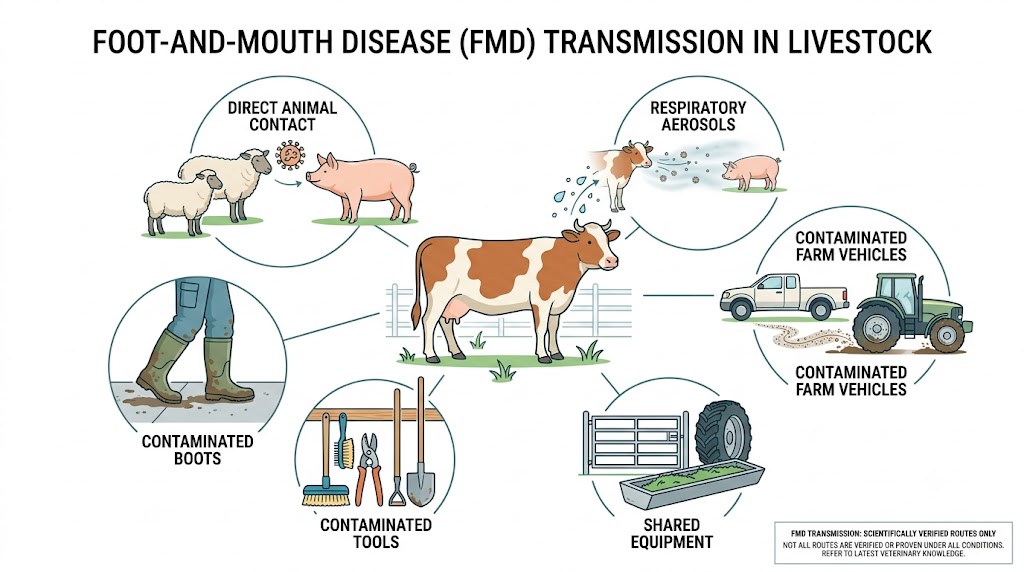
Direct contact and air
The easiest route is direct contact with an infected animal or its secretions, including saliva, blister fluid, milk and semen. That makes FMD in cattle a herd problem, not a single-animal problem.
The virus also travels as an aerosol in breath. MSD notes that it usually moves no more than a few kilometres over land.
Animals can pass on the virus before any sign appears, because it multiplies in the throat first. That is why a healthy-looking herd is not proof of a safe herd.
Hands, boots, vehicles and bedding
People, dogs, cats, rodents, birds, vehicles and equipment can all carry the virus mechanically. MSD advises that showering and changing clothes greatly reduces the risk of carrying it between farms.
The virus is tough. It can survive on hay or straw bedding for up to 20 weeks and in cold-weather slurry for up to six months.
Milk, semen and carriers
Infected cows shed virus into milk before signs appear. Heat treatment lowers infectivity, but MSD says traces may survive depending on the method.
More than half of ruminants that recover, including vaccinated animals later exposed, can become carriers. The carrier state can last a few years in cattle.
MSD adds that the risk from carrier cattle appears low, but it may not be zero. Controlled experiments have not shown cattle-to-cattle spread from carriers.
Signs of FMD in Cattle
The first days
The incubation period in cattle is 2 to 14 days. Fever of about 40°C usually comes first, so spotting FMD in cattle early means checking mouths and feet daily.
Blisters, called vesicles, then appear on the tongue, gums, dental pad, lips, muzzle and nostrils. They also form on the teats and in the cleft and coronary band of the foot.
Affected cows drool heavily, make smacking noises, stamp their feet and prefer to lie down.
The days after
Blisters rupture within about 48 hours and leave raw erosions. Mouth lesions heal in under two weeks.
Foot lesions heal more slowly. They can become infected with bacteria and cause chronic lameness or, in severe cases, death.
Secondary bacterial mastitis is common, because blisters on the teats make cows resist milking. Our guide to heat stress in dairy cattle explains another reason milk yield can fall fast.
Calves, sheep and goats
Young calves can die suddenly without any visible sign, because the virus can damage the heart muscle.
In sheep and goats the signs can be largely inapparent. Lameness is usually the first, and non-specific, clue.
Never assume that a quiet small-ruminant flock is clean when cattle nearby are ill.
How Vets Confirm FMD in Cattle
You cannot confirm FMD in cattle by eye. MSD notes that other diseases, including vesicular stomatitis, malignant catarrhal fever, bovine viral diarrhoea and bluetongue, can look similar.
Any blistering disease in cloven-hoofed animals therefore needs a laboratory investigation. The Center for Food Security and Public Health pocket guide shows what typical lesions look like.
| Test or sample | What it shows | Notes |
|---|---|---|
| Real-time RT-PCR | Virus genetic material | Main laboratory method; very sensitive |
| Fresh blister epithelium | Best sample for virus detection | About 1 g in transport medium, kept cold |
| Saliva or oral swabs | Virus during acute illness | Easier to collect than blister tissue |
| Pen-side lateral flow device | Rapid antigen check | Negative results need laboratory confirmation |
| NSP antibody ELISA | Past or present infection | Works in vaccinated animals too |
The NSP test matters for India. MSD explains that these antibodies form only when the virus replicates, so they can separate infected animals from vaccinated ones.
Let a veterinarian collect samples. Healing lesions older than about ten days often contain little detectable virus.
Can You Treat FMD in Cattle?
MSD states that no treatment is available for infected animals. In endemic countries, vets may give supportive care.
That care focuses on soft feed, clean dry flooring, foot attention and prevention of secondary infection. A vet should decide if antibiotics are needed, since they only help against bacteria and not the virus.
India’s national guidelines promote rational medicine use and antimicrobial stewardship, according to the government briefing. Avoid random antibiotic courses bought without advice.
Prevention therefore carries the whole weight when FMD in cattle strikes. Feed cost is already a pressure point, as our guide on feeding cattle without overspending shows, and an outbreak makes it worse.
Why Vaccine Doses Must Repeat Every Six Months
Inactivated FMD vaccines protect for only four to six months, and only against the serotypes in the vial, says MSD.
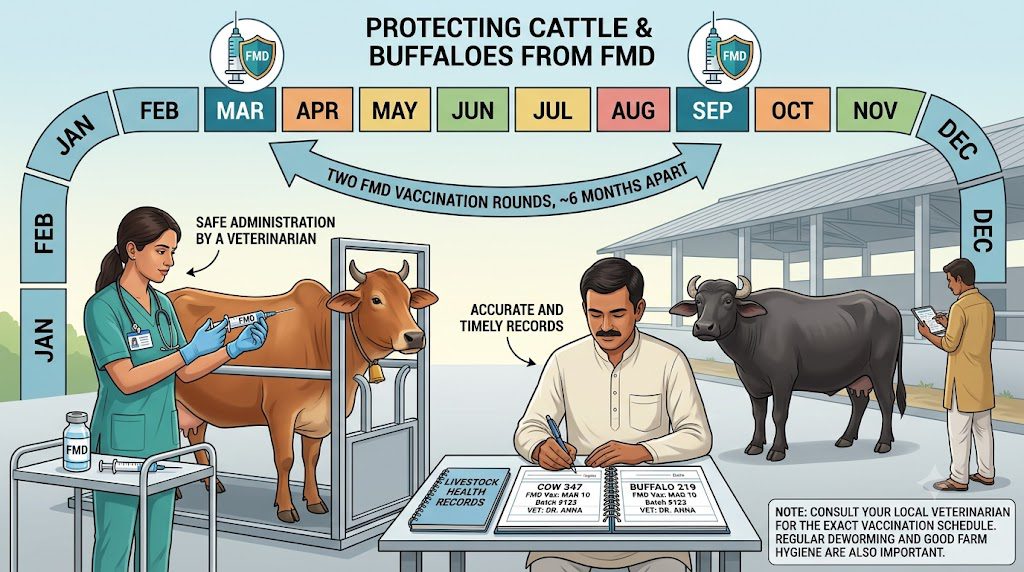
That short window explains India’s schedule. The National Animal Disease Control Programme (NADCP) aims for 100% vaccination of all livestock against FMD twice a year.
Missing a round leaves animals unprotected for weeks. A herd that skips one campaign can lose much of its protection.
Vaccines also have limits. MSD says they prevent clinical illness but not viral persistence in the throat, so vaccinated animals can still become carriers.
That is why vaccination works best alongside biosecurity, never instead of it.
7 Critical Steps to Protect Your Herd from FMD in Cattle
These steps combine MSD’s control guidance with India’s NADCP programme. No single step is enough.
Step 1: Vaccinate every eligible animal twice a year
Cattle, buffalo, sheep and goats all fall under the mass rounds. The Department of Animal Husbandry and Dairying runs mass rounds every six months.
Ask your local veterinary office when the next round starts. Present every animal, including calves and small ruminants.
Step 2: Tag, register and record every dose
The Bharat Pashudhan portal gives each registered animal a 12-digit Tag ID linked to vaccination data. More than 39 crore animals were registered by July 2026.
Keep your own record too, with dates and tag numbers. Systems abroad work the same way, as our post on electronic ID eartags explains.
Step 3: Isolate new animals for at least two weeks
The incubation period reaches 14 days in cattle. Keep new animals apart for at least that long and watch mouths and feet daily.
Be honest about the limit. Isolation catches animals that are incubating the disease, but it cannot catch a symptom-free carrier.
Step 4: Control visitors, vehicles and equipment
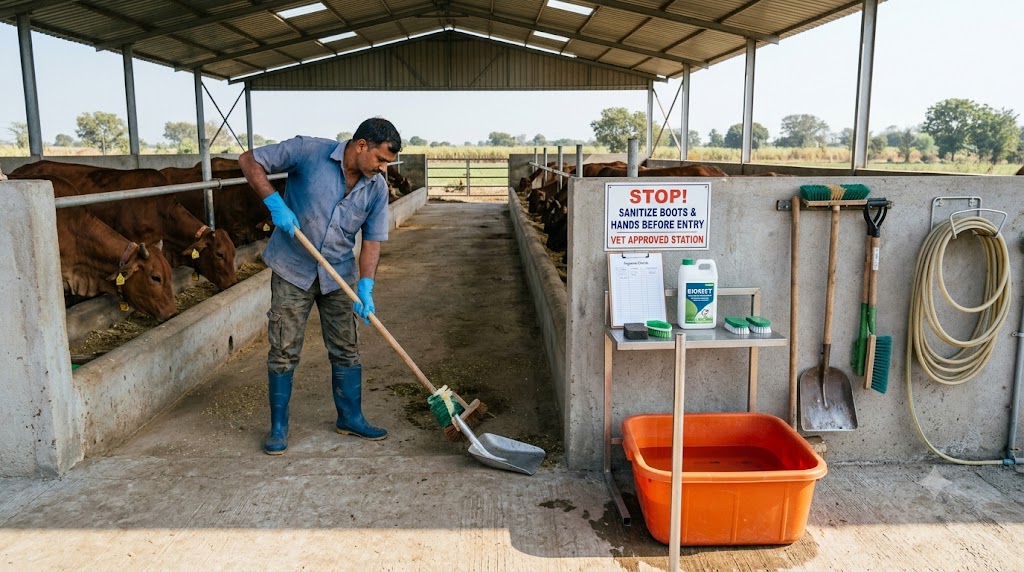
Limit who enters animal areas. Provide boots or a footbath, and insist that anyone returning from another farm changes clothes first.
Do not share ropes, buckets or milking gear between farms. The virus rides on all of them.
The same gate discipline applies to other herd infections, as our dairy biosecurity guide shows.
Step 5: Clean first, then disinfect with the right product
MSD says the virus is destroyed by dryness, heat above 56°C and conditions outside pH 6 to 9. Effective disinfectants include soda ash, citric acid and acetic acid (vinegar).
Iodine-based products, quaternary ammonium compounds, bleach and phenols work less well, especially on dirty surfaces. Remove dung and bedding first.
Caustic soda (lye) also works, but it burns skin and eyes, so only a trained person should handle it.
Step 6: Report any blistering animal immediately
Do not wait to see if it passes. Separate the animal, stop all movement and call your veterinarian or the toll-free 1962 line.
Early reports protect your neighbours. MSD stresses that awareness among farmers is what first detects an incursion.
Step 7: Do not forget sheep, goats and pigs
Mixed farms need mixed protection. Since 2024, vaccination has also covered pastoral sheep and goats in Haryana, Himachal Pradesh, Uttarakhand, Jammu and Kashmir, and Ladakh.
Pigs can exhale far more virus than cattle, MSD says, and they amplify outbreaks. Our guide to pig disease prevention covers pig-side biosecurity, and a flock may need the advice in our sheep and goat pox guide.
What India’s Vaccination Numbers Really Show
The government briefing reports 147.16 crore FMD vaccine doses, benefiting 8.04 crore farmers, since 2019.
Reported outbreaks fell from 132 in 2019 to 40 in 2025. NSP antibody prevalence fell from 20.8% to 8.1% over the same period.
The briefing also says no Asia-1 outbreak has occurred for three years.
These are real gains, and I would not wave them away. Still, two readings deserve caution.
First, average protective immunity was 78.1% for serotype O, 71.7% for A and 77.6% for Asia1. By my reading, that leaves roughly one animal in five to one in three without solid protection.
Second, NSP antibodies appear only after the virus replicates, so a prevalence of 8.1% still means the virus is circulating. Reported outbreaks are also a floor, not a full count.
Is FMD Dangerous to People?
MSD states that FMD is not a zoonosis and is not considered a public health problem. The USDA fact sheet adds that it is unrelated to the human hand, foot and mouth disease seen in small children.
People still matter, because they carry the virus on clothes, skin and boots.
Ask your veterinary authority before selling or consuming milk from sick animals. Heat treatment lowers risk, but it may not remove every trace.
What to Do If You Suspect FMD in Cattle
- Separate the animal and stop all animal, vehicle and visitor movement.
- Call your veterinarian or the 1962 Mobile Veterinary Unit line.
- Do not touch other animals, then change clothes and boots before you do.
- Keep milk, bedding and dung from the sick animal contained.
- Follow official instructions on sampling, movement and disposal.
The government briefing lists 4,019 Mobile Veterinary Units across 29 states and union territories.
What We Still Do Not Know
Outbreak counts measure reports, not infections, so the true burden of FMD in cattle on small farms is unclear.
The briefing links the programme to productivity gains, but it does not isolate FMD from other factors such as breeding and feed. Treat that claim cautiously.
Carrier risk is also uncertain. MSD calls it low but not zero, and research continues.
Questions to Ask Your Vet About FMD in Cattle
- When is the next vaccination round in my block, and which serotypes does the vaccine cover?
- Were my calves and small ruminants included in the last round?
- Should any animal be sampled for NSP antibodies?
- How long should I isolate new purchases?
- Which disinfectant is safe and effective for my sheds?
Write the answers down and keep them with your herd records.
Frequently Asked Questions
1. What is FMD in cattle?
Foot-and-mouth disease (FMD) is a highly contagious viral disease affecting cattle and other cloven-hoofed animals. It can cause fever, mouth blisters, foot lesions, lameness and reduced milk production.
2. What are the first signs of FMD in cattle?
Early signs can include fever, excessive drooling, reduced appetite, mouth lesions, foot tenderness and lameness. Contact a veterinarian if FMD is suspected.
3. How does FMD spread between cattle?
FMD can spread through infected animals, respiratory aerosols, secretions, contaminated equipment, footwear, vehicles and other fomites.
4. Can FMD cause milk production to decrease?
Yes. Pain, fever, reduced feed intake and udder or teat lesions can reduce milk production. Recovery of normal production varies between animals.
5. Is there a specific cure for FMD in cattle?
There is no specific antiviral cure for FMD. A veterinarian can recommend supportive care and treatment for secondary complications.
6. How often should cattle receive FMD vaccination in India?
India’s NADCP programme uses repeated vaccination at six-monthly intervals. Follow the current local veterinary programme for the correct schedule, eligibility and vaccine.
7. Can vaccinated cattle still get FMD?
Vaccination reduces the risk of clinical disease, but protection depends on factors such as vaccine quality, the circulating virus serotype and the animal’s immune response. Vaccination does not guarantee complete protection.
8. Can FMD affect buffaloes, sheep, goats and pigs?
Yes. FMD affects cattle, buffaloes, sheep, goats, pigs and several wild cloven-hoofed species.
9. How is FMD diagnosed in cattle?
Veterinarians and authorised laboratories use appropriate samples and diagnostic tests, including real-time RT-PCR, to confirm infection. Symptoms alone cannot establish a diagnosis.
10. What should farmers do if they suspect FMD?
Separate the affected animals where feasible, stop animal movements, avoid transferring people or equipment between animal groups, and immediately contact a veterinarian or the relevant animal-health authority.
Key Takeaways
- Vaccine protection lasts only four to six months, so both yearly rounds matter.
- There is no cure, so prevention and quick reporting decide the outcome.
- Clothes, boots, vehicles and bedding spread the virus as well as animals.
- Do not assume sheep, goats or healthy-looking cows are clean.
- Record every dose on Bharat Pashudhan.
For more herd-health guides, browse our livestock category. Our lumpy skin disease guide covers another cattle infection. Questions or corrections? Use our contact page.