
Table of Contents
Introduction
A few years ago, buying a drone for your farm meant spending tens of thousands of dollars on something that mostly took nice photos of your fields. Useful for a report, maybe, but hard to justify against the price of a used tractor.
That’s not the situation anymore. Agricultural drones in 2026 spray, seed, map, and scout fields with a level of precision that simply didn’t exist at this price point even three years ago and the price point itself has dropped sharply. Entry-level models now start around $2,000–$3,000, and the labor savings alone are enough to pay one off within a single season on many farms.
This guide walks through what agricultural drones actually do, what they really cost in 2026, how the return on investment works out in practice, and how to figure out whether your farm is a good fit without the sales pitch.
Why Agricultural Drones Are Having a Moment Right Now
Three things converged to make 2026 the year drones went from “interesting gadget” to “standard farm equipment” for a growing number of operations.
Prices fell hard. The average price of agricultural drones has dropped by an estimated 35% compared to 2023 figures, according to Farmonaut’s 2026 agricultural drone pricing report, driven by more manufacturers entering the market and components becoming cheaper to produce at scale. There are now more than 70 agricultural drone models on the global market, spanning everything from basic mapping units to full AI-powered spray systems.
Labor costs kept rising. Manual spraying is slow, physically demanding, and increasingly hard to staff. Drone spraying cuts labor costs by an estimated 75–90% compared to manual methods, according to Agrinofy’s 2026 agricultural drone ROI guide a number large enough on its own to justify the switch for many mid-size operations.
Drone-as-a-service removed the upfront barrier. Not every farmer wants to own a $15,000 piece of equipment that needs maintenance, batteries, and a certified operator. Drone-as-a-service (DaaS) providers now charge roughly $5–$40 per acre for spraying or mapping jobs, letting farmers get the benefit of drone technology with zero capital investment and no equipment to maintain.
Put those three together and you get a technology that’s no longer limited to large commercial operations with dedicated tech budgets. It’s now genuinely accessible to a mid-size family farm, and increasingly to smallholders through cooperative and rental models. Drones are also just one piece of a much bigger shift for the wider picture of where farm technology is headed, see our guide to smart farming and the future of agriculture.
What Agricultural Drones Actually Do
“Agricultural drone” covers a wider range of jobs than most people assume. Here’s the breakdown by function.
Crop Spraying and Fertilizer Application
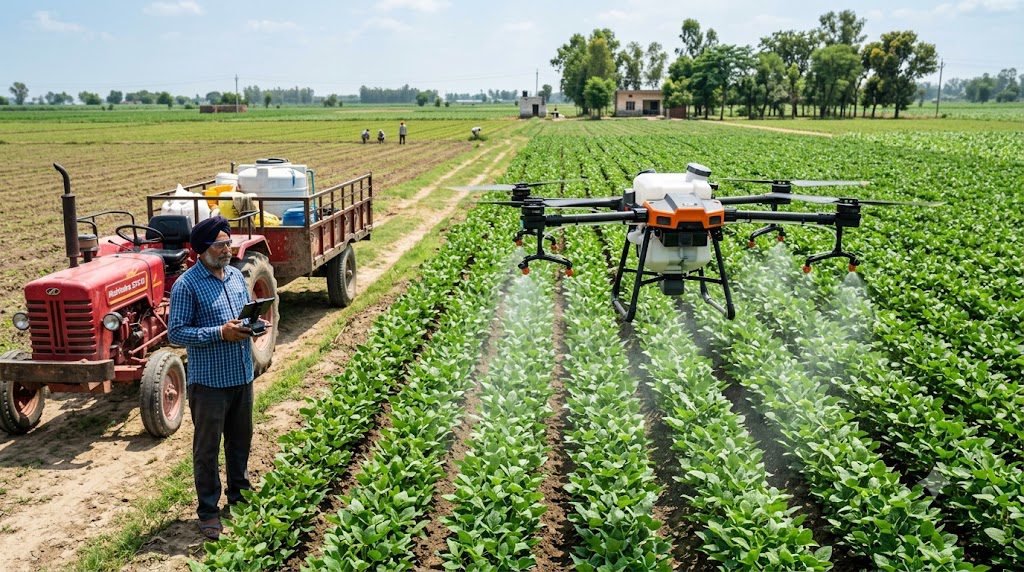
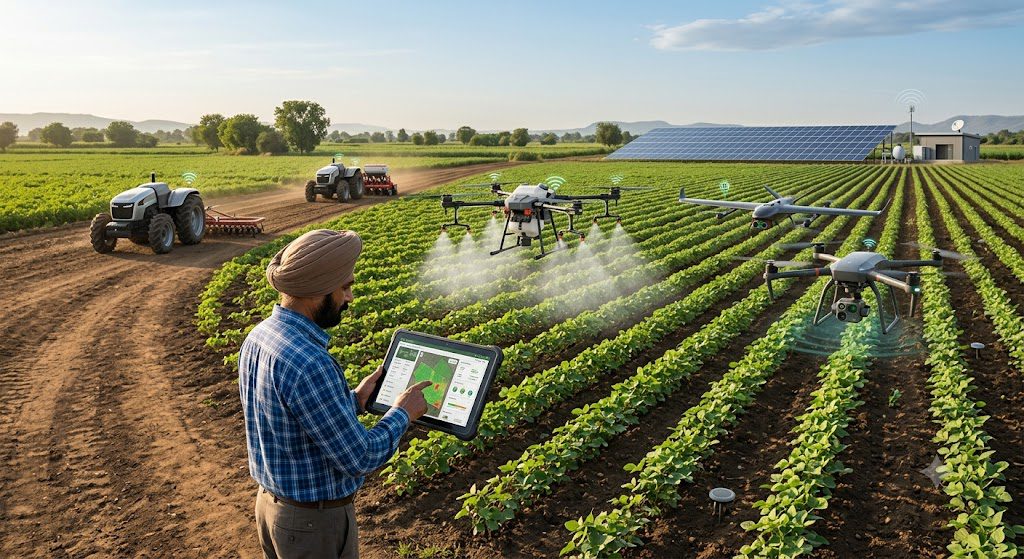
This is the most common commercial use case and the one driving most of the cost savings. Spray drones apply pesticides, herbicides, and fertilizers directly where needed, using GPS-guided flight paths and pre-mapped field boundaries. Precision application through drones reduces chemical usage by 20–50% compared to broadcast spraying, because the drone applies inputs only where sensor data or field maps say they’re actually needed not uniformly across a field where half of it may not need treatment at all.
Crop Monitoring and Health Assessment
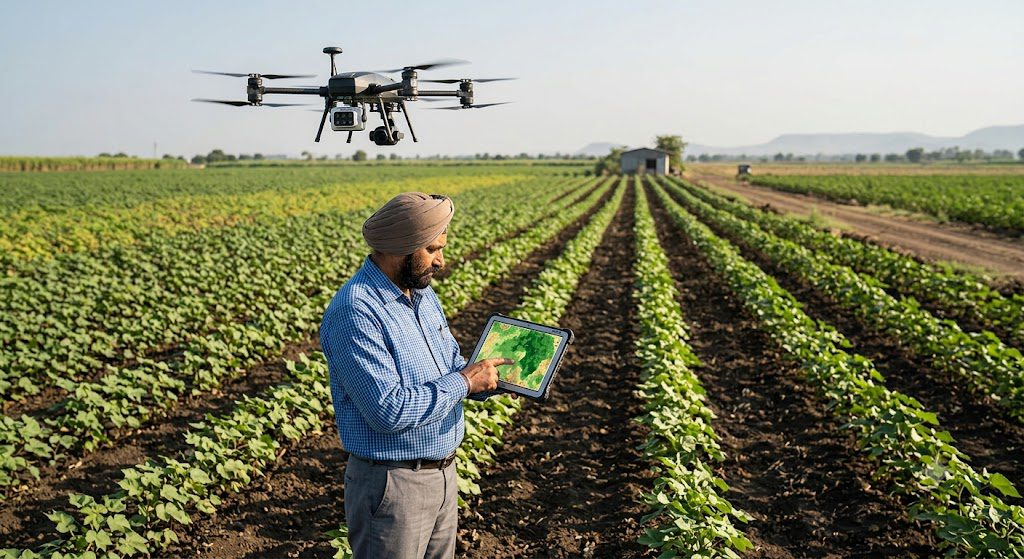
Fitted with multispectral, hyperspectral, or thermal sensors, monitoring drones fly a field and capture data most people can’t see with the naked eye early plant stress, nutrient deficiencies, irrigation problems, or the first signs of a pest outbreak, often days or weeks before visible symptoms would appear. That early warning window is often the difference between a manageable problem and a yield-damaging one.
Seeding and Planting
Less common than spraying, but growing drones can drop seed pods or pellets across a field, particularly useful for cover crops, reforestation-adjacent farming, or fields with terrain that’s difficult for ground equipment to access.
Field Mapping and Surveying
Before you can farm precisely, you need an accurate picture of the field itself. Mapping drones generate georeferenced maps showing elevation changes, drainage patterns, soil variation, and crop density data that then feeds into variable-rate application systems for everything from irrigation to fertilizer.
Livestock and Field Monitoring
A smaller but growing use case: drones for checking herd locations, fence line integrity, and water source access across large grazing operations, cutting down on the hours spent physically driving or riding a property boundary.
Fixed-Wing vs. Multirotor: Which Type of Agricultural Drone Do You Need?
Not all agricultural drones are built the same way, and picking the wrong type is one of the most common and most expensive mistakes first-time buyers make.
Multirotor drones (the four, six, or eight-propeller type most people picture) are the standard choice for spraying and close-range monitoring. They can hover, fly slowly and precisely over a specific zone, and land in tight spaces. Almost all spray drones, including the popular DJI Agras line, are multirotor designs. The trade-off is flight time most multirotor units fly for 15–25 minutes per battery, which is why commercial operators carry multiple spare batteries and rotate them throughout the day.
Fixed-wing drones look and fly more like a small airplane, and they trade hovering ability for range and endurance. They’re the better choice for mapping and surveying large areas some fixed-wing mapping drones can cover several hundred hectares in a single flight, far more than any multirotor could manage. They’re a poor fit for spraying, though, since they can’t hover over a target zone the way a multirotor can.
Most working farms that both spray and monitor end up using a combination a multirotor for application work and either a fixed-wing drone or a satellite-imagery subscription for broad-area mapping. If you can only justify one purchase, buy for whichever task is costing you the most time or money right now, not whichever drone looks the most impressive in a demo video. Drones are just one item on a longer list of tech worth evaluating see our roundup of the best farm-tech tools for agriculture for how they compare to other options.
Agricultural Drone Prices in 2026: What You’ll Actually Pay
Pricing varies a lot depending on payload capacity, sensor quality, and automation level. Here’s a realistic breakdown based on current 2026 market pricing.
Entry-level drones ($2,000–$8,000): Suitable for small farms, rice fields, vegetable plots, and orchards. Typically carry 8–16 liter spray tanks with limited automation. This is the right starting tier for most first-time buyers, especially smallholders testing whether drone spraying fits their operation before committing to something bigger.
Mid-range drones ($8,000–$18,000): Add RTK precision positioning (accurate to within a few centimeters), intelligent route planning, terrain-following flight, and automatic spraying systems. This tier suits established mid-size operations that are past the testing phase.
Professional/commercial drones ($15,000–$40,000+): Built for large farms, plantations, and commercial spraying services. Models in this class think DJI’s Agras T50 or XAG’s P150 carry 40–50 liter tanks, use radar-based obstacle avoidance, and can cover many hectares per hour. A full commercial spraying kit with batteries, charging hardware, and an RTK base station can push total cost to $22,000–$30,000 even when the base drone itself is cheaper, according to Ecoxplus’s 2026 agricultural drone price breakdown.
One thing worth budgeting for that first-time buyers often miss: the complete package usually costs 30–50% more than the drone alone, once you add spare batteries, a smart charger, an RTK base station, backup nozzles, and a generator for field charging. If you’re already weighing other major equipment purchases this season, our guide to tractors, harvesters, and equipment pricing may help you prioritize where your budget goes furthest.
The No-Capital Alternative: Drone-as-a-Service
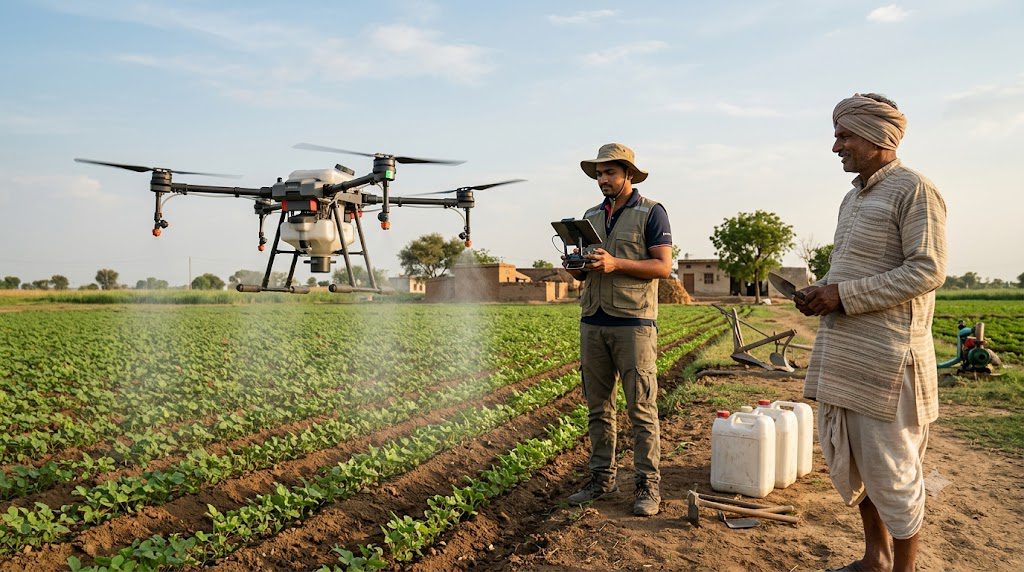
If the upfront cost is the barrier, drone-as-a-service pricing at roughly $5–$40 per acre lets you access the same spraying, mapping, or monitoring capability without buying equipment at all. This model has expanded quickly in regions like Punjab in India, Iowa in the US, and Saskatchewan in Canada, where local drone service providers and farming cooperatives now offer spraying and mapping as an on-demand service rather than requiring every farmer to own a unit outright.
Is Drone Farming Actually Worth It? The Real ROI Numbers
This is the question that actually matters, so here’s what the return on investment looks like in practice rather than in marketing copy.
Drone adoption research from 2026 identifies five sources of return:
- Labor cost savings : 75–90% lower than manual spraying
- Input savings : 20–50% less chemical usage through precision, targeted application
- Yield improvement : 5–15% gains from early disease detection and targeted intervention
- Water savings : where drones inform irrigation decisions, farms have reported meaningfully reduced water use
- Time savings : a task that takes a crew a full day on foot can often be completed by drone in under an hour
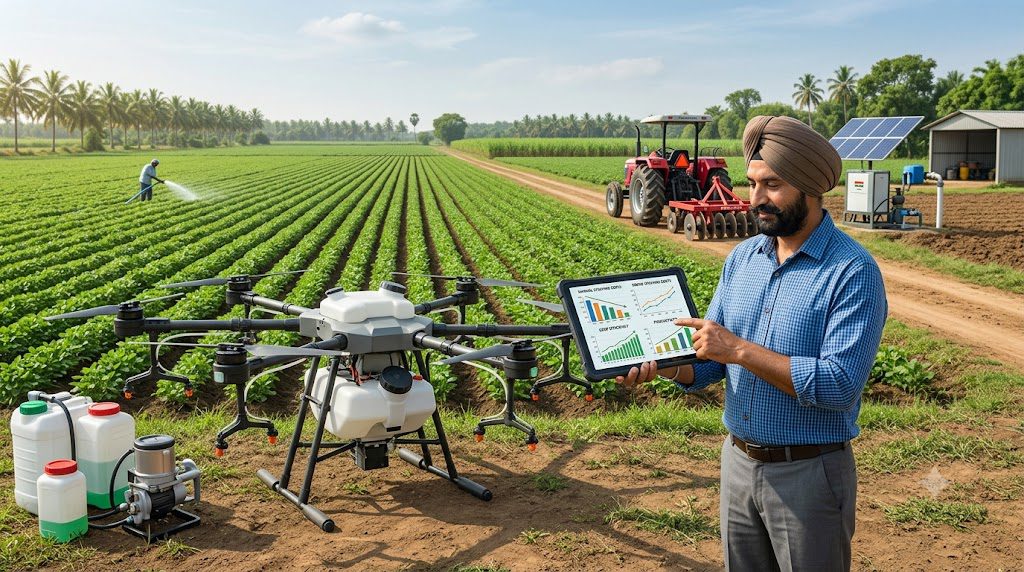
Based on current data, agricultural drones deliver a positive return for most commercial farms within 1 to 3 years of adoption a payback window most farm equipment can’t match. Smaller operations using drone-as-a-service instead of ownership tend to see returns even faster, since there’s no equipment cost to recover in the first place.
When Drone Investment Doesn’t Make Sense
To be fair to the other side of this: drone ownership isn’t automatically the right call for everyone. It tends to make less financial sense when:
- Your total farmed area is small enough that a DaaS provider’s per-acre pricing will always beat ownership costs
- You don’t have (or can’t access) a certified drone operator, and the training and certification cost would eat most of the projected savings
- Local regulations around drone airspace and agricultural spraying are unclear or restrictive in your region
- Your fields are heavily obstructed by trees, power lines, or irregular terrain that limits automated flight efficiency
If any of those apply to your situation, drone-as-a-service is almost always the smarter starting point over outright ownership.
A Realistic Example: Comparing Three Farm Sizes
Numbers land better with a concrete comparison, so here’s a simplified look at how the drone decision plays out differently depending on farm size. These are illustrative estimates based on current market pricing, not a guarantee for any specific operation your actual numbers will depend on your crop, region, and local labor costs.
Small farm (under 10 hectares, vegetables or orchard): An entry-level $3,000 drone with an 8–10 liter tank is usually overkill for the acreage involved. A local drone-as-a-service provider charging $15–$25 per acre for occasional spraying and seasonal crop monitoring will almost always be cheaper than ownership, with zero maintenance burden and no certification process to go through.
Mid-size farm (50–200 hectares, grain or row crops): This is where ownership starts to make financial sense. A mid-range $10,000–$15,000 drone with RTK precision, flown regularly across the growing season, can realistically pay for itself within two seasons once labor and input savings are factored in particularly on farms currently paying for manual spray crews.
Large commercial operation (500+ hectares): At this scale, a single drone often isn’t enough to cover the acreage within tight application windows (like a narrow pre-rain spraying deadline). Larger operations frequently run two or three professional-grade units, sometimes coordinating them as a small fleet, which is where the $30,000–$40,000+ investment tier and swarm-spraying technology become genuinely relevant rather than overkill.
The pattern across all three: the deciding factor isn’t how impressive the technology is, it’s whether your acreage and current labor costs are large enough to justify the switch from paying-per-job to owning equipment outright.
Government Support and Subsidy Programs
Public funding is playing a bigger role in drone adoption than most farmers realize, and it’s worth checking what’s available in your region before you buy anything.
In India, the “Drone Didi” scheme has become a well-known example a government initiative training and equipping rural women’s self-help groups to operate agricultural drones as a service for surrounding farms, combining rural livelihood creation with drone-based spraying access for smallholders who could never justify buying one outright. Similar public subsidy programs exist across parts of North America and Asia-Pacific, where governments are actively encouraging drone adoption to offset labor shortages and improve input efficiency at a regional level.
Before buying a drone outright, it’s worth checking with your local agricultural extension office or department of agriculture subsidy programs can meaningfully change the ROI math in your favor, sometimes covering a substantial share of the equipment cost.
Regulatory and Practical Barriers You Should Know About
Drones aren’t a buy-and-fly technology in most countries, and skipping this step is the most common mistake first-time buyers make.
Airspace and certification rules differ by country, and in many places, operating a commercial agricultural drone requires a pilot certification or registration, not just a purchase. Check your national aviation authority’s rules before you buy in some regions this process takes weeks, not days.
Digital literacy and data workflows can be a genuine barrier for farmers used to purely manual operations. Modern drone software has gotten far more user-friendly, but there’s still a learning curve to interpreting multispectral imagery or setting up automated flight paths correctly.
Battery performance in extreme climates is an underreported issue batteries degrade faster in high-heat, high-humidity conditions common across much of Asia-Pacific, which affects both flight time and long-term replacement costs. Factor this into your budget if you’re farming in a tropical or subtropical region.
How to Choose the Right Agricultural Drone for Your Farm
1. Start with the job, not the drone. Decide whether spraying, monitoring, mapping, or seeding is your actual priority don’t buy a do-everything commercial unit if you only need basic crop health monitoring.
2. Match tank size to field size realistically. An 8–16 liter tank is plenty for a small vegetable operation. A large grain farm will burn through refill cycles constantly on anything under 30 liters.
3. Try drone-as-a-service before you buy. Renting or hiring a local drone service for a season is the cheapest way to find out whether the technology actually fits your workflow before committing capital.
4. Check compatibility with your farm management software. If you’re already using a platform to track field data, make sure whatever drone you choose can feed data into it DJI SmartFarm and DroneDeploy are among the more commonly supported systems. For a broader look at how these platforms fit together, see our guide to agric technology transforming agriculture.
5. Budget for the full kit, not just the drone. Batteries, charging equipment, and an RTK base station can add 30–50% to your total cost plan for that upfront instead of discovering it after purchase.
6. Confirm local regulatory requirements first. Certification and airspace approval can take longer than the equipment delivery itself in some regions start that process early.
What’s Next for Agricultural Drones
A few directions are shaping where drone technology in agriculture goes from here:
- AI-powered obstacle avoidance and autonomous flight are becoming standard even in mid-range drones, not just premium commercial units, reducing the skill barrier for new operators.
- Integration with satellite data is letting drones and satellite imagery work together satellites for broad field-level trends, drones for close, detailed follow-up on the specific zones that need it.
- Swarm spraying, where multiple drones coordinate to cover large fields simultaneously, is moving from research demonstrations toward early commercial deployment on very large operations.
- Falling battery and hardware costs are expected to keep pushing entry-level pricing down, which should continue widening access for small and mid-size farms over the next few seasons.
Frequently Asked Questions About Agricultural Drones
How much does an agricultural drone cost in 2026? Entry-level drones start around $2,000–$3,000, mid-range models with RTK precision and automation run $8,000–$18,000, and professional commercial units cost $15,000–$40,000 or more. A complete kit with batteries and charging equipment typically adds 30–50% to the base drone price.
Is drone spraying actually cheaper than manual spraying? Yes, in most cases. Drone spraying cuts labor costs by an estimated 75–90% compared to manual application, and precision targeting reduces chemical input usage by 20–50%, which adds up quickly across a full growing season.
Do I need a license to fly an agricultural drone? In most countries, yes commercial agricultural drone operation typically requires registration or pilot certification. Requirements vary significantly by country, so check with your national aviation or civil aviation authority before purchasing.
What’s the difference between owning a drone and drone-as-a-service? Ownership makes sense for larger operations flying drones regularly enough to justify the equipment and maintenance cost. Drone-as-a-service, priced around $5–$40 per acre, is usually the better option for smaller farms or anyone testing whether drone technology fits their operation before committing capital.
How long does it take for an agricultural drone to pay for itself? Most commercial farms see a positive return within 1 to 3 years of adoption, driven mainly by labor and input savings. Smaller farms using drone-as-a-service typically see faster returns since there’s no equipment cost to recover.
Final Thoughts
Agricultural drones have crossed the line from experimental technology to standard farm equipment for a growing share of operations worldwide, and the pricing shift over the past two years is the main reason why. What used to require a large capital outlay reserved for big commercial farms is now accessible through entry-level ownership or pay-per-acre service models that fit operations of almost any size.
That doesn’t mean every farm needs a drone this season. But if spraying labor, chemical costs, or slow crop-stress detection are ongoing pain points on your operation, it’s worth running the numbers starting with a local drone-as-a-service provider before deciding whether ownership makes sense for you.
Pingback: Robotic Fruit Harvesting: 9 Powerful Robots Solving the 2026 Labor Crisis -