
Editorial note: This article is built primarily on the European Food Safety Authority’s own peer-reviewed safety assessment, UK Food Standards Agency findings, peer-reviewed studies in the Journal of Dairy Science, and a detailed scientific fact-check from Science Feedback, all linked below. It has not been reviewed by a livestock nutritionist or toxicologist prior to publication.
Table of Contents
Methane-reducing feed additives for cattle — supplements added to cow feed that reduce the methane produced during digestion — became one of the most searched and most misunderstood agritech topics in the world starting in late 2024, when a single product, Bovaer, went from virtually unknown to over 71,000 social media mentions in days, according to social listening data.
This article separates what the peer-reviewed regulatory science actually found from what spread as misinformation, and covers the broader global landscape of methane-reducing technology beyond the one product that made headlines.
What Are Methane-Reducing Feed Additives?
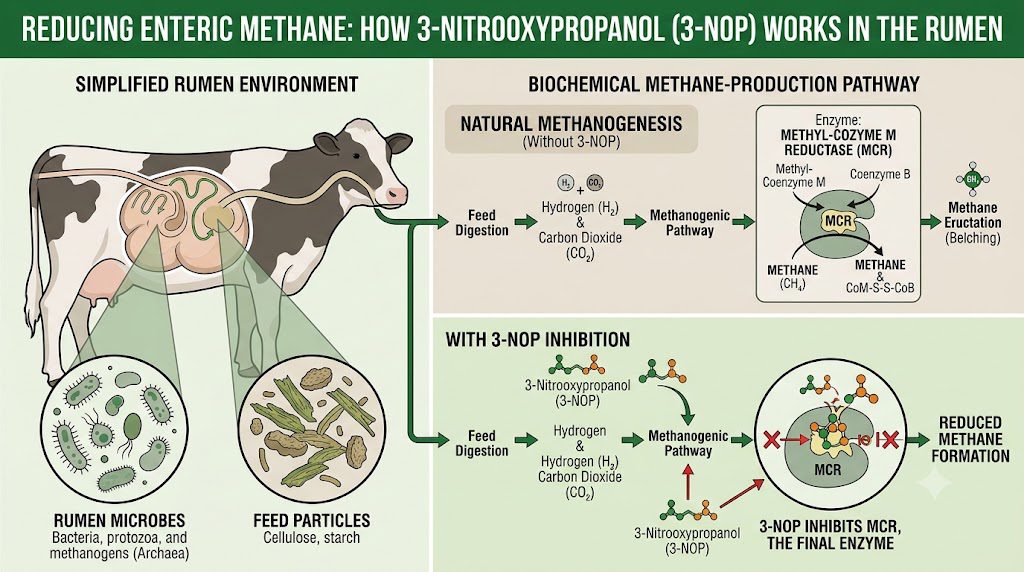
Methane-reducing feed additives are compounds added to cattle feed that interfere with the digestive process that produces methane in ruminant animals — cows, sheep, and goats — without requiring any change to what the animal eats or how it’s raised otherwise.
Ruminants have a specialized stomach populated with microbes that ferment fibrous plant material, and this fermentation process produces methane as a byproduct, released mainly through burping. According to a detailed scientific review, a single cow can produce 70 to 120 kilograms of methane per year, and methane is roughly 28 times more potent as a greenhouse gas than carbon dioxide over a 20-year period.
Why This Became One of the Most-Searched Agritech Topics Globally
1. A single product triggered a genuine global controversy, almost overnight. In November 2024, Danish dairy cooperative Arla Foods announced it would trial Bovaer across roughly 30 UK farms in partnership with Aldi, Morrisons, and Tesco — and within days, misinformation spread rapidly enough that social media mentions of Bovaer surged from virtually zero to over 71,000, according to social listening firm Brandwatch, as reported by industry coverage.
2. The controversy spread to real consumer boycotts. According to detailed fact-checking by Science Feedback, a non-partisan scientific fact-checking organization, the misinformation included false claims that Bovaer made milk “poisoned,” alongside calls to boycott dairy brands and even baseless conspiracy theories falsely linking Bill Gates to the product.
3. The FDA’s own approval letter became a misinformation flashpoint. Some social media posts cited an FDA safety letter to Bovaer’s manufacturer warning that concentrated 3-NOP (Bovaer’s active ingredient) can be a skin and eye irritant and should not be handled without protective equipment — a standard industrial handling warning that critics misrepresented as evidence the product was unsafe for cattle or consumers, despite this warning applying to concentrated industrial handling, not the tiny doses fed to animals.
4. This is happening while regulators are actively conducting fresh reviews, not resting on old approvals. As of this month, Agriland.ie reports that the European Food Safety Authority is completing a new scientific opinion on Bovaer at the request of the European Commission, following reports from some Danish farmers that their cows’ health and milk output had been affected — though the same reporting confirms no scientific link between Bovaer and negative cow health outcomes has been established to date.
5. The underlying climate stakes are genuinely large. According to the same Science Feedback review, livestock production represents a third of global anthropogenic methane emissions, and the UN Food and Agriculture Organization recommends countries cut methane emissions, particularly from livestock, by 30% by 2030 — meaning this single controversy sits at the intersection of food safety fears and one of agriculture’s largest climate targets.
How Methane-Reducing Feed Additives Actually Work
The Chemical Mechanism
Bovaer’s active ingredient, 3-nitrooxypropanol (3-NOP), is an alcohol compound that stops the final chemical reaction needed to produce methane in a cow’s stomach, according to a 2016 study published in the Proceedings of the National Academy of Sciences that first uncovered its specific mode of action.
Dosage
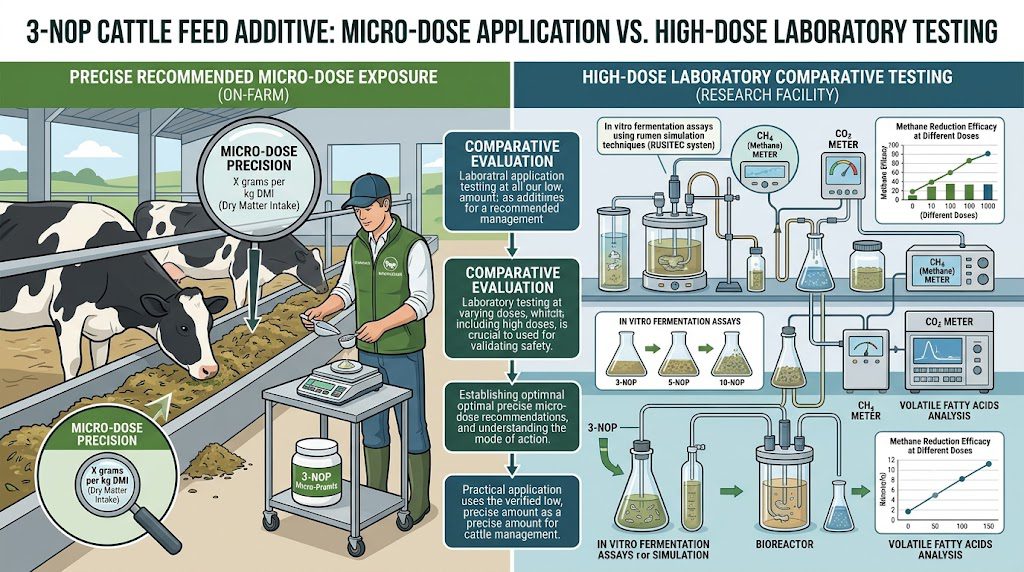
The manufacturer recommends approximately a quarter teaspoon — about 1.5 grams — of the product per animal per day, of which the active 3-NOP ingredient represents only about 10.5%, working out to roughly 0.15 grams per cow daily.
Alternative Approaches: Seaweed-Based Additives
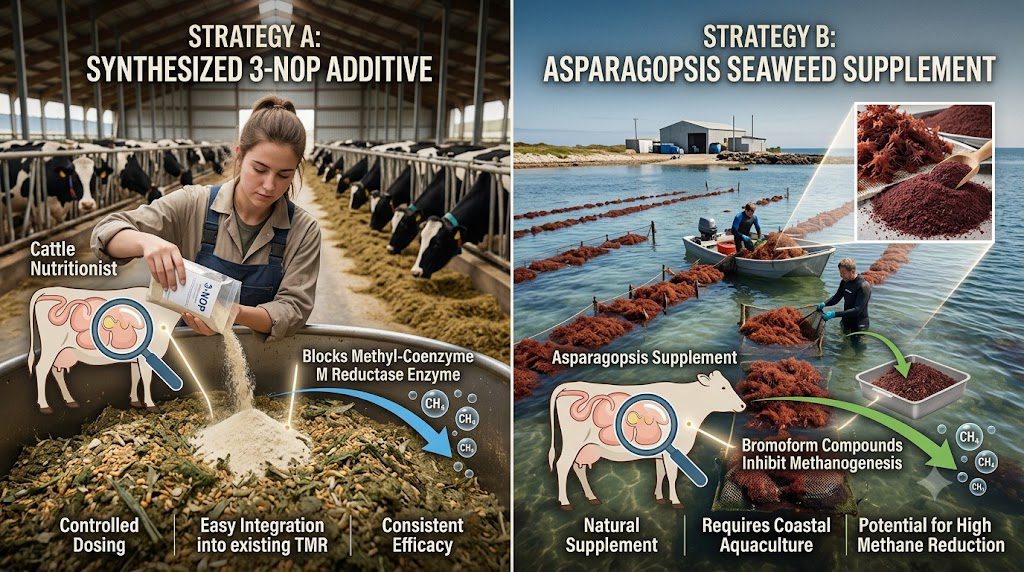
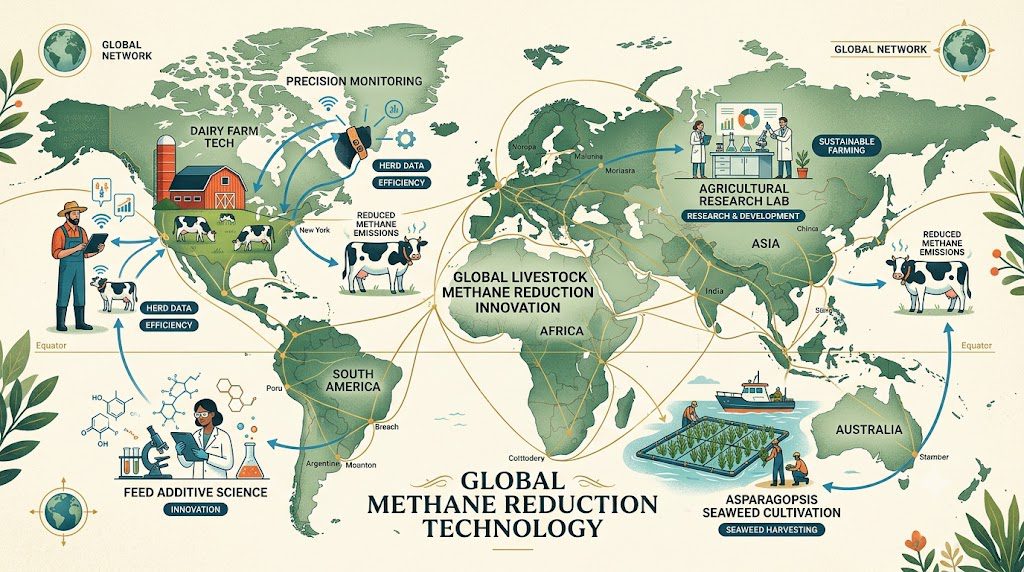
A separate category of methane-reducing feed additives uses red seaweed, specifically Asparagopsis, discovered by Australia’s Commonwealth Scientific and Industrial Research Organisation (CSIRO) to reduce methane production in cattle by up to 20% in initial research, with some commercial trials reporting reductions as high as 90% under specific dietary conditions.
Metabolism and Breakdown
Per the EFSA’s own peer-reviewed safety assessment, 3-NOP is rapidly and almost entirely metabolized by rumen bacteria within 24 hours of administration, breaking down into compounds — 1,3-propanediol, nitrogen compounds, and carbon dioxide — that are already naturally present in the body.
What EFSA’s Actual Peer-Reviewed Data Shows
This is the section worth reading most carefully, because it’s the actual regulatory science, not a summary of a summary.
The European Food Safety Authority’s peer-reviewed safety assessment, published in the EFSA Journal, tested 3-NOP extensively in laboratory cell cultures, rodents, dogs, goats, and cows.
The assessment did identify real findings worth stating plainly rather than glossing over: while most tests showed no DNA damage, the possibility couldn’t be fully ruled out from the data; researchers observed benign, non-cancerous tumors in the intestines of female rats fed very high doses over two years; and testicular shrinkage occurred in rats given high daily doses over three months, with ovarian shrinkage observed in cows given twice the recommended dose for two months.
The critical context missing from viral social media claims is dosage. All of these adverse effects were observed at 300 to 500 milligrams of pure 3-NOP per kilogram of body weight. The EFSA panel found no adverse effects at doses up to 100 milligrams per kilogram of body weight per day, which it used to establish the No Observed Adverse Effect Level (NOAEL).
A cow receiving Bovaer at the manufacturer’s recommended dose gets approximately 0.3 milligrams of 3-NOP per kilogram of body weight — roughly 1,000 times lower than the doses associated with adverse effects in rats, and hundreds of times below the NOAEL threshold.
Critically, the assessment also found no traces of 3-NOP itself in the milk or meat of treated animals, at any dose tested. A related breakdown product, NOPA, was detected at trace levels in milk from just one of 19 cows evaluated — at a concentration the EFSA panel calculated to be at least 1,000 times below the safety threshold for human consumption.
Separating the Real Findings from the Misinformation
A genuinely trustworthy account of this topic has to hold two things as true at once, because both are.
What’s real: EFSA’s own data shows 3-NOP does have measurable toxic effects in laboratory animals at high doses. The FDA’s handling warnings for concentrated 3-NOP are real and accurate — it is an irritant that shouldn’t be handled without protective equipment in its concentrated industrial form. Danish farmers have raised real questions about cow health that regulators are actively investigating.
What’s false: The claim that these findings mean the product is unsafe for consumers drinking milk or eating meat from treated cows.
As RMIT University chemistry professor Oliver Jones told the UK’s Science Media Centre, in reporting cited by Science Feedback, comparing the handling risks of a concentrated industrial substance to its diluted use conflates two entirely different exposure scenarios — “common salt is also an irritant to the eyes and skin, and water is clearly potentially harmful by inhalation… context is extremely important when assessing risk, but entirely missing from the social media videos on this topic.”
This is the pattern worth understanding, not just for Bovaer specifically: a real, technical regulatory finding (a hazard label on a concentrated industrial chemical) got stripped of its dosage and exposure context and repackaged as proof of consumer danger.
The underlying regulatory science doesn’t support that leap, and pretending the concerns were entirely baseless from the start would also be inaccurate — EFSA’s own report is the more honest, complete account than either the original misinformation or a defensive dismissal of it.
Bovaer vs. Seaweed-Based Additives
| Factor | Bovaer (3-NOP) | Seaweed-Based (Asparagopsis) |
|---|---|---|
| Regulatory approval | Authorized in 68+ countries including EU, US, UK, Canada | Approved in Australia for commercial cattle feedlot use |
| Reported methane reduction | 30% in dairy cattle, up to 45% in beef cattle | Up to 20% in initial CSIRO research, higher in some trials |
| Production model | Synthesized chemical compound, factory-manufactured | Farmed seaweed, aquaculture-dependent supply chain |
| Public controversy exposure | High, following the 2024 Arla misinformation surge | Lower profile, less direct public controversy to date |
| Investment scale | Backed by major agribusiness (DSM-Firmenich) | Backed by CSIRO, Bill Gates (via Rumin8), and multiple startups |
The honest takeaway: both approaches have credible science behind them, but they face different practical constraints — Bovaer’s challenge has become public trust and perception following the misinformation surge, while seaweed-based approaches face a more fundamental production cost and aquaculture supply chain scaling problem that has kept them from matching Bovaer’s regulatory reach.
Real Global Adoption Numbers
Treat every figure here as reported by the specific source cited — this is a genuinely fast-moving regulatory and commercial landscape.
Regulatory reach: Bovaer has been authorized and marketed in more than 68 countries worldwide since the EU’s April 2022 authorization, including the United States, Canada, and the United Kingdom.
Investment in the broader category: According to AgFunder data, a relatively modest $233 million has been invested into startups tackling livestock methane over the past decade, with the bulk directed toward red seaweed-based feed supplements specifically.
Notable funding rounds: Rumin8, an Australian methane-reduction startup, secured $17 million in 2023 from investors including Bill Gates and Andrew Forrest; CSIRO’s FutureFeed joint venture raised $13 million in 2020; and a $90 million commercial plant to produce methane-reducing cattle feed is being built in South Australia.
Efficacy data from independent meta-analysis: A peer-reviewed meta-analysis published in the Journal of Dairy Science, examining multiple independent studies of 3-NOP’s effects across dairy herds, confirmed consistent methane reductions in the 28% to 33% range — a figure that aligns closely with the manufacturer’s own claims, from research not funded by the manufacturer.
Who’s Building This: Companies Worldwide
DSM-Firmenich, a Dutch-Swiss company, manufactures Bovaer and has researched the product for nearly 15 years prior to its 2022 EU authorization, according to Science Feedback’s review of the company’s own safety documentation.
CSIRO (Australia’s Commonwealth Scientific and Industrial Research Organisation) holds the global intellectual property for using Asparagopsis seaweed as a methane-reducing livestock feed ingredient, developed through its FutureFeed joint venture with Meat & Livestock Australia and James Cook University.
Rumin8, an Australian startup backed by Bill Gates and Andrew Forrest, is developing a separate synthetic methane-reduction approach — notably a different company from DSM-Firmenich, despite social media misinformation incorrectly linking Gates directly to Bovaer itself.
Volta Greentech, based in Gothenburg, Sweden, offers a seaweed-based additive called Lome, designed to integrate into existing feeding systems for beef production, illustrating that this is a genuinely global industry rather than one concentrated in a single country.
Ruminant BioTech, based in Auckland, New Zealand, has developed a slow-release bolus delivery method as an alternative to daily feed mixing, aimed at improving practical adoption for grazing systems where daily feed supplementation is harder to manage consistently.
If you’re evaluating any methane-reducing additive, ask directly which regulatory bodies have approved the specific product for your region and species, and request the underlying peer-reviewed safety data rather than relying on either manufacturer marketing or social media claims in either direction.
Real Limitations and Open Questions
No credible regulatory source treats this technology as free of open questions.
- EFSA is actively conducting a fresh review of Bovaer specifically, following farmer-reported concerns in Denmark about cow health and milk output — a live, unresolved regulatory process, not a closed matter, as of this article’s publication.
- Seaweed-based additives face real production scaling barriers. Industry sources note that production costs for Asparagopsis-based supplements remain too high to consistently deliver a clear return on investment for farmers using them at scale.
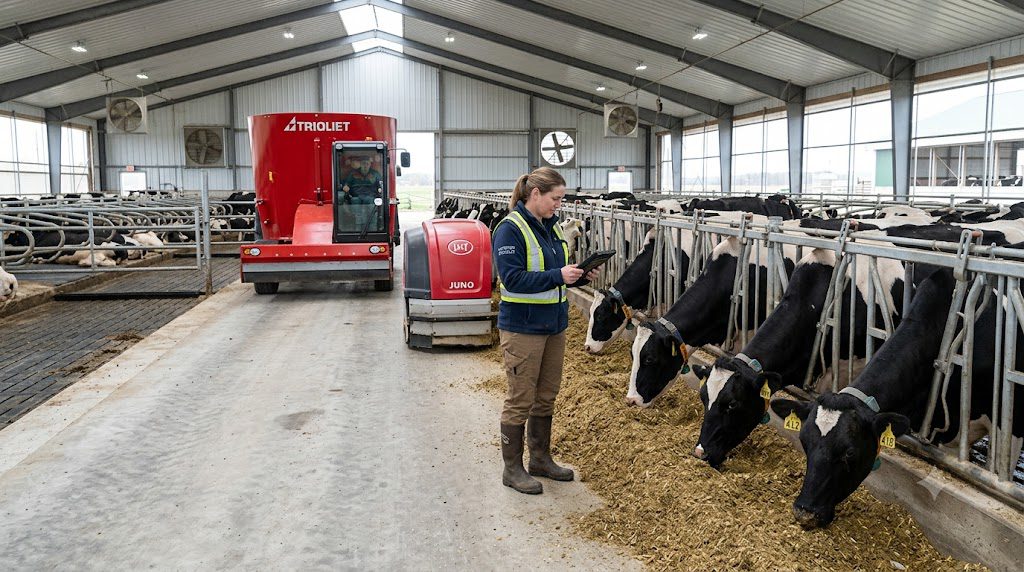
- Grazing systems present a practical delivery challenge. Daily feed-mixed additives work well for confined dairy operations but are harder to administer consistently to grazing cattle, which is why companies like Ruminant BioTech are developing slow-release delivery alternatives.
- Long-term data on continuous, multi-year use is still accumulating. Most large-scale commercial deployment has occurred within the past few years, meaning the multi-decade safety and efficacy track record that would fully settle open questions is still being built.
- Public trust damage from the 2024 misinformation episode is a real, separate problem from the underlying science. Even where the regulatory data is sound, rebuilding consumer confidence after a viral misinformation event is its own significant, ongoing challenge for the industry.
How to Evaluate the Evidence Yourself
- Go to the primary regulatory assessment, not a summary of a summary. EFSA’s and the UK FSA’s full assessments are publicly available and include their own stated limitations, not just conclusions.
- Pay specific attention to dosage in any safety claim. As this article’s data shows, the same compound can be genuinely hazardous in concentrated industrial form and safe at the diluted doses actually used in cattle feed — conflating the two is the single most common source of misinformation on this topic.
- Check whether a claim distinguishes the compound itself from its breakdown products. EFSA’s assessment evaluated both 3-NOP and its metabolite NOPA separately, with different safety thresholds for each.
- Watch for live regulatory reviews rather than assuming a past approval is the final word. EFSA’s ongoing 2026 review of Bovaer is a good example of how regulatory science continues after initial authorization, particularly when new farmer-reported concerns emerge.
- Consider funding source, but don’t dismiss data solely because of it. The peer-reviewed Journal of Dairy Science meta-analysis cited above included both manufacturer-funded and independent research, and found consistent results across both — a stronger form of evidence than either source alone.
This kind of evidence-based evaluation connects directly to the methane-reduction strategies already discussed in our sustainable livestock farming guide, and to the broader carbon credit opportunities covered on this site that increasingly reward verified methane reduction.
Common Mistakes People Make Discussing This Topic
- Citing an industrial handling warning as proof of consumer risk, without accounting for the dosage difference between concentrated and diluted use — the single most common error in the 2024 misinformation surge.
- Treating a manufacturer’s safety claims as sufficient on their own, when independent peer-reviewed research and regulatory assessments provide a stronger, more complete evidentiary basis.
- Dismissing all farmer-reported concerns as misinformation, when some — like the Danish reports currently under EFSA review — are legitimate signals being taken through proper scientific investigation rather than baseless claims.
- Assuming Bovaer is the only methane-reduction option, when seaweed-based, bolus-delivered, and other approaches from companies across Australia, Sweden, and New Zealand represent a genuinely diverse global field.
This same rigor around verified claims and regulatory status applies broadly to evaluating any livestock and animal husbandry technology covered on this site — checking primary sources rather than secondhand summaries in either direction.
FAQs About Methane-Reducing Feed Additives
1. What are methane-reducing feed additives for cattle?
Methane-reducing feed additives are compounds added to cattle feed to reduce methane produced during digestion. They work by interfering with the microbial processes in the rumen that generate methane.
2. What is Bovaer and how does it work?
Bovaer is a cattle feed additive containing 3-nitrooxypropanol (3-NOP). It works by inhibiting a key step in the methane-production process inside the rumen, reducing the amount of methane produced during digestion.
3. Is Bovaer safe for cows?
Regulatory assessments have found Bovaer safe for its intended use at recommended feeding levels. However, the article also notes that high-dose laboratory studies identified certain adverse effects, making dosage and exposure context important.
4. Is Bovaer safe for humans who drink milk from treated cows?
The safety assessments discussed in the article found no consumer safety concern at the approved conditions of use. The article reports that 3-NOP itself was not detected in milk or meat in the relevant testing, while a breakdown product was detected only at trace levels far below the established safety threshold.
5. Does Bovaer reduce methane emissions from cattle?
Yes. The article cites a peer-reviewed meta-analysis reporting approximately 28% to 33% methane reduction in dairy cattle when 3-NOP was used under the studied conditions.
6. What is 3-NOP in cattle feed?
3-NOP, or 3-nitrooxypropanol, is the active ingredient in Bovaer. It interferes with the final biochemical step involved in methane production by rumen microbes.
7. Why did Bovaer become controversial?
Bovaer became controversial after social-media claims about its safety spread rapidly in late 2024. The controversy included claims about contaminated or unsafe milk and misleading connections between Bovaer and Bill Gates. Scientific fact-checking cited in the article found these claims unsupported.
8. Is Bill Gates involved with Bovaer?
Bill Gates has invested in Rumin8, a separate company developing methane-reduction technology. The article states that this does not mean he owns or controls Bovaer or its manufacturer, DSM-Firmenich.
9. What are the alternatives to Bovaer?
Alternatives include seaweed-based feed additives using Asparagopsis, slow-release delivery systems such as boluses, and other methane-reduction technologies being developed by companies including Rumin8.
10. Can seaweed reduce methane emissions from cattle?
Research on Asparagopsis seaweed has shown methane reductions in cattle, although results vary considerably depending on diet, dosage, and trial conditions. The article notes reductions of up to 20% in initial CSIRO research and higher reductions in some specific trials.
Final Thought
Methane-reducing feed additives sit at a genuine intersection of solid regulatory science and one of the most damaging pieces of agricultural misinformation in recent memory.
EFSA’s own peer-reviewed data, examined directly rather than through a social media screenshot, supports the product’s safety at recommended doses — and simultaneously, real farmer-reported concerns are being taken seriously enough to trigger an active regulatory re-review, which is exactly how the system should work when new questions arise.
Neither the original panic nor a reflexive dismissal of every concern raised since captures the full picture. For anyone evaluating this technology, the most useful habit isn’t picking a side in the Bovaer controversy — it’s going directly to the primary regulatory assessments, understanding dosage context, and staying aware that this is an active, evolving scientific and regulatory conversation rather than a settled one.
Related reading on this site: Sustainable Livestock Farming: Unlocking Powerful Solutions to Cut Emissions & Boost Returns 2025, Carbon Credits for Farmers: 7 Amazing Ways to Earn in 2026, Animal Husbandry: 6 Powerful Types of Animal Husbandry & Breeding, and Agric Technology: Transforming Agriculture for Greater Productivity in 2026.