
Farmers face a squeeze from three sides: fertilizer costs, erratic weather and soils that are tired after decades of heavy cropping. Agricultural biostimulants have become one of the most talked-about answers. They are sold as a way to help crops use nutrients better, cope with heat, drought and salinity, and improve quality.
They are also one of the most confusing products on the market. Claims are big, definitions differ by country, and results vary from field to field. In India alone, the government says around 30,000 biostimulant products were being sold before the sector was brought under regulation (Global Agriculture).
This guide cuts through the noise. You will learn what biostimulants are (and are not), the main types, what the best available field research says about yield, how the rules work in the EU, the US and India, and a 7-step process to test products safely on your own farm.
Key Takeaways
- Biostimulants stimulate plant processes; they are not fertilizers and not pesticides. The EU defines them as products that stimulate plant nutrition processes independently of the product’s own nutrient content (Eurofins summary of Regulation (EU) 2019/1009).
- Field research shows average gains but wide variation. One global meta-analysis found about 17.9 percent average yield gain; another found about 9.3 percent. Individual results ranged far above and below those averages.
- Gains tend to be larger under stress (drought, salinity, poor or sandy soils) than in already rich, well-managed soils.
- Check legal status first. In India, only products notified in Schedule VI of the Fertiliser Control Order are legal to sell.
- Always test on your own farm with an untreated comparison strip and calculate the return before scaling.
Table of Contents
1. What Are Agricultural Biostimulants?
A plant biostimulant is a substance, a microorganism, or a mixture of both that is applied to seeds, plants or the root zone to support the plant’s own natural processes. The key idea is that the benefit does not come mainly from the nutrients inside the product.
The European Union’s Fertilising Products Regulation sets out four goals for a biostimulant: improving nutrient use efficiency, tolerance to abiotic stress, quality traits, or the availability of confined nutrients in the soil or root zone (Eurofins summary of Regulation (EU) 2019/1009). The US 2018 Farm Bill describes a plant biostimulant in similar terms: a substance or microorganism that, applied to seeds, plants or the rhizosphere, stimulates natural processes to enhance nutrient uptake, nutrient efficiency, tolerance to abiotic stress, or crop quality and yield (Bergeson & Campbell).
In plain words: a fertilizer feeds the crop, while a biostimulant helps the crop make better use of what it already has and handle stress.

2. Biostimulants vs Fertilizers vs Pesticides
| Product type | Main job | Example |
|---|---|---|
| Fertilizer | Supplies nutrients directly | Urea, DAP, compost |
| Pesticide | Controls pests, diseases or weeds | Fungicide, insecticide |
| Biostimulant | Improves plant processes such as nutrient uptake and stress tolerance | Seaweed extract, humic acid, microbial inoculant |
One review notes that biostimulants act on plant vigor and do not respond directly to pests or diseases the way crop protection products do (Microbial Inoculants as Plant Biostimulants, PMC). They are a supporting tool, not a replacement for sound agronomy, fertilizer or crop protection.
If you are building a broader technology plan for your farm, start with our overview of agric technology in 2026 to see where biological inputs fit alongside sensors, drones and data.
3. The Main Types of Plant Biostimulants
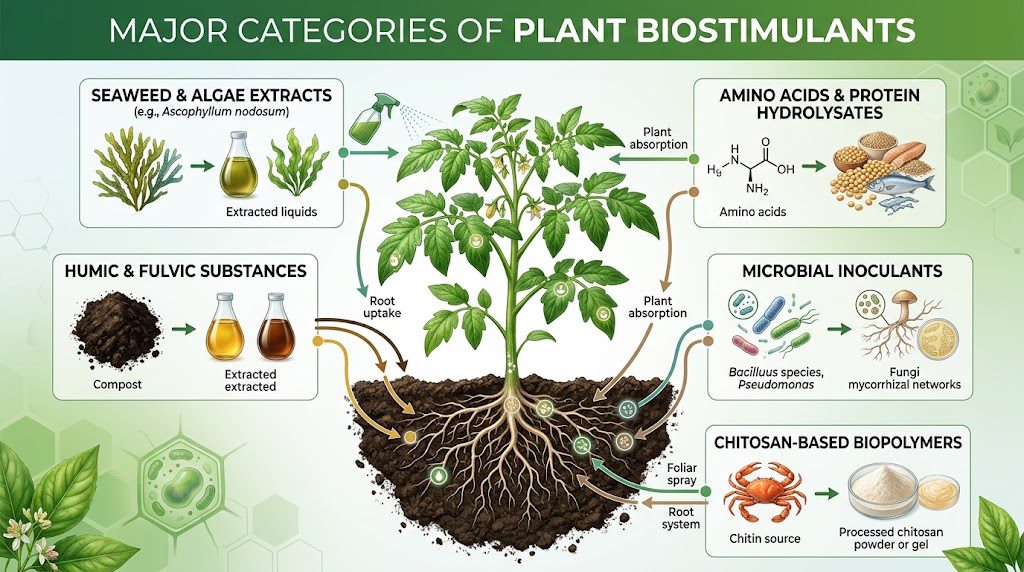
Researchers group biostimulants into several categories. One widely cited review recognizes six distinct categories, including microbial inoculants, humic substances (humic and fulvic acids), protein hydrolysates and amino acids, biopolymers and inorganic compounds, and it singles out seaweed extracts as a widely known group (Biostimulants Application: A Low Input Cropping Management Tool, PMC). Here is how they look in practice.
| Type | Examples | Commonly claimed role |
|---|---|---|
| Humic and fulvic substances | Humic acid, fulvic acid, humalite | Soil structure, nutrient availability, root growth |
| Seaweed and algae extracts | Kelp and other seaweed extracts | Stress tolerance, growth regulation |
| Protein hydrolysates and amino acids | Hydrolysed plant or animal protein | Recovery from stress, nutrient uptake |
| Microbial inoculants | Mycorrhizal fungi, plant growth-promoting bacteria, Trichoderma | Root zone health, nutrient mobilization |
| Biopolymers and others | Chitosan | Stress response, plant defence signalling |
Microbial and non-microbial products are regulated differently in the EU. Under the EU regulation, plant biostimulants are split into microbial and non-microbial groups, with separate requirements (Biorefine factsheet).
4. What the Research Says About Yield
This is the most important section, because marketing often outruns the science.
Large global analysis. A meta-analysis in Frontiers in Plant Science covered over one thousand open-field data pairs from 180 studies worldwide, focusing on non-microbial biostimulants. It reported an average add-on yield benefit of 17.9 percent, with the highest potential from soil treatment. Gains were biggest in arid climates and vegetable crops, and biostimulants were more effective in low-organic-matter, saline, nutrient-poor and sandy soils (Li et al., 2022). The authors themselves suggest the average may overestimate what farmers will see in a commercial setting (New AG International).
More cautious European project data. A 2024 meta-analysis of bio-effector trials on maize, wheat and tomato across Europe and Israel found an average growth or yield increase of 9.3 percent, with tomato responding more than maize and wheat. It also described effectiveness under field conditions as highly variable and poorly quantified, and found better results where abiotic stress was present (Frontiers in Plant Science, 2024).
On-farm trials show the economics matter. A 2025 study of humic biostimulation in main grains notes that the economic result depends on comparing the value of the yield increase with the cost of the product and its application, and that a product can pay off on one farm and not on another (Frontiers in Plant Science, 2025).
What to take from this:
- Expect modest, not miraculous, average gains.
- Stress, poor soil and crop type change the outcome.
- Your own farm trial matters more than any brochure.
A note on industry numbers. Suppliers often quote fast market growth. For example, an ICL AgTech article cites market estimates of 10 to 14 percent annual growth for biologicals and a retailer survey in which 86 percent of distributors planned to expand biological offerings in 2026 (ICL Group). ICL sells crop inputs, so treat the figures as an industry view rather than independent research.
5. Rules in the EU, USA and India
Regulation decides what you can legally buy, so it is worth knowing.
European Union
The EU Fertilising Products Regulation (EU) 2019/1009 applies from 16 July 2022 and created a dedicated category for plant biostimulants (PFC 6). Products that meet the rules can carry a CE mark and move freely across member states (Asia Pacific Biofertilizer and Biopesticide Information Platform, Van Iperen International). Manufacturers can also choose national routes instead (knoell).
United States
The 2018 Farm Bill was the first US federal law to include statutory language on plant biostimulants (Business Wire). There is still no single federal regulatory definition. EPA treats a biostimulant as a pesticide under FIFRA only when its claims and composition fall within the “plant regulator” definition (Beveridge & Diamond). A Plant Biostimulant Act of 2025 (S.1907) has been introduced in Congress to create a consistent definition (Congress.gov). Because bills can change, check its current status before relying on it.
India
India brought biostimulants under the Fertiliser Control Order (FCO), 1985, through a notification dated 23 February 2021. According to a Press Information Bureau release, around 30,000 products were in the market before regulation. Provisional certificates were issued for more than 8,000 products, and these became invalid from 17 June 2025. At that point only 146 biostimulants had been included in Schedule VI (PIB).
The Union Agriculture Minister has directed action against the marketing of unapproved products and asked that farmers be told about the certified list (Global Agriculture). States have also been urged to stop the forced bundling of biostimulants or nano-fertilizers with conventional fertilizers (Global Agriculture).
Practical rule for Indian farmers: before buying, ask the dealer for the product’s Schedule VI notification details and check the Department of Agriculture’s list. The count of notified products can change as new notifications are published, so confirm the latest list.
6. 7 Proven Steps to Use Biostimulants Wisely
Step 1: Diagnose the Real Problem
Do not start with the product. Start with the problem. Is the crop short of nutrients, stressed by heat or drought, facing saline soil, or struggling with poor structure? Soil and leaf tests will tell you if a standard fertilizer correction is needed first. A biostimulant cannot fix a nutrient deficiency that only fertilizer can solve.
Step 2: Match the Category to the Goal
Link the problem to a type from the table above. Stress recovery points toward seaweed extracts or amino acids. Poor, low-organic-matter soils point toward humic substances. Root-zone and nutrient mobilization goals point toward microbial products. Remember that the research found stronger responses on poor, sandy or saline soils.
Step 3: Confirm the Product Is Legal Where You Farm
In India, check Schedule VI notification. In the EU, look for CE marking or national authorization. In the US, check your state’s fertilizer or soil amendment registration rules. If the seller cannot show this, walk away.
Step 4: Check the Evidence and the Label
Ask for independent trial data on your crop and region, not only company data. Look for clear information on active ingredients, application method, timing and the crop it was tested on. Be careful with products that claim to cure disease or kill pests, because that is a crop protection claim, not a biostimulant one.
Step 5: Run a Small On-Farm Trial
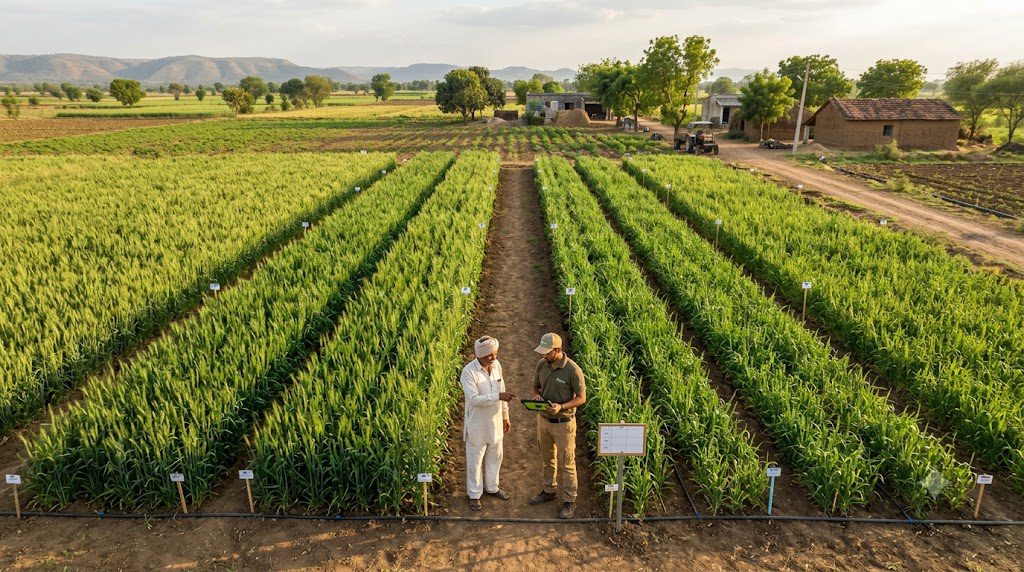
Treat part of a field and leave a comparable strip untreated, same variety, soil, irrigation and timing. Mark both strips and record planting date, inputs and weather. This one step protects you from wasting money across the whole farm.
Step 6: Apply at the Right Method and Time
The global meta-analysis found that application method matters, with soil treatment showing the highest potential in its dataset (Li et al., 2022). Even so, always follow the product label and your agronomist’s advice on rate, timing and compatibility with other sprays. Drones can also apply dry crop-protection products, including biological pesticides and dry fertilizers, according to Ohio State University’s pesticide application specialists (Ohioline, Ohio State University). See our drone farming guide for costs and use cases.
Step 7: Measure the Return Before You Scale
At harvest, compare yield and quality between treated and untreated strips, then subtract the product and application cost. Only expand if the gain clearly pays. Repeat the trial for a second season, since weather changes results.
7. Biostimulants and Smart Farming Technology
Biostimulants work best when you can see their effect clearly. That is where technology helps.
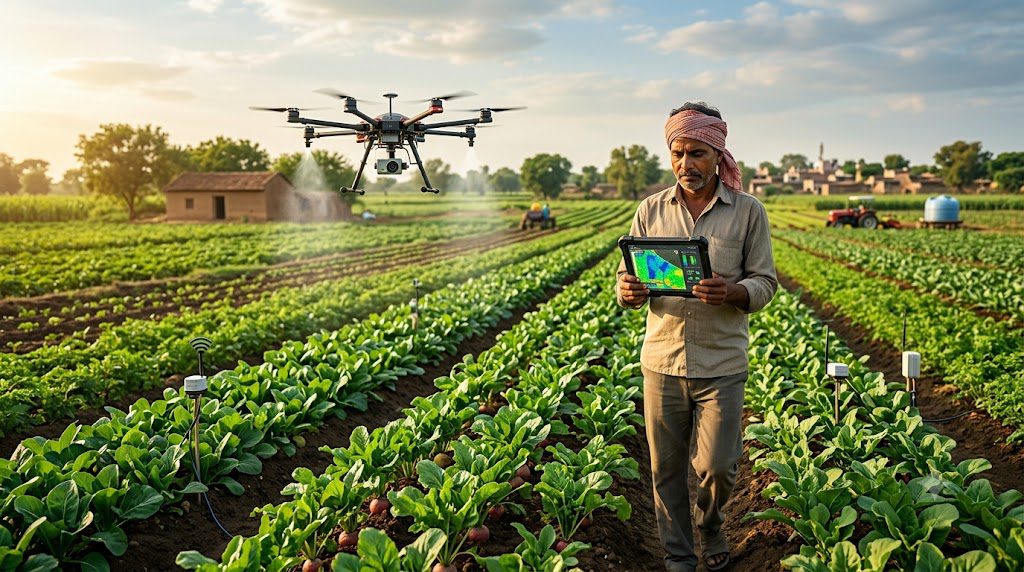
- Sensors and maps show where stress is worst, so you can target treatment. Our precision farming guide explains zone-based management.
- Drones and imaging can compare treated and untreated strips by crop vigor.
- Farm data tools help track costs and yield, as covered in our list of best farm-tech tools.
- Controlled-environment growing also uses biological inputs. See our piece on vertical farming innovations for how closed systems manage plant nutrition.
Used together, these tools turn biostimulant use from guesswork into a measured decision.
8. Risks and Common Mistakes
- Buying on promises. With so many unverified products in some markets, claims often outrun evidence.
- Skipping the soil test. A biostimulant will not replace a missing nutrient.
- No control strip. Without comparison, you cannot tell if the product worked.
- Biosafety of microbial products. A review notes that some bacteria useful for plant growth can also cause disease in humans, so quality control and sourcing from reputable, regulated suppliers matter (PMC review).
- Forced bundling. In India, forcing farmers to buy biostimulants with fertilizer is an illegal practice that authorities have asked states to stop.
- Over-expecting. Gains of a few percent can still be profitable, but only if costs are low enough.
9. Frequently Asked Questions
1. What are agricultural biostimulants?
Agricultural biostimulants are substances, microorganisms, or mixtures applied to seeds, plants, or the root zone to support natural plant processes such as nutrient use, stress tolerance, and crop quality.
2. What is the difference between biostimulants and fertilizers?
Fertilizers primarily supply nutrients directly to crops, while biostimulants stimulate plant processes that can help crops use available nutrients more efficiently and tolerate environmental stress.
3. Are biostimulants the same as biofertilizers?
No. Biostimulants primarily focus on stimulating plant processes, while biofertilizers are generally associated with supplying or mobilizing nutrients through beneficial microorganisms. The exact classification can vary by country.
4. Do agricultural biostimulants really increase crop yield?
Research indicates that biostimulants can increase yield, but results vary significantly. Two large analyses discussed in the article reported average benefits of approximately 9.3% and 17.9%, depending on the crops, conditions, and products studied.
5. Which crops respond best to biostimulants?
Responses depend on the product and growing conditions. Research discussed in the article found stronger responses in vegetables and in some crops grown under arid or stressful conditions. Tomato also showed stronger responses than maize and wheat in one European analysis.
6. What are the main types of plant biostimulants?
Major categories include humic and fulvic substances, seaweed and algae extracts, protein hydrolysates and amino acids, microbial inoculants, and biopolymers such as chitosan.
7. Can seaweed extract be used as a biostimulant?
Yes. Seaweed and algae extracts are widely recognized as a category of plant biostimulants. They are commonly associated with supporting plant growth and stress tolerance.
8. Can biostimulants replace fertilizers?
No. Biostimulants should not be treated as a replacement for essential fertilizer nutrients. If a crop has a genuine nutrient deficiency, appropriate fertilizer and soil-management practices may still be required.
9. Can biostimulants help crops tolerate drought and heat?
They can support crop responses to abiotic stresses such as drought, heat, salinity, and other environmental stresses. However, the size of the benefit depends on the crop, product, growing conditions, and application method.
10. Are biostimulants legal in India?
Only products that meet the applicable requirements under India’s Fertiliser Control Order (FCO) can legally be marketed. The article advises Indian farmers to check whether a product is notified in Schedule VI and verify the latest government list before purchasing.
10. Conclusion
Agricultural biostimulants are a real and growing tool, but they are not magic. The best evidence points to useful, variable gains, strongest where crops face stress or soils are poor. The farmers who benefit most are the ones who diagnose first, buy legal and documented products, trial them against an untreated strip, and measure the return.
Follow the 7 steps above, keep records, and let your own field data decide. As regulations in the EU, US and India continue to evolve, expect clearer labels and fewer unverified products, which should make good decisions easier.
Keep reading: Precision Farming: 9 Powerful Insights, Drone Farming: 6 Powerful Insights, Agricultural Machinery: 9 Implements and Tools and Robotic Fruit Harvesting. For a crop guide in our library, see Makhana Farming: 7 Proven Steps to Amazing Profits.
Disclaimer: This article is for educational purposes and is not agronomic, legal or financial advice. Product rules, registrations and results vary by country, state and crop. Confirm current regulations, read the product label, and consult a local agronomist before applying any input.