
Lentil farming is the cultivation of masur, a cool-season rabi pulse that fixes its own nitrogen, manages with little water, and now sells against a higher government floor price. On 30 September 2026, the Cabinet raised the masur MSP by Rs 390 to Rs 7,390 per quintal for the 2027-28 marketing season. Sowing starts this month, so the decisions you make in the next four weeks will shape your yield.
This guide walks you through nine practical steps, from choosing a field to selling the grain. It draws on state agriculture advisories, ICAR-linked research, and the official MSP announcement, and every source is linked so you can check it yourself.
Quick answer
- Season: rabi, sown mid-October to early December depending on your region
- Duration: roughly 115 to 140 days, depending on variety
- Seed rate: about 30 kg per hectare for line sowing of small-seeded varieties (45 kg per hectare under rice-utera)
- Basal fertilizer: commonly 20:40:20 kg N:P2O5:K2O per hectare, ideally set by a soil test
- Biggest threat: Fusarium wilt
- MSP 2027-28: Rs 7,390 per quintal (up Rs 390)
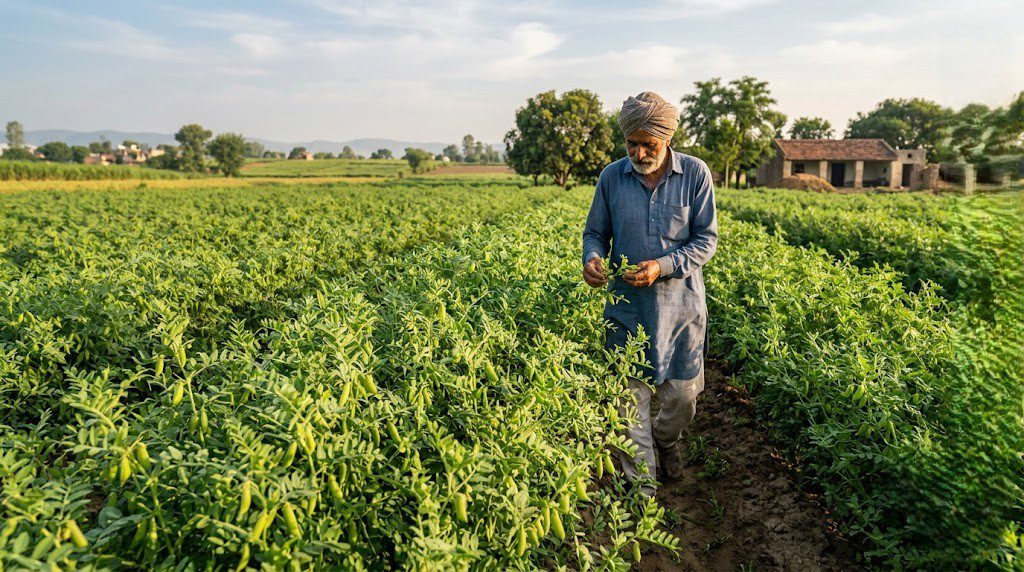
Table of Contents
What Is Lentil Farming?
Lentil farming means growing Lens culinaris, called masur or masoor in Hindi, for its small, protein-rich seeds. The seeds are sold whole, split with the husk (masur dal) or split without it.
It is a legume. With the help of Rhizobium bacteria in its root nodules, the plant captures nitrogen from the air, which is why lentil needs only a small starter dose of nitrogen and leaves the soil in better shape for the next crop.
India ranks among the leading lentil-growing countries. Uttar Pradesh, Bihar, Madhya Pradesh and West Bengal are the states most often discussed in ICAR research on lentil productivity. If you want the wider picture of what else grows in this season, read our guide on the names of rabi crops.
Why Lentil Farming Deserves a Place in Your Rabi Plan
Three reasons stand out.
A better floor price. The masur MSP rose from Rs 7,000 to Rs 7,390 per quintal, an increase of Rs 390, according to the official announcement reported by All India Radio. That is far more than the Rs 25 added to wheat.
A low water bill. Lentil is predominantly a rainfed crop in India, and it generally needs fewer irrigations than wheat. That matters where canal or borewell water is uncertain.
Soil benefit. Because it fixes nitrogen, lentil fits well in rotation after paddy, maize, cotton, bajra or jowar. For the policy background, see our explainer on MSP for farmers.
A fair warning: low input does not mean no management. The national average lentil yield has been reported at only about 753 kg per hectare in older government data, while frontline demonstrations have recorded close to 20 quintals per hectare under improved practices. That gap is where your profit sits.
Step 1: Choose the Right Field for Lentil Farming
Lentil does best in well-drained loam to clay-loam soil with a near-neutral reaction. Waterlogged, saline or strongly alkaline fields are poor choices, because lentil roots and nodules suffer when water stands.
Pick a field where lentil, chickpea or pea has not been grown for a few years. Repeated pulses on the same plot build up soil-borne wilt, and that is the single most expensive mistake in lentil farming.
Before you commit, test the soil. A Soil Health Card tells you your phosphorus, potash and sulphur status, so you spend on what the field actually lacks. You can read about the programme on the government’s Soil Health Card portal.
Step 2: Pick a Variety Suited to Your State
Variety choice decides your disease risk more than any spray. Choose a variety released or recommended for your zone, and ask your Krishi Vigyan Kendra (KVK) for the latest notified list. The varieties below appear in published trials and advisories.
| Variety | Where it appears | Why farmers use it |
|---|---|---|
| Moitree (WBL 77) | West Bengal trials | Popular plains variety with a tested sowing window |
| IPL 81 and JL 3 | On-farm wilt trials | Reported as wilt-resistant, higher yield than farmer practice |
| Pant Lentil 8 | Kanpur-zone frontline demonstrations | Used in improved-technology plots |
| Pant L 406 | ICAR-linked state-wise lists | Listed as tolerant to rust and wilt |
| Axom Masur 1 and 2 | Assam KVK package | Recommended for Assam conditions |
For a cross-check, the NIFTEM lentil write-up lists state-wise varieties with their duration and average yields, which range from about 11 to 17 quintals per hectare in the entries shown.
Always buy certified or truthfully labelled seed with a bill. Home-saved seed from a wilt-affected field carries the problem forward.
Step 3: Time Your Sowing Correctly
Sowing date is the cheapest yield decision you will make. Lentil needs a cool start and a dry, warm finish, so planting too late pushes grain filling into heat.
| Region or source | Sowing guidance |
|---|---|
| Assam (AAU KVK package) | Mid-October to mid-November |
| West Bengal plains (field trial) | 1 to 10 November found optimum |
| Uttarakhand (ICAR advisory) | First fortnight of November; late sowing up to the second week of December |
| Rice-fallow, late sowing | Early December with early-maturing varieties |
Read the Assam KVK lentil package of practices and the West Bengal sowing-date trial to see how sharply dates matter. Delay in sowing causes yield reduction in that trial, and the effect differs by variety.
Do not copy your neighbour’s state calendar. Use the advisory for your own agro-climatic zone, as we explain in our state-wise rabi crop guide.
Step 4: Prepare Land and Treat the Seed
Lentil seed is small, so it needs a fine, firm, moist seedbed. Plough once or twice, harrow, level and leave the field weed-free. In rice fields, sow as soon as the soil is workable.
Seed treatment is where lentil farming is won or lost, and it costs very little.
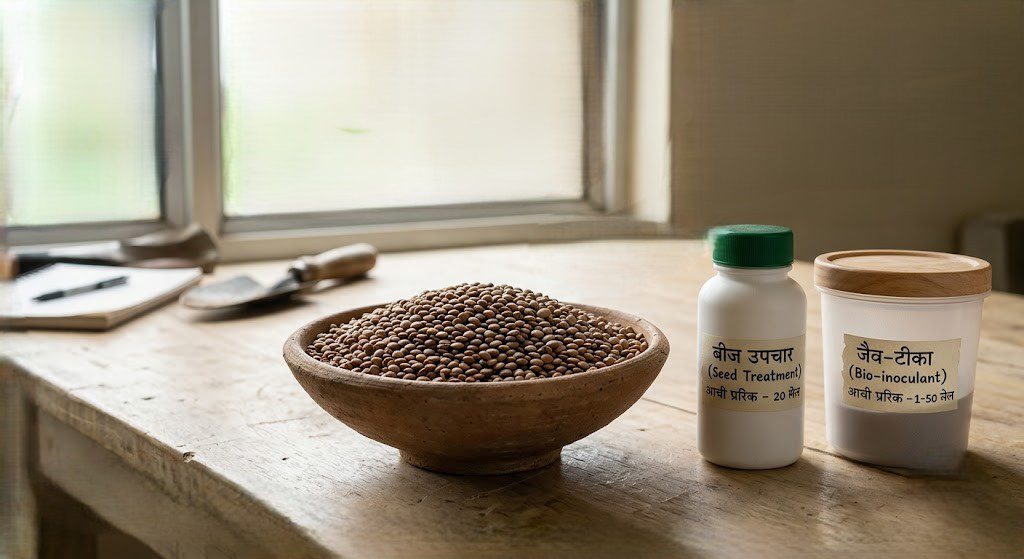
- Treat the seed with a fungicide at the dose in your state advisory, or with Trichoderma (about 4 to 5 g per kg is commonly advised) if you prefer a biological option.
- Inoculate with Rhizobium and phosphate-solubilising bacteria (PSB), each at 50 g per kg of seed, as the Assam package recommends.
- Mix the cultures with a little jaggery solution, coat the seed, dry it in shade and sow the same day.
Never mix a fungicide and a culture in the same step. The fungicide goes on first and the culture last, otherwise you kill the bacteria you paid for.
Step 5: Sow in Lines at the Right Rate
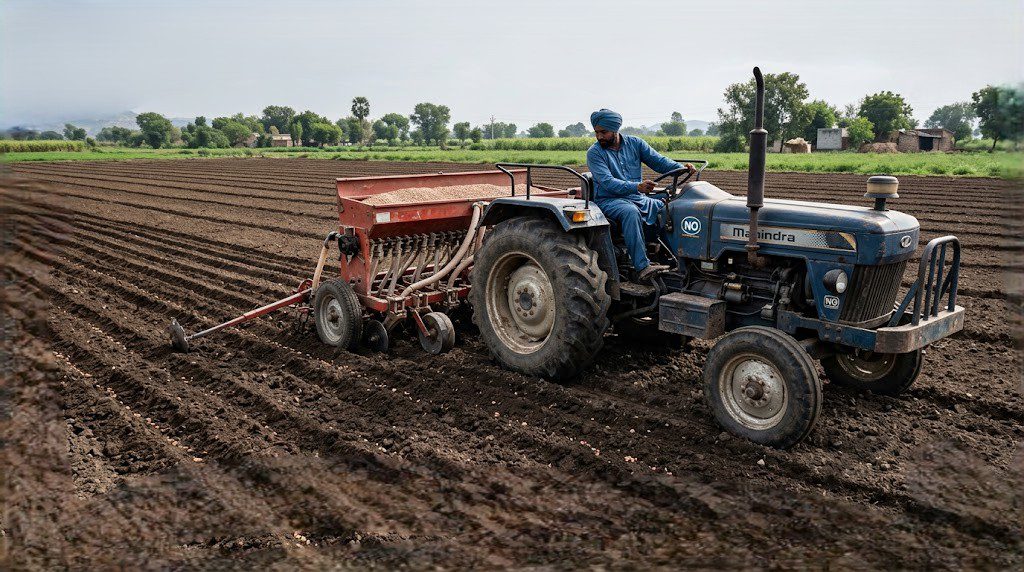
Use a seed drill or sow behind the plough in lines 25 to 30 cm apart, with seed placed about 3 to 4 cm deep. Line sowing saves seed, makes weeding easier and gives an even stand. Broadcasting wastes seed and invites weeds.
For the seed rate, the Assam package gives 30 kg per hectare, or about 4 kg per bigha, and 45 kg per hectare under rice-utera conditions, where seed is scattered into a standing paddy crop. Bold-seeded varieties need more seed than small-seeded ones, so check the label and your advisory.
Step 6: Feed the Crop Without Overdoing Nitrogen
The most quoted basal dose in field trials is 20:40:20 kg of N, P2O5 and K2O per hectare, and Kanpur-zone demonstrations added sulphur at 30 kg per hectare. A West Bengal seed-production trial using the 20:40:20 dose recorded seed yields above one tonne per hectare in the better year.
Apply all of it at sowing, drilled below or beside the seed. Extra urea mostly grows leaves and weeds, not pods. Your soil test result should override these averages, and your dealer can convert the nutrient figures into DAP, SSP and potash bags.
If you want to cut chemical use, our guides to organic farming in India and zero budget natural farming explain how to trial a bio-input plan on a small plot first.
Step 7: Manage Water and Weeds
Lentil Farming is largely a rainfed crop, and extra water can hurt as easily as help. If you have a limited supply, light irrigations around branching and pod filling are the stages most often recommended. Skip irrigation if the soil is still moist, and never let water stand.
Weeds are slow to show but costly. Reports flag roughly 30 to 60 days after sowing as the most critical period, so keep the field clean through that window with hand weeding or a pre-emergence herbicide recommended by your state university. Follow the label dose and safety rules exactly.
Where water is scarce, sprinkler and drip irrigation stretch a limited supply across more acres.
Step 8: Protect the Crop From Wilt, Rust and Pests
Disease is the main reason lentil farming underperforms. Scout your field every week from germination.
| Problem | What you see | What to do |
|---|---|---|
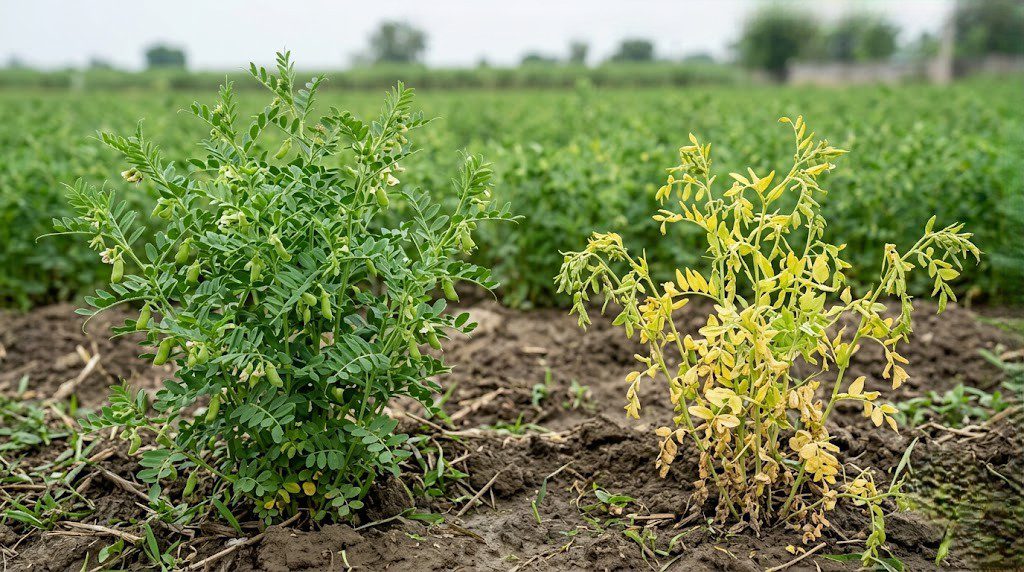
| Fusarium wilt | Yellowing and drying plants in patches | Resistant variety, seed treatment, long rotation |
| Rust | Rusty pustules on leaves and stems | Rust-tolerant variety, early sowing, advisory sprays if needed |
| Stemphylium blight | Leaf spots and defoliation in humid spells | Tolerant variety, avoid dense stands |
| Pod borer and aphids | Holed pods, sticky clusters on shoots | Monitor, neem-based sprays first, label-dose chemicals only if the threshold is crossed |
| Bruchids in storage | Tiny holes in grain | Dry well, store clean, use airtight bags |
Wilt deserves the most attention. A CGIAR chapter on Fusarium wilt estimates about 8.8% yield loss for every 10% wilt incidence. That means a field with 30% wilt loses over a quarter of its yield, so prevention beats cure.
Weather also plays a part. For wider adaptation advice, see our guide on climate-resilient crops.
Step 9: Harvest, Store and Sell
The crop is ready when leaves begin to fall and the stems and pods turn brown. Harvest promptly, because late harvest invites shattering and bird losses, as the NIFTEM post-harvest notes point out. Cut in the cool morning, sun-dry the bundles, thresh and clean the grain.
Dry the seed thoroughly before bagging. A moisture level around 9 to 10% is commonly advised for safe storage. Sell either at the mandi, through the e-NAM platform or to a procurement agency. Our guide to the e-NAM platform explains online mandi selling.
Lentil Farming Economics at the New MSP
The government’s published figures for the 2027-28 season put the masur MSP at Rs 7,390 per quintal against an all-India weighted average cost of production of Rs 3,854 per quintal, a margin of 92%, as reported from the official table.
Here is what that could mean per hectare. This is an illustration using national averages, not a promise.
| Yield per hectare | Gross at MSP (Rs) | Margin over average cost (Rs) |
|---|---|---|
| 7.5 quintals (near national average) | about 55,400 | about 26,500 |
| 12 quintals (good management) | 88,680 | about 42,400 |
The margin figures use Rs 3,536 per quintal (7,390 minus 3,854). Your own cost will differ with land rent, labour and irrigation, so build your own sheet. The point is clear, though: yield matters more than the price hike. Moving from 7.5 to 12 quintals adds more profit than any MSP revision.
MSP is a floor, not a guaranteed sale. Reports note that the government has provided for masur procurement, but arrangements vary by state, so confirm registration dates with your agriculture office and read our note on the digital crop survey, since crop records often decide eligibility. A Kisan Credit Card can fund seed and inputs, and crop insurance protects against a bad season.
Common Mistakes in Lentil Farming
- Sowing in the same field after lentil, chickpea or pea, which builds wilt.
- Using untreated seed and skipping Rhizobium and PSB.
- Over-applying nitrogen, which feeds weeds and delays maturity.
- Broadcasting seed instead of line sowing.
- Letting water stand after heavy rain or irrigation.
- Missing the 30 to 60 day weed window.
- Harvesting late, then losing grain to shattering.
- Planning around MSP alone without checking procurement in your state.
FAQs on Lentil Farming
1. What is lentil farming?
Lentil farming is the cultivation of masur (Lens culinaris), a rabi pulse grown in winter for its protein-rich seed. It needs cool weather, well-drained soil and modest water.
2. Which month is best for lentil farming in India?
It depends on your region. Assam advises mid-October to mid-November, West Bengal trials favoured early November, and hill and northern areas often sow in the first fortnight of November.
3. How much seed is needed per hectare?
The Assam package recommends about 30 kg per hectare for line sowing and 45 kg under rice-utera. Bold-seeded varieties need more, so check your state advisory.
4. Which fertilizer dose is recommended?
Trials commonly use 20:40:20 kg N:P2O5:K2O per hectare at sowing, sometimes with sulphur. A soil test should guide the final dose.
5. Does lentil need irrigation?
Lentil is mainly a rainfed crop. One or two light irrigations at branching and pod filling can help when water is available, but waterlogging harms the crop.
6. What is the biggest disease in lentil?
Fusarium wilt is regarded as the most serious yield-limiting disease. Resistant varieties, seed treatment and crop rotation are the main defences.
7. How long does lentil take to mature?
Most varieties mature in roughly 115 to 140 days, depending on variety, sowing date and region.
8. What is the masur MSP for 2027-28?
The masur MSP is Rs 7,390 per quintal, up Rs 390 from Rs 7,000, as approved by the Cabinet on 30 September 2026.
9. What yield can I expect?
The national average has been reported at about 753 kg per hectare in older data, while variety listings and demonstrations show roughly 11 to 20 quintals per hectare under improved practices. Your result depends on variety, date and disease control.
10. Is lentil farming profitable?
It can be, especially at the new MSP, because costs are modest. Profit depends on yield, your own costs and whether you can sell at or above MSP.
Conclusion
Lentil farming rewards farmers who get four things right: a clean field, a resistant variety, timely sowing and treated seed. The higher MSP helps, but yield and disease control decide your income. Pick your variety now, confirm your local sowing window with your KVK and register for procurement early. If this guide helped, share it with a farmer planning rabi acres, and explore more in our Farming category.