
Table of Contents
What Is Agrivoltaics, Really?
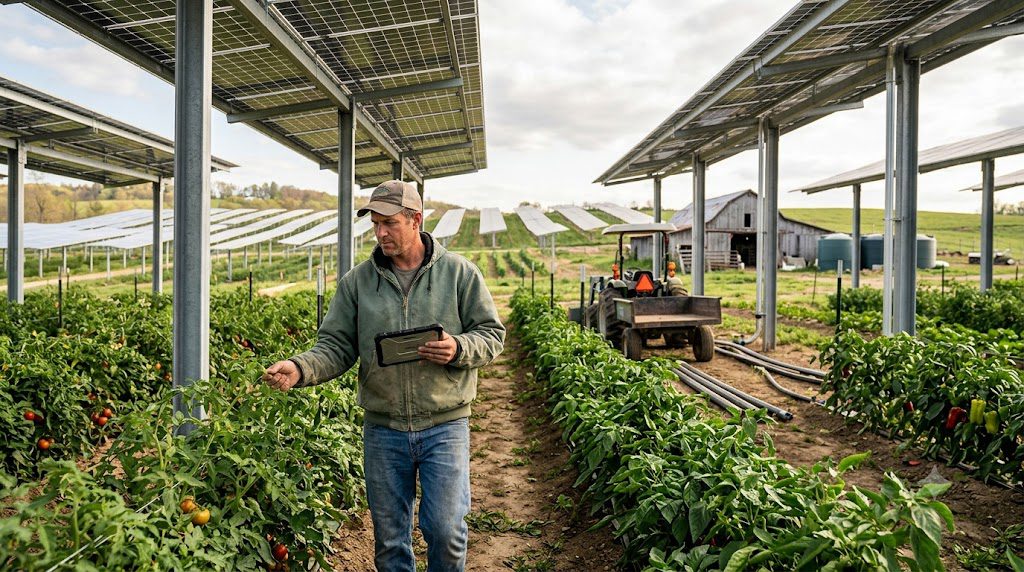
Agrivoltaics means growing crops, grazing animals or both on the same land that produces solar electricity. The panels and the plants share the field.
The idea sounds simple, but the definition matters. Germany’s DIN SPEC 91434 standard, published in 2021 with Fraunhofer ISE among its authors, defines agrivoltaics as combined use of the same land where agriculture is the primary use and electricity is secondary. That ordering is deliberate. It exists to separate genuine dual-use systems from ordinary solar farms with a few sheep or a strip of grass underneath for show.
Keep that distinction in mind. It comes back later, because it is one of the most important questions in this whole field.
Why Everyone Is Talking About It Now
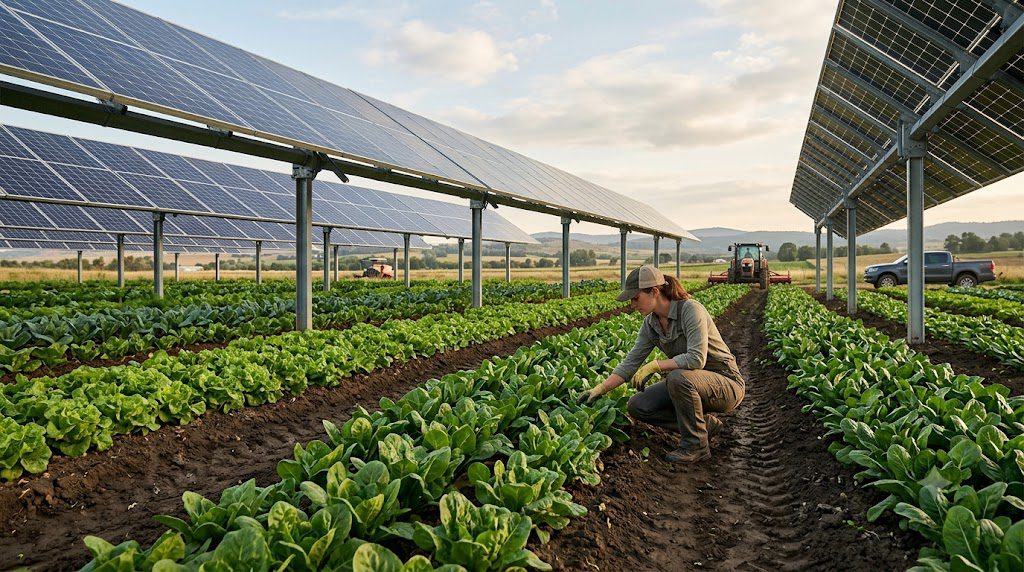
Two pressures are colliding on the same land. Solar is now among the cheapest ways to generate electricity in many regions, so developers want large areas. Food production already needs those areas. Fraunhofer ISE’s overview describes agrivoltaics as a way to increase land-use efficiency and expand solar capacity on agricultural land while keeping farming going.
Interest has grown quickly in research circles. The University of Arizona’s agrivoltaics student team reports that agrivoltaic land grew from roughly 27,000 acres in 2020 to more than 62,000 acres in 2024. That figure comes from a university news item rather than a primary dataset, so treat it as a rough indicator of direction, not a precise count.
For farmers, the pitch is attractive: a second income stream, lower water stress on the crop, and a way to keep land in production rather than leasing it out entirely to a solar developer. If data-driven farming is new to you, our precision farming guide covers the basics.
The “Win-Win” Story You Keep Hearing
Search for agrivoltaics and you will find an optimistic narrative, and some of it has real evidence behind it.
At the University of Arizona’s Biosphere 2, researchers led by Dr. Greg Barron-Gafford found chiltepin peppers produced about three times more fruit under panels, and jalapeños used 65% less water. The team’s summary reports that wheat and potato yields in Germany also rose during a hot, dry summer. Barron-Gafford is quoted as saying farmers “no longer have to choose between food and energy.”
Iowa State University researchers reported in 2026 that squash, peppers, tomatoes, broccoli and raspberries showed good yield and quality in their research plots. Ajay Nair of Iowa State said you can grow broccoli, squash and peppers commercially under panels without compromising yield or quality.
Those results are real. The problem is how far the headline travels beyond them.
The Study That Complicates It
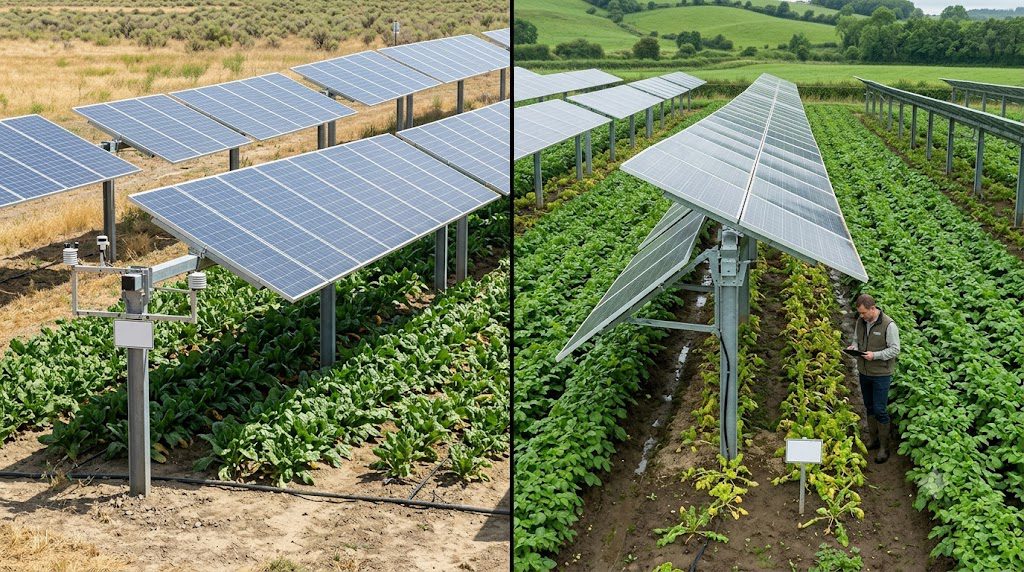
In March 2026, a team led by the University of Illinois Urbana-Champaign published a study in the Proceedings of the National Academy of Sciences (PNAS) with a deliberately different design. Instead of measuring one site, they built a process-based model of how panels change energy, water and plant-soil dynamics, and then ran 15-year simulations across different Midwest climates, with solar arrays covering 33% of each site. They also layered an economic model on top to estimate annual net profit per acre for agrivoltaics, conventional farming and stand-alone solar.
The headline result, in the university’s own words (also summarized by NCAT): agrivoltaics can increase or reduce yields and profits, depending on the crop and where the system is deployed.
Here is the part that should make you pause before trusting any “win-win” claim:
- In the humid eastern Midwest, shading reduced photosynthesis. Maize yields fell 24% and soybean yields fell 16%, which lowered farmers’ profits.
- In the semi-arid Midwest, shading eased water stress. Soybean yields rose 6%, and maize losses were moderated rather than eliminated.
Same technology, same continent, opposite outcomes. That is the tension at the center of this article, and it is why the rest of it is organized around seven truths rather than a list of benefits.
Truth 1: Climate Decides the Winner
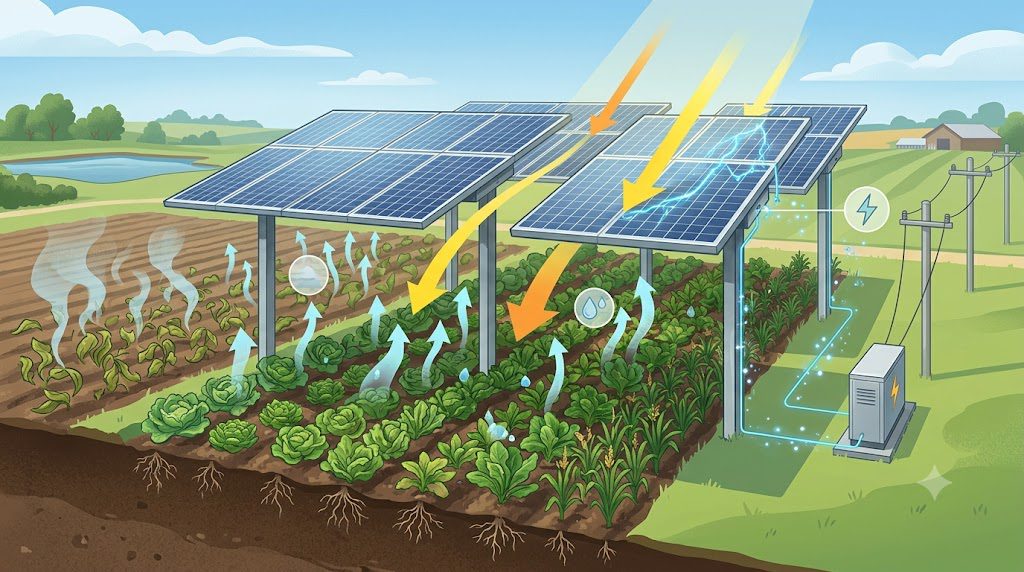
The Illinois study identified average aridity or humidity as a key driver of both crop yields and economic viability. The mechanism is intuitive. Where water is the limiting factor, shade can help. Where light is the limiting factor, shade costs you.
This has a practical implication that most marketing skips. A result from Arizona, Austria or Switzerland does not transfer to a humid region. If your farm gets reliable rainfall and plenty of cloud, the sunniest success stories may not apply to you, and the Illinois model suggests the opposite may be true.
Truth 2: The Crop Matters as Much as the Climate
Even within a single climate, crops respond differently.
Swiss researchers at Agroscope, together with the clean-tech company Insolight, ran four years of trials on strawberries and raspberries under different agrivoltaic systems. In June 2026 they published results showing the two crops reacted differently to shading. According to the title of the accompanying paper in Swiss Agricultural Research, strawberries reacted more sensitively to shading than raspberries.
Iowa State’s work adds a second layer: crop rows closest to the panels had slightly lower yields than rows farther away, which Nair attributed to higher shade levels. So even inside one field, position under the array matters.
In practical terms, this means “agrivoltaics works for vegetables” is too crude a statement. A shade-tolerant leafy green and a light-hungry fruit crop are different bets. Where outdoor shade is a poor fit, some growers look at fully controlled indoor systems instead; see our overview of vertical farming.
Truth 3: Dry Years Favor the Panels
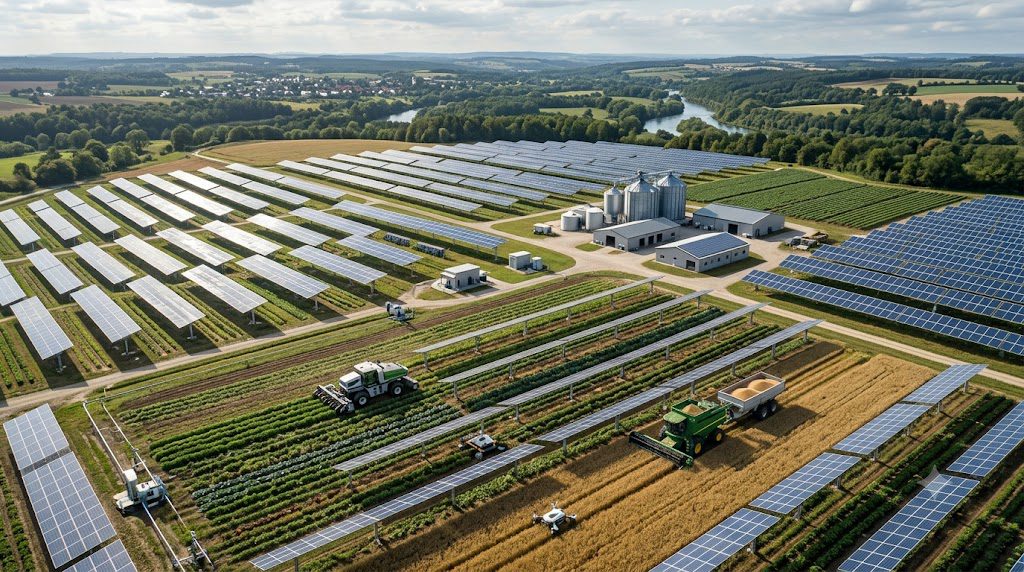
Drought and heat are where panels tend to look best. A 2026 trade report on an Austrian research site near Bruck an der Leitha, run with BOKU University Vienna, said winter wheat yields were 14% higher than a control plot during a dry summer. The site uses movable panels at 8, 11 and 14 metre row spacings.
Read that claim carefully. It is a trade-press summary of one season at one site, and the same report notes yields are also shaped by weather, soil characteristics and soil compaction during construction, and that more research is needed on long-term impact. It supports the idea that panels buffer water stress in dry conditions. It does not show that the effect holds every year.
A hotter, drier climate may make agrivoltaics look better over time, but a single favorable summer is not a long-term yield guarantee.
Truth 4: Money Is the Bigger Barrier Than Biology
Here is the finding that gets the least attention. In the Illinois study, Professor Madhu Khanna said that while agrivoltaics can benefit soybean farmers, especially in semi-arid regions, high installation costs from raising panel height limit its economic competitiveness against stand-alone solar for developers across most of the Midwest. Utility-scale developers, she said, would need policy or market incentives to adopt agrivoltaics with row crops.
Translate that: even where the crop does fine, the economics may not close without subsidy. The researchers also noted that viability depends on commodity prices, land-lease prices and overall weather.
This is why the Illinois team described only specific combinations, such as soybean-based systems in the semi-arid region, as true “win-win” cases for both farmers and solar developers. They did not describe it as a universal outcome.
Truth 5: “Agrivoltaics” Is Not a Single Technology
The word covers very different designs, and they behave differently on a farm. In general terms:
- Elevated systems raise panels high enough for machinery and crops below. They are costlier to build, which is the cost issue the Illinois researchers flagged.
- Interspace systems place panel rows with wide gaps between them for crops. Row spacing, like the 8–14 metre options tested in Austria, changes how much light reaches the crop.
- Adjustable or tracking systems move panels to balance light for plants and electricity. The Austrian site uses movable modules.
- Light-managing systems such as the one Insolight tested with Agroscope, which is designed to control the light reaching the crop beneath.
When someone quotes a yield result, always ask which design, which spacing and what percentage of the field was covered. The Illinois simulations assumed 33% coverage. A different layout could change the answer.
Truth 6: Farmland Rules Are Catching Up Slowly
A governance question sits underneath the agronomy: when is something “farming with solar” and when is it “solar with a farming alibi”?
Germany’s DIN SPEC 91434 was an early attempt to answer it by requiring agricultural use to remain the primary purpose. Fraunhofer’s overview notes that policies vary widely by country, with development driven mainly by Japan, China, France and Germany. A Taiwanese modeling poster presented at the EGU General Assembly in 2026 notes that ground-mounted agrivoltaics are not yet permitted in Taiwan, which currently limits applications to aquaculture-solar systems. The same poster reported that, under a modeled crop rotation, yields could still reach 80% of attainable levels. That is a conference modeling result, not a field trial.
The takeaway for farmers: before investing time, check whether your jurisdiction recognizes agrivoltaics as a distinct land use, what it requires, and whether your land would remain eligible for agricultural status or subsidies. Rules differ sharply by country and region, and this article cannot tell you the rules where you farm.
Truth 7: Most Evidence Is Still Short-Term
Look at the evidence base honestly:
- The Illinois study is a model, not a field trial. It is a rigorous one, validated and published separately in the Journal of Advances in Modeling Earth Systems, but it simulates outcomes.
- The Austrian result is one dry season.
- The Iowa State plots are research plots on a roughly 10-acre site, not commercial farms with real labor, equipment and market constraints.
- The Swiss results are four years, which is among the longer datasets here, but cover two berry crops.
Together these point in a consistent direction: results depend on context. But no one source, and no combination of these, tells you what will happen on your particular field over twenty-five years, which is roughly the working life of a solar installation.
Agrivoltaics vs. Standard Solar vs. Conventional Farming
The table below summarizes the trade-offs as reported in the sources above. It is a qualitative guide, not a financial model.
| Factor | Agrivoltaics | Stand-alone solar | Conventional farming |
|---|---|---|---|
| Land use | Dual: crops/grazing plus power | Power only | Crops/grazing only |
| Yield effect | Can rise or fall depending on climate and crop (Illinois: −24% to +6% in tested cases) | Not applicable | Baseline |
| Water stress | Can be reduced in dry climates | Not applicable | Fully exposed |
| Installation cost | Higher where panels are raised (Illinois) | Lower | Not applicable |
| Income streams | Crop plus energy or lease | Energy or lease | Crop only |
| Evidence maturity | Growing, mostly short-term or modeled | Mature | Mature |
| Regulatory clarity | Varies by country | Generally established | Established |
A Practical Checklist Before You Consider It
If you are a farmer weighing this seriously, these are the questions the evidence says matter most. (For a wider look at technology options, see our roundup of farm-tech tools.)
- What is my climate? Is water or light the limiting factor on my land? The Illinois result suggests this may decide everything.
- Which crop? Is it shade-tolerant? Check crop-specific trials rather than generalizing from other crops.
- Which design? Elevated, interspace, adjustable? Can my machinery work under or between the rows?
- What do the economics actually look like? Include installation cost, lease or energy revenue, and your local commodity and land prices. Indian readers weighing financing can also read our explainer on the Kisan Credit Card scheme.
- What do local rules say? Land classification, permits and any effect on agricultural status or subsidies.
- Who is accountable? A contract with a developer should say what happens to yields, repairs and decommissioning.
- What does an independent expert say? Ask a local extension service or university agronomist before signing anything.
Frequently Asked Questions
What is agrivoltaics in simple terms?
Agrivoltaics is the practice of producing crops, livestock or both on the same land that generates solar power. Under the German DIN SPEC 91434 standard, agriculture should remain the primary use and electricity the secondary use.
Do crops grow better under solar panels?
Sometimes. The evidence depends on climate and crop. A 2026 University of Illinois-led study found shading cut maize yields by 24% and soybean yields by 16% in the humid eastern Midwest, but raised soybean yields by 6% in the semi-arid Midwest. Arizona researchers reported much higher pepper fruit production and lower water use in a hot, dry setting.
Which crops work best under solar panels?
No crop is best everywhere. Iowa State researchers reported good yield and quality for squash, peppers, tomatoes, broccoli and raspberries in their research plots. Swiss trials found strawberries reacted more sensitively to shading than raspberries. Always look for trials in a climate similar to yours.
Is agrivoltaics profitable?
It depends. The Illinois study found that high installation costs from raising panels limit competitiveness against stand-alone solar across most of the Midwest, and that developers would need policy or market incentives. Profitability also depends on commodity prices, land-lease prices and weather.
Can I use farm machinery under agrivoltaic panels?
It depends on the design. Raised systems are built to leave room for machinery, but that adds cost. Check clearance, row spacing and turning room for your specific equipment before committing.
Is agrivoltaics better in dry climates?
The research points that way. Illinois researchers found shading eased water stress in the semi-arid region, and an Austrian trial reported higher wheat yields in a dry summer. One favorable season is not proof of long-term performance.
Is agrivoltaics allowed everywhere?
No. Rules vary widely by country. For example, a 2026 EGU poster notes that ground-mounted agrivoltaics are not yet permitted in Taiwan. Check local land-use and permitting rules.
How long do the benefits last?
No source reviewed here covers a full panel lifetime. The evidence is mostly short-term trials or models, so long-term yield and soil effects remain an open question.
Final Thought
The most useful thing to understand about agrivoltaics is also the least marketable: it is not a yes-or-no technology. The same system that improved soybean yields in a dry region reduced maize and soybean yields in a humid one. Crops differ, designs differ, and the economics often depend on subsidy and local prices.
For a farmer, that is not a reason to dismiss it. It is a reason to ask harder questions than the brochure invites. Which climate was the trial in? Which crop? Which design? Who paid for the construction, and what happens if yields drop?
Where those questions have good answers, agrivoltaics may genuinely be worth a serious look. Where nobody can answer them, be careful.