
Table of Contents
Introduction
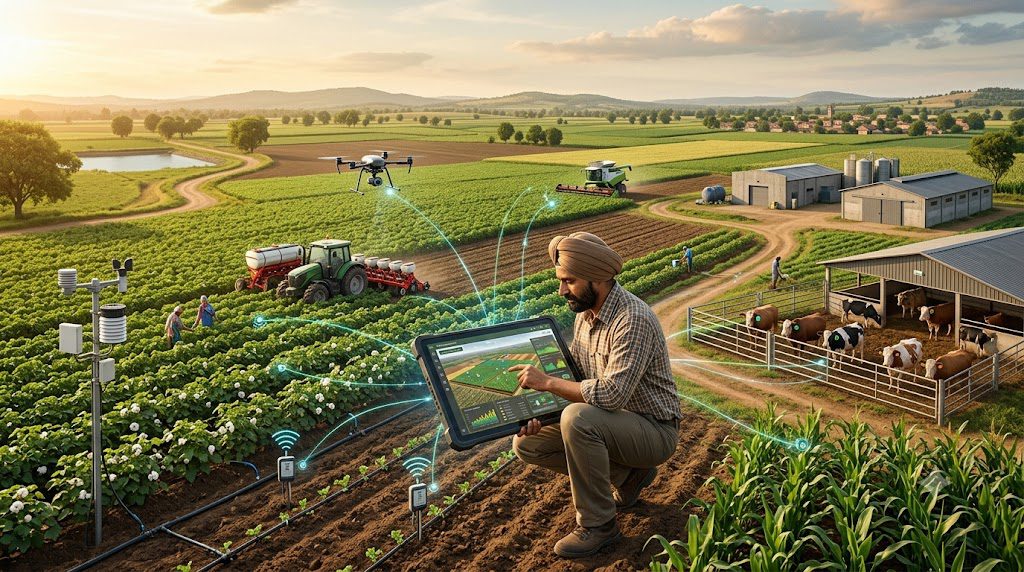
Picture this: before you spend a single rupee on fertilizer or run your irrigation pump for another hour, you could test three or four different plans on your field and see, in advance, which one actually pays off. No guessing, no waiting for the season to tell you whether you got it right. That’s the basic promise of digital twins in agriculture and it’s no longer confined to research papers. It’s starting to show up on real farms.
A digital twin, at its core, is a living, constantly updated virtual copy of something physical. Aerospace engineers have used the concept for years to model jet engines before ever building them. Manufacturers use it to predict when a machine part is about to fail.
Agriculture is now borrowing the same idea and pointing it at fields, crops, herds, and entire farm operations turning a lot of what used to be gut-feel decision-making into something closer to a dress rehearsal.
This piece walks through what agricultural digital twin technology actually does, where it’s already proving useful, and just as importantly where it still falls short of the hype.
Key Takeaways
- A digital twin in agriculture is a real-time virtual model of a farm, field, or crop, built from sensors, drone imagery, satellite data, and weather feeds.
- Unlike a standard monitoring dashboard, a digital twin can simulate what hasn’t happened yet testing an irrigation change or a fertilizer plan before it’s applied for real.
- The clearest, best-documented wins so far are in irrigation optimization, early disease and pest prediction, livestock management, and carbon/sustainability tracking.
- The technology lives or dies on data quality feed it patchy sensor data and you get confident-looking simulations that are simply wrong.
- Most working digital twins today operate at the field or single-farm level. Full supply-chain digital twins are still mostly a research goal, not a deployed product.
- This is genuinely earlier-stage than tools like drones or basic soil sensors, so it’s worth setting expectations accordingly.
What Actually Separates a Digital Twin From Regular Farm Monitoring
It’s worth being precise here, because “digital twin” gets thrown around loosely sometimes it just means a nice-looking dashboard.
A standard monitoring setup the kind covered in our roundup of top farm-tech tools tells you what’s happening right now: current soil moisture, current crop stress index, today’s weather. Useful, but descriptive. It’s a snapshot.
A digital twin goes a step further. It builds a model of your farm that can be run forward asking “what would happen if” instead of just “what’s happening now.” What happens to yield if you cut irrigation by 15% during flowering? How fast is a fungal outbreak likely to spread if this humidity holds for another ten days?
What does a specific fertilizer change do to both this season’s yield and next season’s soil nitrogen? That forward-looking simulation is the actual defining feature not just more data, but the ability to rehearse a decision before making it.
How These Digital Twins Actually Get Built
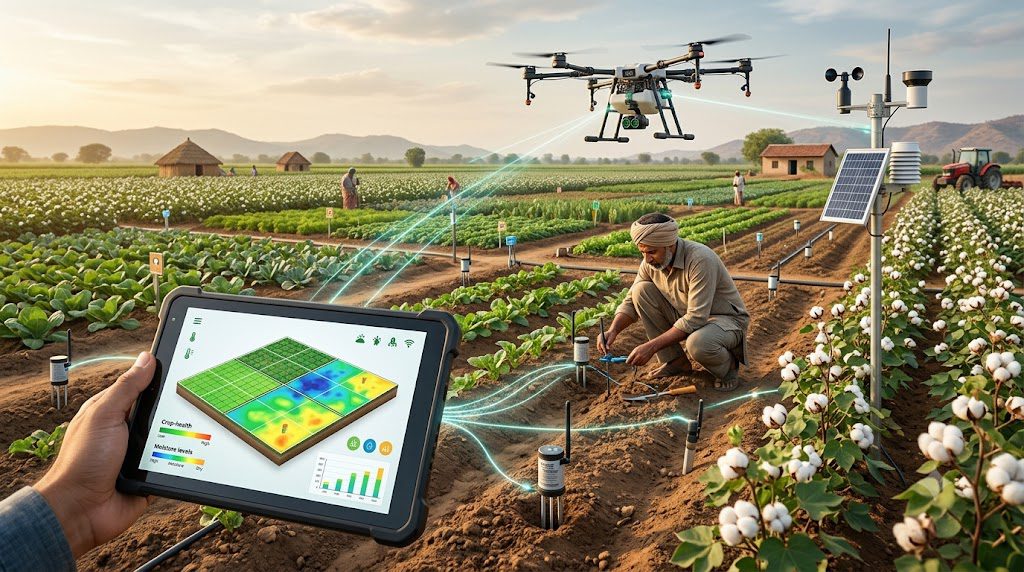
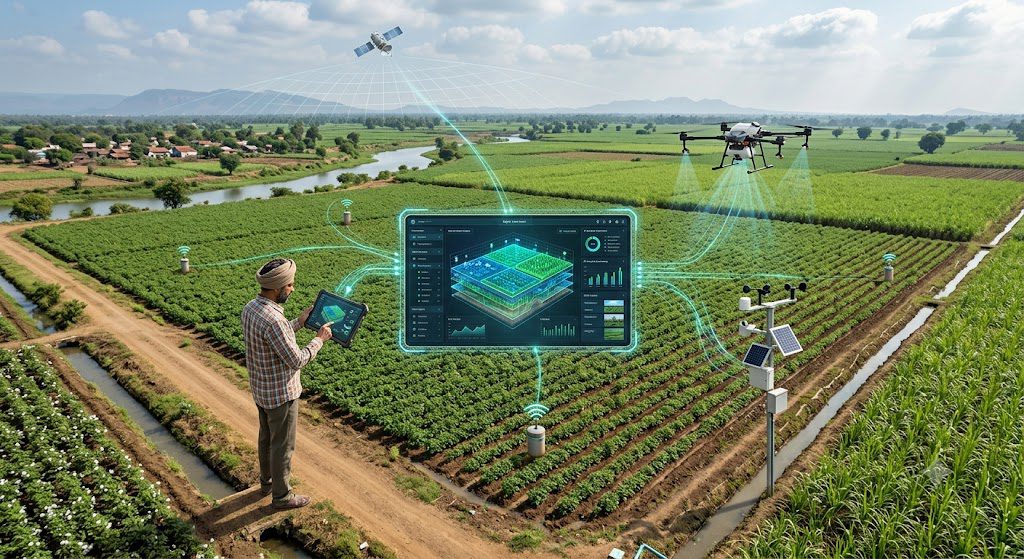
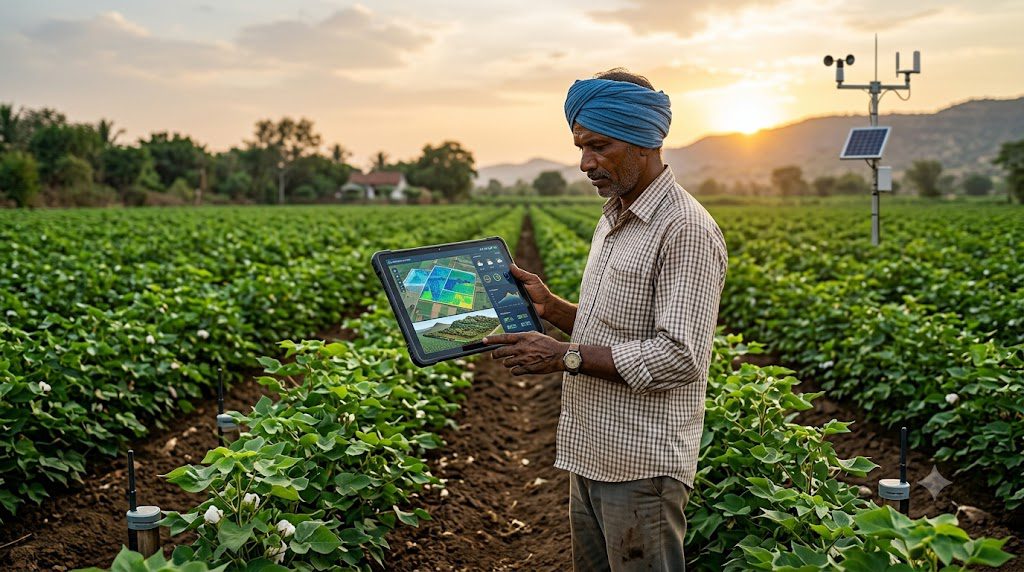
A digital twin isn’t one piece of software. It’s several data streams stitched together into a single, constantly updating model.
1. Sensor and IoT Data
Soil moisture probes, weather stations, and in-field sensors feed live conditions temperature, humidity, nutrient levels into the model. This is the twin’s anchor to reality, rather than a purely theoretical simulation.
2. Drone and Satellite Imagery
Aerial and satellite images add the spatial layer showing exactly where a field is stressed and where it’s healthy, instead of treating the whole plot as one uniform block. If you’ve read our piece on modern farming tech innovations, this is the same imagery infrastructure, just repurposed to feed a predictive model instead of a static report.
3. Historical Farm and Yield Data
Past seasons yield results, what was applied and when, pest incidents train the model on how this specific field actually behaves, which makes its forward-looking predictions far more useful than a generic, one-size-fits-all model.
4. Weather and Climate Forecasting
Short- and medium-range forecasts let the twin simulate what’s coming, not just what’s already here central to how it’s used for irrigation timing and disease-risk warnings.
5. AI and Machine Learning Models
This is the layer that turns raw numbers into an actual prediction how a crop reacts to water stress, how a pathogen spreads under certain humidity, how soil nitrogen depletes across a season.
Where Digital Twins Are Already Earning Their Keep
Much of the academic writing on this topic is still framed around future potential. But a handful of applications are already running on working farms.
Irrigation Optimization
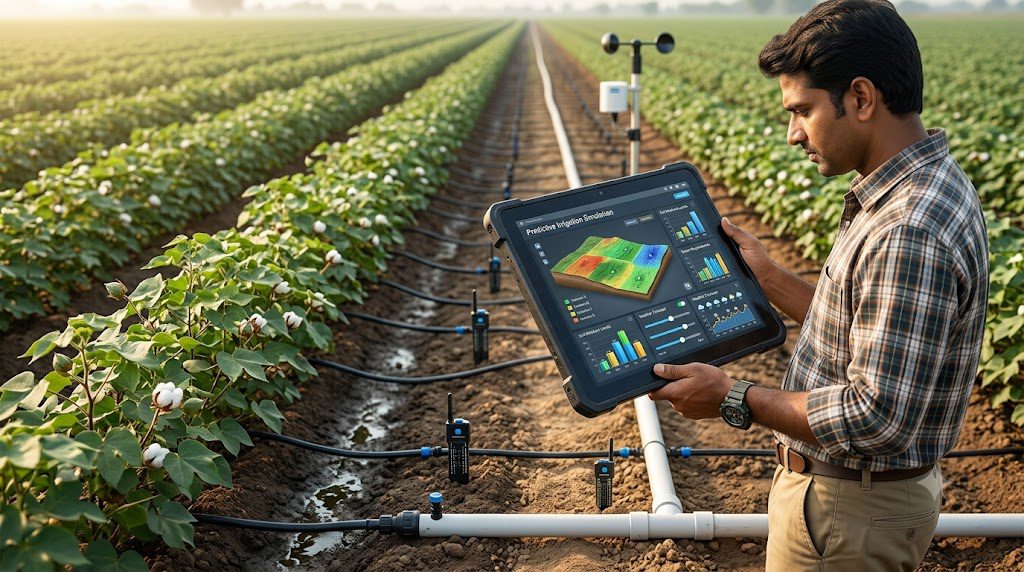
This is probably the most mature use case right now. By simulating different watering schedules against real soil moisture and forecast data, a digital twin can find the minimum irrigation a crop actually needs cutting water use without gambling on yield. In water-stressed regions, that’s not a nice-to-have; it’s the whole ballgame.
Disease and Pest Risk Prediction
Feed in humidity, temperature, and past outbreak patterns, and a digital twin can flag the conditions under which a pathogen or pest is likely to take hold giving you a window to act before you’re looking at visible crop damage.
Fertilization Planning
Instead of a calendar-based, blanket fertilizer schedule, a digital twin can simulate how different products and timings affect both this season’s yield and the soil’s leftover nutrient load moving fertilization from habit to something closer to a tuned response.
Livestock Management
The same modeling approach extends to herds. Combine individual animal health data with feeding patterns and housing conditions, and you can simulate the effect of a feed change or barn adjustment before rolling it out to the whole herd a natural complement to the practical, low-cost feeding strategies we covered in 10 powerful ways to feed cattle without spending more.
Sustainability and Carbon Tracking
As carbon reporting becomes more central to agricultural markets, digital twins are increasingly used to track soil carbon, machinery emissions, and overall resource efficiency giving farms verified numbers instead of rough estimates when it’s time to prove environmental performance.
Digital Twins vs. Standard Precision Agriculture Tools
| Capability | Standard Precision Ag Software | Agricultural Digital Twin |
|---|---|---|
| Shows current field conditions | Yes | Yes |
| Historical trend analysis | Usually | Yes |
| Simulates future “what-if” scenarios | Limited or none | Core feature |
| Tests interventions before you apply them | No | Yes |
| Combines multiple data sources into one live model | Sometimes, partially | Built around this |
| Updates continuously as conditions change | Varies by platform | Designed to |
The practical difference: with standard monitoring software, you’re still the one interpreting the numbers and deciding what to do. A digital twin can run the comparison for you testing a few scenarios and surfacing the best one before you touch the field at all.
The Honest Limits of This Technology
This is a genuinely promising direction, but it’s still early days for agriculture specifically, and a few limitations deserve just as much airtime as the benefits.
Data quality makes or breaks it. A digital twin’s simulations are only as good as what’s feeding them. Badly calibrated sensors, gaps in your records, or spotty connectivity for real-time feeds will quietly wreck the accuracy of every prediction and unlike a plain dashboard, a flawed simulation can still look completely convincing.
Most working models stop at the farm gate. The research is fairly upfront about this: while the idea of a fully connected digital twin spanning an entire agricultural supply chain gets a lot of attention, most real implementations today are scoped to one field, one crop, or one farm. Be skeptical of anyone selling you an “end-to-end supply chain twin” that’s mostly still a research goal.
Cost and complexity are real barriers. Building and running an actual digital twin means sensor infrastructure, dependable connectivity, and either in-house technical know-how or a vendor relationship a considerably bigger commitment than buying a single-purpose monitoring app.
It’s newer and less battle-tested than the alternatives. Compared to drones or basic soil sensors both of which have years of field use behind them digital twin platforms in agriculture are relatively new, and we’re still accumulating solid evidence of how accurate their predictions hold up across different farms and conditions.
It asks something different of you as a farmer. Using a digital twin well means trusting a simulated result enough to act on it before you’ve seen the real outcome a real shift for anyone used to deciding by direct observation and years of experience. In practice, the better approach blends both: treat the simulation as one strong input, not a replacement for your own read of the field.
Who Should Actually Look Into This Right Now
Given where the technology stands today, it’s worth being realistic about who benefits most, right now, rather than in five years.
Larger commercial operations with existing sensor setups are the natural early adopters much of the groundwork (soil sensors, weather stations, historical yield records) may already exist, which lowers the extra investment needed to get a working twin off the ground.
Farms connected to research institutions or agricultural universities may be able to access digital twin capability through a partnership, without carrying the full development cost alone.
High-value or resource-tight crops where a bad irrigation or fertilizer call is expensive, or water costs are already biting see the fastest payback from simulation-based planning, because avoiding one costly mistake covers a lot of the setup cost.
If you’re running a smaller operation without sensor infrastructure yet, the more sensible starting point isn’t a full digital twin it’s the foundational data layer discussed in our overview of agri-tech adoption: basic soil sensors and consistent crop monitoring. That’s what any future digital twin would be built on anyway.
A Practical Walkthrough: Building a Simple Field Digital Twin
It helps to get concrete about what a modest, entry-level project actually looks like, since the concept can otherwise feel abstract.
Step 1 Get the data foundation in place. Install soil moisture and temperature sensors across a few representative zones of a field, connect to a reliable weather feed, and start logging every irrigation, fertilizer, and pest-control action as it happens. Without this baseline, there’s nothing for a model to actually learn from.
Step 2 Add the spatial layer. Periodic drone flights or a satellite imagery subscription add crop-health mapping across the field, instead of treating it as one uniform block. Even a monthly drone pass adds real resolution here.
Step 3 Plug into a modeling platform. Most farms working with digital twins today aren’t building custom software they’re using an existing agricultural digital twin platform or precision-ag provider and feeding their sensor and imagery data through the provider’s integrations. Farmonaut’s 2026 review of agricultural digital twins is a decent starting point if you want to see what current platforms actually offer.
Step 4 Pick one narrow goal to start. Trying to model your whole farm’s every variable at once is how these projects fall apart. Pick one specific decision irrigation scheduling for a single crop, say and build the model around just that first.
Step 5 Validate before you trust it. Check early simulation outputs against what actually happens over at least one full season before leaning on them for major decisions. Skipping this step is one of the more common reasons early digital twin projects disappoint people not because the tech doesn’t work, but because it got trusted before it had earned that trust.
Step 6 Expand gradually. Once one use case is validated and paying off, layer on more data sources and simulation goals pest prediction, fertilization planning, a livestock module rather than trying to do everything at once.
This is basically how most successful digital twin adoption in agriculture has happened so far not as one big rollout, but as a slow build-out that starts small and only grows once the foundation has proven itself.
What This Actually Costs
Unlike buying a drone, a digital twin isn’t a one-time purchase it’s closer to ongoing infrastructure, and it’s worth budgeting for it that way.
Sensor and connectivity setup is usually the highest upfront cost, especially if you’re starting from zero IoT infrastructure. It’s also the easiest to phase in gradually rather than deploying across the whole farm at once.
Platform or software subscriptions tend to be recurring rather than one-off, reflecting the continuous data processing a digital twin actually needs to keep working this isn’t software you buy once and forget.
Drone or satellite imagery adds an ongoing cost, though satellite options are generally cheaper than commissioning regular drone flights, with some trade-off in image resolution and flexibility.
Training and technical support are easy to underbudget, but real reading and correctly acting on a simulation output takes a different skill than reading a straightforward dashboard.
Given all that, the farms getting the best return right now tend to be the ones where a single better decision dodging a disease outbreak, tightening water use on a high-value crop is worth enough to justify an ongoing platform cost, rather than farms hoping for a cheap, quick win.
Where This Is Headed
A few directions are becoming clearer as research and early deployments pile up.
Better data integration. A recurring theme in current research (see this ScienceDirect review of agricultural digital twins) is the push toward modular, interoperable platforms that can pull in drone, satellite, sensor, and weather data without custom integration work for every new source right now, that’s one of the bigger things slowing adoption down.
Movement toward supply-chain-level twins. Still mostly a research direction, but there’s active work on linking field-level twins into broader models connecting farm decisions to downstream processing, logistics, and market outcomes. Recent Springer research covers where this is heading in more technical depth.
A bigger role in sustainability compliance. As carbon reporting and sustainability-linked financing expand, expect digital twins to become a bigger part of generating the verified, real-time data these programs increasingly demand a point ICL’s industry analysis covers well.
Merging with AI-driven decision support. Rather than staying a separate tool, digital twins are likely to become one layer inside broader AI farm-management systems feeding simulations into the same interface farmers already check daily, instead of requiring a whole separate platform.
Frequently Asked Questions
Is a digital twin the same as a farm management app?
No. Most farm management apps show you current and historical data. A digital twin adds a simulation layer on top letting you test hypothetical scenarios and see the likely outcome before you make a real-world change.
Do I need expensive sensors to build one?
Some sensor infrastructure is necessary, since the twin needs real-time data to stay accurate. But it doesn’t have to happen all at once most farms build this up incrementally, starting with basic soil moisture and weather monitoring.
How accurate are the predictions, really?
It depends heavily on data quality and how well the model has learned this specific farm’s history. Accuracy generally improves the longer it runs, and current research is honest that validating this across many different real-world conditions is still ongoing work.
Is this only for large commercial farms?
Right now, larger operations with existing data infrastructure are best positioned to adopt this immediately. That said, research institutions and extension programs are working on simplified versions aimed at smaller farms too.
What’s the single most useful application today?
Irrigation optimization and disease/pest risk prediction are the two most mature, best-documented uses delivering measurable water savings and earlier warning windows compared to just reacting after the fact.
Final Thoughts
Digital twins in agriculture are a real step past basic monitoring being able to rehearse a decision before making it is genuinely different from just having more charts to look at. Irrigation planning, disease prediction, and fertilizer strategy are already showing documented results from this approach.
At the same time, it’s fair to call this a technology still finding its footing. Full supply-chain digital twins are more research papers than deployed products right now, and any twin is only as good as the data behind it.
For most farms, the smart move isn’t chasing the flashiest version of this technology immediately it’s building the sensor and record-keeping foundation that any digital twin, on any platform, is eventually going to need anyway. Get that right, and you’re ready the moment this technology matures enough to be worth the jump.
Curious how this fits with other Agritech tools already covered on this site? Take a look at our guides on Agritech innovations and smart farming for the future for the wider picture.