
Author’s note: I don’t run a feed mill or an insect farm. This article draws on peer-reviewed reviews, EU and Indian regulatory documents, and an academic economic study from Uganda, organized into one global reference instead of the scattered, region-specific coverage currently available.
Table of Contents
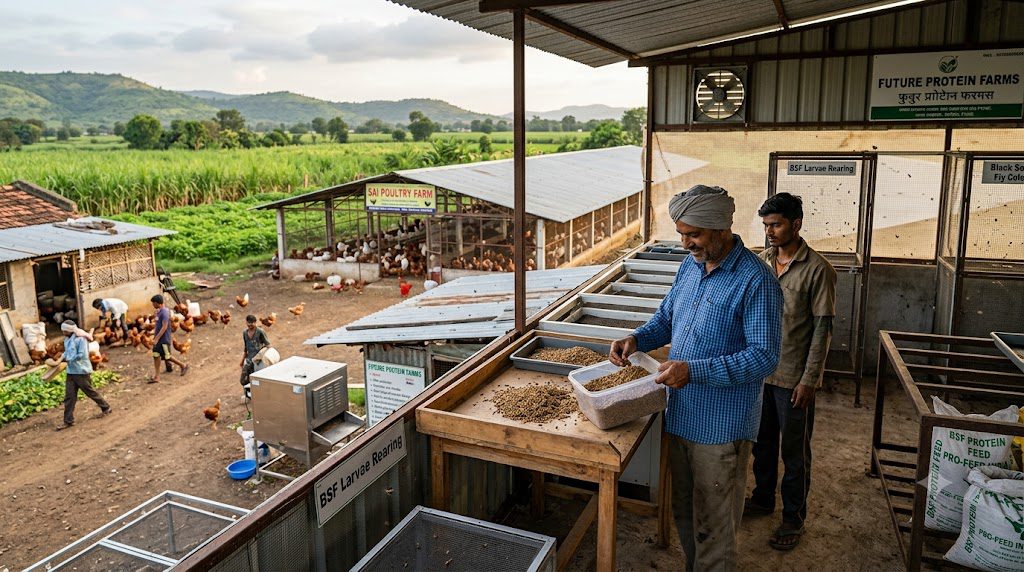
Insect protein for livestock feed has gone from a fringe sustainability pitch to a serious global investment category in the space of a few years, with over $2 billion now committed to insect farming startups worldwide. Black soldier fly larvae, the species driving most of that investment, sit at the center of a genuinely global story spanning EU regulation, African economic development, and an Indian feed industry still waiting for its own rulebook.
Why Insect Protein for Livestock Feed Is Gaining Global Ground
EuroTier 2026, the world’s leading trade fair for professional livestock farming, is dedicating a full technical program to insect protein in feed ahead of its November event in Hanover, according to Feed & Additive Magazine, reviewing the nutritional value, regulatory landscape and production scalability of black soldier fly larvae specifically. That level of institutional attention reflects a sector moving well beyond early-stage pilot projects.
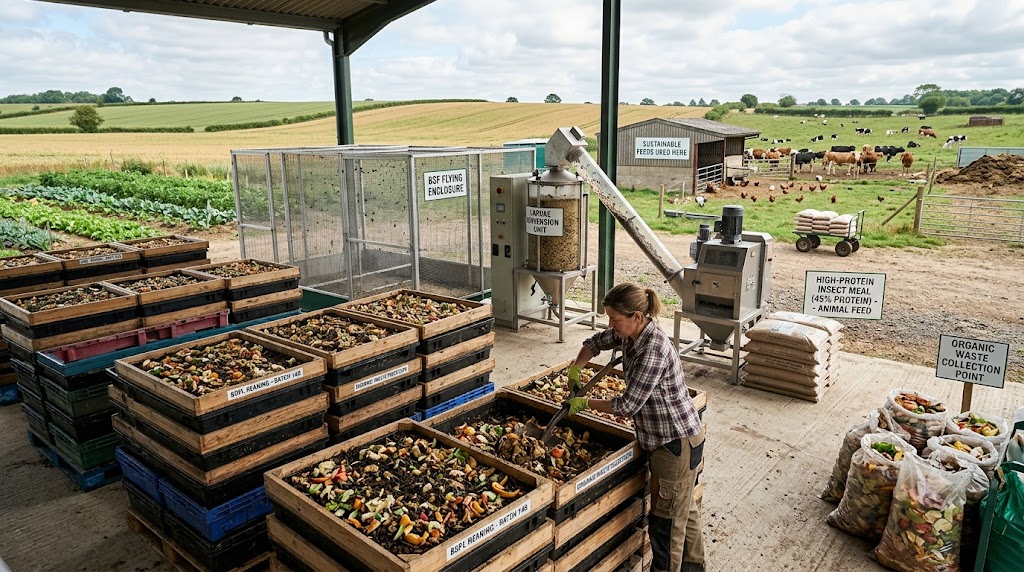
The scale of investment backs that up. More than $2 billion has been invested globally in insect farming startups, with the majority focused on black soldier fly production for feed and organic waste recycling, and the global market for insect-derived feed products is projected to grow at roughly 37% annually. Insect protein for livestock feed is being pursued specifically because it converts organic waste, including food residues and livestock manure, into high-protein biomass far more efficiently than conventional protein crops.
What Insect Protein for Livestock Feed Actually Is
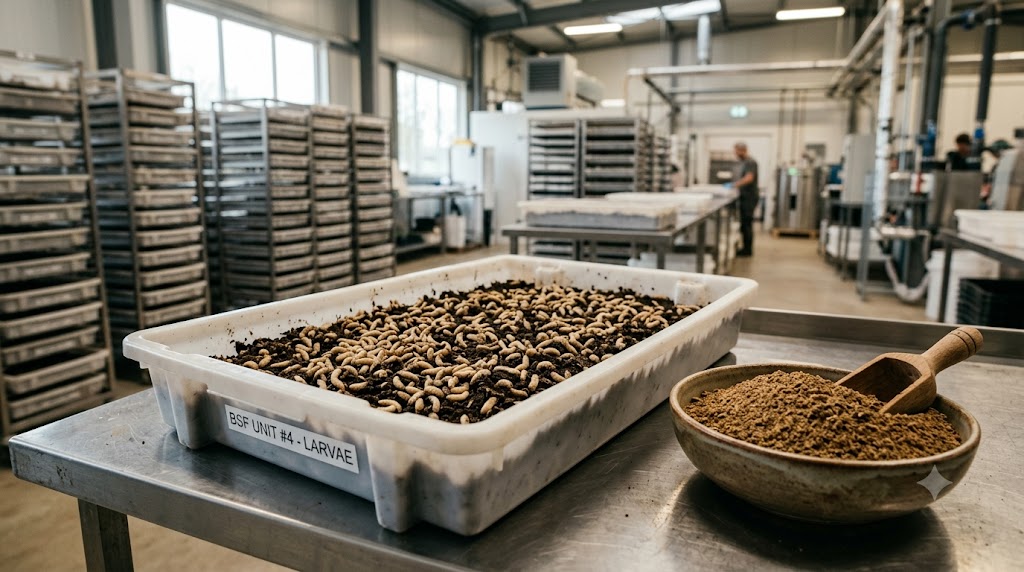
Black soldier fly larvae (Hermetia illucens) are the dominant species in this category, though mealworm, housefly, cricket and silkworm larvae also see commercial and research use.
According to a systematic review published in the journal Insects, black soldier fly larvae contain roughly 42% protein and 35% fat, with high feed-conversion efficiency and the ability to process a broad range of organic materials.
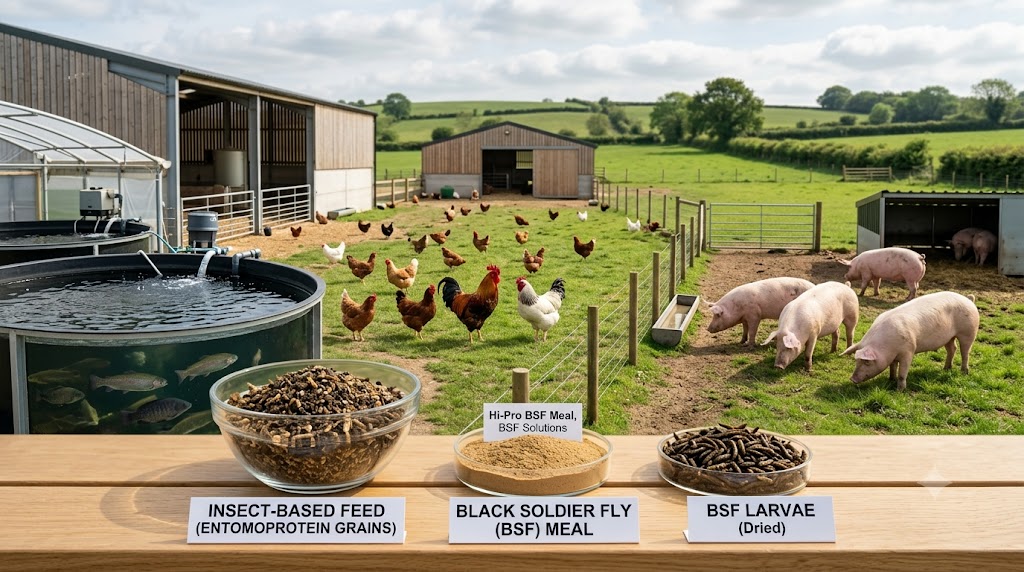
The larvae, or products derived from them, are used in three main forms: whole or dried larvae, processed larvae meal, and larvae oil, each suited to different livestock applications.
A separate peer-reviewed review in the journal Insects confirms these larvae can replace conventional protein sources like fishmeal and soybean meal in poultry, aquaculture and pig diets while supporting growth performance and gut health.
The Economics Behind the Global Investment Boom
The economic case for insect protein for livestock feed is strongest where organic waste is abundant and conventional feed imports are expensive.
A peer-reviewed economic-surplus model study focused on Uganda found a benefit-cost ratio of 28:1 and an internal rate of return of 138% for black soldier fly larvae meal production, figures that explain why several East African governments are actively supporting integration of insect meal into livestock feed policy.
That efficiency argument scales globally, too. Commercial operators have moved from pilot projects to industrial-scale production, with major product launches accelerating through 2025 and into 2026 across poultry, swine, aquaculture and pet food markets.
The pet food sector specifically has become a significant driver of demand, since insect protein for livestock feed applications extends naturally into premium pet nutrition, where consumers are often willing to pay more for a novel, sustainably marketed protein source.
Where Insect Protein for Livestock Feed Is Actually Legal
This is the part of the story that gets glossed over in most coverage, and it matters enormously for producers deciding whether to adopt it. Regulation is genuinely fragmented by region and by species.
In the European Union, insect-derived processed animal proteins were authorized for poultry and pig feed in 2021 under Regulation (EU) 2021/1372, extending an earlier 2017 authorization for aquaculture feed, according to IPIFF’s legislative overview. Eight insect species are currently authorized.
Critically, a 2026 review in Animal confirms that insect-based processed proteins may now be fed to almost all other farmed animals except ruminants, meaning cattle, sheep and goats remain excluded from this authorization entirely, regardless of any nutritional or environmental benefit the research might suggest.
In the United States, approval has proceeded species by species through AAFCO listings rather than a single blanket authorization, with black soldier fly larvae approved for use in food for adult dogs as of 2021, according to a 2026 industry review in International Animal Health Journal.
The same review notes the EU has built a more comprehensive regulatory framework than the more piecemeal US approach.
In India, insect protein for livestock feed remains in a pre-commercial regulatory phase. According to Mordor Intelligence’s India poultry feed market analysis, regulatory vetting under the Food Safety and Standards Authority of India is proceeding methodically, with approval momentum aligned to global precedents positioning insect meal for national rollout by 2027, even as insect meal volumes already show a 28% compound annual growth rate through state-backed pilot plants.
A Balanced Look: The Sustainability Claims Under Scrutiny
The industry’s sustainability pitch for insect protein for livestock feed deserves real scrutiny rather than uncritical repetition, and two findings complicate the simple version of that story.
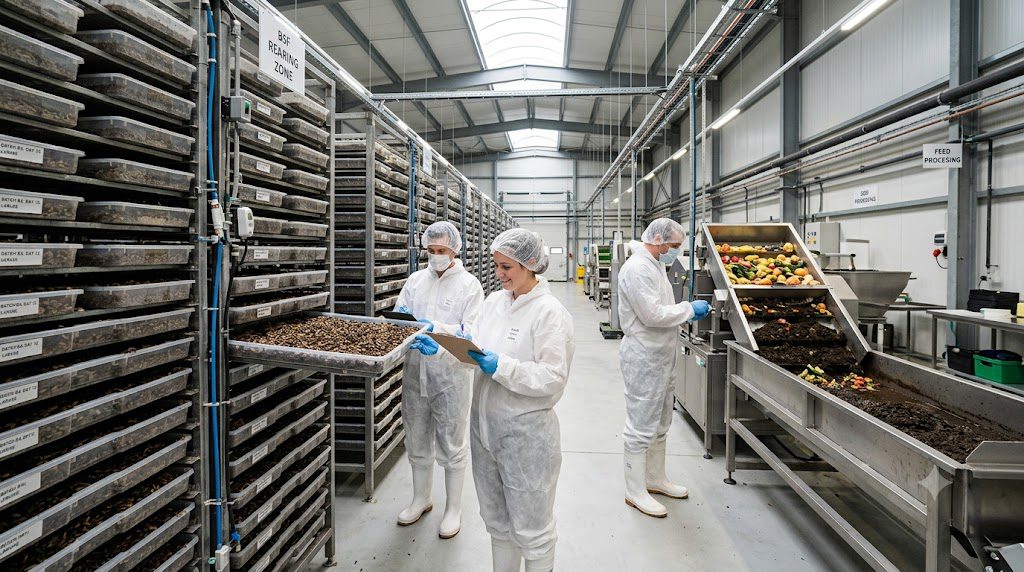
The case for the sustainability claim is genuine in several respects. Black soldier fly larvae process food waste and agricultural byproducts that would otherwise require separate disposal, and a systematic review in the journal Insects found that appropriately incorporated black soldier fly larvae can reduce methane emissions in ruminants specifically, alongside improving gut health and immunity, when tested experimentally.
The complication is twofold. First, that promising ruminant methane-reduction finding exists in research settings while EU regulation currently prohibits feeding insect-derived protein to ruminants at all, meaning the application with a genuine emissions co-benefit isn’t legally available to the cattle and sheep producers who might use it.
Second, broader lifecycle research summarized in academic reviews of insect feed has found that the carbon impact of insect proteins can, in some analyses, be higher than that of conventional soybean meal or fishmeal, depending heavily on how the insects are reared and what energy sources power that production.
A peer-reviewed study on cattle specifically also notes that research on insect protein performance in cattle remains limited compared to poultry and swine, meaning some of the more ambitious claims made for ruminant applications are still provisional rather than settled science.
Producers and policymakers evaluating insect protein for livestock feed should treat “sustainable” as a claim that depends heavily on production method and species application, not a blanket property of the ingredient itself.
What This Means for Poultry, Swine and Aquaculture Producers
For producers in species categories where insect protein for livestock feed is already authorized, primarily poultry, swine and aquaculture in most major markets, the practical question is less about legality and more about supply and cost competitiveness against established soybean meal and fishmeal supply chains. Feed formulators report that insect meal remains a smaller-volume, often premium-priced ingredient relative to conventional protein sources, even as production scales.
Aquaculture in particular has emerged as an early adopter, given the natural dietary overlap between farmed fish and insect-based protein sources, and pet food has become an unexpectedly significant driver of overall demand growth in the category.
Insect Protein for Livestock Feed in India: What’s Coming
India’s trajectory is worth watching closely given the country’s massive poultry sector and heavy reliance on imported soybean meal. Feed firms are already locking in supply agreements as domestic insect farms expand bio-conversion capacity using food waste streams, according to Mordor Intelligence’s analysis, positioning insect protein for livestock feed as a potential domestic alternative to imported protein that could reduce both cost exposure and the sector’s carbon footprint from feed transport.
The 2027 national rollout timeline referenced by industry analysts depends on FSSAI completing its dossier review and shelf-life validation process, meaning Indian producers currently evaluating this ingredient should treat it as an emerging option to plan around rather than one immediately available at commercial scale.
Practical Considerations Before Switching
- Confirm current legal status for your specific species and country. Authorization varies sharply by species (ruminants remain excluded in the EU) and by country, so don’t assume approval in one market applies elsewhere.
- Evaluate supply reliability, not just nutritional specs. Insect protein for livestock feed remains a smaller-scale supply chain than soybean meal or fishmeal in most markets, and consistent volume can be harder to secure.
- Ask suppliers about production method, given that the environmental footprint of insect protein depends heavily on the energy source and waste stream used to rear the larvae.
- Don’t expect it to fully replace conventional protein sources yet. Research shows performance impacts can vary by inclusion rate and species, particularly in cattle, where research remains comparatively limited.
- Watch your national regulator’s timeline if you’re in a market like India where full commercial authorization is still pending.
Producers evaluating feed innovation alongside other technology decisions may find Farm Sutras’ roundup of farm technology tools worth investing in useful for a broader framework on evaluating new agricultural inputs by actual return rather than novelty.
Our guide to sustainable livestock farming solutions covers related approaches to reducing feed costs and building a more resilient operation, and our overview of modern animal husbandry techniques covers herd nutrition fundamentals relevant to evaluating any new feed ingredient.
How Insect Protein Could Fit Into Future Feed Strategies
Insect protein for livestock feed is unlikely to replace soybean meal, fishmeal, or other conventional protein ingredients overnight. A more realistic path is gradual integration, where insect meal is tested at appropriate inclusion levels alongside existing feed ingredients.
For farmers and feed manufacturers, the decision should be based on animal performance, feed cost per unit of production, ingredient availability, regulatory approval, and product consistency rather than sustainability claims alone.
As commercial production expands and regulations become clearer, insect-based ingredients could become a useful part of diversified feed strategies, particularly in poultry, pig, and aquaculture systems where regulatory conditions already allow their use in some markets.
Frequently Asked Questions
1. What is insect protein for livestock feed?
Insect protein for livestock feed is protein derived from insects such as black soldier fly larvae, mealworms, crickets, houseflies, and silkworms. It can be processed into insect meal, dried larvae, or insect oil for use in animal feed.
2. What is black soldier fly larvae used for in animal feed?
Black soldier fly larvae (BSFL) are mainly processed into whole or dried larvae, insect meal, and larvae oil. These products can be used in poultry, pig, aquaculture, and other feed applications where regulations permit.
3. Is insect protein legal for livestock feed?
No, insect protein is not authorized everywhere. Regulations differ by country and animal species. For example, the article states that the EU permits certain insect-derived proteins for poultry, pigs, and aquaculture but excludes ruminants.
4. Is insect protein for livestock feed approved in India?
According to the article, India remains in a pre-commercial regulatory phase, with national approval and wider rollout expected around 2027, subject to regulatory review and validation.
5. Is insect protein more sustainable than soybean meal?
Not necessarily. Insect protein can efficiently convert organic waste into biomass, but its environmental impact depends on factors such as the rearing system and energy source. Some lifecycle studies have found higher carbon impacts than soybean meal or fishmeal in certain production systems.
6. Can cattle be fed insect protein?
Research has identified potential applications of insect protein in cattle, including possible methane-reduction effects, but the article notes that cattle research remains more limited than research involving poultry and swine. Regulations also differ by country.
7. Why is black soldier fly larvae popular for animal feed?
Black soldier fly larvae are popular because they have substantial protein and fat content, efficient feed-conversion characteristics, and the ability to process a range of organic materials.
8. What animals can eat insect-based feed?
Insect-derived feed products are being used or researched for poultry, pigs, aquaculture, and other animal-feed applications. However, the permitted species depend on the regulations of each country.
9. Can insect meal replace soybean meal and fishmeal?
Insect meal has potential to replace conventional protein ingredients such as soybean meal and fishmeal in some poultry, pig, and aquaculture diets. However, the article advises against assuming that insect protein can completely replace conventional protein sources in every species or production system.
10. What are the main benefits of insect protein for livestock feed?
Potential benefits include converting organic waste into protein, providing an alternative protein source, supporting feed diversification, and potentially improving some animal-health and performance outcomes depending on the species and inclusion level.
11. What are the main challenges of insect protein feed?
Key challenges include regulatory restrictions, supply reliability, production costs, environmental impacts that vary by production method, and limited research for some livestock species, particularly cattle.
12. Is insect meal suitable for poultry feed?
Poultry is one of the major livestock categories where insect-derived processed proteins have been authorized in certain markets. However, producers should verify local regulations, product quality, availability, and inclusion requirements before using insect meal.
13. Is insect protein suitable for pig feed?
Yes, insect-derived processed proteins are authorized for pig feed in the EU, while regulations differ in other countries. Its practical use also depends on supply, cost, nutritional formulation, and local feed regulations.
14. What should farmers check before buying insect protein feed?
Farmers should check whether it is legally authorized for their animal species, evaluate supplier reliability, ask how the insects were produced and what energy sources were used, and compare its cost and nutritional performance with conventional protein sources.
15. What is the future of insect protein for livestock feed?
The article presents insect protein as an emerging feed category with growing investment and commercial interest, particularly in poultry, swine, aquaculture, and pet food. Future adoption will depend heavily on regulatory approvals, production scale, cost competitiveness, and demonstrated environmental and nutritional performance.
Actionable Takeaways
- Check your country’s and species-specific regulatory status before sourcing insect protein for livestock feed; don’t assume approval elsewhere applies to you.
- Ask suppliers directly about rearing method and energy source before accepting sustainability marketing claims at face value.
- If you raise ruminants, know that current EU rules exclude insect protein regardless of promising research findings.
- Track your national regulator’s timeline if you’re in a market like India where commercial-scale approval is still pending.