
I don’t operate a dairy farm. This article is built directly from a new USDA Economic Research Service report, a peer-reviewed farmer-perception study, and detailed financial breakdowns from dairy industry analysts, organized into one decision-focused reference.
Table of Contents
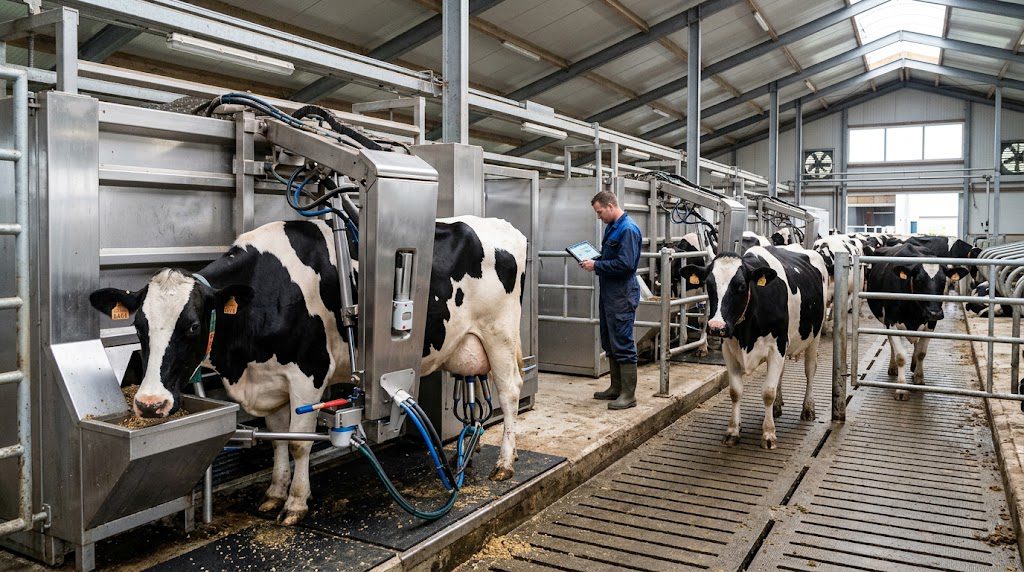
Robotic milking systems for dairy farms have moved from a novelty investment to a mainstream financial decision, and new government research finally gives producers real numbers instead of vendor sales projections to base that decision on. The technology isn’t right for every operation, and the data now makes clear exactly which farms benefit most, and which are better off waiting.
Why Robotic Milking Systems for Dairy Farms Are Going Mainstream
Adoption of robotic milking systems for dairy farms has climbed steadily since the early 2000s, according to the USDA Economic Research Service’s analysis of Agricultural Resource Management Survey data. By 2021, adoption patterns had shifted meaningfully: midsized dairy farms with 150 to 499 head showed the highest adoption rate at 13%, overtaking the smaller and larger operations that had led earlier adoption waves.
That shift matters because it reflects a maturing technology finding its actual economic sweet spot rather than early hype driving scattered adoption. The global market for milking robots was valued at $3.26 billion in 2024 and is projected to reach $7.04 billion by 2030, according to a 2026 market insights report, reflecting sustained double-digit growth rather than a short-lived trend.
What Robotic Milking Systems Actually Do
Before evaluating the economics, it’s worth being precise about what the technology involves. USDA’s research specifically studies “box robots,” fully automated milking units that let cows initiate their own milking sessions without a human operator present, as one category within a broader set of precision dairy technologies.
According to USDA’s ERR-356 report, only 6% of U.S. milk came from cows milked via box robots in 2021, while partially automated technologies like computerized feed delivery already accounted for roughly half of U.S. milk production, showing that full robotic milking remains a smaller subset of a much broader automation trend already well underway.
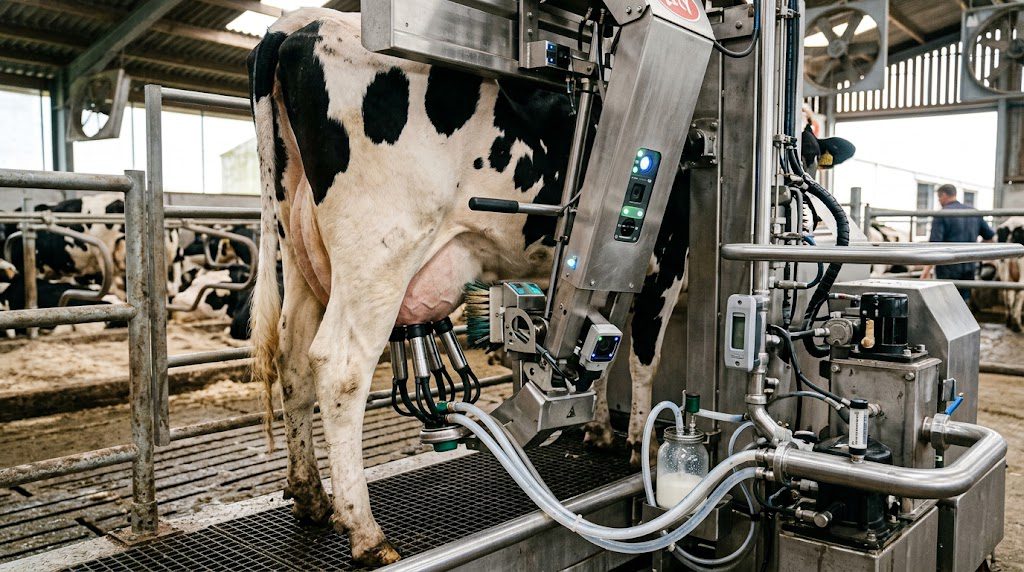
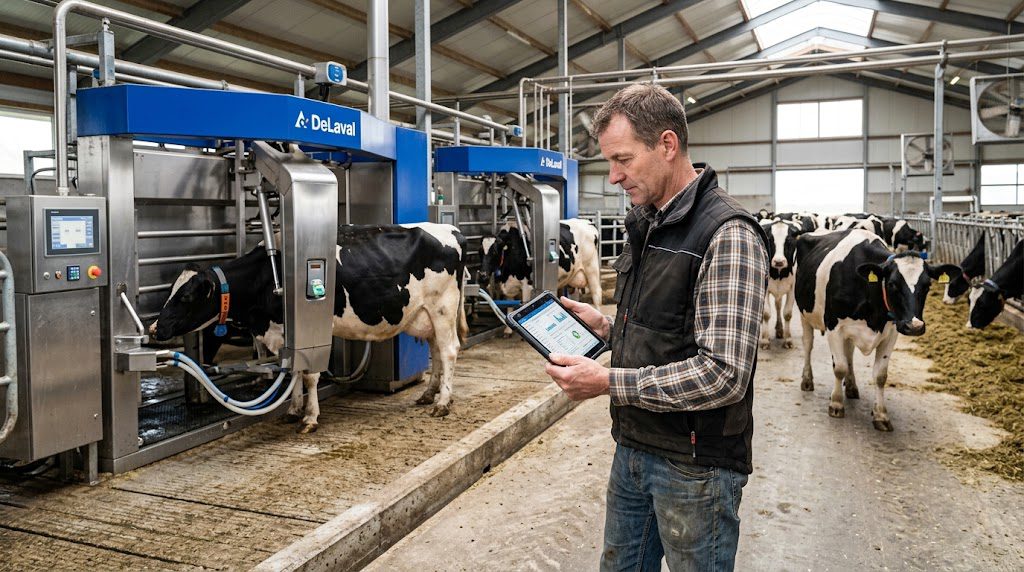
Robotic milking systems for dairy farms typically combine automated teat cleaning, milking unit attachment via robotic arms and vision systems, real-time milk quality sensors, and cloud-based herd management software that tracks individual cow production and health data continuously rather than at scheduled milking intervals.
The Real ROI: What New USDA Research Shows
This is where the January 2026 USDA report changes the conversation meaningfully. Researchers found that robotic milking, or the use of two or more precision dairy technologies from the broader set studied, increases U.S. farmers’ dairy net returns by 13% on average.
This is a rigorous, government-funded estimate based on actual farm financial data, not a vendor-supplied projection, which gives it considerably more weight in a producer’s decision-making than industry marketing claims typically carry.
The same research found that farms adopting robotic milking systems for dairy farms have distinct characteristics: adopters tend to be younger and more educated operators running larger dairies with newer barn infrastructure and stronger high-speed internet connectivity.
Adopters also report lower expenditures on paid labor, unpaid family labor, and veterinary care and medicine relative to non-adopters, suggesting the returns come from multiple efficiency gains simultaneously rather than labor savings alone.
Independent industry analysis adds useful texture to these figures. According to The Bullvine’s 2026 dairy technology guide, automated feeding systems specifically deliver 12–25% feed waste reduction and 5–10% milk yield gains, though typical payback on that particular technology stretches seven to twelve years unless paired with active precision nutrition management, a reminder that different components of a precision dairy investment carry very different payback timelines.
Which Farm Sizes Actually Benefit Most
USDA’s data on adoption patterns doubles as a practical guide to where the economics currently work best. Midsized dairies with 150–499 head show the highest adoption rate for box robots specifically, while the largest share of adopters overall falls in the 50–149 head range, according to USDA’s report summary.
Smaller operations face a specific economic barrier: farms with fewer than 50 cows rely heavily on unpaid family labor rather than paid labor, and robotic milking systems for dairy farms may not reduce cash labor expenses enough to justify the substantial capital outlay when that labor is already unpaid.
Industry analysis from The Bullvine reaches a similar conclusion from the opposite direction: for herds around 1,000 cows, high-efficiency traditional milking parlours still outperform robotic systems at current 2026 labor rates, while the 250-cow range represents the clearest economic sweet spot for robots and automated feeding systems together.
A Balanced View: The Hidden Costs and Failure Points
An honest account of robotic milking systems for dairy farms has to include what vendor marketing tends to leave out.
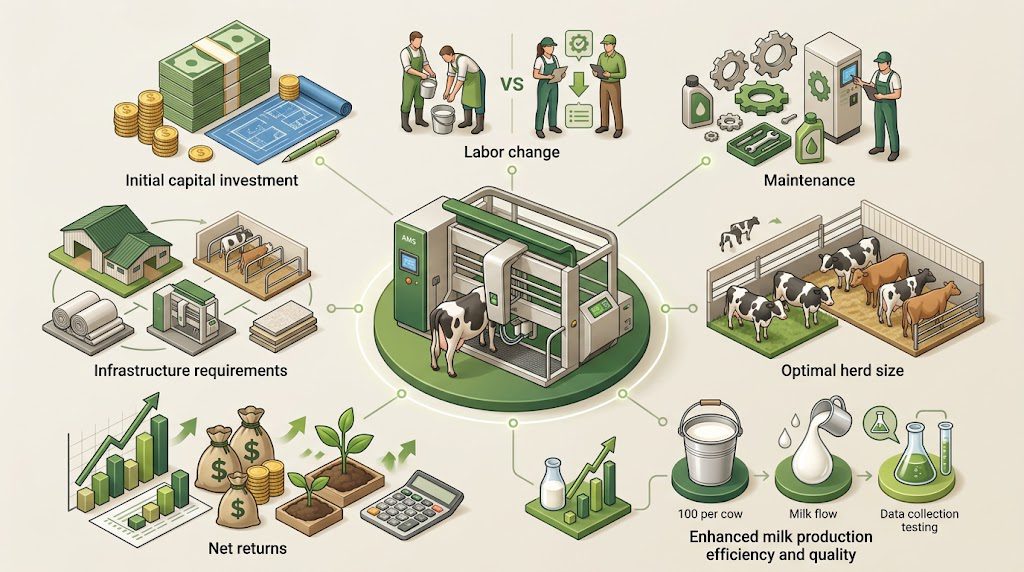
The case for investing rests on solid ground: peer-reviewed government research confirms a real, measurable 13% average increase in net returns, adopters report better management of cow health issues like mastitis and lameness through continuous monitoring, and farmers describe improved working conditions and labor savings as genuine, not just marketed, benefits, according to a peer-reviewed study on large U.S. dairy adoption published in PMC.
The case for caution is substantive too. That same PMC study found the impact on milk production and quality was mixed, with some farms experiencing improvements and others not, meaning yield gains are not guaranteed simply by installing the equipment.
Maintenance costs are a frequently underestimated line item: The Bullvine reports that 25% of farms see maintenance costs exceeding $15,000 per robot per year once units age past five years, a cost that can quietly erode the projected returns if it isn’t budgeted for from the outset.
A detailed financial breakdown from CCFBank similarly stresses that the initial investment is substantial and that a successful transition depends on a comprehensive financial assessment upfront, not an assumption that labor savings alone will carry the investment.
Producers should treat any single ROI figure, including the 13% USDA average, as exactly that: an average across many farms with varying conditions, not a guaranteed outcome for any individual operation.
Robotic Milking Systems for Dairy Farms in India: A Different Calculus
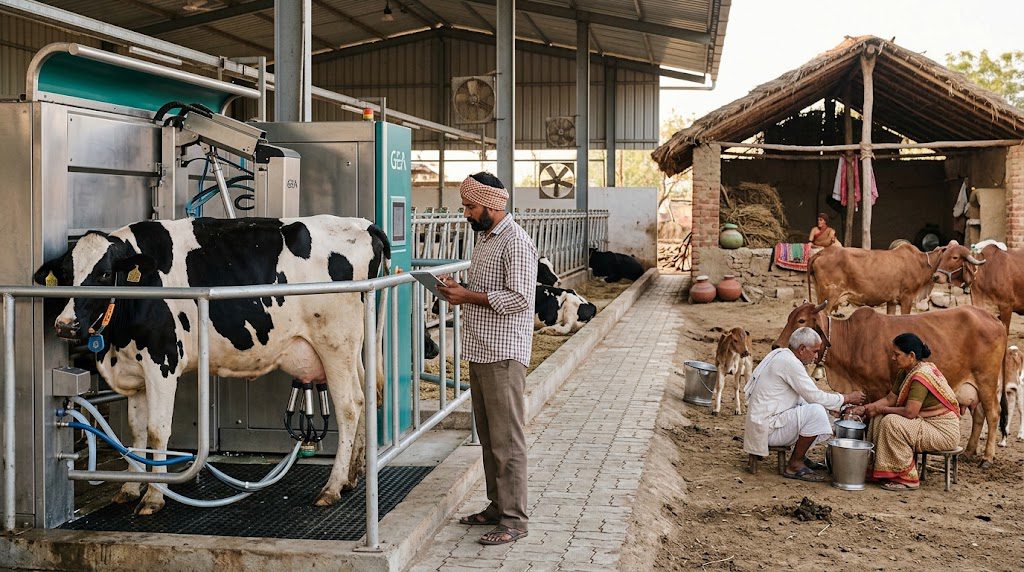
Nearly all of the data above comes from U.S. dairy operations, and that matters for how directly it translates to a market like India’s. Asia-Pacific is described as an emerging market for milking robots, with countries including China and India gradually adopting the technology, according to industry market analysis, but the underlying farm structure is fundamentally different from the U.S. dairies driving most current adoption data.
India’s dairy sector remains dominated by smallholder operations with herd sizes far smaller than the 150–499 head range where U.S. adoption is currently strongest. That structural difference means the core U.S. finding, that midsized operations with paid labor costs see the strongest returns, doesn’t map cleanly onto a market where family-operated, small-herd dairies are the norm rather than the exception.
For Indian dairy cooperatives and larger commercial operations specifically, robotic milking systems for dairy farms may still offer a genuine efficiency case, particularly where labor costs are rising and herd sizes are consolidating, but for the majority of India’s smallholder dairy producers, partially automated technologies like computerized feed delivery are likely to offer a more accessible entry point than full robotic milking in the near term.
A Practical Decision Framework
- Check your herd size against the current adoption sweet spot. USDA data points to 150–499 head as the strongest current adoption range for box robots specifically.
- Calculate your actual paid labor cost, not just total labor hours. Robotic milking systems for dairy farms primarily deliver returns by reducing paid labor and veterinary expenses; unpaid family labor doesn’t generate the same cash-flow benefit.
- Budget for maintenance from year one, not just the upfront capital cost, given documented cases of maintenance costs exceeding $15,000 per robot annually after five years.
- Assess your infrastructure readiness. Adopters skew toward farms with newer barns and strong high-speed internet connectivity, both of which affect total implementation cost if they’re not already in place.
- Model a 7–12 year payback window, not a 2–3 year one, particularly for automated feeding components layered alongside robotic milking.
- Get a comprehensive financial assessment before committing, following the approach recommended by dairy finance specialists, rather than relying on a vendor’s projected ROI figures alone.
Producers evaluating this investment alongside other technology decisions may find it useful to review Farm Sutras’ roundup of farm technology tools worth investing in for a broader framework on evaluating precision agriculture investments by actual return rather than novelty.
Our guide to modern animal husbandry and scientific breeding techniques also covers herd management fundamentals that complement the health-monitoring data robotic systems generate, and our overview of sustainable livestock farming solutions is worth reviewing for producers weighing capital-intensive technology against other paths to a more resilient operation.
Frequently Asked Questions
1. Are robotic milking systems profitable for dairy farms?
Yes, they can be profitable, but returns vary by herd size, labor costs, infrastructure, management, and maintenance expenses. USDA research published in 2026 found robotic milking increased U.S. dairy net returns by an average of $3.15 per hundredweight compared with non-adopters.
2. How much does a robotic milking system cost?
The cost varies significantly depending on the robot, installation, barn modifications, infrastructure, and number of cows served. Current extension sources place individual robot costs broadly in the $150,000–$200,000+ range, before considering all farm-level installation and infrastructure expenses.
3. What size dairy farm is best for robotic milking?
Current USDA data shows that 150–499-head U.S. dairy farms had the highest adoption rate for box robots. However, the financially appropriate herd size depends on paid labor costs, robot capacity, milk production, and existing infrastructure.
4. How many cows can one robotic milking machine milk?
A common planning range is approximately 60–80 cows per robot, although the actual capacity depends on the robot model, milking frequency, cow flow, milk yield, and management system.
5. Do milking robots reduce labor costs?
They can reduce the amount of labor required for milking, but the effect depends heavily on farm size. USDA data found significantly lower paid labor expenses among robotic-milking adopters on 150–499-head farms.
6. What is the ROI of a robotic milking system?
ROI depends on capital cost, milk production, labor savings, maintenance, financing, herd size, and system lifespan. USDA’s 2026 research provides evidence of higher average net returns among U.S. robotic-milking adopters, but that figure should be treated as a benchmark rather than a guaranteed farm-level ROI.
7. How long does it take for a robotic milking system to pay for itself?
There is no universal payback period. Your article recommends modeling a 7–12-year timeframe, particularly when automated feeding and other precision technologies are included. Actual payback can be shorter or longer depending on farm economics.
8. What are the disadvantages of robotic milking systems?
Major challenges include high upfront investment, maintenance costs, infrastructure requirements, staff training, system downtime, cow adaptation, and the need for continuous management and monitoring. Extension guidance also notes that someone must remain available to respond to robot alarms and technical problems.
9. How much does it cost to maintain a robotic milking system?
Maintenance costs vary with robot age, model, warranty coverage, service agreements, and operating conditions. University of Wisconsin Extension reports that farmers it works with commonly estimate roughly $15,000–$25,000 per robot per year, although actual costs vary considerably.
10. Do robotic milking systems increase milk production?
They can, but increased production is not guaranteed. More frequent milking may increase production on some farms, while research and farmer experiences show that results vary according to herd management, cow behavior, system design, and other conditions.
11. Are robotic milking systems suitable for small dairy farms?
They can be, but the economics can be difficult for very small farms. Where most work is performed by unpaid family labor, reducing paid labor expenses may not generate enough cash savings to justify the capital investment.
12. Are robotic milking systems worth it for large dairy farms?
The answer depends on the comparison with the farm’s existing or planned milking system. Large dairies may achieve economies of scale with highly efficient conventional parlors, so robotic milking should be evaluated using farm-specific capital, labor, throughput, and maintenance calculations rather than herd size alone.
13. Are robotic milking systems used in India?
India is an emerging market for robotic milking technology, but its dairy structure differs substantially from the U.S. market. India’s large population of smallholder dairy farms means the economics of full robotic milking do not directly translate from U.S. research. Larger commercial dairies and cooperatives are more likely to consider the technology.
14. What infrastructure is needed for a robotic milking system?
A farm may need suitable barn design, adequate cow flow, electricity, water, drainage, internet connectivity, cooling and milk-handling infrastructure, and sufficient space for robot installation and maintenance. Retrofitting can work when the existing barn is suitable, while major structural limitations may favor new construction.
15. Should dairy farmers invest in robotic milking systems in 2026?
Farmers should compare the technology against their actual herd size, paid labor costs, milk production, infrastructure, financing, maintenance budget, and alternative milking systems. The 2026 USDA evidence shows a measurable profitability association, but it does not mean every dairy farm will achieve the same result.
Actionable Takeaways
- Treat the 13% average net return figure as a benchmark to test against your specific farm’s labor costs and herd size, not a guaranteed outcome.
- Prioritize herds in the 150–499 head range when evaluating whether current adoption data applies directly to your operation.
- Budget explicitly for post-warranty maintenance costs before calculating expected ROI.
- If you operate a smaller, family-labor-dependent dairy, evaluate partially automated technologies before committing to full robotic milking.
Final Thought
Robotic milking systems can deliver meaningful efficiency and financial benefits, but they are not a universal solution for every dairy farm. The 2026 USDA research provides evidence of stronger average net returns among farms adopting robotic and precision dairy technologies, while also showing that farm size, labor structure, infrastructure, and management matter.
For farmers considering the investment, the smartest approach is to calculate the economics for their own operation rather than rely on a headline ROI figure. A robotic system should make financial and operational sense before it becomes a technology purchase.